Monthly Archives: March 2014

Longing for Leadership

Data Point Tuesday
Last week I discussed one of the trends (reskilling HR teams) called out in Deloitte’s annual Global Human Capital Trends Report for 2014. Recently released and influenced by the work of Bersin by Deloitte, the report examines 12 trends that represent the way employees today are driving their organizations to innovate and transform human capital practices. The report, as usual, is full of interesting data on human capital management trends and observations about the impact of those trends. It is definitely worth a read.

This week I’d like to look at another top talent issue facing organizations around the world as identified by Deloitte: leadership. Leadership is cited as the number one talent issue organizations today face, with 86% of respondents surveyed citing leadership as “urgent” or “important”. This is compared with a meager 13% of the same respondents that claim they are doing an excellent job developing leaders at all levels. So of all the trends discussed in Deloitte’s survey, this marks the largest “readiness gap”. Developing the next generation of leaders is urgent, yet very few report meeting the challenge.

When it comes to organizational strategies, most are requiring some significant tweaks due to the increasingly global, tech-savvy, interconnected, and diverse people that are the 21st century workforce, and leadership development is not exempt from this. Organizations are facing challenges such as developing multiple generations of leaders – not just Millennials, developing leaders with high flexibility and global fluency, and ensuring that leaders have the skills to understand and adapt to rapidly changing technologies. Essentially, leadership is taking on a much broader meaning than it did previously, where it may have described simply developing the next CEO or company C-Suite executive.

Looking at responses from executives who participated in Deloitte’s survey paints a clear picture of perceived leadership gaps. 66% reported believing that they are “weak” in their ability to develop Millennial leaders and just 5% rated themselves as “excellent”. Additionally, 51% of executives have little confidence in their ability to maintain clear, consistent, succession programs and just 8% feel they have “excellent” programs to build global skills.
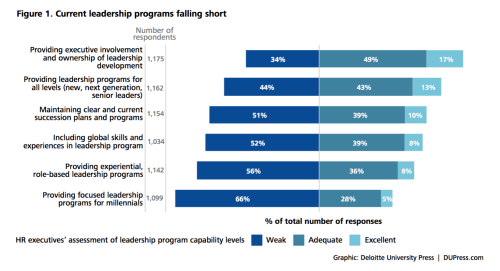
Global Human Capital Trends Report for 2014It becomes clear then that as the global recovery continues to strengthen and organizations start to execute on growth strategies, that these gaps can only be filled by intentional focus and commitment to leadership development and training programs at all levels. Deloitte’s report suggests that companies should start by engaging their own top executives to develop leadership strategies and actively participate in them; refresh previous leadership strategies to link with evolving business goals; and implement a unique leadership program. They recommend that organizations focus on three aspects for developing leaders: developing at all levels, developing global leaders locally, and developing a succession mindset.

If companies want to grow in a global world, they need to grow global leaders. And Deloitte’s research shows clearly that this doesn’t happen accidentally.
Leave a comment

Filed under Bersin, China Gorman, Data Point Tuesday, Deloitte, HR, HR Data, Human Capital, Leadership

Business Leaders Don’t Think HR is Up to Snuff

Data Point Tuesday

Deloitte’s annual Global Human Capital Trends Report for 2014 is out. Influenced by the work of Bersin by Deloitte, it examines 12 trends that represent the way employees today are driving their organizations to innovate and transform human capital practices. The report, “Global Human Capital Trends 2014: Engaging the 21st Century Worker” surveyed 2,532 business and HR leaders in 94 countries around the world over several months, also drawing upon past research on global business challenges in HR, leadership, and talent management. The result of the report is a wealth of data on human capital strategies in the 21st century workplace that can be examined for perspective and insight into our own organizations and strategies. The year’s 12 critical human capital trends were categorized into three broad categories. “Transform and Reinvent” examines the need to reskill HR teams, capitalize on cloud based HR tech, implement HR analytics as a means to achieving business goals, and create a global HR platform that is robust and flexible enough to adapt to local needs.

So. Reskilling HR teams. Really? Why is this a critical trend? According to the report, less than 8% of HR leaders have confidence that their teams have the skills needed to meet the challenge of today’s global environment and consistently deliver innovative programs that drive business impact. Business leaders unfortunately corroborate this statistic, with 42% believing that their HR teams are “underperforming” or “just getting by”. This is compared to the 27% of business professionals who rate HR as excellent or good when assessing HR and talent programs. At a time when CEO’s are reporting human capital strategies as one of the top priorities for growth, it’s important that HR departments have the skills necessary to acquire, develop, and retain top talent as well as engage employees at all levels. And with a workforce that is increasingly global, tech-savvy, highly connected and demanding, HR departments face the challenge of doing all of this with increasingly creative strategies that meet the needs of this 21st century workforce. While such skills are highly necessary, the statistics indicate that HR departments are not as equipped with them as organizations would like.

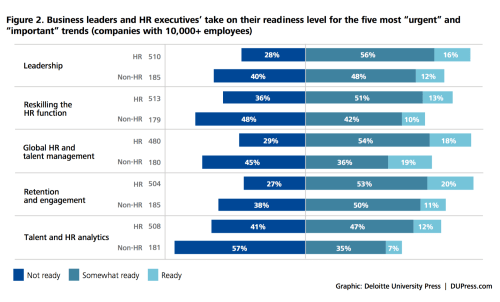
Of further interest, Deloitte’s report discusses how many organizations are reporting seeing a “disruption” of the CHRO role in their organizations. This disruption consists of a refocusing HR as a “business contribution” function with deeper skills in data/analytics as well as MBA-level business capabilities. When it comes to organizations’ readiness to respond to the 12 global human capital trends there is a discrepancy between business professionals’ and HR professionals’ perceptions. For the five most urgent trends identified (leadership, reskilling HR, global HR and talent management, retention and engagement, and talent and HR analytics) business executives report that their companies are less ready to address these issues than HR leaders report. For the issue of reskilling HR, 48% of business respondents reported that HR is “not ready,” compared to 36% of HR respondents.

Deloitte’s report links this perceived lack of HR skills to some basic attributes such as the fact that many organizations do not invest in developing the business skills of their HR teams and to the fact that more than 70 percent of all HR professionals enter the field without a specific degree or certification in business or human resources. Of respondents surveyed from Deloitte’s report, 43% stated that their companies are “weak” when it comes to providing HR with appropriate training and experiences.

While disappointing, data like this are great because they clearly identify perceived areas of weakness and allow organizations to challenge their own programs and strategies for HR, as well as draw conclusions more specific to their organization and strategies for transforming, reinventing, and reskilling the HR team.

The bad news? Business leaders think HR isn’t up to the people challenges of the 21st century. The good news? Now we know and can get to work!

Deloitte Human Capital Trends 2014

3 Comments

Filed under Bersin, China Gorman, Data Point Tuesday, Deloitte, HR, Human Capital

Diversity: No longer just the right thing to do

Data Point Tuesday

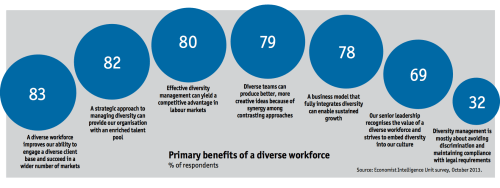
A recent study by the Economist Intelligence Unit, sponsored by SAP and SuccessFactors, explores the challenges of managing an increasingly diverse workforce while highlighting the importance of diversity as a strategic business advantage. The global study, Values-based Divesity, surveyed 228 executives responsible for designing and developing their organization’s human resources strategy, where 53% of respondents were very senior – either CEO’s or board members. As the study explains, many diversity initiatives in the last two decades involved a focus on demographic factors, such as gender and race, or “inherent” diversity. Today there is a wider awareness that the diversity focus should also consider values like cultural fluency, global mindset, language skills etc., or “acquired’ diversity. This shifting awareness, represented in EIU’s survey results, appears to represent a wider shift in organizational perception of diversity.

When respondents were asked about the primary benefits of a diverse workforce 83% of executives reported that a diverse workforce improves their firm’s ability to capture and retain a diverse client base; 82% agreed that a strategic approach to managing diversity can help access a rich talent pool; and 80% viewed diversity management as yielding a competitive advantage in labor markets. While the case for diversity has changed over the years, from a social initiative (it’s the right thing to do) to a strategic argument for supporting and creating new innovation, the bottom line remains the same – it’s always been about business success and competitive market advantage. With the increasingly diverse and multigenerational workforce that exists today however, certain organizational strategies will require greater adjustment. According to the EIU study, the top workforce characteristic that will require the greatest change in HR strategies over the next three years (cited by 57% of executives) was a “lack of interest in assimilating organizational values” followed by “conflicting values of a multi-generational workforce” (51%) and thirdly “educational differences among employees” (50%).

Values Based Diversity EIU

Given the strategic benefits of a diverse talent pool cited by executives, what strategies are organizations using to support and engage diverse talent? The top four strategies listed by respondents focused almost exclusively on learning and development: “mentoring of new and high potential employees”, “exposing high potential employees to diverse business situations”, “opportunities for international careers”, and “opportunities for diverse teams to address strategic business challenges”. When asked about the technologies used to manage diverse workforces, 35% of respondents cited human resources information systems (HRIS) as the highest adopted technology, followed by e-learning systems at 31%, and videoconferencing at 25%. Interestingly given the amount of hype and energy around social media, the adoption of enterprise social networks as a means to manage a diverse workforce was low, with only 20% of respondents reporting this as an adopted tool.

The data from this report clearly indicates that executives recognize the importance and benefits of having a diverse workforce, but also recognize that maximizing the potential of a diverse talent pool requires a strategic approach. Whether this approach means augmenting previous diversity initiatives, or developing new strategies altogether, approaches will likely be specific to each organization and the level of understanding and commitment by its leaders. The information does suggest that this will be an area of focus for many organizations now and into the future as the workforce becomes more globally mobile, multi-generational and flexible.

1 Comment

Filed under China Gorman, Data Point Tuesday, Diversity, Economist Intelligence Unit, EIU, SAP, SuccessFactors

Work-Life Balance is a Myth

Data Point Tuesday
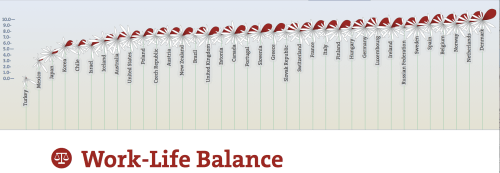
According to the 2013 Better Life Index by OECD (the Organization for Economic Co-Operation and Development) we’re still fighting the battle to find balance between work and our personal lives. Out of the 36 countries ranked on the 2013 Better Life Index the United States came in at 28 for work-life balance, behind almost all the countries in Europe as well as Brazil, New Zealand, and Canada. Australia fell just behind the U.S at 29. The top three countries for work like balance were Denmark at #1, the Netherlands at #2, and Norway at #3. What’s the reason for the U.S ranking so poorly when it came to work-life balance? Perhaps the most obvious factor is one we are probably very familiar with hearing about – American’s work long hours! According to the Index, 11.13% of employees work “very long hours” each week, or fifty plus hours on average. This percentage has held fairly steady since 2004 save a minute decrease (the study ranks the average annual increase since 2004 at -0.4%). For comparison purposes, approximately 9.7% of people in all other countries reported working “very long hours” and in Denmark the percentage of employees working very long hours each week was only 1.97%.

There are other influencers to the United States’ ranking when it comes to work-life balance. Gender roles still heavily influence the distribution of tasks within the family, with women spending an average of 4.3 hours a day on domestic work where men spend only 2.2 hours a day. Additionally, Americans devote less time to leisure and personal care than the OECD average; likely due to the simple fact that the more people work the less time they have to spend on other activities. Sadly, the U.S is the only OECD country without a national paid parental leave policy. The study explains that though total public spending on child welfare and education in the U.S is above the OECD average, most of this money is spent later in a child’s life (on public compulsory education). This reflects that early investment in childcare and support for families during and after pregnancy could have a greater focus. Though increasing parental leave policies would raise employers’ costs, evidence shows that women who take the full leave they are offered are more likely to return to work than women who do not, an incentive for employers to increase leave policies. OECD reports that female employment in the U.S has been falling over the last decade, despite the U.S having better career opportunities for women than most other OECD countries.

Overall, compared to most other countries on the 2013 Better Life Index, Americans work longer hours, spend less time on leisure and personal care, and take less vacation days. How’s that working for your business? How’s that working for you?

Work Life Balance

1 Comment

Filed under Better Life Index, China Gorman, Data Point Tuesday, Organization for Economic Co-Operation and Development, Work Life Balance, Workflex