Monthly Archives: October 2014

What War for Talent?

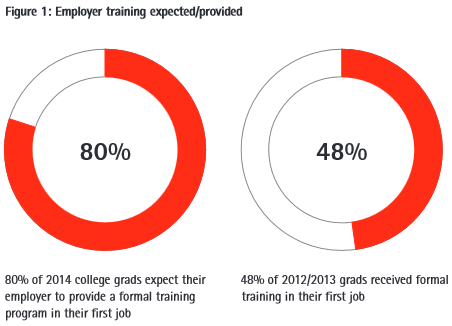
Data Point TuesdayAccenture’s 2014 College Graduate Employment Survey compares the expectations and perceptions of 2014’s university graduates with the realities of the working world according to both 2012 and 2013 graduates. This comparison casts a focused and specific lens on the issue of entry-level talent development, and gives us some insightful data. Accenture’s survey underlines that at the end of the day, many organizations are not effectively developing their entry-level talent. When we consider that 69% of 2014 graduates state that more training or post-graduate education will be necessary for them to get their desired job, we see that organizations are likely facing a major talent supply problem. New graduates and entry level talent’s perceive that their organizations will provide them with career development training: 80% of 2014 graduates expect that their employer will provide the kind of formal training programs necessary for them to advance their careers. Despite this, the percentage of graduates that actually receive such training is low, creating a significant discrepancy between expectation and reality.Expectation vs Reality
Another concern when it comes to recent college graduates is that 46% (nearly half) of 2012/2013 graduates working today report that they are significantly underemployed (i.e. their jobs do not really depend on their college degrees). This statistic was at only 41% a year ago.Entry Level UnderemployedAccenture’s survey found that 84% of 2014 graduates believe they will find employment in their chosen field post graduation, and 61% expect that job to be full time. Again, we find a stark contrast between expectation and reality, with just 46% of 2012/2013 grads reporting holding a full-time job – 13% percent have been unemployed since graduation. How long do recent graduates stay at the jobs they do have? More than half (56%) of 2012/2013/2014 graduates have already left their first job or expect to be gone within one or two years. Is this be a reflection on the lack of development for entry-level talent? It seems more than plausible…

Recent graduates are also finding discrepancies between expectations and realities when it comes to income and job prospects. Of the 13% of 2012/2013 grads who have been unemployed since graduation, 41% believe their job prospects would have been enhanced had they chosen a different major (72% expect to go back to school within the next five years). Among Accenture’s 2014 survey respondents, 43% expect to earn more than $40,000 at their first job, however, just a minimal 21% of the 2012/2013 graduates that are in the workforce are actually earning at that level. 26% of these graduates report making less that $19,000, a concerning figure when roughly 28% of 2014’s graduates will finish school with debt of more than $30,000.

Accenture’s study does point to some silver linings, however. Increasingly, college students are turning an eye towards what they can do to be more market relevant. 75% of those who graduated this year took into account the availability of jobs in their field before selecting their major, compared to 70% of 2013 graduates and 65% of those in the class of 2012. Another positive is that 72% of 2014 graduates agree or strongly agree that their education prepared them for a career (compared to 66% of 2012/2013 grads) and 78% feel passionately about their area of study. 63% of 2014 graduates stated that their university was effective in helping them find employment opportunities, an increase from 51% among their recently graduated peers. Recent graduates are also increasing their chances of employment by being geographically flexible. 74% of 2014 graduates said they would be willing to relocate to another state to find work and 40% of those would be willing to move 1,000 miles or more to land a job.

Accenture’s study does, however, put into question many of the highly publicized reports that point to human capital/talent acquisition issues as a #1 concern in the C-Suite. If talent is the #1 issues, where is the attention to entry-level talent? Is the attention being placed exclusively on development for upper-level positions? It’s clear that there are multiple factors influencing graduates’ struggles for acceptable employment, including the rise of part-time and contingent work, but training and development is an important part of any entry-level position. The survey points to six areas in which organizations can focus on to help meet talent supply challenges:

  1. Reassess hiring and retention strategies
  2. Hire based on potential, not just immediate qualifications
  3. Use talent development as a hiring differentiator
  4. Remember that tangibles matter, even to Millennials
  5. Cast the net more widely
  6. Use talent development and other benefits as part of a total rewards and attraction approach

These are logical conclusions. But perhaps the biggest logical conclusion is that organizations are just paying lip service to the so-called war for talent and aren’t convinced that the there is, in fact, a shortage of talent. Am I wrong?

2 Comments

Filed under Accenture, China Gorman, Data Point Tuesday, Human Capital, Millennials, Professional Development, Talent development

2014 World’s Best Multinational Workplaces: Trends for Thought

Data Point TuesdayHere at Great Place to Work we’re getting ready to reveal the 2014 World’s Best Multinational Workplaces list, so there seems like no better a time to talk about a positive organizational trend that’s been occurring among many of the less encouraging trends we consistently hear about (for example, the war on talent, low levels of employee engagement, or no work/life integration). The positive trend that I’m speaking, to be exact, is that levels of trust, camaraderie and pride are rising at the best workplaces – essentially, the world’s best workplaces are getting better. In recent years we’ve seen “the best” companies get better in the majority of the ~50 countries where we measure workplaces using our Trust Index© employee survey. Additionally, we have seen increasing trust at the companies that make up Great Place to Work®’s annual World’s Best Multinational Workplaces list.
trustindexchange2009-2014

The good news is that while this increase in trust trend is mostly notable within “best companies,” such positive culture changes are influencing other companies as well and helping to create a push towards a higher standard for organizations. The data discussed here comes from the decision to examine trust trends in individual countries and among the world’s best multinationals as we prepared our 4th annual World’s Best Multinational Workplaces list. In particular, we studied the Trust Index© scores of all the national Best Workplaces lists during the past five years. The Trust Index© is Great Place to Work®’s 58-statement employee survey that measures trust, pride and camaraderie in organizations.

Our research highlights seven reasons why trust is rising in great workplaces: awareness, evidence, Generation Y, employee gratitude, wellbeing, momentum, and transparency. Globally, company leaders have been demonstrating an increased awareness towards the importance of a high-trust workplace culture. Furthermore, we’re seeing increasingly more evidence published that great workplaces lead to better business results. For example, publicly traded companies on the U.S. Best Companies to Work For list have nearly doubled the performance of the stock market overall from 1997 to 2013 and a paper published earlier this year by the European Corporate Governance Institute which studied data from 14 countries, concluded that higher levels of employee satisfaction (reflected by earning a spot on a best workplaces list generated by Great Place to Work®) corresponded to stock market outperformance in countries with high levels of labor market flexibility, such as the United States and the United Kingdom.

The Millennial generation is also an influencer. Globally, this generation is demanding better workplaces and pushing employers to place more focus on both social responsibility and work/life integration. Employee gratitude also plays a big role in high-trust cultures. Best workplace environments reflect employee gratitude and reciprocation and aren’t solely about what management is doing for employees. This is especially true during trying times for companies. When one company’s culture may take a turn for the worse during economic hardships, organizations that take care of their employees amid such a time can create higher levels of trust. We can also point to the ‘wellbeing’ movement as an influencer of high trust levels at organizations. With people placing more and more emphasis on mental and physical wellness, in part due to high stress work environments at many organizations, great workplaces are embracing the wellbeing trend. Among the three Trust Index© scores that have risen most among the World’s Best Multinational Workplaces is this statement: “People are encouraged to balance their work life and their personal life.”

Momentum and transparency are the last of the seven key trends we have noted as influencers of high-trust at organizations. Momentum refers to the positive upward spiral that seems to occur (owing to both management and employees) once an organization develops a trust-based workplace culture. This is logical as a more trust-based culture often sees employees that are more active participants in culture related activities and hold a greater appreciate for their workplace. With the amount of new technologies (like social media) and personal mobile devices available, organizations are faced with an amount of unprecedented transparency. This transparency works in favor of organizations with great cultures and rewards them while providing a “public eye” and ample incentive for less than great organizations to step up. Another of the three Trust Index© scores that have risen most among the World’s Best Multinational Workplaces is this statement: “Management keeps me informed about important issues and changes.”

Check out a few “Fast Facts” about the World’s Best Multinational Workplaces 2014 below, and be sure to check back here on Thursday to see which companies made the list!

Fast Facts: The World’s Best Multinational Workplaces 2014

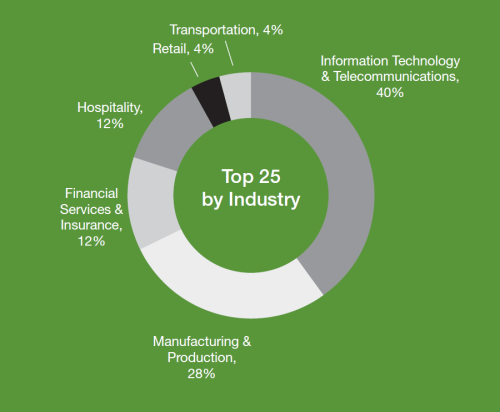
  • Since last year, industry distribution has changed significantly on the World’s Best list. IT and Telecommunications now makes up 40% of the industries, replacing Manufacturing and Production (28%) as the dominating industry. The variety of industries represented has shrunk from 8 industries in 2013 to just 6 this year:industrydistribution2014
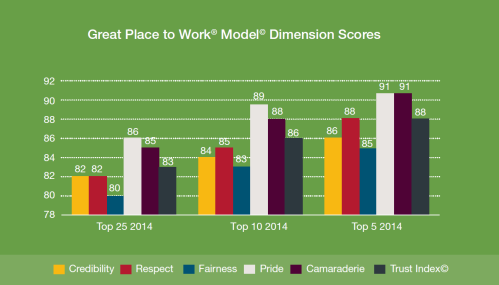
  • Among the 2014 World’s Best Multinational Companies to Work For in 2014, “Pride” is distinguished as the main strength. “Camaraderie” ranks stronger than “Respect” in the Top 10 and the Top 5, while “Fairness” continues to be biggest opportunity area:2014 Dimension Scores
  • Since 2011, the main improvements made by the best multinationals in the world are:
    • Encouraging work-life balance,
    • Management keeping employees informed
    • Promotions based on merit.

2 Comments

Filed under China Gorman, Company Culture, Data Point Tuesday, Employee Satisfaction, Great Place to Work, World's Best Multinational Workplaces

CEO Insights: The Bumpy Road to ALWAYS ON

data point tuesday_500

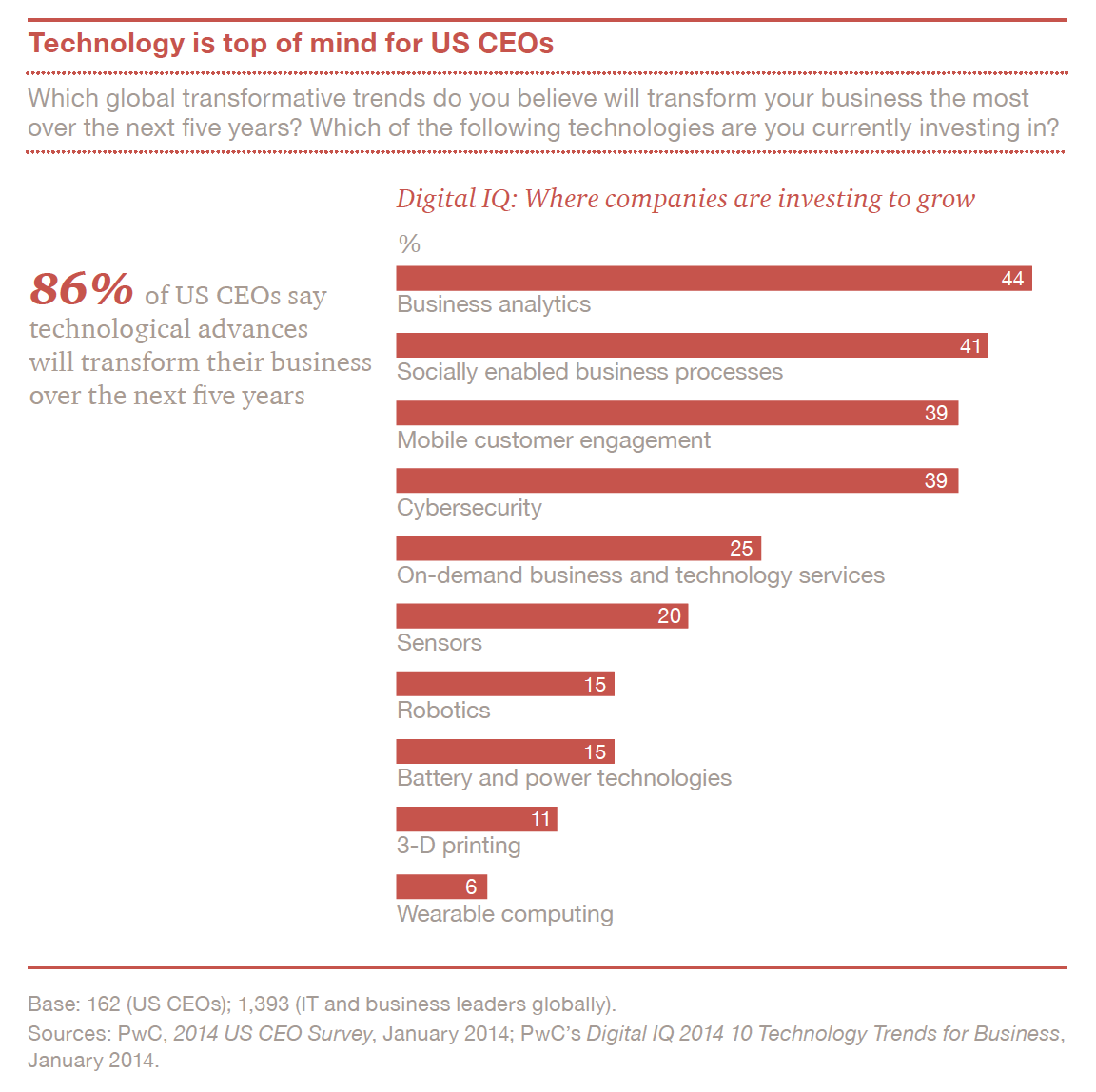
PWC’s 17th annual global CEO report “Good to Grow: 2014 US CEO Survey”, provides a thorough snapshot of executive leadership perspectives and approaches at the current moment. PWC’s report includes perspectives from over 1,300 CEOs from 68 countries, including 162 CEOs with US-headquartered organizations. It’s clear from the responses that, globally, CEOs are making many changes within their organizations. For example, 86% of CEOs stated that advancing technologies are going to transform their businesses over the next five years. Positively, PWC’s data also suggests that CEOs are finding reasons to be more confident in many places (89% of US CEOs are fairly sure their companies will deliver revenue growth this year). In this period of rapid change though, what approaches are CEOs taking, and what insights can they offer?

The majority of CEO’s interviewed reported that “five great forces of transformation” are reshaping business as we know it:

  • Technology is making an impact across the whole enterprise.
  • CEOs are reinventing the operating model towards an “always on customer experience.”
  • CEOs are seeking new ways to work together in joint ventures and alliances to capture disruptive technologies faster.
  • In some cases, the business model is being innovated.
  • There are rising concerns about talent.

As organizations undeniably shift into a period of growth (62% expect to hire more people this year, the highest level of anticipated headcount expansion in the past five years for this survey), how do these five great forces of transformation come into play?

All CEOs seem to agree, that technology is what propels business, and will continue to do so. PWC states that, in part, “Technology” is a watchword for 2014 because CEOs use it when talking about both core innovation and information technology (IT). Technology has become an essential part of strategy in all areas – for organizations pursuing new business models, meeting new customer expectations, remaking their operating model, forging new alliances, or tackling talent challenges.

pwc-Technology


CEOs are reshaping business models though innovation. They are taking cues from the technology industry that has paved the way by creating value for customers in a multitude of new ways. Organizations are looking to create increased profit for what they offer beyond step-by-step product innovation, and they are stepping out of the box to innovate in ways such as turning a product into a service, or vice versa. New approaches to innovation and R&D are part of an increased strategy by many US CEOs in 2014. For example, some organizations report funding innovation incubators to foster rapid prototyping of new ideas, while others report wanting to join up with emerging market innovators who are developing low-cost products.

PWC’s survey also indicates that customer strategies will get a serious makeover in 2014, with 52% of CEOs reporting that they are planning to change their customer growth and retention strategies. As creating a positive and personal customer experience only continues to increase in value (and as a standard of expectation) more organizations will see CEOs leading them toward a strategy of customer interaction. This will move away from stand-alone transactions to a sustainable “always on” relationship with customers. While CEOs plan out such new strategies, they are also discovering that most current capabilities are “fair game for reinvention.” The vast majority of CEOs are already debuting a fair number of change initiatives with a focus on moving away from rigid structures towards more nimble, adaptable operations.

pwc-reinventing-operations

Business alliances and joint ventures also appear as a CEO noted trend for 2014 – within the U.S. and globally. 42% of CEOs surveyed report that they plan to enter a business alliance/joint venture this year while only 4% expect they’ll exit an existing relationship. CEOs are also looking at acquisitions, with 39% of US CEOs planning to complete a domestic acquisition in 2014 and 28% planning on a cross-border deal.

A last trend to note from this survey is in regards to talent. I’ve talked about the talent acquisition “crisis” or “war on talent” in past posts, and unfortunately, PWC’s CEO survey does nothing to dispel this issue. 70% of US business leaders report being concerned about the availability of key skills. This compares to 54% that said so in 2013.

pwc-skill gaps

Despite continued economic uncertainty both within the U.S and globally, PWC reports that the number of US CEOs who believe that global growth is returning has more than doubled since last year, perhaps indicating that organizations are successfully finding a path forward. It is also clear from the research though, that this is a time of intense transformation, which encompasses a wide range of organizational areas and strategies. The ability to navigate such transformational trends is vital for organizational success. So while the overall sentiment is positive for growth, the ride to get there is going to bumpy. Are you and your teams ready to be “always on?”

1 Comment

Filed under 100 Best Companies to Work For, Business Success, China Gorman, Connecting Dots, Data Point Tuesday, Engagement, HR, HR Data, Information Technology, Talent pipeline

HR: How Disconnected Are You From Employees?

ADP recently released a report which, based on data they’ve collected from several studies, examines the causes and implications of a persistent disconnect recorded between HR’s and employees’ perceptions. The topic is an interesting one: despite the vast improvement in and efficiency of communications tools and processes that we’ve witnessed over the years, employees and HR departments have seemed to maintain notably differing perceptions on many key human capital management effectiveness issues. This disparity holds true globally, and in companies of all sizes. ADP has noted this trend in three of their ADP Research Institute® global studies in 2013: Quantifying Great Human Capital Management, Employee Perspectives on Human Capital Management, and HR 360. All three studies measured perceptions of status and value of the HR function and showed consequential differences between employees and HR in key areas such as how well employees were being managed, how well questions regarding HR and benefits issues were addressed, whether feedback was communicated or even collected, and in performance evaluations. Data indicate that similar gaps in perception exist between HR and senior management on these same topics, and as ADP points out, these differences matter because they may be indicative of larger problems within organizations – such as whether investments in HR technology are actually delivering the results of more effective communication, or whether advantages of a strategic HR function are being actively sought and realized.

ADP’s research studies show that globally, employees have much more negative perceptions of how well their organizations are managing them than the perceptions of their senior executives and HR leaders. This disparity is notable in such areas as compensation, work/life balance, career opportunities, and the effectiveness of senior leadership. The data also show that the larger the organization, the greater likelihood that employees’ perceptions of how well the organization is managed will decline.how well companies manage employees

differing perceptionsSenior executives and HR leaders are also significantly more satisfied than employees with the processes they have in place for getting employees’ answers to their questions regarding HR/benefits. Globally, this disparity is greatest in the Asia-Pacific region and in the United States. In the U.S. 79% of HR leaders report that it is Extremely/Very Easy to get HR/benefits questions answered, compared to only 56% of employees. Continuing the gap in perceptions is that, when employees’ questions are answered, HR leaders and senior executives perceive that employees are far more satisfied with the process they’ve gone through to get questions answered than employees actually are.

Such differences in perception bring to light a number of potential challenges. How do organizations know they’ve secured the advantages of providing benefits if HR is more fully convinced of employees’ satisfaction than employees themselves? Additionally, if HR thinks that their processes for answering questions are more effective than they actually are, are employees even aware of all their benefit options? This becomes especially disconcerting if organizations are counting on their benefits as a way to attract and retain talent. Interestingly, more than half of employees in large U.S. companies stated that an employee portal is an important informational resource, while less than one-third of their HR leaders shared that conclusion. The options primarily cited by HR leaders for employees to get answers to their questions included an in-office HR team, a dedicated HR representative, and the employees’ managers. Employees’ responses however, cited an 800 number or internal company portal as the most important resources for getting answers.

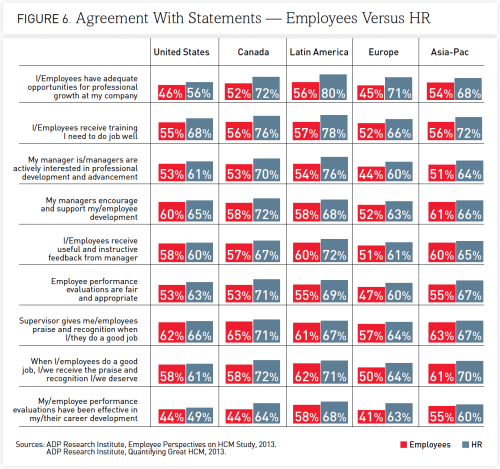
Note too, that among respondents who felt that it was extremely or very easy to have their HR questions answered, less than 1/5 reported they would be likely to look for a new job in the next 12 months; but among respondents who said it is not easy to have their HR questions answered, that number almost doubled to more than 25%. Lastly, another key area to note where disconnect occurs is between employers and employees perceptions of their organizations talent management processes:talent management disconnect

For more on information on the disconnect between employees and human capital management, make sure to check out ADP’s full report, “Human Capital Management’s Employee Disconnect. A Global Snapshot.”

And perhaps it’s time to begin questioning whether the data you are reviewing regarding your organization’s HR effectiveness is actually true.

4 Comments

Filed under ADP, China Gorman, Data Point Tuesday, HR, Human Capital, Workplace Studies