Monthly Archives: April 2015

The Win-Win of Leveraging Baby Boomers

data point tuesdayI’m a Baby Boomer, born smack-dab in the middle of my generation. And I’m beginning to concretely think about the answers to questions like:

  • What is the legacy that my career will leave behind?
  • What kinds of work do I really want to do going forward?
  • What will retirement look like for me?
  • When will I want to retire (because it certainly is the last thing on my mind now…)?

Just as I wrestle with these questions, organizations are facing stiff headwinds on the talent pipeline front making workers like me critical components in workforce planning activities. We all know that workforce demographics are changing rapidly and many organizations are flummoxed when they try to get a picture of how to respond to this critical talent dynamic. Say what we will about the criticality of Millennial employees, many organizations are starting to pay equal attention to retaining the backbones of their organizations: Baby Boomers.

A terrific source of practical and actionable research based information is the SHRM Foundation’s recently published Effective Practice Guideline: The Aging Workforce: Leveraging the Talents of Mature Employees. As with all the reports in this series, it takes a rigorous approach to discovering what the research says and what organizations are actually doing in the topic area. If you haven’t discovered the SHRM Foundation’s EPGs, you’ll thank me after you download and read this free report. Not just because the data are useful and the examples practical, but because it is written for practitioners not academics and is super easy to consume.

“Mature workers will be a firm’s largest source of talent in the next two decades. There will not be enough younger workers for all the positions an organization needs to fill, particularly those requiring advanced manufacturing skills or advanced education in science, technology engineering and math.”

We all know this. The real question is what do we do about it? And this report lays out a roadmap for data gathering within your organization, a planning outline, successful examples from other organizations, and strategies for moving your plan forward.
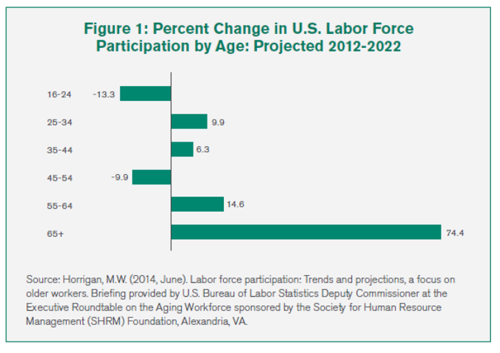
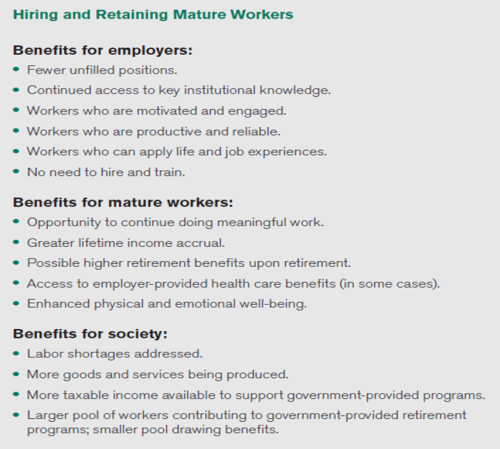
EPG April 28 2015This chart lays out the challenge well. What follows is a trove of information about mature workers. What they want, what they can do, and the inordinate benefits of keeping them engaged in the workforce. Here are several benefits outlined in the report:
EPG 2 April 28 2015The real meat of the report are the 15 strategies for engaging and retaining mature workers that are based on both research and real organization practice. There are mini-case studies from 30 employers sprinkled throughout the strategies that share effective practices. Perhaps the most impactful sentence in the entire report is in the introduction to the 15 strategies: “The best way to engage and retain workers of any age is to provide a strong vision at the executive level, fair compensation and competent, respectful supervisors.” While the focus is clearly on the acquisition and retention of mature workers, every age demographic benefits from these strategies.

15 Strategies for engaging and retaining mature workers:

  1. Acknowledge Work Contributions
  2. Offer Flexible Work Arrangements
  3. Offer Bridge Employment
  4. Support Health and Wellness
  5. Provide Caregiver Support
  6. Offer Skills Training
  7. Provide Career and Personal Growth Opportunities
  8. Use Mixed-Age Workgroups
  9. (Re)Design Work to Match Worker Capabilities
  10. Train Managers and Supervisors
  11. Provide Support for Retirement Planning
  12. Address Age Discrimination (Real and Perceived)
  13. Foster an Age-Positive Organizational Culture
  14. Foster Job and Career Embeddedness
  15. Facilitate Critical Knowledge Transfer

It’s obvious that none of these strategies are rocket science. In fact, as you look at the list you might think, “well, these are just common sense practices that will support the engagement and retention of ALL of our workers.” And that’s the point. We can’t focus our workforce planning activities on one generation alone. And ensuring that we Baby Boomers remain engaged and valued will make the demographic transition that is looming just over the horizon more effectively managed for organizations, for workers and their families, and for society. I call that a win-win!

1 Comment

Filed under Baby Boomers, China Gorman, Data Point Tuesday, Effective Practice Guidelines, SHRM Foundation, Workforce Demographics, Workforce Planning

Big HR Data By Any Other Name

data point tuesday_500I’m mindful of Laurie Ruettimann’s blog post from a couple of weeks ago wherein she put it straight out: HR Research Isn’t Research, It’s Marketing. She ends her post with this: Remember — today’s HR research is marketing, wrapped up in survey data, presented for consumption as sales collateral. And, of course, she’s right. Lots and lots of surveys are fielded in the HR space by consulting firms, service and products providers, professional associations, academics, writers – heck, by anyone who wants to sell something to HR professionals. And many of those surveys are biased, have no real hypotheses, and the resulting white papers are designed to create the case for you want to buy whatever the sponsor is selling.

But this isn’t news. We all know this. HR professionals all over the world know this. And probably none of these white papers with their biased surveys ever propelled a sale. I think we can agree on this.

But I still find value in these so-called research papers because they raise questions, spur investigation, create doubt and motivate thinking. Not a bad thing for HR professionals. Asking questions, investigating additional data, analysis and research, creating doubt about the effectiveness of current practice and motivating thought to consider other ways of creating value for the business – these are all very good things.

I thought about all of this as I read KPMG’s recent white paper, Evidence-based HR: The bridge between your people and delivering business strategy. And as I read it, I thought about whether or not it was useful in creating a case for HR professionals to ask more questions, get a handle on organization data – not just HR data, and think about the future effectiveness of HR in the organization to drive greater business value. And I believe it does. So I recommend that you read it with the understanding that KPMG would like to sell you some consulting services. (With a hat tip to Laurie.)

 The primary points are in no way earth shattering, but the underlying data give some new color to the discussion of HR, Big Data and creating business value:

  • Evidence-based HR is still at the embryonic, pioneering stage

  • The progress of evidence-based HR is hampered by a negative perception of the HR function

  • Evidence threatens the established order, inevitably triggering resistance as a consequence

  • Whatever the obstacles, and whatever the resistance, the growth of evidence-based HR will gain momentum; companies and HR practitioners must respond urgently to avoid losing ground

That third point was particularly interesting to me: “Evidence threatens the established order, inevitably triggering resistance as a consequence.” Evidence threatens the established order in HR for HR professionals who believe the people part of the business is more art than science. Not new. It also threatens the established order in the C-Suite and in other functions where executives have free reign to act on their own experience and perceptions of what works in leading people. And resistance to HR analytics comes from locations in the organization other than HR. New. And also interesting.

“The new era may also endanger the myth of the omnipotent executive, and the massive rewards that flow from it. Decisions based on gut instinct are now becoming exposed to immediate criticism. ‘Evidence suddenly makes people accountable, quite an uncomfortable feeling for some people…’ “

I’m interested that some of those uncomfortable people are other than HR people.

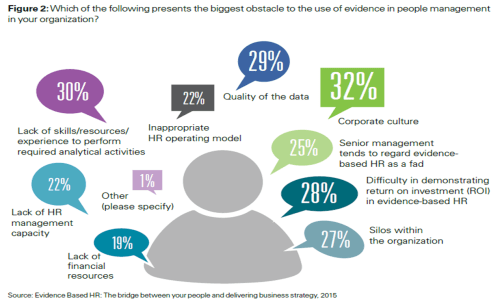
The data in the report are presented appealingly. Here’s one graph:

KPMG April 21 2015 An interesting finding is that the biggest obstacle to the use of evidence in people management is corporate culture. Not HR’s reputation, but corporate culture. Also new and maybe worth considering.

KPMG’s concludes the report with this, “…the days of basing people decisions on the whims or personal motives of one person at the helm are about to end. Organizations that acknowledge that inevitability already have a substantial head start.” That’s more a message to CEOs than it is to CHROs. More a message to the C-Suite than to HR practitioners. I just hope CHROs and HR practitioners are ready when the message is received!

2 Comments

Filed under Big Data, C-suite, China Gorman, Data Point Tuesday, HR Analytics, HR Data, KPMG

Starbucks’ Ethical Sourcing: Beans AND Talent

data point tuesday_500I read in the newspaper yesterday morning that Starbucks has achieved an incredible milestone for the ethical sourcing of virtually all its coffee – 99%! This means that more than 400 million pounds of coffee served globally meets really tough economic, environmental and social standards for growers from whom they buy their coffee. According to Starbucks’ website, they take a “comprehensive approach to ethical sourcing, using responsible purchasing practices; farmer support; economic, social and environmental standards; industry collaboration and community development programs.” And it’s all verified by third parties like C.A.F.E. (Coffee and Farmer Equity) Practices, Fairtrade and Certification Global Services. There is much to admire in Starbucks’ commitment to and execution in the ethical sourcing of its primary physical ingredient and I believe this achievement connects to what we could call the ethical sourcing of talent.

Starbucks also recently announced that it is making a full four-year college degree available without cost to all of its more than 140,000 full- and part-time partners (employees) through Arizona State University’s online degree program. Let’s see… Ethical sourcing of coffee beans from farmers all over the world and offering full college tuition coverage to tens of thousands of employees. I see a consistency of approach to trustworthy leadership here that is hard to find today anywhere in the world.

There are thousands of organizations all over the world that are serious about their corporate social responsibility commitments. They have programs that are helping to build communities, reduce environmental impact, improve the public health, educate young people – the list goes on and on. But these are programmatic approaches reliant upon individual leader commitments, not essential strands of the warp and woof of the organization’s foundation. As an observer of corporate culture, I find it rare to observe an organization that sees every aspect of the business as part of the whole cloth of social responsibility. Starbucks certainly sets the bar high in this regard. From a talent acquisition perspective, paying full college tuition for 100% of your employees is the most ethical sourcing strategy imaginable. And it makes sense when it’s lined up next to ethically sourcing 99% of its primary ingredient, coffee beans.

Trustworthy leadership is reliable in its consistency, transparency and ethical behavior. Starbucks is a pretty great example of this.

1 Comment

Filed under China Gorman, Corporate Social Responsibility, Ethical Sourcing, Starbucks, Talent Acquisition

Moving the HR Industry Forward

data point tuesday_500I love finding new sources of information that shine a light on how organizations can achieve better business results through Key Interval Analysts 2better people practices. This month I found a new source – although the principals are old friends – that is going to make important contributions in the use of HR technology in the improvement of business outcomes. If you haven’t heard of Key Interval Research, you most certainly have heard of John Sumser and William Tincup, the founders and principal analysts. And if you haven’t seen the first of their monthly research reports, let me introduce you to “The Ideal Vendor Relationship.”

The report is based on a survey of 1106 HR and Recruiting professionals conducted in December 2014 and January 2015. The survey respondents were from a broad cross section of titles in HR functions from organizations of all sizes. The survey itself had 85 subject matter questions and 35 demographic questions and the answers were collected online through several methods.

The incidence of “ah ha!” moments are so numerous in this report that sets out to explore, understand and illuminate how HR practitioners and their administrative players work successfully together with HR technology vendors and their administrative players to achieve organizational goals. These are crucial insights because, as William and John believe, “today’s work world requires that HR Departments accomplish their work through outside people and tools.” As we all know, more and more of those people are vendors and those tools are software.

The report is full of surprising findings:

  • The software lifecycle drives relationships
  • Only a small fraction of HR practitioners are dissatisfied with their HRTech tools
  • A majority of respondent companies have terminated an HRTech vendor for cause, but
  • Nearly 80% of respondents like their HR Software
  • The HRTech vendor-practitioner relationships are surprisingly healthy
  • The most important factor in the long term relationship with a vendor is the time required to get an answer

And there are more. Many more surprising findings. I won’t give away most of the good stuff, these guys are in business and want you to buy this report, but the myth busting section was particularly interesting. One of the myths they bust is that what matters most to the customer is schedule and budget. That’s right. A myth. User Satisfaction is significantly more important. This would be important for every vendor to understand and for every customer to own. Here’s the graph explaining…

April 7 2015 Customer MythThe report covers the software lifecycle, discoveries – including the busting of long held beliefs, easily digested findings, notable vendors and a pocket guide. Also included in the report are 4 cases from HR practitioners managing HR software vendor relationships and working on important business issues. The takeaways are critical. (Note: not all of the outcomes are positive.)

These are smart guys asking smart questions that maybe no one else is asking. And the answers aren’t what I expected. They aren’t even the answers they expected. And that’s what makes this report so refreshing and so useful: answers to questions that aren’t being asked and insightful analysis into the surprising answers. Worth the price of admission. Check it out here.

2 Comments

Filed under #HRTechTrends, China Gorman, John Sumser, Key Interval Research, William tincup