Monthly Archives: October 2015

Get To Know Me: Here Comes GenZ

data point tuesday_500

We haven’t quite got GenY figured out, and here comes GenZ! Universum, the global employer branding firm, has conducted a GenZ survey and found some interesting conclusions. In Generation Z Grows Up we’re given a bit of a peek into this new generation that will be 40% of all consumers by 2020 (less than 5 years from now!) and there is news:

  • GenZ is spooked by the college debt of the Millennials

  • GenZ doesn’t think universities are preparing students for workplace success

  • GenZ perceives current high levels of unemployment following university/college graduation

And it appears that Gen Z’s current orientation to post-secondary education isn’t what we might expect:
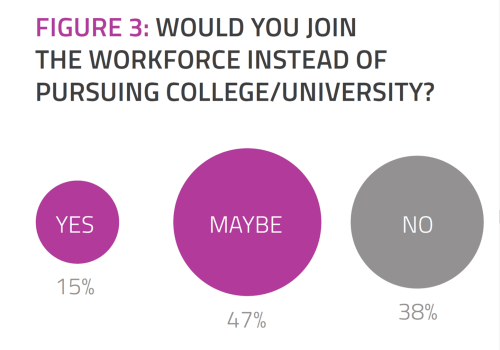
Universum Gen Z 1It would appear that 62% of Gen Z would consider joining the economy right after high school – particularly if employers will invest in their training. Of course, as with all things global, attitudes are different around the world. On average, though, if only 38% of high school students globally are committed to enrolling in a university degree program before joining the world of work, there are a great many young people considering forgoing the traditional post-secondary education route in favor of less debt, more employer-sponsored training, and more employment opportunities. Maybe.

Universum has been surveying college/university and graduate school students about to graduate for almost 30 years. It probably has the biggest and most robust data set of student expectations and employer preferences in the world. The 2015 Gen Z survey asked more than 50,000 recent high school graduates about their future careers, higher education plans, as well as their attitudes about work and life. A real window into the next generation of employees.

I know it seems like we haven’t figured out the Millennials yet. But time is marching on and it’s time to meet and greet a whole new generation of employees. Given the dramatic demographic shifts we’re experiencing, we can’t get to know these newcomers fast enough. The first truly digital natives are sure to provide employers opportunities as well as challenges.

3 Comments

Filed under China Gorman, Data Point Tuesday, Gen Y, GenZ, Universum

Lights Out Productivity

data point tuesday_500One of the benefits of writing a blog that is focused on bringing interesting research analysis to the HR community is that people (vendors, academics, researchers, associations…) send me all kinds of research reports. I receive cool data analyses every day. And I learn a lot reading through them. Here’s a funky little survey analysis that won’t surprise anyone. But it brings up a good point.

The research goal of Generational Trends in Employee Desktop Expectations and Behaviors sponsored by AppSense, was “to capture hard data on experiences and attitudes towards desktop experience among business users.” The methodology included a series of online surveys that were fielded to independent sources of business professionals, all of whom worked at companies with more than 500 employees (1,000 employees in the U.S.) and lived in the U.S., the U.K., Germany, France, The Netherlands or Australia. All in, a total of 258 full-time business professionals who use a desktop computer for than 10% of their work participated in the survey.

If we needed to see more data that would drive a wedge between the Millennials and the Boomers, this would qualify. Except that the data aren’t surprising. Millennials grew up with technology in their hands, pockets and backpacks. Boomers grew up with almost no technology and when it did appear it wasn’t personal, mobile or transportable.

Generational Trends 2 October 2015So, while we all get distracted when our desktops are slow to load, how we spend our time while waiting is different. Evidently Millennials only know how to be productive on a computer.

Generational Trends October 2015On the face of it, it looks like Boomers try to be more work-productive while waiting for their slow desktops to catch up with them, and Millennials tend to be more personal-productive. What we don’t know is how much time these activities take – seconds, minutes, or more.

As I said, this is a funky little survey analysis. You certainly wouldn’t create any policy changes based on these findings. But you might ask questions about how much time is actually spent waiting for slow computers at your organization. If it’s minutes a week versus hours a week, you’re probably fine. If the available time due to slow computers is hours a week, the investment in alleviating the down time might be well-spent.

But the more interesting question this brings up for me is whether or not our workforce, now dominated by digital natives, can be productive when the lights go out. Are we’re teaching them how to be productive off the digital reservation? For sure the Boomers can go Old School and use paper, spreadsheets, telephones and other relics of bygone business eras to get work done if the systems go down. Is it possible that our younger colleagues don’t know non-digital ways of being productive? Is this funky survey and analysis an inadvertent call to ensure that productivity isn’t bound by turning on a computer and being connected to the internet?

Can your workforce continue to serve your customers and be productive if the systems go down for an hour? For a day? For several days?

I’m just sayin’.

2 Comments

Filed under AppSense, Baby Boomers, China Gorman, Data Point Tuesday, Desktop Computers, Millennials, Time Management

Conference Attendance 101

data point tuesday_500This was originally published on August 31, 2010 — it’s still valid today. Especially if you’re joining me at the HRTech Conference next week. Especially the part about smiling…

So.  You took advice from my last blog post and decided which conference to attend.  Congratulations.  But now you want to be sure that you leverage your investment by making the most of your attendance.  Here are three proven strategies for making sure you get your money’s worth.

Sessions

Conferences generally have 3 types of content sessions:

  1. General Sessions:  these are sessions that are intended for the full complement of attendees.  The speakers are typically big names in the industry who speak on universal topics relevant to the conference theme or they are big celebrity names meant to draw your attendance to the conference.  Here in Orlando where I’m attending the SHRM affiliated HR Florida conference, the opening general session featured Henry Winkler.  (He was terrific, by the way.)
  2. Concurrent Sessions:  these are the main content tracks that are scheduled throughout the conference.  Each time slot will hold multiple options for your consideration.  Designed for smaller subsets of the conference attendees, these tend to be led by practitioners, consultants or academics and are focused content of a practical nature.
  3. Sponsor Highlights:  these are sessions that feature a sponsor or exhibitor’s product or service, are marketing-focused in nature, and come as part of their sponsorship/exhibitor fee.

In a typical two and a half day conference, it’s important to select the sessions you want to attend wisely – and in advance.  But it’s also important not to over-schedule yourself (more on that later). I recommend attending all the General Sessions.  The big names generally have value and the celebrity speakers are generally engaging, entertaining and motivating.  Then attend concurrent sessions in about 75% of the time slots.

Save time for Networking

One of the particular values of attending a conference in person (as opposed to an online conference or a series of webinars) is the opportunity to meet other like minded people.  Look at the list of presenters.  Look at the list of sponsors/exhibitors.  Find out who else will be attending.  Then target 4-8 people that you’d really like to meet and talk with – and find them at the conference.  Leaving time in your session schedule to set short appointments when you find people on your target list will allow you to be thoughtful in creating new relationships.  Don’t pass up the opportunity to learn from industry pros – who, by the way, also want to network and meet people just like you!

You know how to network, right?  You prepare for these opportunities in advance by identifying what you’d like to talk about with each target and prepare 2 or 3 questions to get the conversation rolling.  You can ask everyone the same questions, or you can customize your approach to each person.  Your confidence will be strong as you introduce yourself to these folks and you’ll be surprised how amenable perfect strangers are to meet and talk with you.

Nothing is more attractive than a smile

As you walk the conference halls and expo aisles, make sure your demeanor and body language is open.  And smile.  Intentionally.  You’ll appear open, friendly, not intimidating or intimidated.  Really, there’s nothing more attractive than a smiling face.  And there’s nothing that builds your confidence to approach strangers than acting open and welcoming.

Attending a conference and getting your money’s worth isn’t hard.  But it takes some forethought and planning.  Both you and your organization want to realize the investment it took to get there.  Make sure you get the full value of the experience.

Leave a comment

Filed under Bill Kutik, China Gorman, Data Point Tuesday, Globoforce, HR Technology, HR Technology Conference, LRP Publications, Steve Boese

How Bad is Your Succession Management?

data point tuesday_500

84% of organizations report having a lack of candidates in the pipeline ready to assume open and critical positions.

That’s not good, folks. As we wring our hands on the lack of talent in the external pipeline, perhaps we should be spending more time attending to the skills and development of the folks already in the organization!

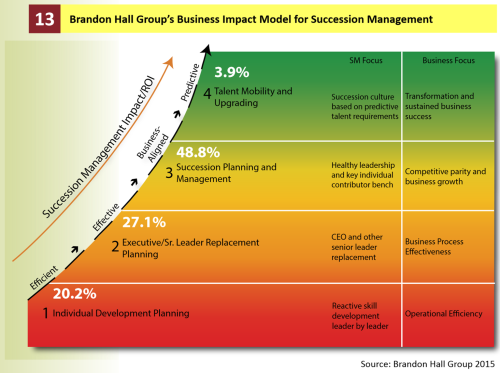
Laci Loew, Vice President and Principal Analyst at Brandon Hall Group, recently published their State of Succession Management 2015. If your organization is in the 84% of organizations above, this report will be helpful in laying out the challenge, what and how high performing organizations in this regard are executing differently, and how to think about the first steps of moving your succession planning needs forward. The report is a great read and has some pretty terrific content and data included.

This graph gives you a taste of what you can expect in terms of getting started as well as what successful outcomes are from both succession management and business focus perspectives.

Brandon Hall Succession Mgmt 1

The report outlines 7 critical findings of Brandon Hall’s research on this topic:

  1. Talent pipeline health continues to threaten leadership continuity.

  2. Succession management commitment is on the rise with prioritization for a formal strategy for all parts of the organization.

  3. Technology is under-utilized, hindering efficiency of succession management.

  4. Successor development as a critical component of succession management is improving.

  5. Lateral mobility takes center stage as a critical successor development strategy.

  6. Using predictive analytics to proactively plan for critical position vacancies will separate organizations with effective succession management from less effective organizations.

  7. Today’s succession management budgets are modest at best, but expected to expand significantly over the next 12 months.

The insights fleshed out in each of these key findings are critical reading for any talent management professional. And you’ll also get some useful data to use in building the ROI for succession management investment in next year’s budget.

The report is published by Skillsoft and can be accessed here. At 34 pages, this is a solid piece of analysis and a useful and highly practical read.

2 Comments

Filed under Brandon Hall Group, China Gorman, Data Point Tuesday, Laci Loew, Skillsoft, Succession Planning, Talent Management, Talent pipeline