Category Archives: China Gorman

A New Voice Demanding Flexibility: Dads!

Data Point TuesdayThe Working Mother Research Institute (WMRI), in partnership with Ernst & Young, recently released a report aimed at better understanding “how men are navigating the flexible work and home terrain.” Data from How Men Flex, The Working Mother Report is the result of survey responses from 2,000 men and women (evenly split) with questions aimed at understanding the impact of flexible work arrangements on their lives. While the impression may be that flexible work arrangements are greater utilized by female employees, WMRI’s data indicates that flexibility in the work environment is both used and desired by men and women equally. 77% of men report having flexible schedules and 79% state that they feel comfortable using such flexibility. Additionally, 62% of men state that their employers can and do support flexible scheduling. What’s also clear from WMRI’s data is that working mothers aren’t the only people struggling to with balancing work and family. 26% of men report that their employers could encourage flexible scheduling but don’t. WMRI notes that in recent studies both working mothers and working fathers, have almost equally agreed that they feel stressed about meeting their responsibilities in both their work and home environments. Studies have also shown that men are increasingly involved in the balancing act of family and work, something that’s often seen exclusively as a working mother’s issue. WMRI highlights a 2011 report, which showed that fathers spent 7 hours a week on childcare and 10 hours a week on housework, a significant increase from a 1965 study that reported fathers spent 2.5 hours a week on childcare and 4 hours on house work. Breadwinning Mom Graph

The above graph highlights changing perceptions when it comes to work and family; 88% of men report that mothers and fathers should share equally in caring for their children and 83% report that household work should be shared equally as well. Organizations should make sure there is an inclusive focus on flexible scheduling not only because family management is a shared responsibility but also because flexible scheduling benefits employers in several ways. The data show that men with access to flexible scheduling are more likely to say they are happy, productive, have high have morale, good relationships with co-workers, and are overall more satisfied with their job than men without access to flexible scheduling. Satisfaction Graph

Employers who do not provide flexible scheduling lose a valuable tool for attracting talent and could be increasing their risk of losing valuable talent they do have. Right out the door, 54% of working fathers and 47% of men without kids state that they would reject a job with frequent travel due to obligations at home.

What flex options should employers provide? While that depends largely on each organization’s professional needs (and their employees’ personal needs) men surveyed for WMRI’s report state that two days of telecommuting each week work best for them. These respondents report higher levels of satisfaction on almost all fronts compared to those who never work from home. Men who commute two days a week also report higher levels of satisfaction than those who work from home three to five days a week. Working From Home Graph

WMRI’s report also finds that 6 in 10 working dads would work part-time if they could still enjoy a satisfying career; however, 36% of working dads say part-time work is looked down upon at their organizations. Working fathers, like working mothers, also report difficulty in managing boundaries around work, with 46% reporting that their job bleeds into their personal time, compared to 32% of men without children.

The data here suggest that flexible scheduling options are just as valuable for men as they are for women, and, moreover, are an area that many organizations are unintentionally neglecting to make as accessible to male employees. Organizations should make sure to engage all employees in conversations around flex time, and to publicize that flex programs are available and their use is encouraged by all.Downsides Graph

Leave a comment

Filed under China Gorman, Data Point Tuesday, The Working Mother Research Institute, Workflex, Workplace Studies

What War for Talent?

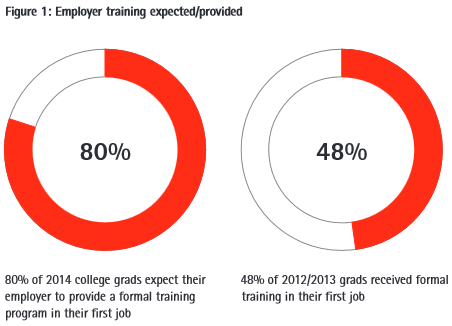
Data Point TuesdayAccenture’s 2014 College Graduate Employment Survey compares the expectations and perceptions of 2014’s university graduates with the realities of the working world according to both 2012 and 2013 graduates. This comparison casts a focused and specific lens on the issue of entry-level talent development, and gives us some insightful data. Accenture’s survey underlines that at the end of the day, many organizations are not effectively developing their entry-level talent. When we consider that 69% of 2014 graduates state that more training or post-graduate education will be necessary for them to get their desired job, we see that organizations are likely facing a major talent supply problem. New graduates and entry level talent’s perceive that their organizations will provide them with career development training: 80% of 2014 graduates expect that their employer will provide the kind of formal training programs necessary for them to advance their careers. Despite this, the percentage of graduates that actually receive such training is low, creating a significant discrepancy between expectation and reality.Expectation vs Reality

Another concern when it comes to recent college graduates is that 46% (nearly half) of 2012/2013 graduates working today report that they are significantly underemployed (i.e. their jobs do not really depend on their college degrees). This statistic was at only 41% a year ago.Entry Level UnderemployedAccenture’s survey found that 84% of 2014 graduates believe they will find employment in their chosen field post graduation, and 61% expect that job to be full time. Again, we find a stark contrast between expectation and reality, with just 46% of 2012/2013 grads reporting holding a full-time job – 13% percent have been unemployed since graduation. How long do recent graduates stay at the jobs they do have? More than half (56%) of 2012/2013/2014 graduates have already left their first job or expect to be gone within one or two years. Is this be a reflection on the lack of development for entry-level talent? It seems more than plausible…

Recent graduates are also finding discrepancies between expectations and realities when it comes to income and job prospects. Of the 13% of 2012/2013 grads who have been unemployed since graduation, 41% believe their job prospects would have been enhanced had they chosen a different major (72% expect to go back to school within the next five years). Among Accenture’s 2014 survey respondents, 43% expect to earn more than $40,000 at their first job, however, just a minimal 21% of the 2012/2013 graduates that are in the workforce are actually earning at that level. 26% of these graduates report making less that $19,000, a concerning figure when roughly 28% of 2014’s graduates will finish school with debt of more than $30,000.

Accenture’s study does point to some silver linings, however. Increasingly, college students are turning an eye towards what they can do to be more market relevant. 75% of those who graduated this year took into account the availability of jobs in their field before selecting their major, compared to 70% of 2013 graduates and 65% of those in the class of 2012. Another positive is that 72% of 2014 graduates agree or strongly agree that their education prepared them for a career (compared to 66% of 2012/2013 grads) and 78% feel passionately about their area of study. 63% of 2014 graduates stated that their university was effective in helping them find employment opportunities, an increase from 51% among their recently graduated peers. Recent graduates are also increasing their chances of employment by being geographically flexible. 74% of 2014 graduates said they would be willing to relocate to another state to find work and 40% of those would be willing to move 1,000 miles or more to land a job.

Accenture’s study does, however, put into question many of the highly publicized reports that point to human capital/talent acquisition issues as a #1 concern in the C-Suite. If talent is the #1 issues, where is the attention to entry-level talent? Is the attention being placed exclusively on development for upper-level positions? It’s clear that there are multiple factors influencing graduates’ struggles for acceptable employment, including the rise of part-time and contingent work, but training and development is an important part of any entry-level position. The survey points to six areas in which organizations can focus on to help meet talent supply challenges:

  1. Reassess hiring and retention strategies
  2. Hire based on potential, not just immediate qualifications
  3. Use talent development as a hiring differentiator
  4. Remember that tangibles matter, even to Millennials
  5. Cast the net more widely
  6. Use talent development and other benefits as part of a total rewards and attraction approach

These are logical conclusions. But perhaps the biggest logical conclusion is that organizations are just paying lip service to the so-called war for talent and aren’t convinced that the there is, in fact, a shortage of talent. Am I wrong?

2 Comments

Filed under Accenture, China Gorman, Data Point Tuesday, Human Capital, Millennials, Professional Development, Talent development

2014 World’s Best Multinational Workplaces: Trends for Thought

Data Point TuesdayHere at Great Place to Work we’re getting ready to reveal the 2014 World’s Best Multinational Workplaces list, so there seems like no better a time to talk about a positive organizational trend that’s been occurring among many of the less encouraging trends we consistently hear about (for example, the war on talent, low levels of employee engagement, or no work/life integration). The positive trend that I’m speaking, to be exact, is that levels of trust, camaraderie and pride are rising at the best workplaces – essentially, the world’s best workplaces are getting better. In recent years we’ve seen “the best” companies get better in the majority of the ~50 countries where we measure workplaces using our Trust Index© employee survey. Additionally, we have seen increasing trust at the companies that make up Great Place to Work®’s annual World’s Best Multinational Workplaces list.
trustindexchange2009-2014

The good news is that while this increase in trust trend is mostly notable within “best companies,” such positive culture changes are influencing other companies as well and helping to create a push towards a higher standard for organizations. The data discussed here comes from the decision to examine trust trends in individual countries and among the world’s best multinationals as we prepared our 4th annual World’s Best Multinational Workplaces list. In particular, we studied the Trust Index© scores of all the national Best Workplaces lists during the past five years. The Trust Index© is Great Place to Work®’s 58-statement employee survey that measures trust, pride and camaraderie in organizations.

Our research highlights seven reasons why trust is rising in great workplaces: awareness, evidence, Generation Y, employee gratitude, wellbeing, momentum, and transparency. Globally, company leaders have been demonstrating an increased awareness towards the importance of a high-trust workplace culture. Furthermore, we’re seeing increasingly more evidence published that great workplaces lead to better business results. For example, publicly traded companies on the U.S. Best Companies to Work For list have nearly doubled the performance of the stock market overall from 1997 to 2013 and a paper published earlier this year by the European Corporate Governance Institute which studied data from 14 countries, concluded that higher levels of employee satisfaction (reflected by earning a spot on a best workplaces list generated by Great Place to Work®) corresponded to stock market outperformance in countries with high levels of labor market flexibility, such as the United States and the United Kingdom.

The Millennial generation is also an influencer. Globally, this generation is demanding better workplaces and pushing employers to place more focus on both social responsibility and work/life integration. Employee gratitude also plays a big role in high-trust cultures. Best workplace environments reflect employee gratitude and reciprocation and aren’t solely about what management is doing for employees. This is especially true during trying times for companies. When one company’s culture may take a turn for the worse during economic hardships, organizations that take care of their employees amid such a time can create higher levels of trust. We can also point to the ‘wellbeing’ movement as an influencer of high trust levels at organizations. With people placing more and more emphasis on mental and physical wellness, in part due to high stress work environments at many organizations, great workplaces are embracing the wellbeing trend. Among the three Trust Index© scores that have risen most among the World’s Best Multinational Workplaces is this statement: “People are encouraged to balance their work life and their personal life.”

Momentum and transparency are the last of the seven key trends we have noted as influencers of high-trust at organizations. Momentum refers to the positive upward spiral that seems to occur (owing to both management and employees) once an organization develops a trust-based workplace culture. This is logical as a more trust-based culture often sees employees that are more active participants in culture related activities and hold a greater appreciate for their workplace. With the amount of new technologies (like social media) and personal mobile devices available, organizations are faced with an amount of unprecedented transparency. This transparency works in favor of organizations with great cultures and rewards them while providing a “public eye” and ample incentive for less than great organizations to step up. Another of the three Trust Index© scores that have risen most among the World’s Best Multinational Workplaces is this statement: “Management keeps me informed about important issues and changes.”

Check out a few “Fast Facts” about the World’s Best Multinational Workplaces 2014 below, and be sure to check back here on Thursday to see which companies made the list!

Fast Facts: The World’s Best Multinational Workplaces 2014

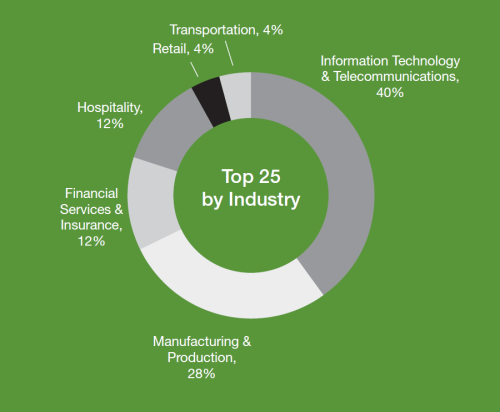
  • Since last year, industry distribution has changed significantly on the World’s Best list. IT and Telecommunications now makes up 40% of the industries, replacing Manufacturing and Production (28%) as the dominating industry. The variety of industries represented has shrunk from 8 industries in 2013 to just 6 this year:industrydistribution2014
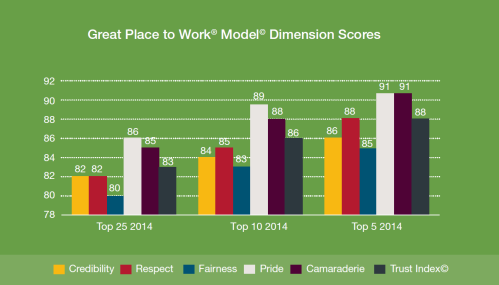
  • Among the 2014 World’s Best Multinational Companies to Work For in 2014, “Pride” is distinguished as the main strength. “Camaraderie” ranks stronger than “Respect” in the Top 10 and the Top 5, while “Fairness” continues to be biggest opportunity area:2014 Dimension Scores
  • Since 2011, the main improvements made by the best multinationals in the world are:
    • Encouraging work-life balance,
    • Management keeping employees informed
    • Promotions based on merit.

2 Comments

Filed under China Gorman, Company Culture, Data Point Tuesday, Employee Satisfaction, Great Place to Work, World's Best Multinational Workplaces

CEO Insights: The Bumpy Road to ALWAYS ON

data point tuesday_500

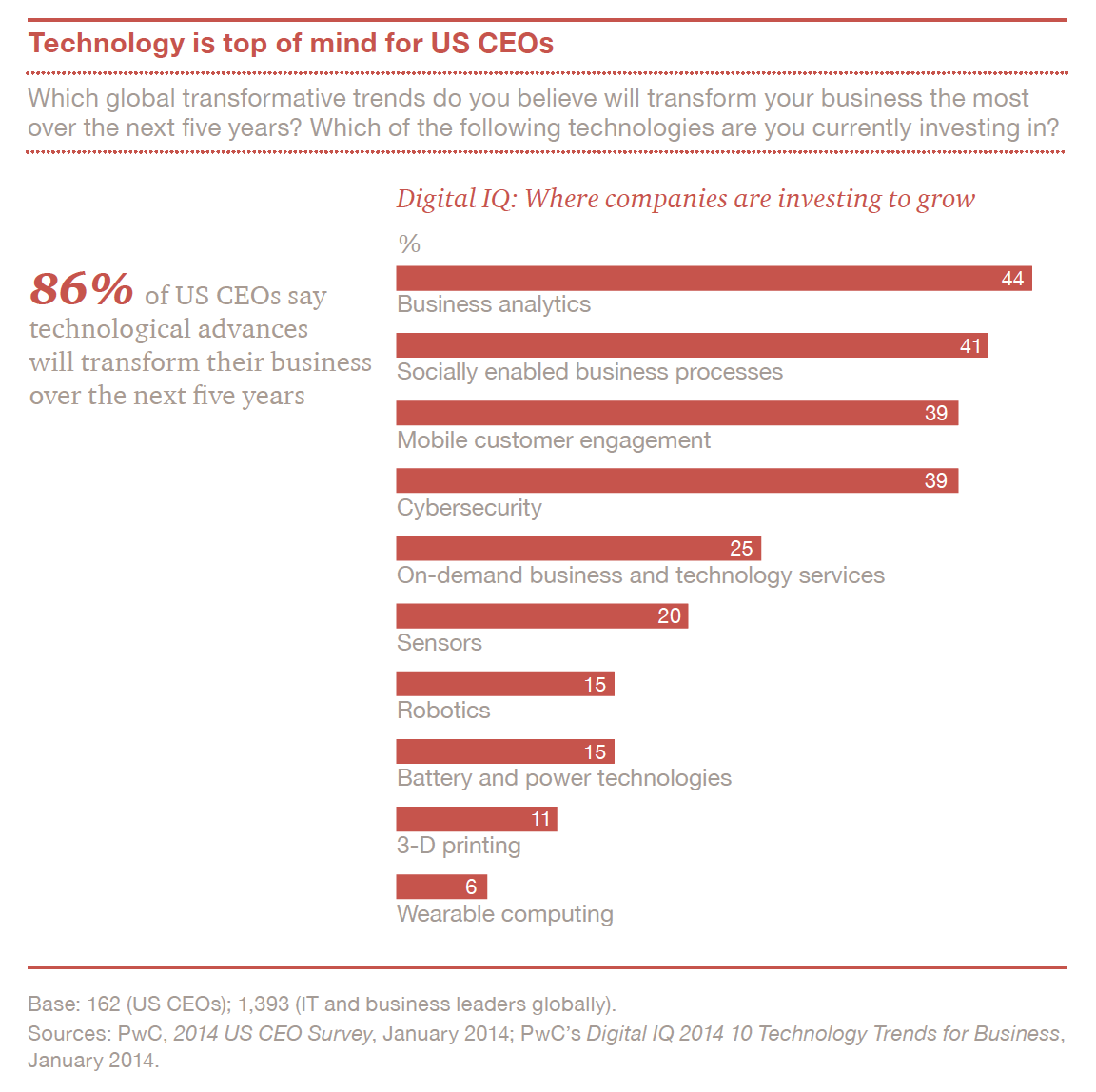
PWC’s 17th annual global CEO report “Good to Grow: 2014 US CEO Survey”, provides a thorough snapshot of executive leadership perspectives and approaches at the current moment. PWC’s report includes perspectives from over 1,300 CEOs from 68 countries, including 162 CEOs with US-headquartered organizations. It’s clear from the responses that, globally, CEOs are making many changes within their organizations. For example, 86% of CEOs stated that advancing technologies are going to transform their businesses over the next five years. Positively, PWC’s data also suggests that CEOs are finding reasons to be more confident in many places (89% of US CEOs are fairly sure their companies will deliver revenue growth this year). In this period of rapid change though, what approaches are CEOs taking, and what insights can they offer?

The majority of CEO’s interviewed reported that “five great forces of transformation” are reshaping business as we know it:

  • Technology is making an impact across the whole enterprise.
  • CEOs are reinventing the operating model towards an “always on customer experience.”
  • CEOs are seeking new ways to work together in joint ventures and alliances to capture disruptive technologies faster.
  • In some cases, the business model is being innovated.
  • There are rising concerns about talent.

As organizations undeniably shift into a period of growth (62% expect to hire more people this year, the highest level of anticipated headcount expansion in the past five years for this survey), how do these five great forces of transformation come into play?

All CEOs seem to agree, that technology is what propels business, and will continue to do so. PWC states that, in part, “Technology” is a watchword for 2014 because CEOs use it when talking about both core innovation and information technology (IT). Technology has become an essential part of strategy in all areas – for organizations pursuing new business models, meeting new customer expectations, remaking their operating model, forging new alliances, or tackling talent challenges.

pwc-Technology


CEOs are reshaping business models though innovation. They are taking cues from the technology industry that has paved the way by creating value for customers in a multitude of new ways. Organizations are looking to create increased profit for what they offer beyond step-by-step product innovation, and they are stepping out of the box to innovate in ways such as turning a product into a service, or vice versa. New approaches to innovation and R&D are part of an increased strategy by many US CEOs in 2014. For example, some organizations report funding innovation incubators to foster rapid prototyping of new ideas, while others report wanting to join up with emerging market innovators who are developing low-cost products.

PWC’s survey also indicates that customer strategies will get a serious makeover in 2014, with 52% of CEOs reporting that they are planning to change their customer growth and retention strategies. As creating a positive and personal customer experience only continues to increase in value (and as a standard of expectation) more organizations will see CEOs leading them toward a strategy of customer interaction. This will move away from stand-alone transactions to a sustainable “always on” relationship with customers. While CEOs plan out such new strategies, they are also discovering that most current capabilities are “fair game for reinvention.” The vast majority of CEOs are already debuting a fair number of change initiatives with a focus on moving away from rigid structures towards more nimble, adaptable operations.

pwc-reinventing-operations

Business alliances and joint ventures also appear as a CEO noted trend for 2014 – within the U.S. and globally. 42% of CEOs surveyed report that they plan to enter a business alliance/joint venture this year while only 4% expect they’ll exit an existing relationship. CEOs are also looking at acquisitions, with 39% of US CEOs planning to complete a domestic acquisition in 2014 and 28% planning on a cross-border deal.

A last trend to note from this survey is in regards to talent. I’ve talked about the talent acquisition “crisis” or “war on talent” in past posts, and unfortunately, PWC’s CEO survey does nothing to dispel this issue. 70% of US business leaders report being concerned about the availability of key skills. This compares to 54% that said so in 2013.

pwc-skill gaps

Despite continued economic uncertainty both within the U.S and globally, PWC reports that the number of US CEOs who believe that global growth is returning has more than doubled since last year, perhaps indicating that organizations are successfully finding a path forward. It is also clear from the research though, that this is a time of intense transformation, which encompasses a wide range of organizational areas and strategies. The ability to navigate such transformational trends is vital for organizational success. So while the overall sentiment is positive for growth, the ride to get there is going to bumpy. Are you and your teams ready to be “always on?”

1 Comment

Filed under 100 Best Companies to Work For, Business Success, China Gorman, Connecting Dots, Data Point Tuesday, Engagement, HR, HR Data, Information Technology, Talent pipeline

HR: How Disconnected Are You From Employees?

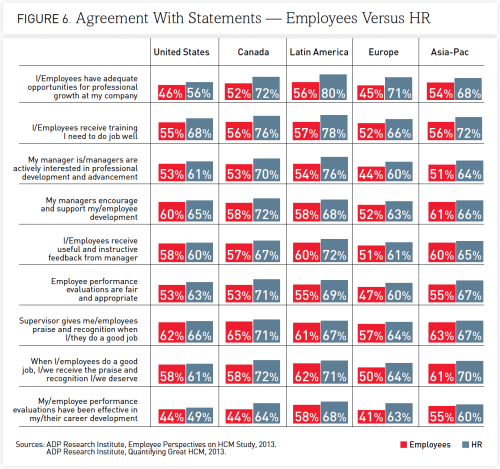
ADP recently released a report which, based on data they’ve collected from several studies, examines the causes and implications of a persistent disconnect recorded between HR’s and employees’ perceptions. The topic is an interesting one: despite the vast improvement in and efficiency of communications tools and processes that we’ve witnessed over the years, employees and HR departments have seemed to maintain notably differing perceptions on many key human capital management effectiveness issues. This disparity holds true globally, and in companies of all sizes. ADP has noted this trend in three of their ADP Research Institute® global studies in 2013: Quantifying Great Human Capital Management, Employee Perspectives on Human Capital Management, and HR 360. All three studies measured perceptions of status and value of the HR function and showed consequential differences between employees and HR in key areas such as how well employees were being managed, how well questions regarding HR and benefits issues were addressed, whether feedback was communicated or even collected, and in performance evaluations. Data indicate that similar gaps in perception exist between HR and senior management on these same topics, and as ADP points out, these differences matter because they may be indicative of larger problems within organizations – such as whether investments in HR technology are actually delivering the results of more effective communication, or whether advantages of a strategic HR function are being actively sought and realized.

ADP’s research studies show that globally, employees have much more negative perceptions of how well their organizations are managing them than the perceptions of their senior executives and HR leaders. This disparity is notable in such areas as compensation, work/life balance, career opportunities, and the effectiveness of senior leadership. The data also show that the larger the organization, the greater likelihood that employees’ perceptions of how well the organization is managed will decline.how well companies manage employees

differing perceptionsSenior executives and HR leaders are also significantly more satisfied than employees with the processes they have in place for getting employees’ answers to their questions regarding HR/benefits. Globally, this disparity is greatest in the Asia-Pacific region and in the United States. In the U.S. 79% of HR leaders report that it is Extremely/Very Easy to get HR/benefits questions answered, compared to only 56% of employees. Continuing the gap in perceptions is that, when employees’ questions are answered, HR leaders and senior executives perceive that employees are far more satisfied with the process they’ve gone through to get questions answered than employees actually are.

Such differences in perception bring to light a number of potential challenges. How do organizations know they’ve secured the advantages of providing benefits if HR is more fully convinced of employees’ satisfaction than employees themselves? Additionally, if HR thinks that their processes for answering questions are more effective than they actually are, are employees even aware of all their benefit options? This becomes especially disconcerting if organizations are counting on their benefits as a way to attract and retain talent. Interestingly, more than half of employees in large U.S. companies stated that an employee portal is an important informational resource, while less than one-third of their HR leaders shared that conclusion. The options primarily cited by HR leaders for employees to get answers to their questions included an in-office HR team, a dedicated HR representative, and the employees’ managers. Employees’ responses however, cited an 800 number or internal company portal as the most important resources for getting answers.

Note too, that among respondents who felt that it was extremely or very easy to have their HR questions answered, less than 1/5 reported they would be likely to look for a new job in the next 12 months; but among respondents who said it is not easy to have their HR questions answered, that number almost doubled to more than 25%. Lastly, another key area to note where disconnect occurs is between employers and employees perceptions of their organizations talent management processes:talent management disconnect

For more on information on the disconnect between employees and human capital management, make sure to check out ADP’s full report, “Human Capital Management’s Employee Disconnect. A Global Snapshot.”

And perhaps it’s time to begin questioning whether the data you are reviewing regarding your organization’s HR effectiveness is actually true.

4 Comments

Filed under ADP, China Gorman, Data Point Tuesday, HR, Human Capital, Workplace Studies

Pump Up Your Change Management Competencies

Data Point Tuesday
IBM
recently released an executive report: “Making change work… while the work keeps changing – How change architects lead and manage organizational change.” The report, based on data from their latest “Making Change Work Study” seems a very pertinent one for the times. As a whole, we know that this is a period of significant change for the workforce, we talk about these changes, and how they can and are affecting organizations, but there is significantly less talk around how organizations are successfully managing such change – which is exactly what IBM’s report dives into. As IBM states, “the gap between the magnitude of change and the ability of organizations to manage it continues to widen.” While many organizations are struggling to close this gap, IBM identifies a select few – change architects – that have “found the keys to making change work while the work keeps changing.” IBM’s data is based on survey results from almost 1,400 individuals responsible for designing, creating or implementing change across their respective organizations.

In IBM’s study, they consider only the top 20 percent of organizations to be highly successful when it comes to change management. These “Change Architects” are organizations that indicated at least 75% of their projects were a complete success (i.e. a minimum of three-in-four projects met all predefined goals).Avg. success rate of projects

Change Architects capitalize on “the vortex of change permeating every aspect of business.” Such organizations are considerably more successful at managing projects. Compared to the average in IBM’s survey, Change Architects have at least 56 percent more projects that were a complete success. What do Change Architects do differently to manage change in their organizations? IBM identifies three critical imperatives that allow them to be change-effective:

  • “Lead at all Levels”
  • “Make Change Matter”
  • “Build the Muscle”

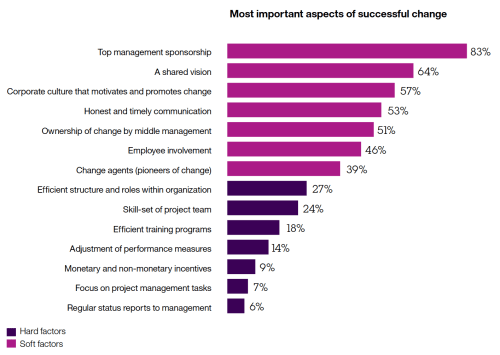
When it comes to managing change, organizations must lead at all levels. Many organizations fail to successfully manage change because they have do not embrace a “change-centric” culture, despite, as IBM points out, that change is the one constant that organizations will always face. Driving a change-centric culture must begin at the top from executive management and cascade throughout all levels of the organization. Survey respondents view “Top Management Sponsorship for Change” as the #1 most important aspect for organizational change:

Most important aspects of change
Despite this fact, only 66% of respondents state that their top management is enabled to act as change leaders (for Change Architects, this jumps to 77%). How are top management at Change Architect organizations driving change? IBM identifies three key characteristics that enable leaders to drive change across the organization:

  1. Role modeling throughout the organization.
  2. Engaging employees with a compelling case for change.
  3. Empowering new and passionate change leaders at all organizational levels.

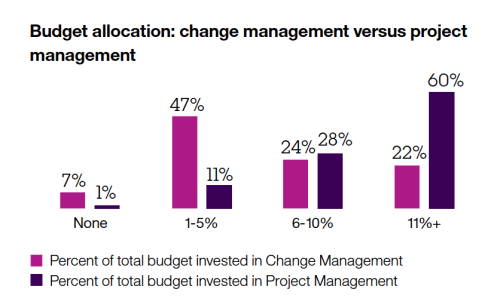
Another critical responsibility of top management in regards to effectively managing change is making change matter. Managers must make sure that if change management programs exist, employees thoroughly understand the activities and benefits of those programs. The majority of organizations invest only 5% or less of total project budgets in change management activities on key projects, and 87 percent of respondents indicate that not enough focus is currently placed on change management in critical projects.

Budget allocation project management vs. change management

Respondents report that when change management activities are incorporated into the overall project plans from the beginning, successful project results are more likely. What then, is preventing change management activities? According to survey respondents, there are five key barriers that keep organizations from pursuing new change capabilities:

  • Change management benefits are not clear (69%)
  • Change management activities are not clear (53%)
  • Role of change professional is not clear (49%)
  • Lack of skilled change management resources (43%)
  • Change management is too expensive (26%)

Last but not least, Change Architect organizations – those that are successful at managing change – have a focus on “building muscle.” 60% of organizations in IBM’s study confirm a formal career path for project managers. This is opposed to only 25% for change professionals. Change Architects often establish a formal career path for change professionals (42% more than other organizations). They use this formalized change discipline for central change coordination; to drive consistent methods, change-related trainings, career developments, asset reuse, company-wide knowledge and best practice sharing.

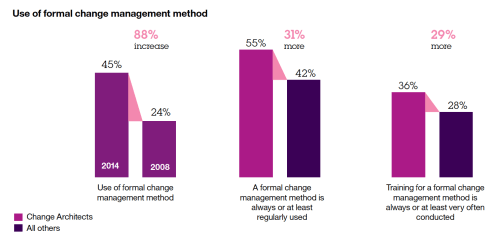
Formal Change Management methods
While organizations that we can truly call “Change Architects” may still be few are far between, the good news is that between 2008 and 2014 the use of formal change management methods increased significantly. This indicates that awareness for this organizational management need is, at the very least, rising on companies’ radars. Managing change is tough, as we all know. This report suggests that making change management a core competence in our organizations may just make our change experiences more successful in every way. Building and exercising change management muscles may make all the difference!

6 Comments

Filed under Change Management, China Gorman, Data Point Tuesday, IBM

Sustainability in 2014: The Language of CSR

Data Point Tuesday
GreenBiz Group Inc.
recently released their 2014 Sustainability & Employee Engagement Report, content generated from responses of more than 5,600 members of the GreenBiz Intelligence Panel (executives and thought leaders in the area of corporate environmental strategy and performance). GreenBiz’s report “examines aspects of corporate environmental and sustainability education initiatives at companies at varying stages of program development and provides a quantitative understanding of the evolution of employee engagement” and notes that while sustainability professionals commonly think of challenges in terms of the physical or fiscal impact of their efforts, the most problematic challenge for this area today may actually be its use of language. Take the term “employee engagement” as an example. While sustainability professionals frequently use this term to describe their attempts to motivate a company’s employees to participate in furthering the sustainability or CSR program, it’s likely that HR executives already have a definition for the term and a way to measure it. HR commonly defines engagement as an employee’s willingness to apply discretionary effort toward meeting the company’s goals and to do more than merely meet job requirements/customer needs and measures this via an index approach using employee answers to survey questions. For example “are you proud to work at this company?” or “do you feel this is a great place to work?”

If HR and Sustainability teams have different definitions of terms like employee engagement, it can cause disconnect and communication barriers. GreenBiz uses the example of a CSR professional who ran into resistance when he met with HR to talk about how to improve employee engagement efforts at his organization. When he changed the language of the conversation however, and asked to discuss how they could increase the participation numbers in the company’s sustainability programs, he was meet with much more enthusiasm. GreenBiz points out that another potential language gap occurs when Sustainability and HR professionals discuss how to achieve greater participation from employees in furthering the sustainability mission. While 73 percent of respondents indicated that their company is educating employees across the organization about its corporate sustainability goals, in a recent study by The Conference Board, only 5 percent of the S&P 500 have instituted employee CSR training. This highlights the differences in association and potential confusion that can occur between the terms “training” and “education,” where training is generally more skills based and education often refers to broader and more general learning activities.

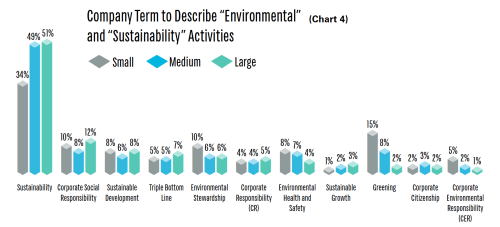
Sept 16 sustainability definitions chart
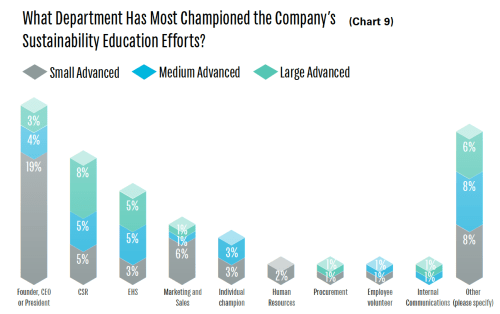
Understanding the kinds of language used in CSR and HR programs, and how to frame such language, can be a vital tool in breaking down communication barriers within an organization. With this in mind, let’s look more closely at what GreenBiz’s report uncovered, starting with the basic definition of “sustainability” initiatives. Over the last six years the term “sustainability” has become the standard for describing such initiatives. 51% of respondents report identifying with this term, up from 49 percent in 2011 and 34 percent in 2008. While this term is increasing, two terms have lost value in describing sustainability initiatives, “environmental, health and safety” and “greening” (see chart above). Another sustainability trend for 2014 is the convergence of social and environmental issues. When GreenBiz looked at the extent to which environmental and social issues are linked today vs. five years ago, they noted an increase across all companies regardless of size. The largest increase in the correlation was at large companies, from 87% to 94%. When it comes to educating employees about their corporate sustainability goals, almost all companies participate. 73% of respondents at small companies indicated their organizations are providing this education, as did 80% of respondents at large companies. Interestingly, which department champions sustainability education efforts most seems to be dependent on the size of the company (see graphic below).

Sustainability champions grapic
When it comes to the topics on which departments focus for employee sustainability education programs, the top 5 have remained steady over the last six years and are: “general information about sustainability initiatives,” “the company’s sustainability successes and accomplishments,” “Actions at work to conserve or protect resources,” “environmental footprint of the company,” and “volunteer programs.” For 2014, the top three motivators for employee participation in corporate sustainability activities were: “concern for the environment and society,” “evident CEO support or mandate,” and “sustainability goals included in performance evaluation.” GreenBiz’s report also cites internal hurdles to sustainability education, which include executive commitment, education and communication, budget/resources/competing priorities, and time.

This data around participation by employees in corporate CSR or Sustainability programs, links nicely to last week’s post about Millennials’ participation in “cause work.” Coming at this topic from both directions – desire on the part of Millennials to participate and corporate CSR/Sustainability professionals’ desire for higher participation levels – creates significant opportunity for everyone. Building trust levels , creating opportunities for growing camaraderie and making strides in being good stewards of the Earth, the economy and our communities in one fell swoop could be a monumental win/win for all of us.

1 Comment

Filed under China Gorman, Corporate Social Responsibility, CSR, Data Point Tuesday, Great Place to Work, GreenBiz Group, Sustainability

Millennial Employees: Defying Assumptions

Data Point TuesdayApproximately 80 million Millennials live in the U.S today. In my last post on Talent Acquisition Trends I touched on the fact that this group is the largest generation in history and, while the exact percentages vary depending on the research, is expected to make up more than 50% of the workforce by 2020. We may still think of Millennials as “the next generation” but the fact is that this group will make up the majority of the workforce in the not too distant future, so research on the values and expectations of this generation is valuable – and actionable. A great example of this kind of research is the “2014 Millennial Impact Report: Inspiring the Next Generation Workforce” by Achieve, whose purpose for the research is to “Understand Millennials’ preferences for cause work and to share those findings with organizations that are looking to better engage this influential group.” Surveys were distributed to Millennial employees of corporate research partners from various industries, as well as a generic survey with respondents representing more than 300 companies and organizations across the United States. For the study, Millennials were defined as individuals born after 1979.

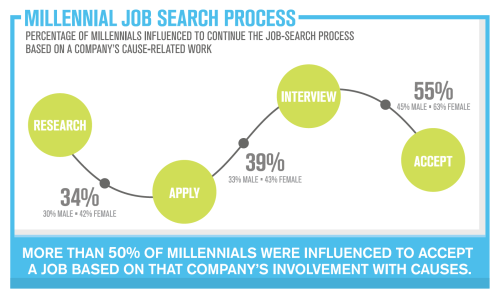
As I’ve discussed in previous posts, Millennials place a high value on corporate social responsibility. Achieve’s research looks specifically at the role “cause work” plays in motivating Millennials overall – from job search, application, through to employment. Consider that of the Millennial employees surveyed, 92% felt they were actively contributing to a company having a positive effect on the world. Where cause work starts motivating Millennials though, may differ a bit from our assumptions. Of those surveyed, 63% of Millennials said that a company’s involvement with cause work and community initiatives did not factor into the search that resulted in their current job! This contradicts the common assumption that cause work matters from the beginning of a Millennial’s job search. Achieve discovered that, in fact, most Millennials first looked at what a company does, as well as pay and benefits, when deciding whether or not to apply. Cause work was not a significant factor. While only 39% of Millennials reported their company discussed cause work during the interview process, the companies that did do this, influenced interviewee’s decisions. Of the Millennials who heard about cause work in the interview, 55% of them said the company’s involvement with causes helped persuade them to take the job. Bottom line: mention cause work in interviews – especially with Millennial candidates!

Job Search Process

Another trend that I have previously discussed is Millennials’ relationships in the workplace, specifically that Millennials have a tendency to build close friendships and desire to work with those they know and would be friends with outside of work. This desire also presents itself in Millennials’ preferences for company-sponsored volunteer projects/programs. Of the Millennials surveyed, 77% preferred to perform cause work with groups of fellow employees as opposed to doing independent service projects. More specifically, 62% of Millennial employees preferred volunteering and doing cause work with employees in their same department rather than employees in the company they didn’t directly work with.

What Inspires Millenials

For Millennials, relationships also play an important part in informing candidates about a company’s causes. Information from past and current employees was the third most common source for Millennial employees who researched their company’s cause work (36%). The most common source of information was the company’s website (93%), followed by Google Search (61%). These top three sources, including word-of-mouth, beat social media outlets Facebook (22%), LinkedIn (12%) and Twitter (11%).

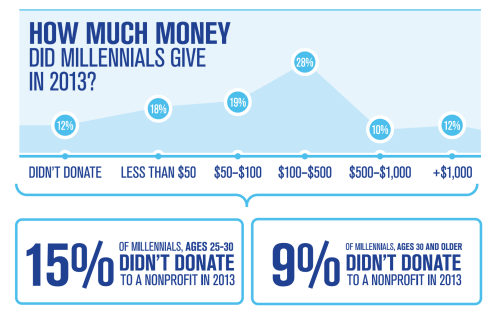
One last interesting area of commentary from Achieve’s report is how Millennials view the assets they can potentially donate. As it’s put in the study: Millennials differ from previous generations in that they “may still give money, time and skills, but they also view their network and voice as two very beneficial assets they can offer a cause. For Millennials, all of these resources are equal in how they may help a cause. A Millennial may see Tweeting about a cause as a way of giving resources, because they are donating their network.” When it comes to giving, Millennial employees donate money to nonprofits both on their own and through their company’s promoted giving campaigns, and they donate generously! Only 13% of the Millennials surveyed did not donate money to nonprofit organizations in 2013.

Donations

This report tells us that Millennials consistently defy employers’ expectations along a broad continuum. We need to pay attention, continue to ask questions, and learn to meet them on their own ground. Who would have thought that company websites and Google searches would be far more powerful (and motivating) than social media in this aspect of job search behavior in the Millennial cohort? And it’s interesting to note that camaraderie in their workgroup – not in their employer in general – is motivating for them. That’s one piece of data that is consistent with what we know about all cohorts in the workplace: we all want to trust our leaders, have pride in our work, and camaraderie within our workgroups. Great Place to Work has been validating these data points for more than 20 years.

3 Comments

Filed under Achievers, China Gorman, Corporate Social Responsibility, Data Point Tuesday, Great Place to Work, Millennials, Workplace Studies

5 Talent Acquisition Trends to Watch

Data Point Tuesday
Ultimate Software
(#20 on this year’s FORTUNE 100 Best Companies to Work for list) just released a whitepaper that looks at 5 top talent acquisition trends in today’s market. As much data as we might see on talent acquisition, it’s a perpetually interesting topic to look at because (and Ultimate Software puts it well), “A company can have the right technology, the right infrastructure, the right products and services – yet still fall short of expectations without the right people.” People are the heart and soul of an organization, and attracting, hiring, and engaging the right people for an organization is vital to its growth and success. Ultimate Software highlights that over the past five years we’ve seen a huge change in the landscape of talent acquisition. We’re still in the midst of an ongoing economic recovery and Millennials, who are the largest generation in history, (~95 million compared with ~78 million Baby Boomers) are currently filling one out of every three positions in the United States. By 2025, they are projected to make up 75% of employees in the global marketplace. Add this to the incredibly competitive, fast-paced, technologically advanced, and increasingly inter-connected world that we live in and hiring the ‘right’ person becomes “both more difficult and more important than ever.”

Out of the 5 Top Talent Acquisition trends that Ultimate Software details, “User Experience” is number one. Over the last five years, companies have increasingly focused on the “candidate experience” in talent acquisition (see the ground breaking research done by Gerry Crispin’s and Elaine Orler’s Talent Board), putting themselves in the job seekers’ shoes with a focus on treating them like a unique individual or “the customer.” When Ultimate Software discusses “User Experience” as a talent acquisition trend though, they’re talking about a more recent trend than focusing on candidate experience, one that emphasizes user experience in terms of designing or selecting a recruiting solution. In the same way that people expect exceptional user-experience from consumer-level technology like their smartphones, employees now expect the same level of ease-of use with recruiting solutions technology in the workplace. Candidates themselves also expect an easy (and mobile) user-experience when searching for and applying to positions. Not being able to do this on a smartphone, for example, has become a huge barrier to entry.

Trends two and three are “Personalization” and “Social Connections and Collaborations.” Personalization, in the context of talent acquisition, is described as “the fusion of a positive user experience with an emphasis on the individual.” Essentially, organizations that treat candidates as individuals and potentially valuable employees from the beginning of the recruiting process have a number of advantages. Using a more personal, behaviorally based interviewing approach can lead to better information for the recruiter (they may for example find a candidates fits well for another role) and a more engaged candidate. It may also help candidates leave with a better impression of the organization overall, and prevent what Ultimate Software calls the “candidate black hole” (referring to the statistic that nearly 50% of job applicants never get any response after submitting an application). “Social Connections and Collaborations” refers to talent acquisition solutions integrating with social media platforms (think LinkedIn and Facebook) to leverage more effectively the vast amount of useful information on candidates that these platforms provide. Note that 89% of all job seekers report using social media sites and almost 50% report using these sites every day.

“Global Recruiting” and “Recruiting Millennials” make up the last two trends in the whitepaper. Successful organizations have embraced the advantages of creating a more global workforce, leveling technology like video interviewing and telecommuting to find the right candidate for the job, no matter where in the world the might be. Ultimate Software cites data from a recent KPMG survey, which reports that 71% of HR executives feel that collaborating across international borders is more prevalent today than just five years ago, and more than 50% are considering or have added new international offices. The “Global Workforce” is here to stay. Last but not least, successful talent acquisition programs have been specifically addressing Millennial candidates applying for positions – a smart move when we consider that they’re projected to make up 75% of the workforce by 2025! This attention on Millennials does not necessarily comprise a total remaking of the talent acquisition process, but a purposeful implementation of changes to the recruiting process – like keeping in mind that 83% of Millennials own a smart phone, or that Millennials place a high value on an organization’s mission, purpose, and culture.

Together these 5 trends point to new realities for organizations as they plan to add new talent to their ranks. It’s not just demographics that are changing. Social technologies are changing our ability to engage and retain the right people – where and when we need them. And that spells big opportunity for organizations who believe that people are at the heart of the cultures and their successes.

6 Comments

Filed under China Gorman, Data Point Tuesday, Hiring, Ultimate Software, Workplace Studies

Purpose: A Hedge Against Organizational Challenges

Data Point Tuesday

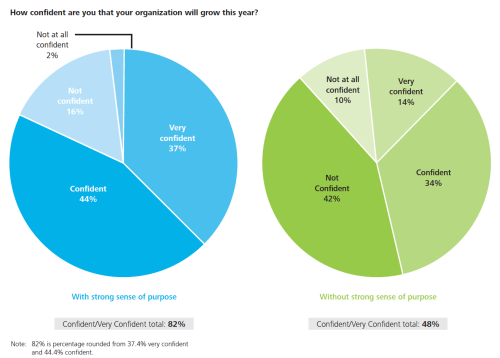
The Deloitte “2014 Core Beliefs and Culture Study” proves it again, that those workplaces who focus on creating a meaningful environment for all their stakeholders (customers, employees, and communities) foster a culture of purpose that builds confidence, drives investment, and “can lead to competitive advantage in a time of economic vitality.” The survey was conducted in February of this year and is designed to explore the concept of workplace culture, defined by a set of timeless core values and beliefs, as a business driver. This year’s survey looks specifically at whether a strong sense of purpose leads to higher levels of confidences among stakeholders and drives business growth. Methodology included the survey of a sample of 1,053 adults (300 executives and 753 employed adults) employed full time within an organization with at least 100 employees.

Evidence from the survey indicates that focusing on purpose rather than profits is what builds business confidence. What do organizations define as purpose though? When respondents were asked about activities that are part of the purpose of their organization, the top 5 cited answers were:

  • Providing business services and/or products that have meaningful impact on clients/customers (89%)
  • Providing business services and/or products that benefit society (84%)
  • Providing employees with education, experience, and/or mentorship benefits (77%)
  • Encouraging employees to volunteer (74%)
  • Generating financial returns for our stakeholders/shareholders (69%)

Deloitte “2014 Core Beliefs and Culture Study”

Deloitte also found that those respondents who agree they work for an organization with a strong sense of purpose were more likely to say their organization recorded positive growth (81% vs. 67%) and outgrew competitors (64% vs. 44%) in 2013. When looking to the future, respondents who say their organizations have a strong sense of purpose are also much more optimistic about the future prospects of their organizations: 91% of respondents who believe their organization has a strong sense of purpose feel that their company will maintain or strengthen its brand reputation and loyalty vs. 49% of respondents at organizations without a strong sense of purpose.

Organizations with a strong sense of purpose tie confidence to three main factors:

  • a commitment to delivering top quality goods/services
  • focus on long term sustainable growth
  • clear understanding of organization’s purpose and commitment to core values.

Companies reporting they do not have a strong purpose however, find confidence tied almost exclusively to financial factors:

2014 Core Beliefs and Culture Study

When looking at priorities of leadership at these companies, we see a similar trend. For organizations that report having a strong sense of purpose, making a positive impact on clients is ranked most often as the top priority for leadership vs. leadership at companies without a strong sense of purpose, who most often report short-term financial goals as their top priority (the study notes that there were no major differences in top leadership priorities as stated by employees and executives).

Purpose also appears to drive investment. Respondents at organizations with a strong sense of purpose are consistently more likely to say their organization will increase investments year over year than companies without a strong sense of purpose, especially in areas such as:

  • New technologies: 38% vs. 19%
  • Expanding into new markets: 31% vs. 21%
  • Developing new products/services: 27% vs. 17%
  • Employee development and training: 25% vs. 11%

Companies with a strong sense of purpose also perceive higher levels of confidence among key stakeholders – 89% of respondents say their clients trust that they deliver the highest quality products and services (vs. 66% at organizations without strong purpose).

If this data isn’t enough to suggest that there really is something to creating a strong sense of purpose and values at an organization, Deloitte’s data also detail that more fully engaged employees, greater diversity, and encouragement of innovation are also more present at organizations reporting a strong sense of purpose. Despite the benefits though, 20% of respondent’s state that leadership fails to set an example for the rest of the organization by truly living the organization’s purpose and 18% say it is not part of performance evaluations.

Once again, the data are persuasive. Organizations with strong missions that are focused on more than profits are clear winners creating successful, sustainable businesses. Put another way, creating a strong purpose-focused culture may be the best hedge against the difficult economic, political and talent challenges facing most organizations today.

1 Comment

Filed under China Gorman, Culture, Data Point Tuesday, Deloitte, Leadership, Workplace Studies