Tag Archives: Data Point Tuesday

Longing for Leadership

Data Point Tuesday
Last week I discussed one of the trends (reskilling HR teams) called out in Deloitte’s annual Global Human Capital Trends Report for 2014. Recently released and influenced by the work of Bersin by Deloitte, the report examines 12 trends that represent the way employees today are driving their organizations to innovate and transform human capital practices. The report, as usual, is full of interesting data on human capital management trends and observations about the impact of those trends. It is definitely worth a read.

This week I’d like to look at another top talent issue facing organizations around the world as identified by Deloitte: leadership. Leadership is cited as the number one talent issue organizations today face, with 86% of respondents surveyed citing leadership as “urgent” or “important”. This is compared with a meager 13% of the same respondents that claim they are doing an excellent job developing leaders at all levels. So of all the trends discussed in Deloitte’s survey, this marks the largest “readiness gap”. Developing the next generation of leaders is urgent, yet very few report meeting the challenge.

When it comes to organizational strategies, most are requiring some significant tweaks due to the increasingly global, tech-savvy, interconnected, and diverse people that are the 21st century workforce, and leadership development is not exempt from this. Organizations are facing challenges such as developing multiple generations of leaders – not just Millennials, developing leaders with high flexibility and global fluency, and ensuring that leaders have the skills to understand and adapt to rapidly changing technologies. Essentially, leadership is taking on a much broader meaning than it did previously, where it may have described simply developing the next CEO or company C-Suite executive.

Looking at responses from executives who participated in Deloitte’s survey paints a clear picture of perceived leadership gaps. 66% reported believing that they are “weak” in their ability to develop Millennial leaders and just 5% rated themselves as “excellent”. Additionally, 51% of executives have little confidence in their ability to maintain clear, consistent, succession programs and just 8% feel they have “excellent” programs to build global skills.
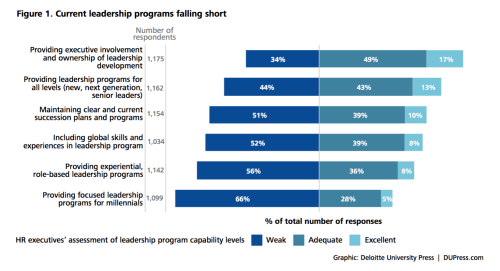
Global Human Capital Trends Report for 2014It becomes clear then that as the global recovery continues to strengthen and organizations start to execute on growth strategies, that these gaps can only be filled by intentional focus and commitment to leadership development and training programs at all levels. Deloitte’s report suggests that companies should start by engaging their own top executives to develop leadership strategies and actively participate in them; refresh previous leadership strategies to link with evolving business goals; and implement a unique leadership program. They recommend that organizations focus on three aspects for developing leaders: developing at all levels, developing global leaders locally, and developing a succession mindset.

If companies want to grow in a global world, they need to grow global leaders. And Deloitte’s research shows clearly that this doesn’t happen accidentally.
Leave a comment

Filed under Bersin, China Gorman, Data Point Tuesday, Deloitte, HR, HR Data, Human Capital, Leadership

Business Leaders Don’t Think HR is Up to Snuff

Data Point Tuesday

Deloitte’s annual Global Human Capital Trends Report for 2014 is out. Influenced by the work of Bersin by Deloitte, it examines 12 trends that represent the way employees today are driving their organizations to innovate and transform human capital practices. The report, “Global Human Capital Trends 2014: Engaging the 21st Century Worker” surveyed 2,532 business and HR leaders in 94 countries around the world over several months, also drawing upon past research on global business challenges in HR, leadership, and talent management. The result of the report is a wealth of data on human capital strategies in the 21st century workplace that can be examined for perspective and insight into our own organizations and strategies. The year’s 12 critical human capital trends were categorized into three broad categories. “Transform and Reinvent” examines the need to reskill HR teams, capitalize on cloud based HR tech, implement HR analytics as a means to achieving business goals, and create a global HR platform that is robust and flexible enough to adapt to local needs.

So. Reskilling HR teams. Really? Why is this a critical trend? According to the report, less than 8% of HR leaders have confidence that their teams have the skills needed to meet the challenge of today’s global environment and consistently deliver innovative programs that drive business impact. Business leaders unfortunately corroborate this statistic, with 42% believing that their HR teams are “underperforming” or “just getting by”. This is compared to the 27% of business professionals who rate HR as excellent or good when assessing HR and talent programs. At a time when CEO’s are reporting human capital strategies as one of the top priorities for growth, it’s important that HR departments have the skills necessary to acquire, develop, and retain top talent as well as engage employees at all levels. And with a workforce that is increasingly global, tech-savvy, highly connected and demanding, HR departments face the challenge of doing all of this with increasingly creative strategies that meet the needs of this 21st century workforce. While such skills are highly necessary, the statistics indicate that HR departments are not as equipped with them as organizations would like.

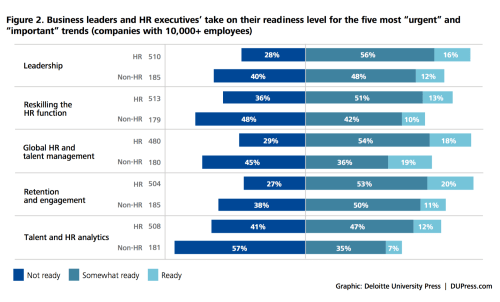
Of further interest, Deloitte’s report discusses how many organizations are reporting seeing a “disruption” of the CHRO role in their organizations. This disruption consists of a refocusing HR as a “business contribution” function with deeper skills in data/analytics as well as MBA-level business capabilities. When it comes to organizations’ readiness to respond to the 12 global human capital trends there is a discrepancy between business professionals’ and HR professionals’ perceptions. For the five most urgent trends identified (leadership, reskilling HR, global HR and talent management, retention and engagement, and talent and HR analytics) business executives report that their companies are less ready to address these issues than HR leaders report. For the issue of reskilling HR, 48% of business respondents reported that HR is “not ready,” compared to 36% of HR respondents.

Deloitte’s report links this perceived lack of HR skills to some basic attributes such as the fact that many organizations do not invest in developing the business skills of their HR teams and to the fact that more than 70 percent of all HR professionals enter the field without a specific degree or certification in business or human resources. Of respondents surveyed from Deloitte’s report, 43% stated that their companies are “weak” when it comes to providing HR with appropriate training and experiences.

While disappointing, data like this are great because they clearly identify perceived areas of weakness and allow organizations to challenge their own programs and strategies for HR, as well as draw conclusions more specific to their organization and strategies for transforming, reinventing, and reskilling the HR team.

The bad news? Business leaders think HR isn’t up to the people challenges of the 21st century. The good news? Now we know and can get to work!

Deloitte Human Capital Trends 2014

3 Comments

Filed under Bersin, China Gorman, Data Point Tuesday, Deloitte, HR, Human Capital

Diversity: No longer just the right thing to do

Data Point Tuesday

A recent study by the Economist Intelligence Unit, sponsored by SAP and SuccessFactors, explores the challenges of managing an increasingly diverse workforce while highlighting the importance of diversity as a strategic business advantage. The global study, Values-based Divesity, surveyed 228 executives responsible for designing and developing their organization’s human resources strategy, where 53% of respondents were very senior – either CEO’s or board members. As the study explains, many diversity initiatives in the last two decades involved a focus on demographic factors, such as gender and race, or “inherent” diversity. Today there is a wider awareness that the diversity focus should also consider values like cultural fluency, global mindset, language skills etc., or “acquired’ diversity. This shifting awareness, represented in EIU’s survey results, appears to represent a wider shift in organizational perception of diversity.

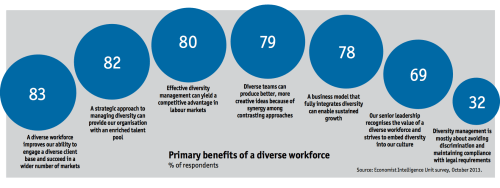
When respondents were asked about the primary benefits of a diverse workforce 83% of executives reported that a diverse workforce improves their firm’s ability to capture and retain a diverse client base; 82% agreed that a strategic approach to managing diversity can help access a rich talent pool; and 80% viewed diversity management as yielding a competitive advantage in labor markets. While the case for diversity has changed over the years, from a social initiative (it’s the right thing to do) to a strategic argument for supporting and creating new innovation, the bottom line remains the same – it’s always been about business success and competitive market advantage. With the increasingly diverse and multigenerational workforce that exists today however, certain organizational strategies will require greater adjustment. According to the EIU study, the top workforce characteristic that will require the greatest change in HR strategies over the next three years (cited by 57% of executives) was a “lack of interest in assimilating organizational values” followed by “conflicting values of a multi-generational workforce” (51%) and thirdly “educational differences among employees” (50%).

Values Based Diversity EIU

Given the strategic benefits of a diverse talent pool cited by executives, what strategies are organizations using to support and engage diverse talent? The top four strategies listed by respondents focused almost exclusively on learning and development: “mentoring of new and high potential employees”, “exposing high potential employees to diverse business situations”, “opportunities for international careers”, and “opportunities for diverse teams to address strategic business challenges”. When asked about the technologies used to manage diverse workforces, 35% of respondents cited human resources information systems (HRIS) as the highest adopted technology, followed by e-learning systems at 31%, and videoconferencing at 25%. Interestingly given the amount of hype and energy around social media, the adoption of enterprise social networks as a means to manage a diverse workforce was low, with only 20% of respondents reporting this as an adopted tool.

The data from this report clearly indicates that executives recognize the importance and benefits of having a diverse workforce, but also recognize that maximizing the potential of a diverse talent pool requires a strategic approach. Whether this approach means augmenting previous diversity initiatives, or developing new strategies altogether, approaches will likely be specific to each organization and the level of understanding and commitment by its leaders. The information does suggest that this will be an area of focus for many organizations now and into the future as the workforce becomes more globally mobile, multi-generational and flexible.

1 Comment

Filed under China Gorman, Data Point Tuesday, Diversity, Economist Intelligence Unit, EIU, SAP, SuccessFactors

Work-Life Balance is a Myth

Data Point Tuesday
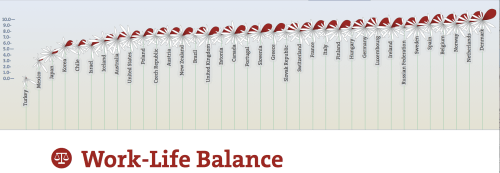
According to the 2013 Better Life Index by OECD (the Organization for Economic Co-Operation and Development) we’re still fighting the battle to find balance between work and our personal lives. Out of the 36 countries ranked on the 2013 Better Life Index the United States came in at 28 for work-life balance, behind almost all the countries in Europe as well as Brazil, New Zealand, and Canada. Australia fell just behind the U.S at 29. The top three countries for work like balance were Denmark at #1, the Netherlands at #2, and Norway at #3. What’s the reason for the U.S ranking so poorly when it came to work-life balance? Perhaps the most obvious factor is one we are probably very familiar with hearing about – American’s work long hours! According to the Index, 11.13% of employees work “very long hours” each week, or fifty plus hours on average. This percentage has held fairly steady since 2004 save a minute decrease (the study ranks the average annual increase since 2004 at -0.4%). For comparison purposes, approximately 9.7% of people in all other countries reported working “very long hours” and in Denmark the percentage of employees working very long hours each week was only 1.97%.

There are other influencers to the United States’ ranking when it comes to work-life balance. Gender roles still heavily influence the distribution of tasks within the family, with women spending an average of 4.3 hours a day on domestic work where men spend only 2.2 hours a day. Additionally, Americans devote less time to leisure and personal care than the OECD average; likely due to the simple fact that the more people work the less time they have to spend on other activities. Sadly, the U.S is the only OECD country without a national paid parental leave policy. The study explains that though total public spending on child welfare and education in the U.S is above the OECD average, most of this money is spent later in a child’s life (on public compulsory education). This reflects that early investment in childcare and support for families during and after pregnancy could have a greater focus. Though increasing parental leave policies would raise employers’ costs, evidence shows that women who take the full leave they are offered are more likely to return to work than women who do not, an incentive for employers to increase leave policies. OECD reports that female employment in the U.S has been falling over the last decade, despite the U.S having better career opportunities for women than most other OECD countries.

Overall, compared to most other countries on the 2013 Better Life Index, Americans work longer hours, spend less time on leisure and personal care, and take less vacation days. How’s that working for your business? How’s that working for you?

Work Life Balance

1 Comment

Filed under Better Life Index, China Gorman, Data Point Tuesday, Organization for Economic Co-Operation and Development, Work Life Balance, Workflex

Show Some Workplace Volunteering Love!

Data Point Tuesday

Many companies have health and wellness programs in place for employees, whether it be through cash based wellness-incentives or physical programs like exercise classes, challenges, or health seminars, and this trend is on the rise. According to a 2013 report from Fidelity and the National Business Group on Health, 86% of employers offered wellness-based incentives to employees in 2013, a figure up 29% from 2009. It’s hugely positive that companies are emphasizing a focus on employee health and wellness, and what’s even better news? It’s likely many businesses have programs in place that they may not even know serve to keep their employees healthy!

Volunteering is one such program. A recent study by UnitedHealth Group examines the benefits of volunteering on an individual’s health, and the result? Doing good is good for you. The 2013 survey involved a representative sample of adults across the country, the young, old, in good health and in poor health and recorded that people who volunteer feel better physically, mentally, and emotionally. Out of those surveyed who had volunteered in the last 12 months, 94% of people reported that volunteering improves their mood, 76% stated that volunteering has made them feel healthier, and 78% said that volunteering lowers their stress levels. Additionally, volunteers are more likely than U.S. adults overall to report that they felt calm and peaceful most of the time, and that they had a lot more energy most of the time, over the past four weeks.

Employers should be able to directly see the value of employees’ volunteering, and by virtue of that, reap the benefits of having healthier employees. Healthier employees reduce health care costs, and less stressed employees are likely to be more engaged and productive. With this in mind, businesses that support volunteering programs in their workplace are likely to experience even deeper benefits than organizations with employees who volunteer solely on their own prerogative. UnitedHealth Group reports that four out of five employed people who volunteered through their workplace in the past 12 months felt better about their employer because of the employer’s involvement in volunteer activities. 81% agreed that volunteering together (as a workplace) has strengthened relationships and collaboration among colleagues.

In the end, when it comes to health and wellness it may be true that nothing beats the basics of healthy eating and exercise. However, research shows us that there sure are many additional things we can do in our lives to promote healthy living, such as volunteering. Consider that non-profit you’ve donated to, or find one that does work you admire; do they have a volunteer day you could check out? And if you’re an employer looking to add some edge to the health and wellness programs in your company, consider showing some love to workplace volunteering programs!

2 Comments

Filed under China Gorman, Data Point Tuesday

Good News From Your L&D Department!

Data Point Tuesday

A 2014 report from Bersin by Deloitte, “The Corporate Learning Factbook 2014: Benchmarks, Trends, and Analysis of the U.S. Training Market” relays some positive information regarding investment in employee development. Businesses increased training budgets by an average of 15% last year, reflecting the highest growth rate in this area in the last seven years, and also likely that as the economy continues to mend, organizations are able to reinvest in areas that experienced significant cost cutting during the downturn. At a time when there is discussion of a lack of specified skills in the talent pool, this would appear to be welcome news, particularly because this investment applies not only to short term training. For mature organizations this training budget involves identifying capability gaps now and into the future and combats them by developing a “supply chain” of skills to fill gaps in the long term.Bersin by Deloitte

How much are organizations spending on these increased L&D budgets? On average in 2013, businesses across the United States spent $1,169 per learner. This amount varies by company size and industry, with tech firms leading the pack in terms of amount invested per learner (spending an average of $1,847). As far as which areas of training and development organizations are focusing their increased budgets on, leadership development takes the largest share, with 35 cents on average of each training dollar going to leadership development at all levels. This certainly suggests this is an important strategic investment for companies in the coming year. As the study reports, “more than 60% of all companies cite leadership gaps as their top business challenge”.

Spending on L&D initiatives is likely to be higher for organizations with a more “mature” L&D function. Those ranked at either 3 or 4 on Bersin by Deloitte’s maturity model spent an average of 37% more on training and development than the least mature organizations. Here at Great Place to Work, we can certainly attest to the fact that organizations on the FORTUNE 100 Best Companies to Work For list invest significantly in training and development programs. In 2013, companies on the list offered 66.5 hours of training annually for salaried employees and 53 hours of training for hourly employees, with close to 70% of those hours devoted to employees’ current roles and nearly 40% focused on growth and development. Though they display impressive training and development programs, many of these Best Companies cited employee development as remaining an area of focus, with 3 key areas highlighted: Leadership Development (reflecting the data from Bersin by Deloitte), Career Road-mapping, and Diversity Development.

This investment trend is good news for employers and employees alike. Employers will have greater inventories of skills in-house and may not have to turn to the marketplace as often – or expensively – in coming years to support basic business operations. Additionally, by providing skills development to younger workers who are arriving with significant skills deficits, employers may be staunching the early talent drain from their organizations. And employees of all ages continue to need growing support to expand their knowledge and skill bases as the world of work continues to evolve and certain skills het harder and harder to find.

But the opportunity to develop management and leadership skills may be the most valuable investment for both sides of the employee-management relationship. It prepares the next generation of organizational leaders, it communicates a commitment to employees’ futures and it strengthens the ties between these two sides of the employment equation. That high performing employers are spending 40% of corporate learning dollars on their future leadership talent would be a compelling component of any employer’s employee value proposition.

2 Comments

Filed under Bersin, China Gorman, Data Point Tuesday, Deloitte, Great Place to Work, Leadership, Learning/Development, Skills Gap, Talent development

HR and Sustainability: Where’s the Beef?

Data Point Tuesday
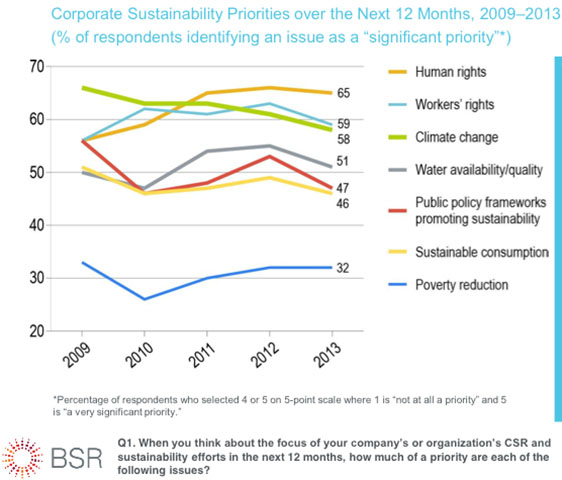
According to results from an annual sustainability survey by BSR and GlobeScan “State of Sustainable Business Survey 2013” which provides insights into the world of sustainable business and tracks the successes and challenges faced by corporate sustainability professionals, HR is one of the least engaged corporate functions when it comes to sustainability. Respondents of the survey ranked HR as 34% engaged when it came to their companies’ CSR and sustainability commitments in 2013. This is a 3% drop in engagement levels since 2011. However, HR is not the only corporate function recording low engagement when it comes to sustainability. Finance ranked the lowest in levels of engagement with sustainability activities, with product development, R&D, strategic planning and marketing not far behind. Respondents overall ranked marketing as only 28% engaged when it came to sustainability initiatives at their organizations and this engagement level has dropped 14% since 2011. External facing corporate functions, like corporate communications, public affairs, and the CEO’s office showed high levels of engagement with sustainability (corporate communications ranked highest in engagement levels at 77%).

It’s potentially concerning however that departments like HR and marketing, which have important relationships with both internal and external stakeholders, are showing such low levels of engagement with sustainability initiatives. Why are we not seeing higher engagement with these corporate functions?

At a time when many organizations are placing greater emphasis on their role as a socially conscious company, we find many highly successful companies leading by example. Despite the obvious reasons for shining a light on sustainability practices like showing strong ethics and helping others/the planet, there are other incentives to highlighting such practices. Reports show that young workers more often choose employers that are socially conscious and align with their own values. Additionally, we’re seeing more and more successful companies “going green” and injecting sustainability deeply into their business strategy, using it to create value for their employees and customers. Given that today’s job seekers are looking for their work to provide them with a sense of meaning, it would seem only logical for HR to engage more completely with such initiatives – and perhaps even take the lead. But this does not appear to be the case.

BSR/GlobeScan report that only one in five companies has fully integrated sustainability into business strategy and practices, and from this data it appears that company-wide collaboration on sustainability is still the exception rather than the norm. When asked about the most important leadership challenge of business today, 62% of respondents cited the integration of sustainability into core business functions. This is a significantly higher percentage than the next leading answer, “convincing investors that sustainability enhances value’” at only 28%. Climate change and public policy frameworks promoting sustainability were ranked highest when asked what sustainability issues need collaboration the most. Consider the sustainability/social initiatives at your organization. Is there a collaborative engagement in these practices across all departments? Or do only the most external facing functions show high levels of engagement? And where is HR in the discussion at your organization? Leading? Participating? Or waiting for another function to step up?

BSR Chart

1 Comment

Filed under BSR, China Gorman, Data Point Tuesday, GlobeScan

Failure to prepare…

Data Point Tuesday


…is preparing to fail. – John Wooden, legendary NBA player and UCLA Head Coach

We constantly see media coverage discussing the business world’s negative perceptions of younger workers. At times it seems like an unfair piling on for a generation that’s been bombarded with negative labels like entitled, unwilling to pay their dues, and unprepared. The good news is that much of the coverage is now discussing the reasons why such labels persist based on research, analysis and facts rather than a common starting point of “…when I was starting out…”

In a study released last Tuesday by Bentley University and KRC Research, which examined the preparedness of Millennial workers by surveying over 3,000 business decision-makers, corporate recruiters, young workers, students, parents and higher education influentials, 51% of business professionals who participated stated that their companies tend not to invest in young workers’ development because of the perception that they are likely to leave the job soon and aren’t worth the investment. This is a startling example of one of the perceptions perpetuating negative views of Millennial workers:  they are short-timers. It’s a real Catch-22 – it’s hard for a business to invest in the skill development of employees they believe to be short-timers. Where’s the ROI in that investment? But thinking through to the next question, “what can we do to increase the likelihood of retaining this cohort?” is occurring more and more. Orlando Barone, from the Wharton School of Business, is quoted in the study as believing that Millennials “perceive themselves as more loyal to their values than to a particular company…” And this gets to the heart of the Millennials vs. the Business World grudge match that many observe.

If, as in great workplaces all over the world, an organization’s values were in sync with the values of all of its employees, investment in skill development would be a no brainer because it would be ensuring the longer tenure of its entire workforce – not just its Millennials. It would be an investment in the bottom line as measured by lower turnover costs, lower talent acquisition costs, greater innovation and higher productivity.

Bentley University and KRC ResearchThe Bentley study shows clearly that business shares the accountability for lower retention of Millennials. However, this is not to say that everything we hear about young workers is unfounded. After all, the consensus from Bentley University’s study (as observed by both business professionals and Millennials themselves), is that Millennial workers are less prepared than other generations to enter the workforce. However, this unpreparedness is not necessarily due to a broad lack of passion, feeling of entitlement, or poor work ethic of the younger generation as many assume. This quote from the study sums up the idea well: “Despite the view of Millennials as the “it’s not my fault” generation, nearly four in ten grade their own personal preparedness as a “C” or lower”.  It comes down to a mutual shouldering of blame for why young workers are unprepared. While recent college graduates admit that unpreparedness is a problem among their own cohort, 49% of higher education influentials give colleges and universities a “C” or lower on how well they are preparing recent college graduates for their first jobs and 51% of business decision-makers give the business community a “C” or lower on how well they are preparing students for their first jobs. So everyone involved believes that many young people entering the economy for the first time are unprepared for success and unprepared to make a contribution.

A surprising outcome of this study is that 35% of business leaders give recent college graduates that they have hired a “C” or lower in being prepared for the job. Businesses are clearly not be connecting the dots as the study also reveals that 51% of business professionals are not investing in the development of young workers. Knowingly (one would assume) hiring an unprepared young worker and then knowingly (again) not investing in their development seems like missing the obvious to me. And pretty simple to solve: if you hire unprepared workers you have to be prepared to provide opportunities to ensure their preparedness or they will be gone in the business equivalent of sixty seconds.

The bottom line is this:  we must hop off the label bandwagon and jump on the training train. Millennials are faced with a different set of challenges than earlier generations as they enter the workforce, but current judgments of their work ethic or values are shortsighted and misinformed bases for non-investment in their development once they arrive in our organizations. It’s long past time for all stakeholders (higher education influential, business leaders and decision makers, students and their parents) to remedy the problem of unpreparedness vs. being a catalyst for it. Business leaders in particular can step up and begin to deliver development programs that will result in young employees who are more productive and more aligned. And if you’re worried about young workers “jumping ship” remind yourself that investment in their development could be just what they’re looking for to stick with you for the long haul.

3 Comments

Filed under Bentley University, China Gorman, Data Point Tuesday, Millennials

Job Seekers: Look to Best Companies!

data point tuesday
I discussed a few posts ago how companies on the FORTUNE 100 Best Companies to Work For list are experiencing huge amounts of growth in headcount. That post focused on how these outstanding workplaces are combating growing pains and dealing with rapid expansion. Being ranked one of the best workplace cultures in the US certainly helps feed the cycle of growth, as job seekers apply in droves.

The good news for job seekers? The Best companies are hiring and they are hiring a lot! FORTUNE reports that at least 24 companies on this year’s 100 Best Companies to Work For list are planning to fill at least 1,000 (and for some, even more!) jobs in the coming year. From big tech companies like Google (ranked #1), Intel, and Cisco, to medical organizations like Houston Methodist, retail stores like Nordstrom, and markets like Whole Foods and Wegmans, the “we’re hiring” sign is posted out front.

What are these companies looking for in a new hire, and who is getting hired? At Great Place to Work, the research and analysis firm that produces the lists, we’ve pulled together some hiring statistics from this year’s Best Companies to provide a little perspective.  The 100 Best Companies last year filled 6,297 positions, on average, for both new and already existing positions. The average number of these positions filled internally was nearly 30%. The average number of new hires referred by current employees was 28%. This corroborates what we already assume, that internal referrals add significant weight to applications, so before all else, reach out to potential contacts! There can be big benefits for the person referring you as well, so don’t automatically assume people might view it as a hassle. The average maximum bonus paid for a single referral at best companies in the last 12 months was $3,595!

How to impress in an interview? According to recruiters from best companies that are hiring (via FORTUNE), top ways to impress include: being able to articulate your alignment with the company’s mission and values (and explain why they resonate with you), doing exceptional “homework” and truly understanding the business and key competitors going into an interview, being able to discuss how you plan to impact the company, and demonstrating passion, curiosity, and (a big one!) innovation.

For new college grads the numbers may seem a bit less optimistic, out of the average new hires in the last year (6,297) the average number of new graduates hired was 496, and the average percent of positions filled by college students at this year’s best companies is 9.9%. However, this shouldn’t discourage new graduates from applying, as they are automatically equipped with several highly valued skills beyond a basic degree. Examples I’ve touched on in previous blogs include that college students and Millennials are more likely to be passionate about social responsibility and attuned with an organization’s mission and values, be highly aware of technology and social media and able to quickly assimilate with a company’s use of such tools. No matter who you are, however, if you are looking to find a new job consider these stats, and check out this year’s FORTUNE 100 Best Companies to Work For list– you may be very glad you did.

Best Companies Hiring

1 Comment

Filed under 100 Best Companies to Work For, China Gorman, Data Point Tuesday, FORTUNE Magazine, Great Place to Work, Great Place to Work Institute, Hiring, Millennials

Empowering Business Leaders as Talent Leaders

Data Point Tuesday
A new research brief by Aberdeen Group looking at Human Capital Management trends for 2014 highlights that talent acquisition, specifically the scarcity of talent available in the external marketplace, is the biggest driver of HCM strategy today. In 2013 we saw a lot of discussion around talent acquisition (in another report by Aberdeen shortages of key skills were cited as a top challenge by 64% of respondents, up 55% from 2011) and as the economy continues to recover in 2014 it appears this trend will continue. What are organizations doing to combat this? According to the report, the most commonly cited strategy by respondents involved developing front-line business leaders as talent leaders to create a vital connection between talent strategy and business execution. The reasoning plays out in a connect-the-dots, A to B, the knee-bone’s connected to the hip-bone, fashion. If employees with the greatest ability to see both business needs and the skills/capabilities of the talent on the ground (front-line leaders) are empowered as talent leaders, it ensures communication between HR and business leaders around talent initiatives and increases the chance of identifying gaps in business strategy.

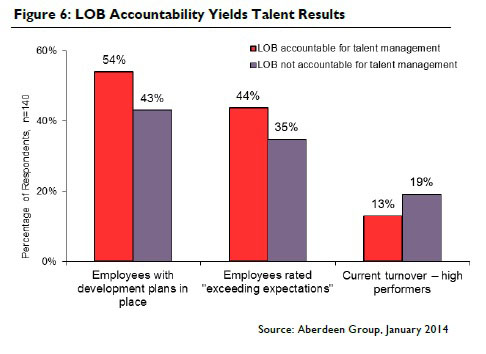
There’s data to back up this strategy. A study conducted by Aberdeen last year found that top-performing organizations were 73% more likely than all other organizations to have dedicated learning programs for front-line leaders and committed 40% more of their training time to leadership skills. As the brief points out though, for the strategy to succeed it is important front-line leaders are given the necessary support and tools to handle talent processes as well as day-to-day business goals. Technology and automated performance tools provide a plausible solution to this concern, offering greater efficiency to workforce processes. Currently, 56% of organizations report that line of business leaders are accountable for talent management initiatives such as hiring, developing, and performance management within their teams. As you can see in the below graphic, this accountability pays off, increasing businesses likelihood of having employee development plans in place, offering a higher number of employees that exceed performance expectations, and seeing greater retention of high performers (which is especially important at a time when talent scarcity is a top concern).

Accountability Yields Talent Results

1 Comment

Filed under Aberdeen Group, China Gorman, Data Point Tuesday, Human Capital, Talent Acquisition