Monthly Archives: September 2012

The Language of Business

Visier, named one of the “2012 Awesome New Technologies for HR” by Bill Kutik, the founding conference co-chair of the upcoming HR Technology Conference in Chicago, is changing the face of HR analytics.  And by changing the face, I mean, putting a beautiful, incredibly interactive and astonishingly useful face on the workforce data collected by the many and disparate systems inside organizations.

All vendors in the HCM space commission research and surveys by credible third party organizations and write what they hope are useful white papers to ensure an educated prospect and customer base.  These white papers, while clearly biased, have some powerful data and insights that any HR practitioner – generalist, specialist or leader – can use to educate themselves.  Trolling through the Resources tabs of HCM solutions providers when you have some downtime can be worthwhile.

As I was browsing through the white papers at the Visier site, I came upon some great stuff.  Since Visier is in the workforce analytics business the subject matter is all tied to workforce analytics.  And they’ve got some great survey and research data for you.  But in this survey report, 2012 Survey of Employers:  Workforce Analytics Practices, Preferences & Plans, tucked in at the very end, was a chart showing what more than 150 U.S.-based employers (presumably through the voice of HR professionals taking the survey) thought their top workforce concerns were for 2012:
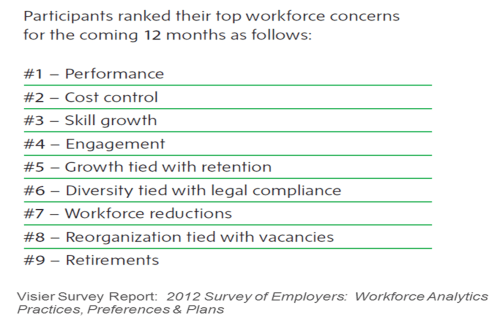
This is the first survey that I’ve read in which performance was ranked as the top workforce concern of HR professionals.  These top concerns lists are everywhere and none of them rank performance at the top.

  • Llloyd’s annual Risk Index (most recent 2011) lists Talent and Skills Shortages as Risk #2 (Loss of Customers is Risk #1)
  • Deloitte’s 2012 Human Capital Trends lists Growth as #1
  • The HR Policy Association (most recent list is 2011) lists Executive Development and Succession at the top of CHRO concerns
  • The WFPMA &  Boston Consulting Group survey (most recent is 2010) of global HR leaders lists Managing Talent as the most critical global HR issue
  • Human Resource Executive’s annual “What’s Keeping You Up Now” survey (most recent is September 2011) lists “Ensuring employees remain engaged and productive” as #1 (note that the 4th concern in the Visier survey was engagement.  Performance and engagement are not the same thing.)

I’m happy to see a survey of HR professionals identifying workforce performance as their top concern because performance is about business.  Performance is quantifiable.  Performance isn’t touchy feely.  Performance is not the language of professionals who chose HR because they “like to work with people.”  Performance is the language of professionals who are comfortable with measurements, analytics, data, accountability, business success.  In short, performance is the language of business people.  And I cheer when HR people speak the language of business rather than the language of HR.

Leave a comment

Filed under Analytics, Business Language, Business Success, China Gorman, HR Analytics, HR Conferences, HR Technology, Performance, Visier

Hiring is Broken

SmartRecruiters, a two-year old recruitment platform for social enterprises, published the findings of a survey of 1,100 online adults on today’s hiring process.

The findings are:

a)      Fascinating

b)      Not terribly surprising if you’re paying attention

c)       The stuff of nightmares

d)      All of the above

If you chose “d” you are correct.  Here’s the data:

  • Finding the right candidate takes too long:  55% of respondents involved in hiring at their company reported that filling a vacant position typically takes longer than 60 days, and 43% reported that open positions aren’t filled within their required timeframe
  • Employers settle for good enough:  almost half of respondents involved in hiring report settling for a candidate that was just “good enough” because finding the right candidate took too long
  • Most people are unhappy with hiring:  more than 60% of respondents, job-seekers and employers said that their experience with the hiring process has been less than positive
  • Inefficient hiring impacts more than HR:  70% of people surveyed indicated that their company includes at least three employees in each hiring decision
  • Candidates give up before applying:  almost half – 46% — of respondents have chosen not to apply for a job they are interested in due to an application process that was “too lengthy or complicated”
  • Candidates expect a more mobile, more social experience:  nearly half – 47% — of people surveyed said they would be more likely to apply for a job if they could apply with their online social profile (such as LinkedIn or Facebook) rather than with a resume and cover letter, and 57% would be interested in applying from their mobile device if that option existed

This is one of those areas of talent management — like performance management — where everyone, all the stakeholders, knows that the current systems don’t work.  And they don’t work with a vengeance.  But getting it to the top of the “to do” list for action never seems to happen.

With more than 15 million Americans looking for work (and another several million who have given up), taking more than 60 days to fill positions seems ludicrous.

With more than 15 million Americans looking for work (and another several million who have given up), employers settling for good enough because their systems are cumbersome and selection is hard and there are lots of candidates shortchanges the business and ensures a workforce that won’t deliver on the organization’s goals and strategies.

With more than 15 million Americans looking for work (and another several million who have given up), having more than 60% of the processes’ participants report a less than positive experience means we’re demotivating all the stakeholders to do this well.

With more than 15 million Americans looking for work (and another several million who have given up), involving 3 or more people in the hiring process might not be such a bad idea.  But when it takes months to arrange interviews instead of hours we’re missing the most valuable talent.  Guaranteed.

With more than 15 million Americans looking for work (and another several million who have given up), using processes that dis-incent participation – even when there’s a job at the other end – shows that we don’t value the candidate pool or the candidate experience.  No matter how much we bemoan the lack of talent that meets our needs (see my posts here and here), using systems that intimidate, confuse and scare applicants is simply crazy.

With more than 15 million Americans looking for work (and another several million who have given up), using pre-existing data like profiles on LinkedIn and Facebook can only improve the efficiency of the process.

And it’s not that recruiters aren’t working hard.  And it’s not that job seekers aren’t doing their best to connect and market their abilities. It’s that we haven’t prioritized this as a “must fix.”  Leveraging technology to match supply and demand is a no-brainer.  And emerging businesses like SmartRecuiters, HireVue, RiseSmart, Pinstripe, Acertiv, Achievers – and all the other innovative tech-based solutions out there – have elegant, easy-to-use, cost effective applications that can start to solve these issues.  And start to solve them NOW!

So yeah: hiring is broken.  And yeah, fixing it could be really easy.

The real question is:  why haven’t we moved hiring to the top of the to-do list?  Hiring will continue to be the stuff of nightmares until we decide to fix it.  It might be that simple.

8 Comments

Filed under Annual Performance Reviews, Candidate Experience, China Gorman, Hiring, Hiring Difficulty, Performance Management, SmartRecruiters, Talent Acquisition

Best-in-Class Engagement Metrics

The Aberdeen Group just published a fascinating report, The Rules of Employee Engagement:  Communicating, Collaborating and Aligning with the Business, that looks at what best-in-class organizations are doing about engagement and why they’re doing it.  Author Madeline Laurano takes a pretty deep dive into the subject and her analysis reveals some pretty intriguing conclusions.  What hooked me from the start were the three metrics for performance criteria to distinguish best-in-class companies for employee engagement:

  • 71% of employees exceeded performance expectations, compared to 14% of Laggard organizations
  • 85% of 1st choice candidates accepted an offer, compared to 8% of Laggards
  • 72% of employees rated themselves highly engaged, compared to 9% of employees of Laggard organizations

Most of the statistics we see about the value of engagement focus on tying engagement scores to financial outcomes.  No question:  we need that.  Data about the outcomes of engagement are helpful in building business cases for investing in the employee experience.

But tying other types of outcomes to higher engagement scores can also be helpful – like the number of 1st choice candidates accepting employment offers.  If a talent shortage truly is the number 1 concern of CEOs and their boards around the world, as the latest Lloyd’s Risk Survey suggests, then strategies that effectively raise the likelihood of securing the top talent you go after should be of interest. And it makes sense that A+ talent likes to affiliate with other A+ talent.

And connecting the dots between engagement outcomes and high levels of individual employee performance also makes sense.  I’ve long wondered at the value of trumpeting the engagement scores of every employee — when we all know that it’s the most effective employees’ opinions we care most about.  Linking employee performance and engagement scores makes a great deal of sense to me.

Take a look at the report.  I think you’ll find the data extremely useful.

2 Comments

Filed under Business Case, Business Success, China Gorman, Connecting Dots, Economist Intelligence Unit, Engagement, HR, HR Data, Lloyd's, Performance Feedback

HR Stakeholders

I was doing some research for a keynote speech I’ll be giving and I took another look at the SHRM Foundation’s Effective Practice Guideline on CSR.  I wrote about it here, and was reading it again, thinking “Gee this is great stuff.”  (Stuff, being a highly technical term that data geeks use a lot.)

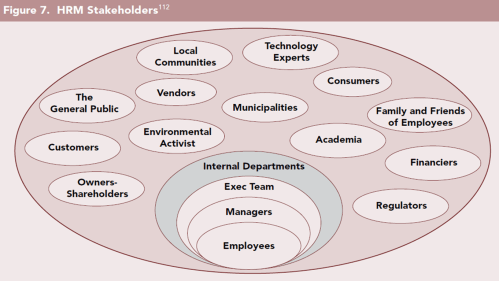
I came across this graphic of the stakeholders HR professionals need to connect with when designing and promoting CSR approaches and programs within their organizations.   As I reviewed it, I thought it was a good reminder of the breadth of the stakeholders that HR needs to factor into all of its work – whether it’s CSR, talent acquisition, talent management, benefits administration, strategic planning, learning and development – or yes, even the planning of the annual company picnic.

As I looked over the graphic, the only missing stakeholder group that I noted was the Board of Directors – but I’m pretty sure the authors include them the Owners-Shareholders group.  With the growing regulation of business and the focus on board oversight, I’d call them out as a separate group.  What do you think? Would you add any other distinct groups?

7 Comments

Filed under China Gorman, Corporate Social Responsibility, CSR, HR, HR Data, HR Stakeholders, SHRM Foundation