
Monthly Archives: October 2013

The Love Hate Relationship: Technology and Work/Life Balance

data point tuesday_500

Does technology really help us in our endeavor for work/life balance? This is not a new question, but it remains an open one – if you believe that there is such a thing as work/life balance. I’ve always had a problem with this description and it drives me nuts. The issue is to what degree does work define your life, drive your life, and how do you make choices to live a full life – not a life just filled with work.

But all that aside, my initial response would be that technology aids us in our quest for a balanced life “A LOT” for the idea of working without the convenience of modern technology is certainly painful to contemplate. I would argue, however, that while we all shudder to think of life without remote access, the true relationship between technology and work/life balance may not be as simple as we think. Though helpful, the use of technology provides no automatic guarantee of a more balanced work and personal life, and we would be remiss if we didn’t remind ourselves of this from time to time. I found myself reflecting on this while reading the results of a 2013 global research study conducted by Accenture.

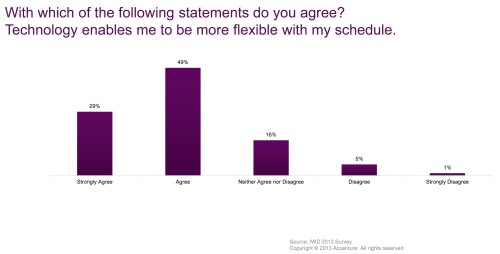
Accenture conducted an online survey to 4,100 business executives from medium to large organizations across 33 countries in order to gain insight on behaviors and attitudes towards women’s careers. One series of results stated “78% of respondents agreed that technology enables them to be more flexible with their schedules.” However, “70% of respondents also agreed that technology brings work into their personal lives.” These two sentiments seem to be in diametric opposition to each other. So what’s the bottom line here? Is technology really helping us balance our work and our personal lives? These results would lead me to argue that I’m not the only one still feeling quite conflicted.
Color_Top_16-9_02_2012

The ability to have a flexible schedule because of the technology at our finger-tips provides a great resource for better balancing work and our personal lives. However, at the very same time these statistics point out that technology’s influence on flexibility can just as easily undermine our quest for life balance as it can help it. This is valuable information. It informs us that to capture the positive benefits of technology on work/life balance we much be proactive in our use of technology, set boundaries around our use, and be aware of what this use entails. Just as we seek to be informed consumers, we must be informed users, and recognize that for technology to help and not hurt our endeavors for life balance we must set personal boundaries in our use. Perhaps this means asking ourselves some “when, what, where, and why” questions about our use of technology. Or maybe this means creating accountability by telling a family member that we will only check email for a certain amount of time while on vacation. There are many options; it’s just a matter of finding one that works for you.

These diametrically opposing statistics also allow us to question the very definition of work/life “balance”. If technology helps us balance life and work as much as it hurts us balance them, I find myself wondering if there was really much “balancing” going on in the first place? Perhaps it’s antiquated to think of work and our personal lives as two separate things we can place on a scale. Instead we could look to these statistics as a clue that true work/life “balance” is not something we can objectively measure on a scale, but the feeling of “having it all” that comes from leveraging the people, places and things in our lives (like technology) to create a sense of harmony.

We’ve all read the articles; we’ve heard the debates about whether technology hurts us, helps us, is “good” or “bad” and we know that technology and the ensuing ability to work from anywhere has probably left traditional “office walls” gone for good. Ultimately though, the question of whether or not technology helps or hurts our search for life balance can only be answered on an individual basis, and it is our individual use and personal choices that will determine whether or  not technology helps us balance our work and personal lives, or if it tips the proverbial scale.

Tell me in the comments section what your take is on the technology and work/life balance relationship!

Leave a comment

Filed under Accenture, Balance, China Gorman, Workflex

The Big Reveal

2013 Best

Everyone wants to work at a great place, and today, they’ll find out if they do. Great Place to Work® is counting down the 2013 World’s Best Multinational Workplaces list during a live, online broadcast today for the first time ever. Join me in congratulating the 2013 World’s Best Multinational Workplaces and follow us at 9AM Pacific Time in the GoLive event when we’ll stream live the reveal of the third annual list of the World’s Best Multinational Workplaces.

Several executives from the top 25 companies will join us on set to share their approaches and successfull practices that help them build, sustain and grow the world’s most coveted workplace cultures. These organizations have thousands of people in different countries working across multiple time zones, and yet, their universal commitment to every employee makes them great beyond any border.

It’s no coincidence that great workplaces are also industry leaders across the board. Client satisfaction, ROI and quarterly earnings all start with the people who make it happen. Year after year, companies that see each employee as a whole person ultimately see the most valuable business results. These companies offer internal programs for personal well-being, provide professional development opportunities, and foster transparent communities for the best talent to connect, learn and succeed together.

We are honored to celebrate these companies and their dedication to sustaining healthy work environments for their employees. They help us achieve our mission of creating a better society by having a positive impact on their people and the communities within which they work.

Join us at 9:00 a.m. Pacific Time today, Tuesday, October 22, to find out who made the 2013 list and hear from the best what it takes to become a Great Place to Work®. http://worldsbest.greatplacetowork.net/index.html

Leave a comment

Filed under China Gorman, Culture, Great Place to Work Institute, World's Best Multinational Workplaces

From the Archives: We can’t succeed without Millennials

This was a very popular post from April, 2012. The data is pretty much the same. And it bears repeating.

Managers and supervisors (especially in the Baby Boomer cohort) in almost every type and size of business have been known to lament the lack of loyalty and so-called business savvy in the Millennial generation.

  • “They want to be promoted too fast!”
  • “They don’t want to pay their dues!”
  • “They don’t understand how things work!”
  • “They want too much flexibility!”
  • “When things don’t go their way they quit!”
  • “Why won’t they stay?”

The bottom line is that organizations are finding it challenging to keep Millennials engaged and on the payroll.  In fact, with the average employment tenure of workers in the 20-24 year -old age group at 1.5 years (per the BLS), it’s challenging to keep all our employees engaged and the on the payroll.  (See my previous post on the Quits vs. Layoffs gap.  It might not be what you think!)

Achievers and Experience Inc. fielded their annual survey of graduating college students in January.  The data are eye opening.

Despite what we think we know about them, the vast majority of these about-to-enter-the-workforce Milllennials would really like to stay with their next (in most cases, first) employer for 5 years or longer!  Wait.  What?  Look at the chart below:

47% of the 8,000 college graduating respondents in the Achievers/Experience Inc. survey indicated that they expected to stay with their next employer five years or longer.  Note the language:  expect to stay not would like to stay!  That means when they join our organizations they have every expectation of making a career with us.  They’re not just accepting a job.  They’ve evaluated our EVP (Employer Value Proposition) as a match for the meaning they want to create in their lives through their work.  (Interesting to note that the biggest percentage of respondents expect to stay with their employer for 10+ years!)

So, OK.  This has got to be their youthful exuberance and relative inexperience speaking, right?  Well, I wonder if that really matters.

Employers need these Millennials.  Employers need these Millennials now.  Employers will need these Millennials more every day.  (See my recent post here.)

And employers need them to stay a whole lot longer than 1.5 years!

So what happens between “I expect to stay with my employer for 10 or more years…” and “…after one year with the organization I’m leaving for a better opportunity”?  I think we all know that answer to that question.

We don’t live up to the EVP we sold them.  We don’t engage Millennials the way they tell us they want to be engaged.  Instead, we…

  • make sure they fit into our existing career paths and job descriptions
  • focus on making sure they “pay their dues” – the way we did
  • keep our processes and rules rigid and unbending – and only pretend to listen when they offer up “different” ways of working
  • resist the notion that work can be done with excellence anywhere but in a cubicle
  • make it difficult for Millennials to interact with senior leaders
  • make it difficult for Millennials to collaborate with colleagues
  • designate social responsibility activities a perk instead of a foundational value
  • try to “lure” them to stay with tenure-based plaques and timepieces

These data are a wake-up call for employers.  It’s a message from our talent pipeline that they really do want to engage with us; they believe our employer brand marketing messages; they want to learn and grow with us.

It’s time to listen harder and make sure our employer brand messages aren’t experienced as bait and switch tactics.

I don’t know about you, but I’d hate for the Millennials to have such negative employment experiences at the beginning of their careers that they opt out of organizational life altogether before they’re 30.  We’d really be in a pickle then!

16 Comments

Filed under Achievers, Baby Boomers, Bureau of Labor Statistics, Business Success, China Gorman, Demographics, Employment Data, Engagement, Millennials, Rewards & Recognition, Student Job Search, Talent pipeline, U.S. Department of Labor