Monthly Archives: December 2013

Employee Recognition

Data Point Tuesday

The Gift That Keeps on Giving

Employee recognition is an important form of positive feedback (who doesn’t love being recognized for their efforts after all?!) and a 2013 study by Globoforce gives us even more reason to institute this type of feedback in our organizations. The study examines the growing intersection between recognition and employee performance and has some noteworthy points. Where recognition is concerned, perhaps the most important point made is that recognition directly impacts business results. Out of 708 randomly-selected fully employed persons in the United States (aged 18 or older) who are employed at organizations with a staff size of 500 or more employees,  those who were recognized with values-based recognition reported a positive change in their productivity. Additionally, 49% of respondents who had experienced values-based recognition indicated a positive change in relationships, 43% indicated a positive change in their customer service efforts, and 82% stated that being recognized for efforts at work motivated them in their job.

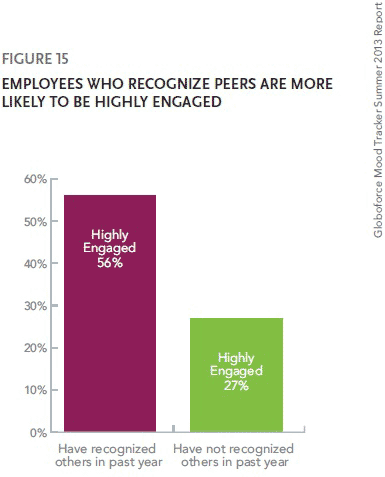
These statistics reinforce the value and importance of recognizing employees, but what I found particularly interesting and a less obvious benefit of employee recognition was how the ability to give vs. receive recognition affected employees. The study found that employees who are empowered to recognize other employees at their organizations were twice as likely to identify themselves as highly engaged; highlighting that value should be placed on allowing employees to give recognition as much as it is placed on making sure employees receive recognition. Another interesting and less obvious result of employee recognition is the link between recognition and alignment with organizational culture and values. Of respondents surveyed, 48% indicated that receiving recognition when they did something right served to align them with their organization’s values and culture. As I discussed in another recent post, employees who feel strongly aligned with company values and mission are more satisfied with and likely to remain at a job, so this relationship between values and employee recognition is a valuable one to explore.
globoforce

Employee recognition can also influence employees’ perception of performance reviews. Globoforce’s study found that 76% of respondents thought recognition data would make reviews better, and 75% of respondents who had been recognized recently stated that they enjoyed their reviews. We can attribute these changes in perception toward reviews to the attributes like engagement and connection with company values, but also to another idea. As the study points out, peer and managerial recognition act as a form of social crowdsourcing, a familiar and comfortable concept for employees who most likely use crowdsourcing programs like Yelp or Amazon regularly. 80% of respondents felt that crowd sourced (manager plus crowd sourced peer feedback) to be more accurate. With employee recognition serving as a form of crowd sourced feedback it makes sense then that employees who were recently recognized felt more comfortable in reviews. But why does it matter if employees enjoy their reviews? The research shows that employees who are satisfied with reviews are more highly engaged, less susceptible to job poaching, and more satisfied with their job.

This data show that creating a system that gives employees feedback from peers as well as from managers – feedback that is values-based – is the gift that keeps on giving. To employee engagement, to higher retention, to financial performance. Who doesn’t want that gift under the tree on Wednesday?

What does employee recognition look like in your organization? Do you have recognition programs in place? Do you encourage employees to recognize others as well as for managers and supervisors to give recognition? Use this data as a catalyst to examine how recognition plays a role in your business. Ramping up the positive feedback could just be the key to a healthy domino effect, creating employees that are more engaged, more productive, more connected to company values, and more satisfied with their reviews.


Leave a comment

Filed under China Gorman, Data Point Tuesday, Employee Engagement, Employee Recognition, Globoforce, Great Place to Work, Great Place to Work Institute

The Trustworthy Leader

Data Point Tuesday
More Mindfulness for the Holiday Season

The holiday season is upon us, and many of us have been relishing the traditional cheer, treats, gifts and parties that accompany this time of year. It’s likely we’ve been reflecting on, and giving thanks for the joy in our lives, our family, friends and loved ones; or maybe we’ve been getting into the holiday spirit by donating to or helping out at our favorite philanthropic organizations. These are effective trustworthy leader practices to embrace during the holidays, and practices that, realistically, we should attempt to embrace year-round! For me, a specific practice comes to mind that we should give some serious extra “oomph” to during the holidays – mindfulness.

While practicing increased mindfulness during the holidays can be helpful for everyone, it’s an especially great practice for business and HR leaders. With so much focus on holiday celebrations and cheer, it can be easy to miss that for some of our colleagues the holidays prove to be the most stressful or difficult time of year. According to statistics from a poll by the American Psychological Association, 69% of people feel increased stress during the holidays from a perceived lack of time, 69% feel increased stress from a perceived lack of money, and 51% of respondents also experienced stress during the holidays from the perceived pressure to buy and give gifts. While financial worry seems an obvious stressor during the holidays, there are other stresses that the holiday season can amplify, such as feelings of loneliness or sadness (especially for those who may not have a strong support system or close-knit family). And during a time of year when we celebrate family and loved ones, it can be particularly difficult for those who have experienced loss.

Keeping this in mind, aim for increased mindfulness and awareness in your workplace this holiday season. Consider checking in with employees more frequently, whether it’s with a phone call, email, or an in-person visit. As we all know, sometimes something as simple as asking “how are you doing?” can brighten a day. Also consider making sure lines of communication are extra clear. It’s important to remember that no matter how someone may appear, we can never assume what is going on in their life. If you’re willing to help or have tools and resources and available for employees in need, make this known.  Reminding employees that their Employee Assistance Programs are easily accessible could encourage those who need support to seek it out. Asking for assistance can be difficult or feel shameful, and knowing that someone is willing to help could mean the difference between obtaining assistance, and suffering in silence.

Though “tis the season,” we’re not necessarily exempt from stress, and the holidays may even be amplifying worry. Perhaps it’s feeling a little anxiety about what the final year-end financial results will look like, or that the 2014 budget isn’t as perfect as we’d like, maybe it’s serious financial stress, or maybe there’s no stress at all. Whatever the case may be, work to be the true trustworthy leader who brings an increased mindfulness to your colleagues, your friends and family, and those around you this holiday season.

2 Comments

Filed under American Psychological Association, China Gorman, Data Point Tuesday, holiday

The B2T Revolution

data point tuesday_500

Employees (And Prospects) Are Consumers When it Comes to HR Technology

Mobile devices and apps are no longer the hot new craze. The B2C (Business-to-Consumer) sectors have taken care of that. Mobile devices have become an essential item for communication and internet access, and as Cisco reports, by the end of this year (in three weeks!) the number of mobile-connected devices will exceed the number of people on earth. By 2017, it’s predicted there will be nearly 1.4 mobile devices per capita. We’re now seeing companies like Lenovo, the world’s largest PC maker, selling more mobile devices than PCs. And as you’re undoubtedly aware, smartphones are a huge part of this mobile device equation. The growth of smart phone usage in 2012 was 81% and has only increased since. We’re using our smartphones for MUCH more than phone-calls though. Downloading applications, checking email, accessing the internet, getting directions, making dinner reservations, paying for purchases and meeting Mr./Ms. Right are just a few examples of ways smart-phones and mobile devices are being used today by people all ages from all walks of life. The bottom line is people are living their lives on mobile. And as long as the product is intuitive, easy to use and fast, the potential for success on mobile devices is huge.

HR Technology applications are no exception. A 2013 Mobile Consumer Report from Nielsen found that 82% of U.S smartphone users browse the web on their smartphone, and 63% use smartphones for social networking sites like LinkedIn, Facebook, and Twitter. According to Talent Management Headquarters, one billion (1,000,000,000) job searches are conducted on mobile devices each month! Mobile recruiting is well on its way to being the next big thing for talent acquisition. This makes sense when we consider that we can use mobile devices during short moments of down time, on a bus or during a lunch break.  As career sites and job postings become increasing mobile friendly, it’s likely that both passive and active job seekers will turn to their mobile devices before they turn to their desktop to hunt for jobs or job search related information.  And mobile recruiting offers organizations the benefit of exposure to job seekers who may not own or be frequent users of computers.

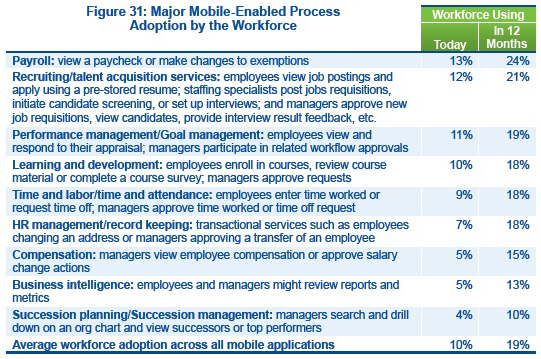
More importantly, with so many employees working from mobile devices, it has become increasingly critical for employers to provide HR information through vendors with easy to use, native mobile apps. Perhaps this is the new focus:  B2T – Business to Talent! Mobile HR applications offer employees (as well as HR managers) instantaneous interaction and engagement with HR Data like payroll and benefits information, recruiting/talent acquisition services, performance/goal management, and time and labor information – even more so than using a laptop or desktop. And in the day and age when all of us are used to instant access when we are living our non-work related lives, having these important processes and data easily accessible are becoming a must-have not a nice-to-have. In 2011, the ADP Research Institute looked at how mobile technology could make HR mobile solutions a game-changer. Respondents reported a significant benefit in using HR mobile solutions, citing improved workforce satisfaction, improved real time decision making, and improved workforce productivity. So the B2T revolution is here.

Mobile technology has revolutionized much in our lives and for HR leaders and employees there is more change to come. User friendly HR applications for mobile devices will prove an effective way to increase efficiency for managers and employees, just as the popularity of job searching on mobile devices will undoubtedly impact how we recruit. Communicating with talent – current and future – via mobile really could be a game changer for employers, employees, job seekers and HR technology providers.

The B2T bottom line:  employees are consumers. And they expect to have consumer-like experiences with the technology and software at work and about work. And if you aren’t providing it for them, they’ll likely use their smartphone to find another employer!

Mobile-Enabled Process Adoption

*This post is part of SilkRoad’s first annual #HRTechTrends Blog Carnival. A recap of all participants will be posted on SilkRoad Ink on December 20, 2013.

1 Comment

Filed under #HRTechTrends, ADP Research Institute, Business to Talent, China Gorman, Data Point Tuesday, HR, HR Technology, Mobile Devices, SilkRoad, Talent Management Headquarters

Bring me a Higher… Purpose!

Data Point Tuesday
The Importance of Connecting Employees to a Clear Corporate Mission

A recent study by Spherion, “The 2013 Emerging Workforce” examines the 2013 workforce and the post-recession resurgence of the “emergent worker mentality” characterized by the study as one which focuses on a free-agency style employment. While the study provides data to support this point it is more than likely we have experienced the validity of this resurgence in our daily lives, perhaps witnessing friends or colleagues job-hopping more frequently, or seeing an increased social conscience in employees and new talent. Whether we’ve confirmed suspicions that our current workforce is driven by a very different set of factors than previous generations or not, insights from this report can help to remind us of the importance of understanding this emergent worker mentality.

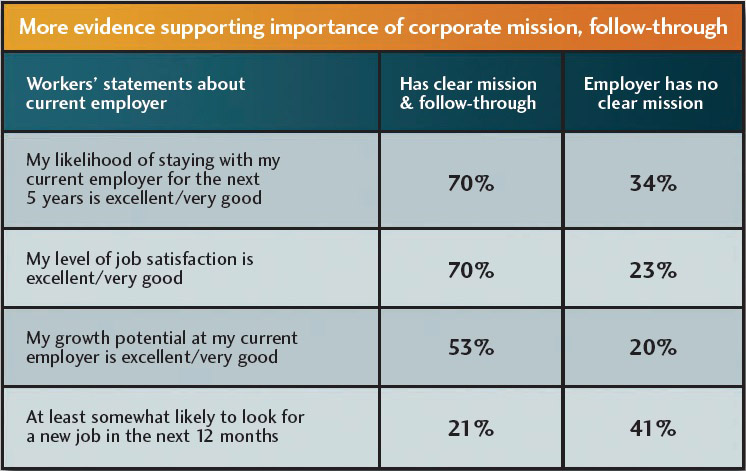
Data supports that connecting employees to an organizations values and greater corporate mission is one of the most influential attributes of job satisfaction for the emergent worker. 70% of respondents from Spherion’s study who worked for a company with “a clear mission and follow through” reported that their level of job satisfaction was very/extremely good , compared to a job satisfaction rate of just 23% for organizations with no clear mission and follow through. As Jake Magleby stated in a blog published by Great Place to Work last month: “Businesses with vision are often more successful than their competitors. This is because people like to support a specific cause or purpose. Business leaders who recognize this can develop a vision for their company that is based on common values and shared goals… This vision for a better world is something that most people not only relate to, but very much want to support. This support translates into a healthy bottom line for the company and a healthier community”.

Data from Spherion’s 2013 Emerging Workforce Study not only confirms that employees at companies with a clear mission are more satisfied with their jobs but are also that they are more likely to stay at their jobs. 70% of respondents at a company with a clear mission and follow through reported that the likelihood they would stay at their current job for the next five years was excellent/very good, and only 21% responded that they were at least somewhat likely to look for a new job in the next 12 months. Additionally, respondents from companies with a clear mission and follow through felt more confident in their growth potential than employees from organizations without a clear mission and follow through. Given these returns, all organizations should consider making their mission and values even more visible and relatable for employees and this has been a top priority for me in my new role at Great Place to Work. Does your company place a premium on mission and values? What actions do you take to connect employees to your mission?

corporate-mission-importance

2 Comments

Filed under Business Success, China Gorman, Data Point Tuesday, Great Place to Work, Great Place to Work Institute, Spherion