Monthly Archives: June 2014

I’m Not Crazy: Let’s Talk About Paternity Leave!

Data Point Tuesday

Perhaps it was the Father’s day celebrations that happened a few weeks back that sparked this week’s blog topic… a subject that stills seems rarely addressed: paternity leave, and workplace policies for new fathers. On the flip side, there are oodles of studies and piles of data on maternity leave and programs/policies for new mothers. While traditional social roles are still very influential and probably the biggest underlying factor for such discrepancies, at a time when working mothers are just as common as working fathers and gender equity is not something to strive for but a necessity in a great workplace, we owe it to ourselves to discuss paternity leave in the same light, and with the same vigor, as maternity leave. A 2014 study by the Boston College Center for Work and Family “THE NEW DAD: Take Your Leave” provides great perspectives on paternity policies at leading organizations, as well as an insightful global look at policies for fathers, incorporating interviews and surveys taken by ~3,000 dads.

When it comes to paid leave for time off directly following the birth of a child (for both women and men), the U.S is an outlier compared to nearly every other developed country in the world, offering no national policy on paid leave. In terms of paternity leave specifically, today there are 70 countries that offer paid leave in either the form of shared parental leave or paternity leave. It was perhaps most interesting to see father’s attitudes towards childcare and paternity leave. The vast majority of fathers surveyed rated their children as their top priority in life, more than 3 out of 4 fathers wished to spend more time with their children than they do presently, and more than 2 out of 3 fathers said caregiving should be a 50/50 proposition and wished to divide this evenly between spouses. When respondents were asked, in considering a new job, how important paid paternity/parental leave was in the U.S 89% indicated it was important, and more than half 60% indicated it was very important. The intensity of responses varied by generation, 93% of fathers from the millennial generation said paternity leave is extremely, very or somewhat important, Gen X fathers felt similar (slightly subdued at 88%) and Boomers felt least strongly (77%) – perhaps for obvious reasons.

The average amount of time off taken by fathers following the birth of a child is two weeks. Boston College’s study found, however, that there is a strong correlation between the supportiveness of the workplace culture and the number of weeks that fathers took off. The more encouraged new fathers were to spend time with their children, the more weeks they took off (on average). Whether leave was paid or unpaid was another big influencer on whether leave was taken. 86% of respondents said they would not make use of paternity leave or parental leave unless at least 70% of their salaries were paid, and 45% said compensation needed to be at 100%. When asked what the right amount of paternity leave/paternal leave should be in the U.S, 74% of fathers said 3-4 weeks.
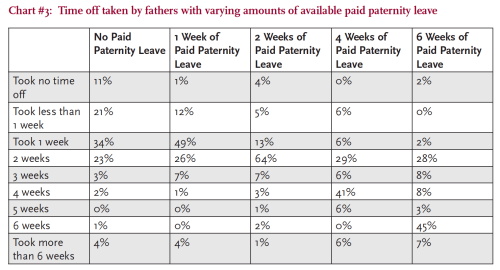
Study by Boston College Center for Work and Family “THE NEW DAD: Take Your Leave”

The data clearly reflect the changing role of fathers and the expectation for men to be more involved with their children. Beyond this though, it may indicate that men have a strong desire to be more active parents, something organizations should encourage, for a number of reasons. More and more studies are acknowledging the importance of father/infant interaction. A recent paper in the Journal of Child Psychology and Psychiatry shows a correlation between behavioral disorders (the most common psychological problem affecting children) to disengaged interactions of fathers with their infants. A 2010 study cited in the Boston College report found that developing bonds with children at an early age improves the likelihood of a stronger relationship later in life. Additionally, global research has demonstrated benefits to families when fathers take paternity leave, including increased wellbeing for the new mothers. A recent study in the Journal of Business and Psychology Organizations found that men switch between four images of themselves as fathers: provider, role model, partner and nurturer and that depending on their work environment, one of these roles is always dominant. Men that work in an environment where they can talk about their children, for example, are more likely to be nurturers, whereas men who feel unable to discuss anything but breadwinning are likely to conform mostly to that role.

Organizations offering paternity leave are sending clear messages about work life integration and its values. While U.S. employers are not required by law to provide paid maternity or paternity leave, the positive impacts of these on building a culture of high trust are inescapable. As are the positive impacts on fathers, mothers and children. It gets increasingly difficult to argue against creating these kinds of policies.

Leave a comment

Filed under China Gorman, Data Point Tuesday, Employee Benefits, Paid Leave, Time off, Trust, Work Life Balance

Employee Wellness: It’s All About Control

data point tuesday_500

June is National Employee Wellness Month, so let’s focus on some current workplace health and wellness stats. We know that a workplace culture based on Trust creates happier, engaged and higher preforming employees on all levels. And health and well-being should be considered an important factor towards this overall goal because employees who experience poor health and wellness are likely to (amongst other things) experience higher levels of stress, miss more days of work and experience less productivity – all important determinants in an employee’s overall engagement. With Employee Wellness Month in mind, let’s celebrate the health and wellness of those around us, and consider the wellness initiatives at our own organizations – are there programs in place? Do they work? Do employees know about them?

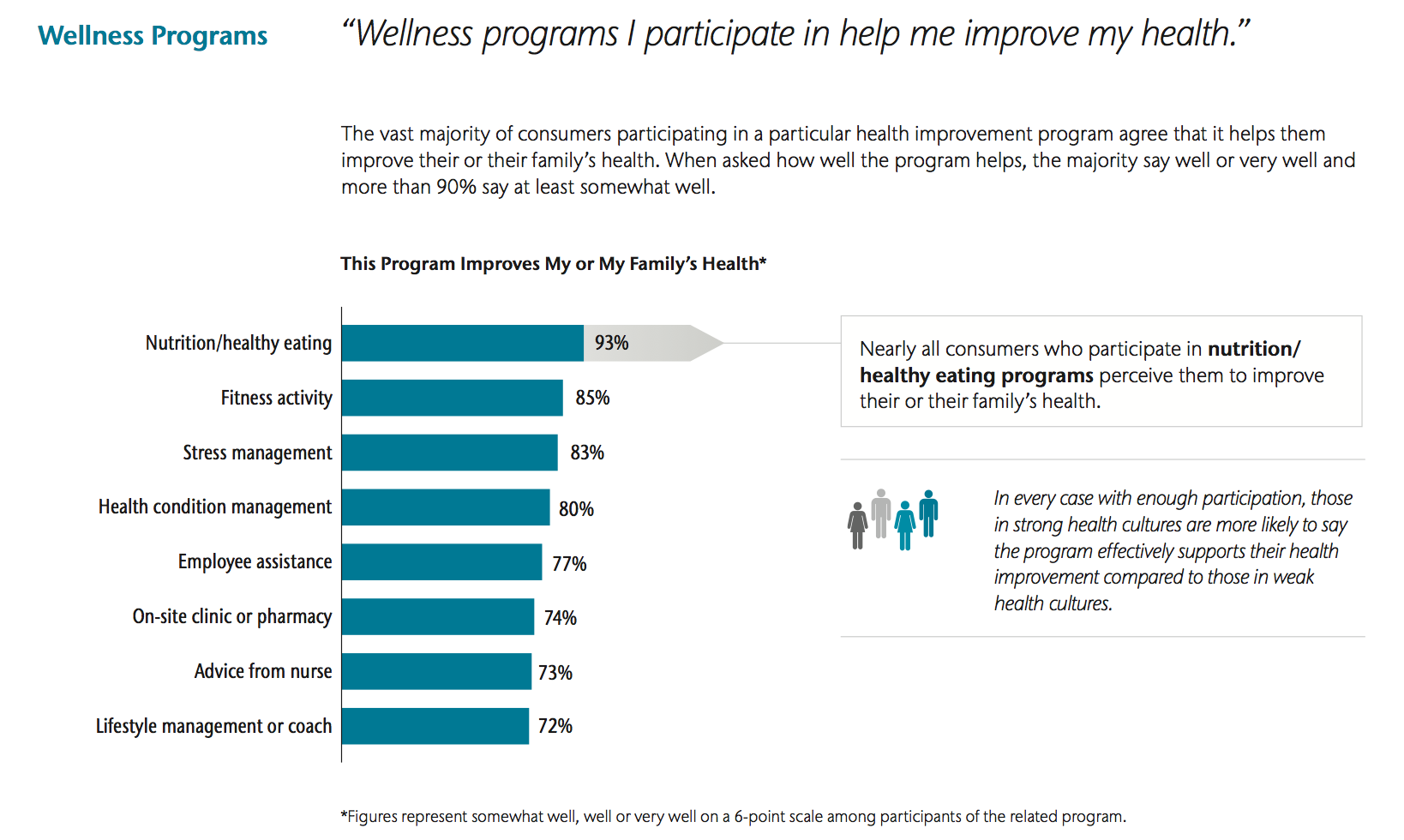
In “The 2014 Consumer Health Mindset StudyAon Hewitt has partnered with The National Business Group on Health (The Business Group) and The Futures Company to explore the “perspectives, attitudes and behaviors that employees and dependents hold toward health and health care as they interact with their employer-sponsored health plans and wellness programs”. When it came to respondents’ perceptions of personal health, there were some interesting takeaways, including that overall, from 2012-2013, the amount of people reporting that their “health is at least good” has slightly increased (from 87% in 2012 to 92% in 2013). However, respondents continue to fail to consider their weight when accounting for their overall health; with 59% of those reporting being in “at least good health” considered medically to be overweight or obese, up from 53%.

Wellness programs graphic

As far as actions that lead to good health, respondents ranked the most influential factor as “making smart healthy choices in my daily life”, which ranked over factors such as “getting regular preventive care,” “living and or/working in a healthy environment,” “having good genes,” and “having enough money to pay for all the care I need to stay healthy.” Those employees who do work in strong cultures of wellness, however, were more likely to say that they had control over their health. Additionally, related to culture at work, respondents ranked “work environment” as the 3rd biggest obstacle that kept them from getting and staying healthy (lack of time at 63%, affordability at 40%, work environment at 35%). When looking at health care costs over the last decade it comes as no surprise that affordability ranks amongst the biggest concerns for maintaining health – employees’ share of health care costs will have increased 125% from 2004 ($2,011) to 2013 ($4,542).

Interestingly, only 12% of respondents see health information from their employer as significantly influencing their actions (but this number is up 50% from 2012). This is interesting considering that we have seen a significant increase of companies instituting health and wellness programs as a whole; are these programs in place but just not being used? Are employees not interested in the types of wellness programs being offered? Aon Hewitt’s study states that 19% of respondents feel their employers encourage healthy behavior between a 0-3 range (on a 10 point scale), whereas 47% believe their employers encouragement of healthy behavior falls between a 4-7 point ranges. Given this, it seems less likely that companies don’t have any programs in place at all, and more likely that they are either programs employees aren’t interested in, or aren’t aware of.

So how can companies encourage employees to take advantage of health and wellness programs? Respondents indicated that two of the biggest influencers of feeling like their organization had a strong health-related culture were: that their employer seriously considers all actions that improve employee health, and that employees were actively encouraged to incorporate healthy activities during the work day. Additionally, employees want programs that they can personally relate to. 46% of respondents stated they would not participate in a wellness program that is not relevant to them or does not apply to their situation (the number one reason). Additionally, in terms of what makes wellness programs most appealing, financial rewards (even small sums like $50 or less) takes the top spot, followed by programs being easy to do or convenient. Lastly, remember that respondents perceive making independent “smart healthy choices in my daily life,” to be the biggest overall influencer on their health and wellness. With this in mind, perhaps the most successful workplace wellness programs are the simple things put in place to encourage employees to make these choices – sometimes it’s the little things. Happy National Employee Wellness Month!

Leave a comment

Filed under Data Point Tuesday, Uncategorized

Core Employee Needs: Not All or Nothing!

data point tuesday_500

It seems as though we are consistently seeing data that show decreasing levels of employee engagement and feelings of fulfillment at work. This data can be, and has been, attributed to many factors, such as a lean post-recession workforce, an increasingly competitive talent landscape, and the uber-connected, uber-informed and uber-on business world in which we operate. I’d agree that all of these can create barriers to an engaged workforce, or challenge an already highly engaged workforce. There’s also data indicating (as I discussed in my post on what Millennials look for in a great workplace) that high amounts of stress, feelings of low-engagement or no work/life balance are not as significant as we may think. There are, on a positive note, data that suggest workplaces are doing much to negate issues of engagement and work/life balance, but much of this research comes from companies classified as “Best Workplaces” and considering the frequency of content reporting low levels of engagement, trust, and happiness, such companies may be few and far between. Ultimately, we can only take data at face value. The real importance of looking at such workplace statistics is to inform ourselves and build our “bigger picture” – know what’s out there, know what’s conflicting, and create solutions and approaches that are right for our own people, culture and strategic goals.

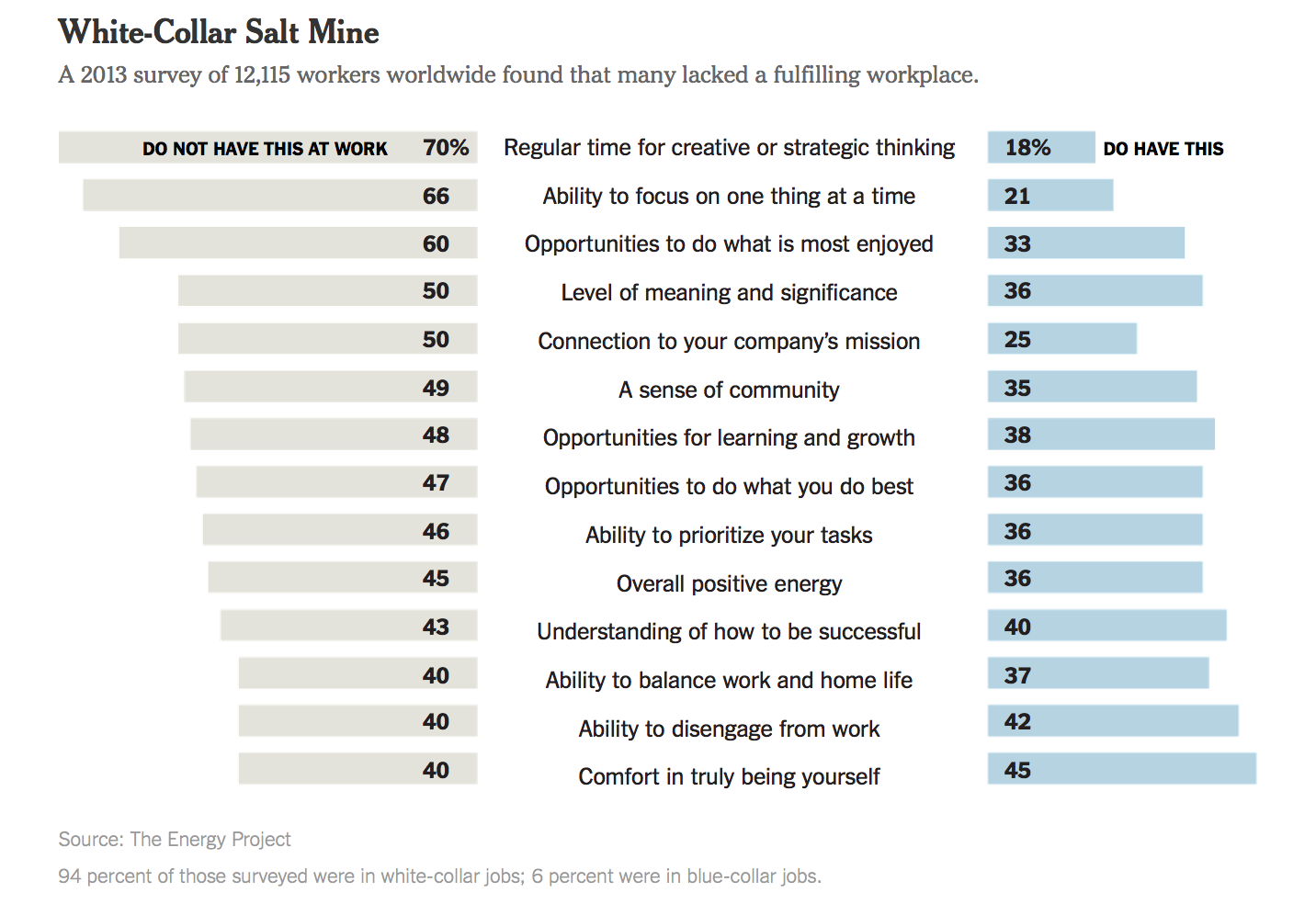
Some data I recently found interesting comes from an article published in The New York Times, “Why You Hate Work” which included research from The Energy Project, an organization that aims to increase employee engagement and sustainable performance for organizations and their leaders. The article, by The Energy Company’s CEO Tony Schwartz and consultant Christine Porath, discusses how “the way we’re working isn’t working” and that it’s increasing common for both middle managers and top executives to feel overwhelmed and disengaged. In an effort to understand what’s impacting people’s engagement and productivity at work, The Energy Project partnered with The Harvard Business Review to survey 12,000 + mostly white-collar employees across a range of industries and organizations. They found that employees are considerably more productive and engaged when they have the opportunity to: regularly renew and recharge at work, feel valued and appreciated for their contributions, focus in an absorbed way on their most important tasks, define when and where they get their work done, do more of what they do best and enjoy most, as well as feeling connected to a higher purpose at work. The study attributed these four areas to four core needs: physical, emotional, mental, and spiritual.

Energy ProjectIn terms of the core physical need at work, The Energy Project’s study determined that employees who take breaks every 90 minutes find themselves with a 30 percent higher level of focus than those who take one or no breaks during the day. These employees also report a 50% greater capacity to think creatively and a 46% higher level of health and well-being. Also interesting, is that when employees feel encouraged by their supervisor to take breaks, their likelihood to stay with any given company increases by nearly 100%.  For the core emotional need, feeling cared for by one’s supervisor has the biggest impact. Employees who noted having more supportive supervisors were 67% more engaged. The core mental need? Respondents that were able to focus on one task at a time reported being 50% more engaged (although only 20% of respondents reported being able to do this). Comparably, just 1/3 of respondents reported being able to effectively prioritize their tasks, but those who did were 1.6 times better able to focus on one thing at a time. In regards to the core spiritual need, the Energy Project’s research found that employees who derive meaning and significance from their work reported 1.7 times higher job satisfaction and were 1.4 times more engaged at work.  In a nutshell, this data show that how employees feel at work has a huge impact on their engagement and productivity.

One last valuable nugget of data to note from this study is that when employees have even just one of the core needs discussed above met, versus none, all variables of their performance improve (from engagement, to loyalty, job satisfaction, positive energy at work, and lower perceived levels of stress). This is good incentive for organizations to work on things one step at a time. It clearly isn’t an all or nothing proposition. Positive changes in employee engagement don’t necessarily happen from massive culture changes or vast implementation of new programs. Baby steps are okay folks; and the more core needs are met, the more positive the impact!

1 Comment

Filed under Career Planning, Center on Education and the Workforce, Millennials, Talentism, Uncategorized, Workplace Strategies

Memo to Women in Corporate America: Pick One – Mother or Leader

Data Point Tuesday
SHRM
and the Families and Work Institute have recently released their 2014 National Study of Employers (NSE), which identifies changes in the workplace since 2008. The report sample includes 1,051 employers with 50 or more employees, with 67% of these organizations for-profit employers and 33% are nonprofit organizations. 39% operate at only one location, while 61% percent have operations at more than one location. A pretty big sample. And the trends are interesting. Some make sense. And some, well, not so much.

Workplace flexibility is top of mind for many business leaders, and the 2014 National Study of Employers notes two major trends between 2008 and 2014 related to this. First, employers have continued to increase the amount of options that allow at least some employees to better manage the times and places in which they work, including occasional flex place (from 50% to 67%); control over breaks (84% to 92%); control over overtime hours (27% to 45%) and time off during the workday when important needs arise (73% to 82%). Second, employers have reduced the amount of programs that give employees the opportunity to spend significant amounts of time away from full-time work. These include sharing jobs (29% to 18%), working part year on an annual basis (27% to 18%), and flex career options like sabbaticals (38% to 28%) and career breaks for personal or family responsibilities (from 64% to 52%). So, yes to more control over place and time while working and no to opportunities to not work.
SHRM Flexibility Chart
A continuing trend from 2008 to 2014 is “12 weeks of leave.” No doubt based on the FMLA, this is usually given for the birth of a child, adoption of a child, or serious family illness. 12 weeks has become the norm, with more employers offering this amount of time since 2008. Currently, 93% of employers offer women 12 weeks of leave after giving birth (85% in 2008), 89% of employers offer employees 12 weeks after the adoption of a child (81% in 2008), and 90% of employers offer employees 12 weeks leave to care for seriously ill family (84% in 2008). Despite these increases, it’s disappointing to note that the maximum length of caregiving leaves offered to new fathers, new adoptive parents, and employees caring for seriously ill family members, as well as disability pay, has declined since 2008. Additionally, support from employers in areas like diversity and inclusion is declining, with fewer employers training supervisors in managing employees of different ages (59% in 2008 and 52% in 2014) and fewer employers providing career counseling programs or management/leadership programs for women (12% in 2014 vs. 16% in 2008). Also along this line, fewer employers report that supervisors are encouraged to assess employee performance by what they accomplish vs. by just “face-time” (71% in 2008 and 64% in 2014). So yes to new birth mothers and no to just about everything else. Hmmm…

What support programs then, are workplaces increasing for employees? Employers are increasingly helping employees with elder care, with employers in 2014 12% more likely to report that they offer Elder Care Resource and Referral than employers in 2008. Employers are also 18% more likely in 2014 than 2008 to offer DCAPs (Dependent Care Assistance Programs) for elder care and 4% more likely to offer access to respite care. Wellness programs are also increasing, with 60% of workplaces providing wellness programs today (compared to 51% in 2008). SHRM and the Families and Work Institute’s report also noted an increase in the amount of workplaces providing Employee Assistance Programs to help with personal/family problems and pressures (78% now, compared with 58% in 2008). When it comes to healthcare, 98% of employers provide personal health insurance for full-time employees, a 3% increase from 2008. Additionally, there has been a 6% increase in employers providing more health care coverage for family members of full-time employees from 2008 to 2014 (91% to 97%), and a huge increase between 2008 and 2014 in the amount of employers providing health insurance for domestic partners (29% to 43%). Lastly, almost all employers (96% of those with 50+ employees) provide 401(k) or 403(b) retirement plans, and 80% of employers make contributions to employees’ individual retirement plans.

While it’s easy to provide reasoning for many of these trend changes (more elder care due to an aging workforce, more domestic partner coverage due to changes in legal and societal perceptions of the LGBT community, more employee assistance programs due to increasingly stressful work environments, etc.) it’s harder to pinpoint the cause of others, like the decrease in leadership programs for women. Could one conclude that that the rising incidences of providing new birth mothers time off has influenced the decrease of leadership development programs for women? Probably not, but it’s interesting to think about, isn’t? This data could support the view that corporate America may be telling women that they’ll support their role as mothers but not their roles as leaders…

Leave a comment

Filed under China Gorman, Data Point Tuesday, SHRM, Workflex