Monthly Archives: June 2016

The ROI of Working Human

data point tuesday_500

The SHRM Foundation’s latest Effective Practice Guideline, Creating a More Human Workplace Where Employees and Business Thrive, was released just in time for the SHRM Annucal conference this week. The timing couldn’t have been more appropriate, as it follows on the heels of last month’s WorkHuman conference.

If you’ve been following Data Point Tuesday for a while, you know I’m a big fan of the SHRM Foundation’s EPGs. They are researched, written, and reviewed by leading academics in the Human Resources field, and are underwritten by some of the most innovative suppliers in the HR arena. This EPG, sponsored by Globoforce, brings a great deal of data and analysis into one easily read report. In other words, it’s chock full of validated research and data on a topic that is becoming top of mind for CEOs, boards, and all C-Suite members:  the connection between employee well-being and business success.

The business case for creating a more human workplace is made in the first section of the report. It includes Strategies that pay off, High costs of our current work culture, and Multiple benefits of a thriving work culture. A few of the gems from this section include:

  • The American Psychological Association estimates that workplace stress costs the U.S. economy $500 Billion (!) a year.

  • Workplace stress increases voluntary turnover by nearly 50%.

  • Gallup estimates that poor leadership associated with active worker disengagement costs the U.S. economy $450 – $550 Billion (!) per year.

  • 550 Billion workdays are lost annually due to stress on the job.

  • 60 – 80% of workplace accidents are attributed to stress.

The supporting data showing how detrimental most workplace cultures are to their financial success are proliferating. Even if treating employees as if they were human beings wasn’t the right thing to do, the numbers alone make it hard to understand why creating more humanity-focused cultures aren’t the leading priority for every single organization and for every single CEO!

Once past the business case, the report lays out a thorough treatment on how to fix your culture in the section, Seven Ways to Help Employees Thrive. Not rocket science, but rather simple common sense, these seven elements come with case studies, examples and specific “how tos” for you to consider in your own organization.

  1. Share Information About the Organization and Its Strategy
  2. Provide Decision-making Discretion and Autonomy
  3. Create a Civil Culture and Positive Relationships
  4. Value Diversity and Create an Inclusive Atmosphere
  5. Offer Performance Feedback
  6. Provide a Sense of Meaning
  7. Boost Employee Well-Being

Citing employers like Alaska Airlines, Genentech, General Mills, Ritz-Carlton, Microsoft and many others, author Christine Porath loads this EPG with practical tips, examples and evidence.

At its heart, however, humanity-focused workplaces start at the top. They start with trustworthy leadership and sustainable leadership behaviors. This graphic says it all:
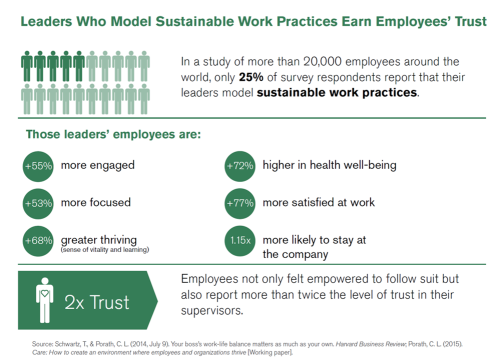
EPG May 24 2016

This report shows, once again, that there is absolutely no downside to not only treating employees humanely, but consciously and intentionally investing in their well-being. When our employees feel respected as individuals, appreciated for their contributions, and supported in their family lives and community commitments, as well as their physical health and mental well-being, our organization missions are more likely to come to fruition and all of our stakeholders – every single one of them – will be more than happy with the return on their various investments.

Thanks to the SHRM Foundation’s newest EPG, The ROI of Working Human has never been more clear.


1 Comment

Filed under China Gorman, Christine Porath, Company Culture, Culture, Data Point Tuesday, Effective Practice Guidelines, Employee Engagement, Employee Stress, Engagement, Globoforce, HR Data, SHRM Foundation

Human Capital Trends To Think About

data point tuesday_500

Deloitte’s Human Capital Trends 2016 Report, The new organization: different by design, is definitely worth a read. It’s long – 124 pages – but it will make you smart. Download it and start browsing.

I won’t say much about the content – you need to read it all – except to show you the 10 trends identified as worth our consideration this year. The trends are:

  1. Organization design/The rise of teams

  2. Leadership awakened/Generations, teams, science

  3. Shape culture/Drive strategy

  4. Engagement/Always on

  5. Learning/Employees take charge

  6. Design thinking/Crafting the employee experience

  7. HR/Growing momentum toward a new mandate

  8. People analytics/Gaining speed

  9. Digital HR/Revolution not evolution

  10. The gig economy/Distraction or disruption?

This is a meaty, insightful discussion of the trends facing organizations, leaders, culture and people. Even if you don’t agree with the conclusions, you need to be educated and thoughtful about these ten trends. Take a look:

Deloitte HCM Trends 2016

Down the report here. Now. It’s that important.


1 Comment

Filed under China Gorman, Data Point Tuesday, Deloitte, Global Human Capital, HR Analytics, HR Data, HR Trends, Human Capital, Human Resources, Josh Bersin

Your People and Global Internet Trends

data point tuesday_500

Data Point Tuesday’s mission is to find reports and impactful data sources that most HR professionals would never find and serve up some of their more interesting data points for consideration. Usually the reports come out of the Human Capital Management arena:  academic papers, vendor survey analyses, white papers, etc. There’s a ton of data flowing in our space that the average HR person would never have the time to find. It’s what I do here. But sometimes the best data and analytics sources don’t come out of the HCM arena. And the annual Internet Trends reports is one of those sources.

I have been waiting with bated breath for Mary Meeker’s Internet Trends 2016 report – and it’s here! Last year, I suggested that the report really should have been titled The Internet in 2015 Is All About HR. I wrote about it here. This year, I think the report should be titled How the Internet is Just Beginning to Change Everything at Work. Again, it should be required reading for HR professionals everywhere.

The annual Internet Trends report that Meeker publishes is certainly not an HR report. But it contains critical information and data that HR people need to know. It’s all big picture stuff that relates to the Internet, but it also all has impact on people – and most of it has impact on people at work. In the U.S., in Asia, in Europe – all over the world. I encourage you to flip through the report – it’s in PowerPoint – even though it’s really long. This is the outline – and I defy you to not find the majority of it interesting and relevant to your HR work, your workforce planning and your role in setting business strategy.

Here are the topics covered in this year’s report:

  1. Global Internet Trends
  2. Global Macro Trends
  3. Advertising/Commerce + Brand Trends
  4. Re-Imagining Communication – Video/Image/Messaging
  5. Re-Imagining Human-Computer Interfaces – Voice/Transportation
  6. China = Internet Leader on Many Metrics
  7. Public/Private Company Data
  8. Data as a Platform/Data Privacy

Every single one of these topics has an impact on how you interact with your people, your people strategy or your people policies. Seriously.

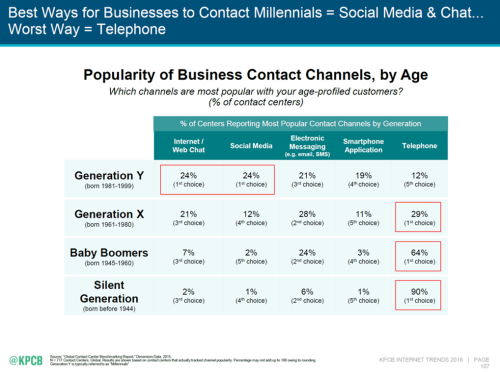
For example, as you think through your internal communication strategy, this graph might be helpful:

Internet Trends 2016 1

Think it’s useful to know that 64% of Baby Boomers cite the telephone as their most preferred contact channel vs. 12% of Millennials? (It won’t be shocking, I hope, to note that Millennials prefer – by 48% — social media and internet/web chat channels.) While you might instinctively know this, seeing the hard data puts the need to rethink employee communication into a different perspective, doesn’t it.?

The advent of using microphones instead of keyboards to interface with computing is in very early days, according to Meeker. However, in 2013 35% of smartphone owners used voice assistants (think Siri) and 65% used the voice interface in 2015. Adoption is rising fast among smartphone owners of all ages. Even if the majority of voice commands are about calling and navigating home, the use is skyrocketing. And as the Boomers age, think of the impact – at home and at work – of not needing to use a keyboard to utilize technology. Is your organization prepared for this radical shift?

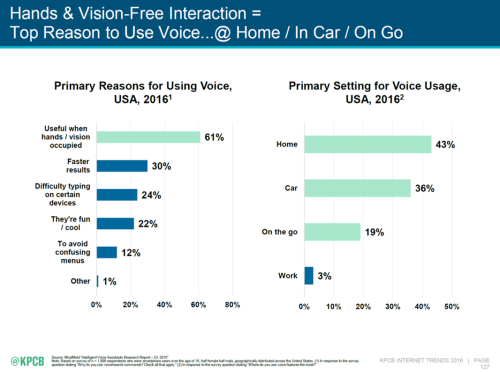
In the US, the reasons for using voice interface and the locations we are using it are not so focused on the job. But the trends are pretty clear. What can you do to anticipate and leverage this and enhance productivity, knowledge transfer and the employee experience?

Internet Trends 2016 2

So if calling mom and dad, and navigating (literally) home are the current most often uses of using voice for computer activation, then the charts above make an inordinate amount of sense. But if you keep the oldest demographic of the workforce in mind when reading these charts, you can see that a sea change could be on the very near horizon. What if the oldest demographic of the workforce isn’t going away in the next 10 years? Even more, what if enabling/convincing the oldest demographic of the workforce to stay in the workforce was the key to your workforce plans over the next 10 years? And what if the newest/youngest demographic of the workforce was already using voice for computer interaction nearly 100% of the time as they enter the economy?

Interesting data. Interesting questions. See what I mean about non-HR sources of data?

And just to leave you wishing for the good old days, there’s this graph comparing the attributes of technology use among the emerging Gen Z cohort to the Millennials:

Internet Trends 2016 3

As my dad used to say, “If that doesn’t make your hair curl, I don’t know what will!”

The workplace and workforce planning implications of this report put the future in new light. A good light, I think. A challenging, but good light. And a light you need to focus. What do you think?

3 Comments

Filed under Analytics, Big Data and HR, China Gorman, Data Point Tuesday, Employee Demographics, GenX, GenY, GenZ, Internet Trends, KPCB, Mary Meeker, Millennials