Category Archives: China Gorman

Employee Recognition

Data Point Tuesday

The Gift That Keeps on Giving

Employee recognition is an important form of positive feedback (who doesn’t love being recognized for their efforts after all?!) and a 2013 study by Globoforce gives us even more reason to institute this type of feedback in our organizations. The study examines the growing intersection between recognition and employee performance and has some noteworthy points. Where recognition is concerned, perhaps the most important point made is that recognition directly impacts business results. Out of 708 randomly-selected fully employed persons in the United States (aged 18 or older) who are employed at organizations with a staff size of 500 or more employees,  those who were recognized with values-based recognition reported a positive change in their productivity. Additionally, 49% of respondents who had experienced values-based recognition indicated a positive change in relationships, 43% indicated a positive change in their customer service efforts, and 82% stated that being recognized for efforts at work motivated them in their job.

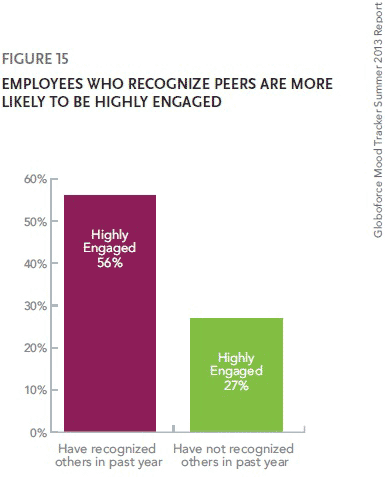
These statistics reinforce the value and importance of recognizing employees, but what I found particularly interesting and a less obvious benefit of employee recognition was how the ability to give vs. receive recognition affected employees. The study found that employees who are empowered to recognize other employees at their organizations were twice as likely to identify themselves as highly engaged; highlighting that value should be placed on allowing employees to give recognition as much as it is placed on making sure employees receive recognition. Another interesting and less obvious result of employee recognition is the link between recognition and alignment with organizational culture and values. Of respondents surveyed, 48% indicated that receiving recognition when they did something right served to align them with their organization’s values and culture. As I discussed in another recent post, employees who feel strongly aligned with company values and mission are more satisfied with and likely to remain at a job, so this relationship between values and employee recognition is a valuable one to explore.
globoforce

Employee recognition can also influence employees’ perception of performance reviews. Globoforce’s study found that 76% of respondents thought recognition data would make reviews better, and 75% of respondents who had been recognized recently stated that they enjoyed their reviews. We can attribute these changes in perception toward reviews to the attributes like engagement and connection with company values, but also to another idea. As the study points out, peer and managerial recognition act as a form of social crowdsourcing, a familiar and comfortable concept for employees who most likely use crowdsourcing programs like Yelp or Amazon regularly. 80% of respondents felt that crowd sourced (manager plus crowd sourced peer feedback) to be more accurate. With employee recognition serving as a form of crowd sourced feedback it makes sense then that employees who were recently recognized felt more comfortable in reviews. But why does it matter if employees enjoy their reviews? The research shows that employees who are satisfied with reviews are more highly engaged, less susceptible to job poaching, and more satisfied with their job.

This data show that creating a system that gives employees feedback from peers as well as from managers – feedback that is values-based – is the gift that keeps on giving. To employee engagement, to higher retention, to financial performance. Who doesn’t want that gift under the tree on Wednesday?

What does employee recognition look like in your organization? Do you have recognition programs in place? Do you encourage employees to recognize others as well as for managers and supervisors to give recognition? Use this data as a catalyst to examine how recognition plays a role in your business. Ramping up the positive feedback could just be the key to a healthy domino effect, creating employees that are more engaged, more productive, more connected to company values, and more satisfied with their reviews.


Leave a comment

Filed under China Gorman, Data Point Tuesday, Employee Engagement, Employee Recognition, Globoforce, Great Place to Work, Great Place to Work Institute

The Trustworthy Leader

Data Point Tuesday
More Mindfulness for the Holiday Season

The holiday season is upon us, and many of us have been relishing the traditional cheer, treats, gifts and parties that accompany this time of year. It’s likely we’ve been reflecting on, and giving thanks for the joy in our lives, our family, friends and loved ones; or maybe we’ve been getting into the holiday spirit by donating to or helping out at our favorite philanthropic organizations. These are effective trustworthy leader practices to embrace during the holidays, and practices that, realistically, we should attempt to embrace year-round! For me, a specific practice comes to mind that we should give some serious extra “oomph” to during the holidays – mindfulness.

While practicing increased mindfulness during the holidays can be helpful for everyone, it’s an especially great practice for business and HR leaders. With so much focus on holiday celebrations and cheer, it can be easy to miss that for some of our colleagues the holidays prove to be the most stressful or difficult time of year. According to statistics from a poll by the American Psychological Association, 69% of people feel increased stress during the holidays from a perceived lack of time, 69% feel increased stress from a perceived lack of money, and 51% of respondents also experienced stress during the holidays from the perceived pressure to buy and give gifts. While financial worry seems an obvious stressor during the holidays, there are other stresses that the holiday season can amplify, such as feelings of loneliness or sadness (especially for those who may not have a strong support system or close-knit family). And during a time of year when we celebrate family and loved ones, it can be particularly difficult for those who have experienced loss.

Keeping this in mind, aim for increased mindfulness and awareness in your workplace this holiday season. Consider checking in with employees more frequently, whether it’s with a phone call, email, or an in-person visit. As we all know, sometimes something as simple as asking “how are you doing?” can brighten a day. Also consider making sure lines of communication are extra clear. It’s important to remember that no matter how someone may appear, we can never assume what is going on in their life. If you’re willing to help or have tools and resources and available for employees in need, make this known.  Reminding employees that their Employee Assistance Programs are easily accessible could encourage those who need support to seek it out. Asking for assistance can be difficult or feel shameful, and knowing that someone is willing to help could mean the difference between obtaining assistance, and suffering in silence.

Though “tis the season,” we’re not necessarily exempt from stress, and the holidays may even be amplifying worry. Perhaps it’s feeling a little anxiety about what the final year-end financial results will look like, or that the 2014 budget isn’t as perfect as we’d like, maybe it’s serious financial stress, or maybe there’s no stress at all. Whatever the case may be, work to be the true trustworthy leader who brings an increased mindfulness to your colleagues, your friends and family, and those around you this holiday season.

2 Comments

Filed under American Psychological Association, China Gorman, Data Point Tuesday, holiday

The B2T Revolution

data point tuesday_500

Employees (And Prospects) Are Consumers When it Comes to HR Technology

Mobile devices and apps are no longer the hot new craze. The B2C (Business-to-Consumer) sectors have taken care of that. Mobile devices have become an essential item for communication and internet access, and as Cisco reports, by the end of this year (in three weeks!) the number of mobile-connected devices will exceed the number of people on earth. By 2017, it’s predicted there will be nearly 1.4 mobile devices per capita. We’re now seeing companies like Lenovo, the world’s largest PC maker, selling more mobile devices than PCs. And as you’re undoubtedly aware, smartphones are a huge part of this mobile device equation. The growth of smart phone usage in 2012 was 81% and has only increased since. We’re using our smartphones for MUCH more than phone-calls though. Downloading applications, checking email, accessing the internet, getting directions, making dinner reservations, paying for purchases and meeting Mr./Ms. Right are just a few examples of ways smart-phones and mobile devices are being used today by people all ages from all walks of life. The bottom line is people are living their lives on mobile. And as long as the product is intuitive, easy to use and fast, the potential for success on mobile devices is huge.

HR Technology applications are no exception. A 2013 Mobile Consumer Report from Nielsen found that 82% of U.S smartphone users browse the web on their smartphone, and 63% use smartphones for social networking sites like LinkedIn, Facebook, and Twitter. According to Talent Management Headquarters, one billion (1,000,000,000) job searches are conducted on mobile devices each month! Mobile recruiting is well on its way to being the next big thing for talent acquisition. This makes sense when we consider that we can use mobile devices during short moments of down time, on a bus or during a lunch break.  As career sites and job postings become increasing mobile friendly, it’s likely that both passive and active job seekers will turn to their mobile devices before they turn to their desktop to hunt for jobs or job search related information.  And mobile recruiting offers organizations the benefit of exposure to job seekers who may not own or be frequent users of computers.

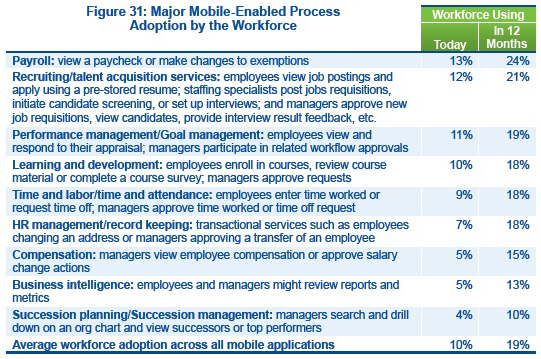
More importantly, with so many employees working from mobile devices, it has become increasingly critical for employers to provide HR information through vendors with easy to use, native mobile apps. Perhaps this is the new focus:  B2T – Business to Talent! Mobile HR applications offer employees (as well as HR managers) instantaneous interaction and engagement with HR Data like payroll and benefits information, recruiting/talent acquisition services, performance/goal management, and time and labor information – even more so than using a laptop or desktop. And in the day and age when all of us are used to instant access when we are living our non-work related lives, having these important processes and data easily accessible are becoming a must-have not a nice-to-have. In 2011, the ADP Research Institute looked at how mobile technology could make HR mobile solutions a game-changer. Respondents reported a significant benefit in using HR mobile solutions, citing improved workforce satisfaction, improved real time decision making, and improved workforce productivity. So the B2T revolution is here.

Mobile technology has revolutionized much in our lives and for HR leaders and employees there is more change to come. User friendly HR applications for mobile devices will prove an effective way to increase efficiency for managers and employees, just as the popularity of job searching on mobile devices will undoubtedly impact how we recruit. Communicating with talent – current and future – via mobile really could be a game changer for employers, employees, job seekers and HR technology providers.

The B2T bottom line:  employees are consumers. And they expect to have consumer-like experiences with the technology and software at work and about work. And if you aren’t providing it for them, they’ll likely use their smartphone to find another employer!

Mobile-Enabled Process Adoption

*This post is part of SilkRoad’s first annual #HRTechTrends Blog Carnival. A recap of all participants will be posted on SilkRoad Ink on December 20, 2013.

1 Comment

Filed under #HRTechTrends, ADP Research Institute, Business to Talent, China Gorman, Data Point Tuesday, HR, HR Technology, Mobile Devices, SilkRoad, Talent Management Headquarters

Bring me a Higher… Purpose!

Data Point Tuesday
The Importance of Connecting Employees to a Clear Corporate Mission

A recent study by Spherion, “The 2013 Emerging Workforce” examines the 2013 workforce and the post-recession resurgence of the “emergent worker mentality” characterized by the study as one which focuses on a free-agency style employment. While the study provides data to support this point it is more than likely we have experienced the validity of this resurgence in our daily lives, perhaps witnessing friends or colleagues job-hopping more frequently, or seeing an increased social conscience in employees and new talent. Whether we’ve confirmed suspicions that our current workforce is driven by a very different set of factors than previous generations or not, insights from this report can help to remind us of the importance of understanding this emergent worker mentality.

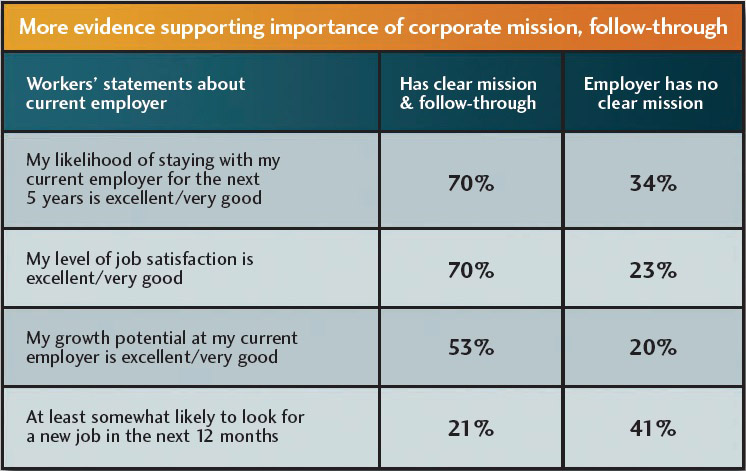
Data supports that connecting employees to an organizations values and greater corporate mission is one of the most influential attributes of job satisfaction for the emergent worker. 70% of respondents from Spherion’s study who worked for a company with “a clear mission and follow through” reported that their level of job satisfaction was very/extremely good , compared to a job satisfaction rate of just 23% for organizations with no clear mission and follow through. As Jake Magleby stated in a blog published by Great Place to Work last month: “Businesses with vision are often more successful than their competitors. This is because people like to support a specific cause or purpose. Business leaders who recognize this can develop a vision for their company that is based on common values and shared goals… This vision for a better world is something that most people not only relate to, but very much want to support. This support translates into a healthy bottom line for the company and a healthier community”.

Data from Spherion’s 2013 Emerging Workforce Study not only confirms that employees at companies with a clear mission are more satisfied with their jobs but are also that they are more likely to stay at their jobs. 70% of respondents at a company with a clear mission and follow through reported that the likelihood they would stay at their current job for the next five years was excellent/very good, and only 21% responded that they were at least somewhat likely to look for a new job in the next 12 months. Additionally, respondents from companies with a clear mission and follow through felt more confident in their growth potential than employees from organizations without a clear mission and follow through. Given these returns, all organizations should consider making their mission and values even more visible and relatable for employees and this has been a top priority for me in my new role at Great Place to Work. Does your company place a premium on mission and values? What actions do you take to connect employees to your mission?

corporate-mission-importance

2 Comments

Filed under Business Success, China Gorman, Data Point Tuesday, Great Place to Work, Great Place to Work Institute, Spherion

Laws Require WorkFlex – Really?

data point tuesday_500

There’s been a lot of talk recently regarding flexible scheduling policies in organizations. All kinds of people have been writing about whether such policies are actually beneficial or harmful for businesses, as well as questioning if flexible scheduling polices are really essential or non-essential to things like employee engagement, well-being, and productivity.  Actually, I think these discussions miss the point and I don’t think any of these questions can be answered on such a broad scale. The potential for flexible scheduling policies to help or hinder an organization is dependent on a whole series of variables, making such questions decidedly organization specific and not answerable as a larger theme that applies to all organizations. What we can confirm about flexible scheduling policies however, is that they are a highly regarded benefit and broadly implemented by some organizations.  The graph below from Statista, detailing data from a 2013 Employee Benefits Report by SHRM, found that  in the U.S in 2013, 58% of employers offered the option of telecommuting to some of their employees and 4% planned on starting to offer telecommuting within the next year. This data gives us a rough idea of the implementation of flexible scheduling policies within the U.S, and with more than half of employers offering telecommuting options it’s obvious that this is an approach worth discussing.

Statista SHRM Telecommuting 2013

We can clearly point to Marissa Mayer’s decision to ban telecommuting at Yahoo! (see my post here) as one of the major sparks in the recent discussions around flexible scheduling. Adding to the controversy is legislation that has passed in Vermont and now San Francisco, requiring certain organizations to seriously consider employee’s requests for a flexible work schedule. The most recent legislation around flexible scheduling passed just last month on October 8th 2013 in San Francisco. The Family Friendly Workplace Ordinance (FFWO) will become operative on January 1st 2014, and mandates that employers with twenty or more staff give employees in caregiver roles the right to request a predictable or flexible work schedule. To qualify an employee must have worked for the organization for more than six months, work at least eight hours a week on a regular basis, and be a caregiver for a child or children under the age of 18, a parent(s) over the age of 65, or a person(s) with a serious health condition in a family relationship with the employee. If an employee meets these standards they have the right to submit a request for a flexible schedule and their employer is required to meet with them within 21 days. The employer is required to respond to the request within 21 days of their meeting and if the employer denies a request they must explain the denial in a written response that sets out a bona fide business reason for the denial and provides the employee with notice of the right to request reconsideration.

Legislation like this raises a whole new set of questions around flexible scheduling policies. The San Francisco ordinance is positive in that it helps to protect employees against discrimination based on their caregiver status, however, at the same time, could you argue that legislation like this goes too far? Does it restrict an organization’s right to organize their business in the way they see fit, and most conducive to achieving goals? The FFWO could be positive in prompting employees that desire flexible scheduling policies to speak out – employees that may have previously felt afraid to voice such requests do to the bureaucracy of their organizations. But what will the effects be on organizations that have never implemented flexible scheduling policies? Will the ordinance cause a roadblock and additional internal conflict? These are some of the top questions that come to mind as I consider the implications of flexible scheduling legislation. What do you think?

Leave a comment

Filed under China Gorman, Data Point Tuesday, Employment Data, Great Place to Work, Great Place to Work Institute, HR, SHRM, Statista, Workflex

Kids Need Jobs, Too!

data point tuesday_500

When you think about our current economy you probably evaluate that we’re in a recovery period, a time in which the job market is slowly – very slowly – on the mend. You probably imagine employment rates on the rise, and would claim we’re faring considerably better than we were during the recent recession. And you’d be right. But for one group in our nation, this holds hauntingly, troublingly, untrue, and we need do our darnedest to figure out a solution because this is one important group of people:  they are our future.

A recent report by The Center for Labor Market Studies at Northeastern University and JAG (Jobs for America’s Graduates) examines in detail the employment outcomes of high school graduates from the class of 2012 who did not enroll in college, and the results were not positive. Employment rates for our nation’s teens over the last several years (all demographic, socio-economic, and schooling groups) have seen steep drops. These drops have been so steep that employment rates for teens have reached new historical lows for the post WWII period. High school students and young high school drop outs have seen the greatest differences in securing paid employment (of any type) in recent years and young high school graduates , especially those not enrolling in college in the fall after graduation, have seen both declining employment rates and a strongly reduced ability to secure full time work.

JAG Policy Brief #1

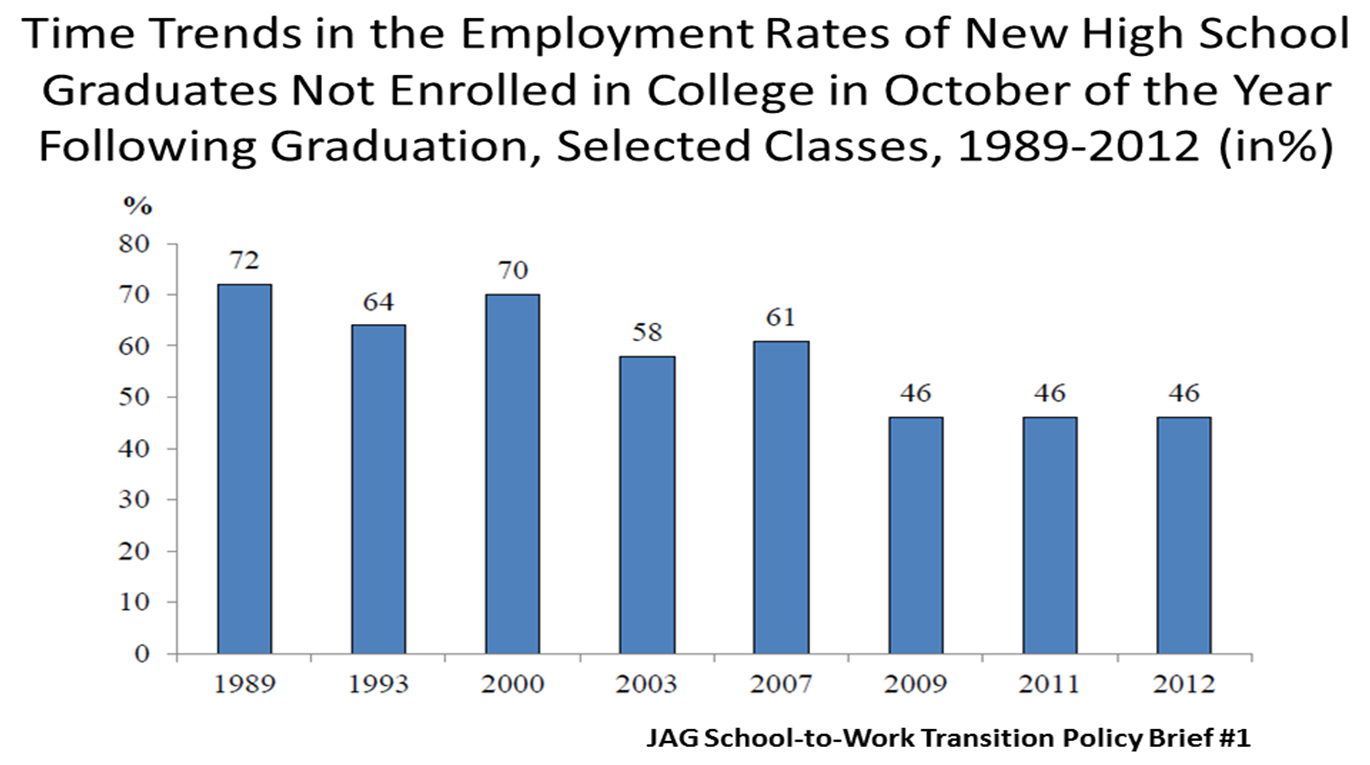
What’s concerning is the nature of these drops. Until recently the ability of America’s teens to obtain work has been fairly cyclical, with teen employment rates rising to above average during periods of job growth and falling during periods of recession. During the economic recovery of 2003-2007 however, teen employment rates did not see any significant rise, dropping from a rate of 70% in 2000 to 58% in 2003 and recovering only three points to 61% in 2007. Employment rates failed to increase again during the current job recovery from the recession of 2007-2009, dropping from 61% in 2007 to 46% in 2009 and holding there in both 2011 and 2012. These are the lowest employment rates for new non-college enrolled high school graduates in the U.S since the data series began being recorded in 1959.

The employment rates of high school graduates varied considerably by gender and race ethnic group and across the board male high school graduates fared worse than female graduates, their employment rates dropping to an all-time low of 44% in Oct. 2012. Family income also influenced employment rates, with high school graduates coming from higher income families (no surprise here) seeing a stronger likelihood for employment. Another important note though, is that the ability of employed High School graduates not attending college to obtain full time jobs has also declined dramatically since 2000. This number dropped to 43% in October 2012, the lowest full time job share ever recorded in in this data series.

The report combined the findings on the employment rates of non-college enrolled high school graduates with the share of the employed working full time to calculate their employment to population ratios, which are consistent with the declining employment statistics and darker still. In the month of October 2012 only 19 of every 100 high school graduates who did not attend college in the fall were employed full time, another historical low. As this study implores us, we need to think about the message and implications of these unemployment rates. Not only will this lack of employment adversely affect the future of these graduates in terms of lower employment rates, wages, and reduced training from employers, but it also sends the wrong message to youths still in school. How can we expect young people to understand the value of a high school degree, and support our claim that it’s important to stay in school, when their direct experience is observing the many idle graduates (their peers) with no employment and nothing to do? As of now, no new policy initiatives exist to address this large-scale labor market issue.

So it’s up to us. What are we going to do about it?


1 Comment

Filed under Andrew Sum, Center for Labor Market Studies, China Gorman, Data Point Tuesday, Employment Data, High School Graduates' Employment Rates, JAG, Student Job Search

Get With the Program — the Development Program!

data point tuesday_500

“Learning is not a one-time experience but an ongoing process.” This is one of the overarching ideas in a recent report written by Mollie Lombardi from Aberdeen, which examines the business impact of organizations focus on learning programs. The study is based on a collection of responses from 185 organizations and seeks to determine how organizations connect learning to business priorities, create development programs that impact every stage of the employee lifecycle, and utilize technology to support learning initiatives.  The study concludes that there is a definite correlation between organizational success and a high focus on learning initiatives. Let’s look at some of the specifics of this report…

Most HR professionals – as well as many other organization leaders – inherently recognize the importance of building/developing talent within, especially at a time when the economy is still recovering and our new generation of hires is consistently heralded as “lazy,” “entitled” or “unready” for the workforce. It shouldn’t surprise us then that the #1 pressure driving learning initiatives in all organizations surveyed is the need for more leadership talent, with the #2 pressure driving learning initiatives coming from the lack of critical skills in the marketplace, which requires development from within. While I think the general negativity surrounding Millennials is misplaced, it is generally understood that a new college hire will require some training to become an effective member of the workforce.

According to Aberdeen’s research, 40% of organizations say that their college hires will require additional training and coaching, and 29% say they will have to spend significant time training and developing new college hires. It should surprise us then when we find out that only 19% of organizations have programs for new college hires and only 36% have dedicated leadership programs for emerging leaders. These employee groups are effectively cited as the top two groups requiring training/development, so why the lack of programs in place to do this? The data clearly support that organizations understand the importance of focusing on learning programs, however, it also indicates that there are problems with organizations’ abilities to implement these programs.

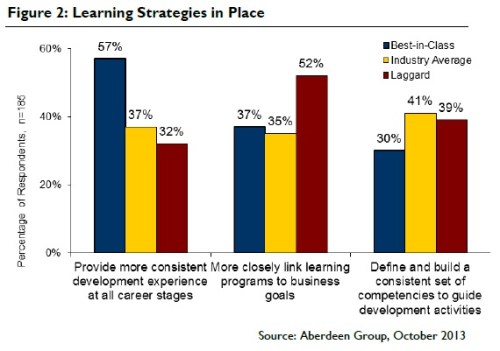
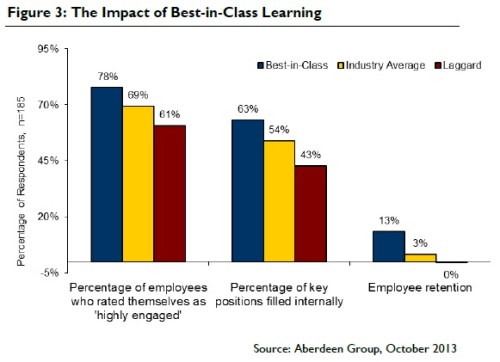
We should use this disconnect to critically examine own our organizations and take a moment to reflect on the factors we know to be important (like learning initiatives). We may acknowledge the importance, even necessity, of such programs, but we should question whether this knowledge is actually being implemented or just internalized. If there is disconnect between awareness and implementation, the question then becomes how to fix it. The data is this report suggests we look to what best in class organizations are doing, and in the case of learning initiatives, a few factors stand out. Best in class organizations are 78% more focused than laggard organizations on providing a more consistent development experience at all career levels, and they are visibly less concerned than industry average or laggard organizations on more closely linking programs to business goals and defining /building a consistent set of competencies to guide development.

Nov 12 fig 2

While these findings may be surprising at first glance, they may suggest that best in class organizations have already been able to link programs to business goals and develop a consistent set of competencies to guide development. This in turn has allowed them the freedom to focus more attention on having dedicated learning programs for individuals at all stages of the employee life cycle.  In the least, the data here can provide a broad set of steps for laggard and industry average organizations to follow in order to reap the benefit of learning initiatives. An added bonus of successfully instituted learning programs? Organizations that use learning programs also see improved performance in employee engagement, their ability to fill leadership positions with internal candidates, and their ability to retain talent.

Nov 12 fig 3

Getting with the program and focusing on the development of talent may seem obvious to you and me – but evidently not so much.

2 Comments

Filed under Aberdeen Group, China Gorman, Data Point Tuesday, Learning/Development, Mollie Lombardi

Ouch! Creativity Spurred by Abuse?

data point tuesday_500

I came across this article from Pacific Standard Magazine the other day and thought it was discussion worthy – certainly a little controversial. And completely at odds with the principles of creating great workplaces from the Great Place to Work Institute. The article discusses a recent study from South Korea published in The Leadership Quarterly, which concludes that a moderate amount of abusive supervision in the workplace prompts employees to be more creative than they would be in an environment with either extremelyabusive supervision graph high or extremely low levels of abusive supervision. The study consisted of a survey taken by employees and supervisors of “a large government-affiliated institute” in which employees rated their supervisor’s level of abusiveness and supervisors evaluated their employee’s level of creativity. The result was a curvilinear relationship between abusive supervision and creativity.

As author Tom Jacob’s points out in the article for Pacific Standard, we could simply take these findings as a critique of East Asian Culture and dismiss them. Since our culture is so different from that of East Asia, what’s the value of this controversial study to us? If we look deeper than the questionable ethics though, I believe there’s some interesting insight into human nature here. We all know the annoying and over-used adage, you’ve got to “think outside the box” to inspire innovation, but I must say that I think actually incorporating the results of this study would be taking it a little too far. Actually, it would be taking it a lot too far. Working to find creative ways to inspire innovation from our employees is growing in importance, but to use this data to “okay” an abusive environment at work, even to okay a moderately abusive manager (which is the type of supervision the study links to the highest levels of employee creativity) wouldn’t just be crossing a best practice line, it would be crossing a moral line.

Besides providing more organizational research on the potentially dark side of leadership, the study reminds us of several core characteristics of human nature that, while basic, are extremely important to our ability to be successful and creative at work, and in our lives. Firstly, stress: the study reminds us that in moderate levels stress is healthy, and even necessary, for us to achieve our goals and prompt us to make new ones. It’s when stress exceeds our ability to cope (like when employees experienced high levels of abusive supervision) or is entirely absent (when employees experienced no abusive supervision) that we become overwhelmed or underwhelmed, unmotivated, and are unable to do our jobs effectively.

The second element of human nature that the study highlights is the importance of accountability. The data remind us that when we have forces holding us accountable (stress in this case) we are more likely to be creative. Employees in this study were held accountable by stress brought on from moderately abusive supervision, and were motivated by a desire to eliminate the tension causing the stress.  Though, let’s be clear here! There are tons of different ways we can hold ourselves accountable and stress is by no means the only way.

Ultimately, I think we all experience enough stress without adding an abusive supervisor to the mix, so don’t leave here inspired to go stress out your employees in an effort to up the ante on their creativity! Just keep in mind that, like it or not, we all do need a wee bit of stress and accountability in our lives. They may seem negative at times, but we can celebrate by knowing that they could just be the necessary ingredient to that next big idea!

1 Comment

Filed under Abusive Supervision, China Gorman, Data Point Tuesday, Great Place to Work Institute

The Love Hate Relationship: Technology and Work/Life Balance

data point tuesday_500

Does technology really help us in our endeavor for work/life balance? This is not a new question, but it remains an open one – if you believe that there is such a thing as work/life balance. I’ve always had a problem with this description and it drives me nuts. The issue is to what degree does work define your life, drive your life, and how do you make choices to live a full life – not a life just filled with work.

But all that aside, my initial response would be that technology aids us in our quest for a balanced life “A LOT” for the idea of working without the convenience of modern technology is certainly painful to contemplate. I would argue, however, that while we all shudder to think of life without remote access, the true relationship between technology and work/life balance may not be as simple as we think. Though helpful, the use of technology provides no automatic guarantee of a more balanced work and personal life, and we would be remiss if we didn’t remind ourselves of this from time to time. I found myself reflecting on this while reading the results of a 2013 global research study conducted by Accenture.

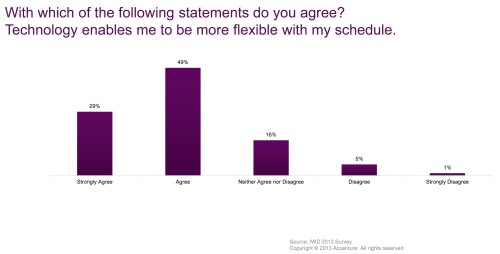
Accenture conducted an online survey to 4,100 business executives from medium to large organizations across 33 countries in order to gain insight on behaviors and attitudes towards women’s careers. One series of results stated “78% of respondents agreed that technology enables them to be more flexible with their schedules.” However, “70% of respondents also agreed that technology brings work into their personal lives.” These two sentiments seem to be in diametric opposition to each other. So what’s the bottom line here? Is technology really helping us balance our work and our personal lives? These results would lead me to argue that I’m not the only one still feeling quite conflicted.

Color_Top_16-9_02_2012

The ability to have a flexible schedule because of the technology at our finger-tips provides a great resource for better balancing work and our personal lives. However, at the very same time these statistics point out that technology’s influence on flexibility can just as easily undermine our quest for life balance as it can help it. This is valuable information. It informs us that to capture the positive benefits of technology on work/life balance we much be proactive in our use of technology, set boundaries around our use, and be aware of what this use entails. Just as we seek to be informed consumers, we must be informed users, and recognize that for technology to help and not hurt our endeavors for life balance we must set personal boundaries in our use. Perhaps this means asking ourselves some “when, what, where, and why” questions about our use of technology. Or maybe this means creating accountability by telling a family member that we will only check email for a certain amount of time while on vacation. There are many options; it’s just a matter of finding one that works for you.

These diametrically opposing statistics also allow us to question the very definition of work/life “balance”. If technology helps us balance life and work as much as it hurts us balance them, I find myself wondering if there was really much “balancing” going on in the first place? Perhaps it’s antiquated to think of work and our personal lives as two separate things we can place on a scale. Instead we could look to these statistics as a clue that true work/life “balance” is not something we can objectively measure on a scale, but the feeling of “having it all” that comes from leveraging the people, places and things in our lives (like technology) to create a sense of harmony.

We’ve all read the articles; we’ve heard the debates about whether technology hurts us, helps us, is “good” or “bad” and we know that technology and the ensuing ability to work from anywhere has probably left traditional “office walls” gone for good. Ultimately though, the question of whether or not technology helps or hurts our search for life balance can only be answered on an individual basis, and it is our individual use and personal choices that will determine whether or  not technology helps us balance our work and personal lives, or if it tips the proverbial scale.

Tell me in the comments section what your take is on the technology and work/life balance relationship!

Leave a comment

Filed under Accenture, Balance, China Gorman, Workflex

The Big Reveal

2013 Best

Everyone wants to work at a great place, and today, they’ll find out if they do. Great Place to Work® is counting down the 2013 World’s Best Multinational Workplaces list during a live, online broadcast today for the first time ever. Join me in congratulating the 2013 World’s Best Multinational Workplaces and follow us at 9AM Pacific Time in the GoLive event when we’ll stream live the reveal of the third annual list of the World’s Best Multinational Workplaces.

Several executives from the top 25 companies will join us on set to share their approaches and successfull practices that help them build, sustain and grow the world’s most coveted workplace cultures. These organizations have thousands of people in different countries working across multiple time zones, and yet, their universal commitment to every employee makes them great beyond any border.

It’s no coincidence that great workplaces are also industry leaders across the board. Client satisfaction, ROI and quarterly earnings all start with the people who make it happen. Year after year, companies that see each employee as a whole person ultimately see the most valuable business results. These companies offer internal programs for personal well-being, provide professional development opportunities, and foster transparent communities for the best talent to connect, learn and succeed together.

We are honored to celebrate these companies and their dedication to sustaining healthy work environments for their employees. They help us achieve our mission of creating a better society by having a positive impact on their people and the communities within which they work.

Join us at 9:00 a.m. Pacific Time today, Tuesday, October 22, to find out who made the 2013 list and hear from the best what it takes to become a Great Place to Work®. http://worldsbest.greatplacetowork.net/index.html

Leave a comment

Filed under China Gorman, Culture, Great Place to Work Institute, World's Best Multinational Workplaces