Category Archives: China Gorman

Decreasing ROI on Human Capital

PwC Saratoga publishes an executive summary every year that picks out noteworthy new data from its US Human Capital Effectiveness Report.  The report covers more than 200 unique metrics related to the effective management of human capital from more than 300 organizations in 12 industry sectors.  The average organization in this year’s report has yearly revenue of $5.5 billion and 19,500 employees.  While PwC Saratoga gathers information globally, this report covers data from US operations only.

This executive summary is not a difficult read – it includes some case studies – and it contains some pretty sobering statistics.  For example:

The revenue per FTE (full-time equivalent) has been declining steadily since 2008 –  by 18% — and has only marginally improved over 2006 levels. During the same time period, labor cost per FTE has grown nearly 14%:

It doesn’t take an MBA to understand that when costs rise and revenue falls:  you have a big problem.  And when labor costs rise and productivity declines, HR has a big problem.

The continued growth in labor costs per employee could be surprising to some given the relatively flat increases that trended during the recession.  According to this survey data, however, even during the darkest days of the recent recession, compensation costs per FTE (without healthcare or other benefits) increased year over year.  Surprising no one, though, health care costs increased year over year with the exception of 2009-2010.

The bottom line is that while the all-in cost of labor is going up, the revenue produced by that labor is decreasing, thus the diminishing ROI of human capital in the U.S.

While this might look like bad news for HR – do they really understand the dynamics of business? – it actually creates the beginning of the business case for increased investment in workforce planning, productivity and engagement.

Turning these trends around will take clear-eyed assessments of the current state, deep knowledge of solutions and the ability to connect the dots between multiple organization and environmental dynamics, compelling fact-based business cases for new investment and the courage to take bold action.

Want to be a strategic business leader?  This may be your best opportunity yet!

7 Comments

Filed under Average Wage, Business Case, Business Success, China Gorman, Connecting Dots, FTE, Full Time Equivalent, HR Credibility, Human Capital ROI, PwC Saratoga

Getting leave management wrong has consequences — and they aren’t what you think!

Leave management is one of those tactical HR functions that we’re required by law to get right.  With more than 300 state, local and federal laws/regulations with which to comply, U.S. employers have to stay on top of an ever-changing morass of guidelines that impact their employees in very personal ways.  It’s not just about vacation or PTO.

Workforce Management has published trend survey data on this topic and even though the subject of tracking employee time off is pretty tedious, the issues surrounding it are business critical.  The 2011 trend survey, published in early 2012 and sponsored by WorkForce Software, is amazingly interesting. I know, surprising, right?

For example, unless you’re the one responsible for ensuring compliance with all applicable laws/regulations, did you know that 40% of employers report an error rate of 3 or more unearned leave days per 100 employees per pay period? That’s pretty big from a payroll expense perspective.  And what do you do when you find out? Clawback the unearned time? And how do you do that? Take time out of next year’s leave pool? Ouch.

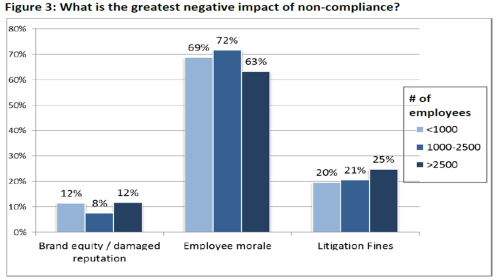
That’s why I found it really interesting that when the survey asked employers what the greatest negative impact of non-compliance was, Employee Morale was far and away the biggest impact. Regardless of the employer’s size.

Here’s why this makes sense to me:  I learned early in my leadership career that you have to get employees’ compensation right. You have to pay them the right amount; you have to pay them on time; and you have to manage their time off accurately. You can’t screw up any of these and not impact morale. And if you screw up any or all of these up more than once you’re sunk.

And so it really isn’t surprising that more than litigation fines/costs and brand equity/reputation, employee morale is HR’s biggest concern in ensuring compliance in managing time off. I don’t think this concern is driven by the old “touchy-feely” rap that HR used to get. This is cold, hard reasoning about the cost to the engagement and retention of employees if the organization can’t get the basic building blocks of paying people correctly right.

So reducing the error rate isn’t just about reducing payroll dollar mistakes, it’s about productivity and morale. There’s more interesting data in this report. You can download it here.

1 Comment

Filed under China Gorman, Connecting Dots, Engagement, HR Data, Leave Management, PTO, Talent Management, Workforce Management, WorkForce Software

“Survey Says…”

I was talking to a friend in the research/analysis business the other day and she lamented that there didn’t seem to be a firm understanding of the definitions of FTE (Full Time Equivalent) or Head Count in the HR world. Specifically, she shared that when research firms like hers send out surveys to HR professionals there frequently are demographic questions that include asking how many FTEs are in the HR function in their organization.  My friend has been frustrated by the frequency of responses that show the confusion between the definitions of FTE and Head Count and how that impacts the ability make accurate conclusions from the rest of the survey responses.

Here’s the thing:  I know that HR professionals know the difference between FTE and Head Count. But somehow, when surveys need filling out, confusion reigns.

I’ve spoken to a number of HR folks over the last couple of weeks and asked what the head count in their HR department was. They quickly came up with a number and the answer usually started with “…around…”   Then I asked what their budgeted FTEs were.  Regardless of the size of the organization, the answer started with, “well, I’m not sure. I’d have to look that up.”

HR people know head count, that’s for sure – or can come pretty darned close.  But they first ask if you want them to include temps, interns and other “off the budget” people. They literally count heads. Which, of course, is correct. Thus the term, Head Count.

If you ask for FTEs, they are frequently not sure. FTE seems to require preciseness; head count, not so much.  Maybe it has to do with the budget.  Budget-related = official:  “I’ll look it up.”  Not budget-related = unofficial:  “I can get close.”

Here’s  how SHRM defines FTEFTE is an abbreviation for full-time equivalent, which represents the total labor hours invested. To convert part-time staff into FTEs, divide the total number of hours worked by part-time employees during the work year by the total number of hours in the work year (e.g., if the average work week is 37.5 hours, the total number of hours in a work year would be 37.5 hours per week x 52 weeks = 1,950 hours). Converting the number of employees to FTEs provides a more accurate understanding of the level of effort being applied in an organization. For example, if two employees are job sharing, they constitute one FTE.

So there is a difference; and sometimes it’s a big difference.

The next time you receive a survey from SHRM, a research organization, or your C-suite, and it asks for FTE information, don’t confuse Head Count for FTE – and go ahead and look it up!

2 Comments

Filed under C-suite, China Gorman, FTE, Full Time Equivalent, Head Count, HR, HR Data, SHRM, Survey

Data Analytics: Too Sophisticated for HR?

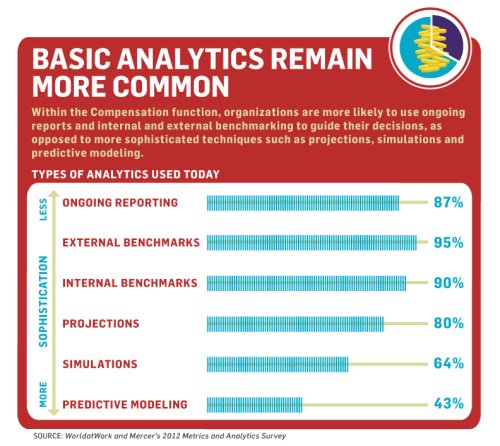
Mercer and WorldatWork have collaborated again on a survey and report about current total rewards/compensation trends in metrics and analytics.  The focus of the research was to understand what types of analytics are currently being conducted and what technologies are being used to conduct them.

It’s an interesting report – especially from the vantage point of what it says about the relationship between HR and data and HR and analytics.  The survey was fielded in February, 2012 to compensation leaders who are WorldatWork members (the dataset held 560 scrubbed responses , a final 10.9% response rate), so they all have more than a passing knowledge of the total rewards function.

The big takeaways of the survey data are that:

  • Rather than use sophisticated analytical approaches like projections, simulations and predictive modeling to support decision making, organizations are more likely to use ongoing reports and benchmarking from internal and external peer groups.
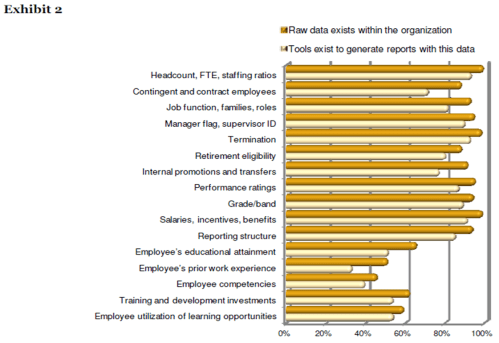
  • Survey respondents report lack of access to and confidence in data regarding education competencies/capabilities and training investments – critical to workforce analytics.
  • Compensation professionals may be falling behind their colleagues in other HR functional areas in their adoption of more sophisticated analytics methodologies.

The report discusses why adoption of more powerful analytics is low despite 67% of respondents indicating adequate skill levels to engage in higher level analytics and almost half (47%) having 1 -2 FTEs tasked with HR-related analytics.  More important, 75% of the respondents reported that C-suite executives in their organizations have asked for workforce projections, simulations or predictive modeling.

Mercer and WorldatWork point out that while respondents report that some data is not available or of poor quality, 75% of respondents say their organizations are working to improve the consistency of their data. Paradoxically, 52% are unclear where responsibility for data integrity lies.

I found it interesting that the researchers suggest that “unavailable” data may result from a lack of interest in the data rather than an ability to access it.  A compelling point.

From the responses outlined in the exhibit above, one could readily agree with the researchers that critical workforce information about education, competencies, prior work experience and investments in training aren’t top of mind for compensation professionals. It could easily be that compensation professionals believe these datasets and their analysis more naturally belong to other HR functions:  learning/development and talent management/acquisition.

The writers argue that rewards/compensation professionals have a preoccupation with the behavioral side of rewards and overlook the “asset side” – the impact of rewards on the ability of the organization to acquire appropriate talent.

The bottom line for the researchers is to encourage rewards/compensation professionals to begin to think more expansively – and use higher levels of analytics – on the role of rewards in driving human capital development and business success and focus a little less on salary competitiveness and pay-performance sensitivity as performance drivers.

A very interesting report and very useful data as you begin to plan your 2013 budget.  Stepping up your workforce analytics sophistication could be a game changer for your organization.

4 Comments

Filed under C-suite, China Gorman, Employee Benefits, Engagement, HR Analytics, HR Data, HR Technology, Mercer, Rewards & Recognition, Talent Management, Total Rewards, WorldatWork

A Day in the Life…

One of many things that SHRM does well is to try to evaluate the services it provides to its members. So I wasn’t surprised that SHRM sent me an invitation to evaluate my experience at this year’s Annual Conference in Atlanta. And I tried to be honest. But really, how do you give feedback to an organization that executes its biggest event so well – year in and year out?

But I’ve been thinking about the question that asked what I would recommend for future Annual Conferences.  I gave a quick answer.  And I’ve been thinking about it more and I’d like to expand on my answer.

I suggest having a series of sessions called “A Day in the Life of…”  When I answered the question I was specific: engage one of the CHROs in the Fortune 100 to describe what their job and life are really like as an example for emerging HR leaders to see. We don’t see many CHROs on any stage at SHRM. I understand all the reasons why we don’t see them, but I think SHRM needs to try harder. Presenting a role model in the flesh would be high impact.

But as I’ve been thinking about it, why not also have sessions with CHROs from a privately held company with 5,000 employees, from a public company with 25,000 employees, from a large education institution, from a think tank, from a large national non-profit, and from a pre-IPO tech start-up? Not a panel discussion. A session by each of them, individually.

Not everyone in HR wants to be the CHRO of GE, but some do. Not everyone in HR wants to be the CHRO in a privately-held company, but some do. Show them what it’s like. Show them what it takes to get there – and stay there.

And then I thought, well, how about other functions? What’s it like to be the Chief Marketing Officer in the Fortune 100 – and what do they think about and want from HR?

How about a day in the life of the CFO of a global public retailer – and what they think about and want from HR?

How about the Chief Information Officer at a large privately-held technology company?

And how about the head of Total Rewards in a Fortune 250 company – how did they get there?

The head of Talent Acquisition in a Fortune 500 company – how did they get there?

The Chief Learning Officer in a global hospitality company – how did they get there?

You get my drift. A series of “A Day in Life of…” would put real leaders on the podium to share what works for them and what doesn’t work for them.  How they got there and what they’d do over again and what they would skip. And from everyone:  what advice for emerging or aspiring HR leaders.

Not only would this be interesting for intentional HR professionals, it would be helpful for those who got here by accident and aren’t sure where to go, whether or not to stay, and what is possible.  Holding successful HR (and other) leaders up for conference attendees to hear from and get coaching from might be the next big step in speaker impact that SHRM is looking for.

As with most good ideas, this came out of several conversations I had with HR leaders in Atlanta. Thanks. You know who you are.

8 Comments

Filed under China Gorman, Conferences, HR, HR Conferences, SHRM, SHRM Annual Conference

Is HR in a Bad Mood?

Results from The Fifth Annual Talent Management Study by Knowledge Infusion and Human Resource Executive® were published recently in HR Executive by Mike Brennan and some of the findings were surprising.

I didn’t find it surprising that 63% of the respondents report that they have trouble filling jobs and that they can’t find the right candidates. That’s been reported frequently.

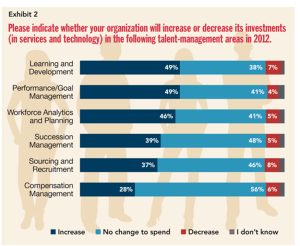
It also doesn’t surprise me that more organizations than not will be increasing their investments in Learning/Development, Performance/Goal Management and Workforce Analytics/Planning services and technology. That’s obvious.

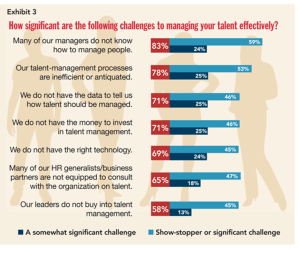
What really does surprise me is that 58% of HR executives believe that peer leaders in their organizations “do not buy into talent management.”

Lordy, I hope this isn’t the furniture conversation. And I’m willing to believe it isn’t because 83% of the respondents also believe that “many of our managers do not know how to manage people.” Additionally, 65% of the respondents believe that “many of our HR generalists/business partners are not equipped to consult with the organization on talent.”

Ouch. Either the HR respondents to this survey were all in a colossally bad mood, or they’re starting to look clear-eyed at their organizations and re-calibrate their challenges.

It’s clear that many organizations need to look at legacy systems and programs in the talent management arena (can you say annual performance review system?) and, according to this survey, they are. But focusing on leadership understanding and managerial effectiveness in talent management might be a strong first step.

It’s a great day for HR if the results of this survey mean a new focus on talent management effectiveness – at the top, in the middle, and most importantly, in HR.

But if it was just a systemic bad mood, we’re sunk. Because, in the words of one of my favorite movie characters in one of my favorite movies, “we have serious problems to solve, and we need serious people to solve them.”

7 Comments

Filed under American President, China Gorman, HR, HR Credibility, HR Executive Magazine, HR Technology, Knowledge Infusion, Managerial Effectiveness, Talent Management

It’s a Wrap!

Well…another SHRM Conference is in the can. In Atlanta. In the Georgia World Congress Center. More than 13,000 attendees – with more than 1,000 from outside the U.S.

Here’s my assessment:  no one does HR conferences like SHRM. Period.

  • More than 200 concurrent sessions
  • High profile keynote speakers
  • World class entertainment
  • More than 800 exhibitors in the Expo Hall
  • Social media integrated throughout
  • Involvement of more than 700 local SHRM member volunteers
  • More than 350 SHRM employees

The SHRM Annual Conference is the single largest gathering of HR professionals anywhere in the world – year in and year out. And it’s motivating and exciting to be a part of that.

And while the mechanics are impeccable, the content engaging, and the crowds impressive, the real value of a gathering like this aren’t the mechanics, content and crowds. The real value of SHRM is the personal connections we make, the conversations we have, the meeting IRL of people we only know through social media, the meeting IRL of people we read about in HR Magazine, the private coaching from our mentors, the chance meetings of people who will be new personal and professional friends.

On second thought, it’s not actually a wrap, my friends. It’s a hug. It’s a hug from our profession. It’s a hug from our colleagues, our heroes, our game changers.  And who doesn’t need a hug from time to time?

4 Comments

Filed under China Gorman, Conferences, HR Conferences, SHRM, SHRM Annual Conference

Certificates: the New Associate’s Degree?

Georgetown University’s Center on Education and the Workforce has published a new report:  Certificates: Gateway to Gainful Employment and College Degrees. I’m a big fan of a previous report from these authors, Help Wanted: Projections of Jobs and Education Requirements Through 2018 and wrote about it here.

This new report gives a clear look under the hood of one of the staples of our post-secondary education infrastructure: the certificate.

Take a look. It’s not a hard read.

Uniquely American, certificates are widely varied in their positive impacts and largely ignored by private, public and government socioeconomic surveyors. The study’s authors contend that if certificates “with a demonstrated labor market value” were counted in official post-secondary surveys as “credentials” they would improve the U.S.’s post-secondary completion position from 15th to 10th among industrialized nations (OECD countries).

And 1 million certificates were awarded in 2010 – up from 300,000 in 1994.

Interesting data from the report include:

  • Certificates are the fastest growing form of post-secondary credentials in the U.S. increasing from 6% in 1980 to 22% today
  • 20% of certificate holders go on to get two-year degrees
  • 13% of certificate holders go on to complete four-year degrees
  • Workers with certificates earn an average 20% more than workers with just high school degrees

As talent management and HR professionals continue to struggle to find “qualified” workers to fill their openings, perhaps a new look at the experience and credentials they require might open a large segment of fully qualified workers – those with certificates instead of college degrees.

Something to think about.

5 Comments

Filed under Career Planning, Certificates, China Gorman, Demographics, Education Deficit, Employment Data, Post-secondary education, Talent Management, Talent pipeline, Unemployment

Maximizing Your Conference Investment

This is an updated post from August 2010.

The 2012 SHRM Annual Conference is just around the corner.  Word has it that there will be many first-timers in attendance.  This is for them — and for other attendees who want to be sure they maximize the financial and time investments they’re making.  Here are three proven strategies for making sure you get your money’s worth.

Sessions

Conferences generally have 3 types of content sessions:

  1. General Sessions:  these are sessions that are intended for the full complement of attendees.  The speakers are typically big names in the industry who speak on universal topics relevant to the conference theme or they are big celebrity names meant to draw your attendance to the conference.  SHRM does both — and usually always has a movie star or TV personality on the big stage.  Big names sell tickets, folks.  Think of them as the motivational part of the conference.
  2. Concurrent Sessions:  these are the main content tracks that are scheduled throughout the conference.  Each time slot will hold multiple options for your consideration.  Designed for smaller subsets of the conference attendees, these tend to be led by consultants, academics and a few practitioners and are focused content of a practical nature.  Think of them as the skill building part of the conference experience.
  3. Sponsor Highlights:  these are sessions that feature a sponsor or exhibitor’s product or service, are marketing-focused in nature, and come as part of their sponsorship/exhibitor fee.  SHRM doesn’t do this very often — but the exhibitors frequently hold mini-sessions in their booth space in the expo hall.  Don’t dismiss them.  You can get great information about what’s new and cutting edge as well as scope out potential new partners.  (I’ll be conducting mini sessions in the Achievers booth on Sunday and Monday.  Come over and say “hi.”)

In a typical two-and-a-half- or three-day conference, it’s important to select wisely the sessions you want to attend – and in advance.  But it’s also important not to over-schedule yourself (more on that later). I recommend attending all the General Sessions.  The big names generally have value and the celebrity speakers are usually engaging, entertaining and motivating.  Then attend concurrent sessions in about 60-75% of the time slots.

Save Time For Networking

One of the particular values of attending a conference in person (as opposed to an online conference or a series of webinars) is the opportunity to meet other like minded people.  Look at the list of presenters.  Look at the list of sponsors/exhibitors.  Find out who else will be attending.  Then target 4-8 people that you’d really like to meet and talk with – and find them at the conference.  Leaving time in your session schedule to set short appointments when you find people on your target list will allow you to be thoughtful in creating new relationships.  Don’t pass up the opportunity to learn from industry pros – who, by the way, also want to network and meet people just like you!

You know how to network, right?  You prepare for these opportunities in advance by identifying what you’d like to talk about with each target and prepare 2 or 3 questions to get the conversation rolling.  You can ask everyone the same questions, or you can customize your approach to each person.  Your confidence will be strong as you introduce yourself to these folks and you’ll be surprised how amenable perfect strangers are to meet and talk with you.

If you aren’t on Twitter or FaceBook, now would be a good time to start accounts.  Many of the people you want to meet are using social media to connect with new and old friends.  I’ll be there.  Connect with me.  On Twitter I’m @ChinaGorman and it’s easy to friend me on FaceBook.  Just mention #SHRM12 in the invitation and I’ll accept.  Social media will be prevalent in Atlanta.

Nothing is More Attractive Than a Smile

As you walk the conference halls and expo aisles, make sure your demeanor and body language is open.  And smile.  Intentionally.  You’ll appear open, friendly, not intimidating or intimidated.  Really, there’s nothing more attractive than a smiling face.  And there’s nothing that builds your confidence to approach strangers than acting open and welcoming.

Attending a conference and getting your money’s worth isn’t hard.  But it takes some forethought and planning.  Both you and your organization want to realize the investment it took to get there.  Make sure you get the full value of the experience.

5 Comments

Filed under Achievers, China Gorman, Conferences, HR, HR Conferences, SHRM, SHRM Foundation, Talent Management

The Wisdom of CEOs

Booz & Company recently published its 12th annual CEO Succession Survey. It’s fascinating reading:

  • As the economy gets stronger, the numbers of CEOs leaving their jobs are rising to pre-recession rates
  • CEO turnover is highest at the largest companies
  • CEO turnover is highest in market sectors that face the most challenges
  • Outsider CEOs returned to historical averages
  • Insider CEOs bring higher returns
  • Insider CEOs serve longer
  • The combined chairman-CEO model continues to decline

With average CEO tenure declining, the survey’s data are clear that new CEOs – whether they come from the inside or the outside – are under historically high pressure to perform quickly.  (Can you say Leo Apotheker?)  And concerned boards are more frequently appointing the outgoing CEO as board chairman to provide a sort of “apprenticeship” experience in the early months of a new CEO’s tenure.  Interesting stuff.

This year, the study focused on the new CEO’s first year.  Booz & Co. interviewed a number of CEOs from around the world and asked their advice for incoming CEOs.  There were 7 common recommendations:

  1. Deal with the obvious executive team changes as early as possible
  2. Be wary of changing strategy too quickly, even if you think the current strategy is wrong
  3. Make sure you understand how every part of the company operates and how it is performing
  4. Build trust though transparency
  5. Be selective in listening to advice
  6. Find a sparring partner with whom you can discuss plans openly
  7. Manage your time and your personal life with care

The survey provides a great deal of background data and commentary on these 7 “tips” for succeeding as a new CEO — and I encourage you read it.  But I’m thinking this is great advice for any new executive at any level.

And I’m really thinking this list is great coaching for HR.

6 Comments

Filed under Booz & Company, Business Success, C-suite, CEO Tenure, CEOs, China Gorman