Category Archives: HR Data

Annual HR Systems Survey Analysis Is Here!

data point tuesday_500One of the highlights of the HR Technology Conference each fall is the publication of the annual HR Systems Survey White Paper by Sierra-Cedar. With the retirement of long-time analyst Lexy Martin, Stacey Harris has stepped up magnificently and published a whopper of an analysis of all things HR tech, the 18th since 1997.

Sierra-Cedar encourages the dissemination of this white paper and I encourage you to download it here because it’s full of interesting survey data analysis. Here are a few high level nuggets from the executive summary:

  • This is the year of the Enterprise HR Systems Strategy: 43% of organizations are undertaking a major HR systems strategy initiative

  • HR organizations achieve higher levels of HR, Talent and Business outcomes by embracing their organization’s culture.

  • We’ve hit the tipping point: over 50% of purchased core HRMSs are SaaS solutions.

  • More than 50% of organizations are using new Talent Acquisition tools outside of their applicant tracking systems.

As organizations invest more time, attention and financial resources in HR management solutions, Sierra-Cedar sees three primary outcome models for these investments: Talent-Driven, Data-Driven and Top Performing. It’s good to see organization principles for how business spend their money and time. And these three buckets make good sense. We could probably all tick off well-known brands in each of those buckets. As a business leader, I find it interesting to see the comparison between talent-driven outcomes vs. data-driven outcomes.

Here’s one of many charts in the report that I found interesting:

Sierra Cedar 2015 2It is interesting to note here that the business outcome measures – especially market share and profitability – trend higher across the board. A great reminder that using data and business intelligence to be smart about talent makes the business more successful.

I love reading this report each year. It provides a frame of reference for what’s new, what’s old and what’s coming. If your organization is currently thinking through the effectiveness of any of your suite of HRMS solutions, this is a must read. If your organization is not currently thinking about the availability of HR related business intelligence, this is a must read. If your current HRMS solutions all live on premise, this is a must read. Come to think of it, if you’re in HR, this is a must read.

You can download it here. And then read it. Really. And then send Stacey Harris a thank you note.

2 Comments

Filed under China Gorman, Data Point Tuesday, HR Data, HR Technology, Sierra-Cedar

Today’s Frontier is NOT Technology

data point tuesday_500I’m not sure where I ran across this report from Interact Authentically, Disengagement and Separation of the Virtual Worker. But I’m glad I found it. What actually caught my eye as I was reading it, were the last two sentences:

“We cannot forget our most basic core goal in business: to create connections and relationships. Today’s frontier is not the technology required to run a global company – it is applying technology while bringing along the nurturing, engaging aspect of human communication.”

That really resonates with my work on the WorkHuman project with the Globoforce folks.

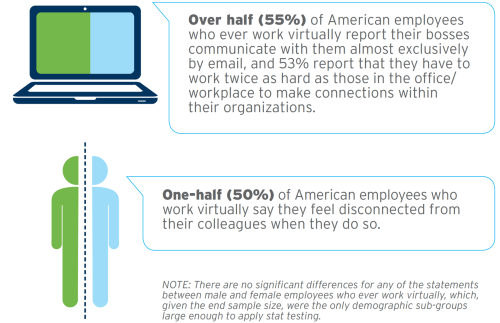
The report, published in January, analyzes a survey conducted by Harris Interactive among 2,026 adults over 17 years old in the United States. Here’s an interesting data point that may interest you: nearly two-thirds (63%) of U.S. employees report that they ever work virtually. Surprised? I was. Given the heated discussions about the lack of workplace flexibility and work/life integration, that’s a lot of people with at least some flexibility. And over two-thirds of those folks think their management needs to communicate better in order to keep them engaged.

Other findings of note:

Interact Sept 29 2015The message seems clear – flexibility to work from home isn’t enough for employees. They still need to feel the love from their bosses. In fact, working from home requires managers to do more to keep their employees feeling engaged and that they have a human, real relationship with the organization, their work, and their boss.

Certainly not rocket science. But a good reminder that the big challenge isn’t finding the right technology to enable more flexible work arrangements. The big challenge is keeping the humanity flowing when employees are isolated from their colleagues and bosses.

Here’s a thought: maybe Marissa Mayer wasn’t crazy after all!

2 Comments

Filed under China Gorman, Data Point Tuesday, HR Data, Interact Authentically, Work Life Balance, Workflex

The Optimal Technical HR Stack

data point tuesday_500I’ve written previously about the new research coming out of KeyInterval Research here and here. The third report from the dynamic duo that is Tincup and Sumser is out now and it’s a blockbuster! Determining the optimal technical HR stack is big. It’s big and expensive. It’s big and expensive and can make or break an HR leader’s career.

But first, you have to know what a technical stack is. I don’t assume that the majority of HR professionals know what this is, so here’s what Wikipedia says:

“A technology stack comprises the layers of components or services that are used to provide a software solution or application. Traditional examples include the OSI seven-layer model, the TCP/IP model, and the W3C technology stack. Technology stacks are often articulated as a list lof technologies, such as “J2EE with Java Server Faces running against a SQL Server database” or as a diagram.”

So a Technical HR Stack would be the collection of technologies/solutions that HR uses to manage all the people processes across an organization. It’s the payroll, recruiting, performance management, total rewards/recognition, learning management systems – all of these and more. And an Optimal Technical HR Stack would be the best collection of technologies/solutions that HR would use to manage the people processes across an organization.

I read some research 3 or 4 years ago that reported that organizations deploy, on average, 18 separate HR technology solutions – many of which are unable to connect with each other. These days the average may well be higher as HR professionals (and their IT partners) turn to technology to provide more efficient outcomes and the HR vendor community continues to innovate the use of SaaS, analytics, mobile and video.

So how can an HR leader or department make sense of the opportunities to apply technology, much less identify the “optimal” vendors and solutions? Well, the first step would be to buy this report. The analyses are practical. The insights are remarkable. This is a sea change in showing how HR technology is working – or not working – and what is actually happening in terms of finding solutions in an existing suite, looking for new providers or developing home grown solutions. The realities will surprise you.

The report delves into thirteen major areas of HR Technology and reveals 8 separate metrics in each area. The metrics include some of these:

  • Market Penetration
  • Net Promoter Score®
  • How long companies keep their software
  • Whether companies outsource, develop internally or use a tool that is part of an existing suite

The areas covered are:

KIR Optimal HR Stack July 14 2015It’s interesting to note that as a result of their research, nine other areas of adoption will be added to their research agenda for 2016. Some of those are Engagement, Collaboration Tools, Video Interviewing, and Assessment.

Without giving away the groceries here, some of the interesting findings include the following;

  • The components (see above) with the highest and lowest NPS® scores are not what you think
  • The replacement cycle (the amount of time between purchases) might be exactly what you would predict
  • The frequency of developing homegrown solutions is pretty low
  • The market penetration of the components is less than you would have predicted
  • The likelihood that a component is outsourced is surprising
  • Vendor brand recall is pretty high

Let’s look at just one of the thirteen solution components:  Recruiting Systems. The analysts at KeyInterval believe that “Recruiting is where innovation happens most frequently in HR.”

“With between 12 and 20 sub-processes, recruiting operations rarely use all of the same tools in the same sequence. Unlike other HR functions recruiting techniques vary by job, industry, region, corporate culture and, business model.” Because of this, the analysis shows that practitioners don’t much like their recruiting systems. The conflict between the required fast action of identifying, recruiting and hiring the right kind of talent, and the legal requirements to collect and retain hiring data often collide. Indeed, the KeyInterval research shows that no other tool in the HR Tech Stack is so conflicted. HR professionals “routinely expect innovative results and performance from a system that is designed to mitigate legal risk.”

If you’re thinking about going to the market for a new HR technology solution, or you’ve finally decided to replace an existing solution, this report should be your first stop. It will help you see what other organizations your size are doing – buying, building or outsourcing. It will provide a road map for how to begin.

Here’s the thing:  it will make you smarter than you already are. You can order it here.

1 Comment

Filed under #HRTechTrends, China Gorman, Data Point Tuesday, HR Data, HR Technology, KeyInterval Research, Recruiting

Millennials To Business: You’re Doing It Wrong!

data point tuesday_500

Deloitte’s 4th annual Millennial Survey sends a message from more than 7,800 degreed and employed Millennials from 29 countries around the world to employers: “Business should focus on people and purpose, not just products and profits.” It’s easy for the Gen Xer and Baby Boomer business leaders to respond to this message with the corporate equivalent of “Get off my lawn!” But that would be short sighted, since the Millennials are now officially the largest age group in the economy and we need them. And we need them pretty desperately.

In this world of Big Data one can find a survey analysis to prove any position. Pretty much. And I am generally wary of survey analyses that play up differences between the generations in the workplace because my go-to research from the Great Place to Work® Institute shows that – in the workplace, at least – every person, regardless of generation, wants 3 things:

  • Resepct – including appreciation and fairness
  • Work that gives meaning to their lives and makes them proud
  • Camaraderie with their workmates

These three dynamics in a culture power all kinds of good outcomes and they show little differentiation between age cohorts regardless of industry, geographic location or size of business.

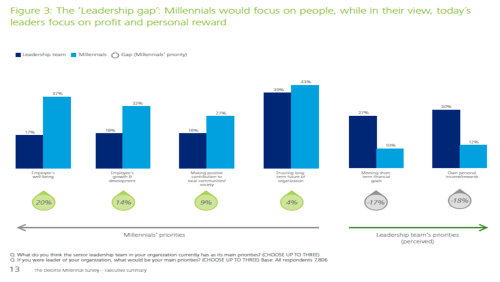
So I take with a grain of salt the results of surveys like this and still recommend that you read them. They provide interesting insights that can add color to your own questions and planning. And the graphs show some interesting gaps in the perception of what Millennials believe “should be” in contrast to “what is.” These are useful insights.

“Today’s Millennials place less value on visible (19%), well-networked (17%), and technically-skilled (17%) leaders. Instead, they define true leaders as strategic thinkers (39%), inspirational (37%), personable (34%) and visionary (31%).”

Deloitte Millennial survey 1

That’s troublesome for celebrity CEOs but good news for the rest of us.

The last 15 pages of the report show graphs that depict Millennials’ takes on the purpose of business, business performance and employee satisfaction, leadership attributes, their skills, and the gender gap regarding leadership readiness and leadership aspirations. Interesting stuff.

But these data points also underscore the growing global focus on creating more human workplaces. The resounding success of the recent WorkHuman Conference produced by Globoforce, is another piece of this trend. My belief is that while all of us want a more human workplace: Millennials are just demanding it more than those of us who were socialized in a less human era. And they are voting with their careers.

The results of surveys like this one from Deloitte give us directional information to use when considering the challenges of growing our businesses, attracting the right talent, and developing and retaining the talent we need to succeed in our competitive marketplaces. And to make our workplace cultures more human.

2 Comments

Filed under China Gorman, Data Point Tuesday, Deloitte, Globoforce, HR Data, Leadership, Millennials, WorkHuman

Working in the “Gig Economy”

data point tuesday_500

Last week I introduced you to Mary Meeker’s Internet Trends 2015 report which I suggested should be required reading for HR. This report, which really should have been titled, The Internet in 2015 Is All About HR, shared important data points and analysis relating to basic HR functions and the impact the internet is having on basic organization functions.

This week, I’d like to point out the McKinsey Global Institute’s new report, A Labor Market That Works: Connecting Talent With Opportunity in the Digital Age. Even if you only the read the Executive Summary, this is worth your time. It’s full of employment-related data from the major global economies as it links those statistics to the growing impact of online talent platforms – and their potential, in the gig economy, to transform both the employer/employee relationship and how workers find work and build economic opportunity. It’s important information and their analysis of (mostly) Linkedin data are arresting.

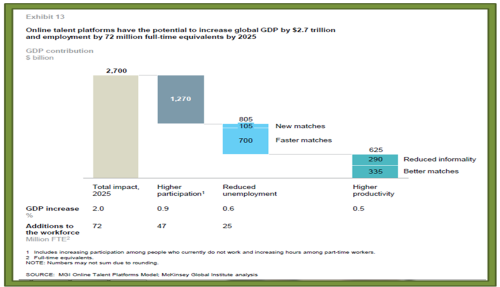
The report is organized into three broad topics: Better, fast matching; Economic impact; and Talent management for companies. All three topics could sustain a full report on their own, but I’ll focus on the second: Economic impact. The gig economy powered by online talent platforms, by their analysis, will be contributing $2.7 trillion to global GDP by 2025. They do the math by analyzing three channels of impact:

  • Increasing labor force participation and hours worked among part-time employees
  • Reducing unemployment
  • Raising labor productivity

McKinsey Exhibit 13 June 9 2015

This adds 72 million workers to the global workforce and adds a full 2% to the projected world GDP for 2025. The largest impact, $1.3 trillion, come from great labor participation and more hours worked. Shortening job searches and creating matches that would not have been otherwise will lower unemployment rates, creating the second biggest impact at $805 billion. The third biggest impact is the increase of productivity through higher quality job matches and a shift to formal employment from informal grows global GDP by $625 billion.

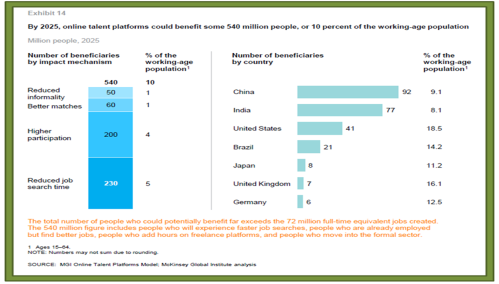
But their analysis also shows that the positive impact of the gig economy is greater than dollars as 540 million people (nearly 70% more than the current population of the United States) will benefit from these new ways of connecting workers to work. That’s big, right? And that’s only 10 years from now.

McKinsey Exhibit 14 June 9 2015

As an HR leader, are you concerned about the talent pipeline? Having trouble filling your current open positions? Wondering if the use of internet based solutions will produce better results? The real question may be, “how fast can I start implementing online talent platform solutions in order to connect workers to the work we have available?”

The report continues to make the economic case for the positive impact of internet enabled platforms by predicting their use could reduce public spending on labor market programs, allocating as much as $89 billion/year from unemployment benefits savings to education and vocational training programs to ensure a skilled talent pipeline. McKinsey also predicts that online talent platforms may increase innovation, strengthen productivity and generally “improve the development of human capital across economies.”

This is Big Data at its best: boiled down to useful constructs. The full report is 100 pages. I recommend that you download it and take it section by section. I think you’ll be glad you did.

1 Comment

Filed under Analytics, Big Data and HR, China Gorman, Data Point Tuesday, Gig Economy, HR Analytics, HR Data, McKinsey, Online Talent Platforms

Improve Corporate Performance: Invest in Leadership/Talent Development

data point tuesday_500The relationship between talent and financial performance has been an “intuitive” given to enlightened leaders for a long time.

“Top executives intuitively understand that they cannot win without the right people and the right skills.”

Thanks to recent work by Boston Consulting Group (BCG) it’s no longer intuitive. The data are in and they are convincing. BCG fielded its Global Leadership and Talent Index survey of 1,263 CEOs and HR directors of global companies in 85 countries. The results are compelling to say the least.

The high level findings include:

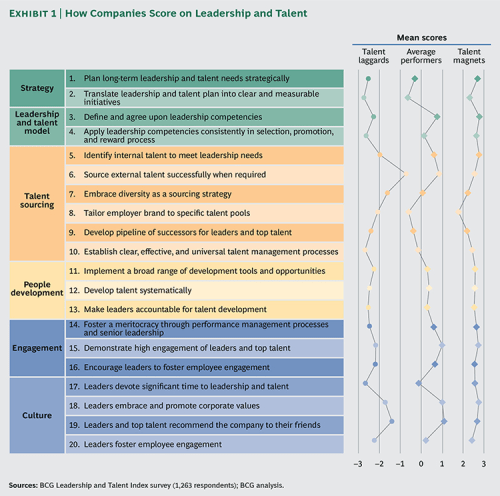
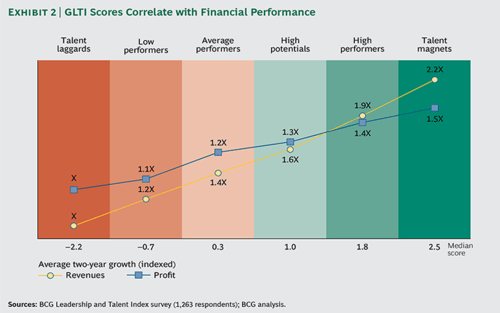
  • Leadership and talent management capabilities have a surprisingly strong correlation with financial performance. “Talent Magnets” – those companies that rated themselves strongest on 20 leadership and talent management capabilities – increased their revenues 2.2 times as fast and their profits 1.5 times afast than “talent laggards,” or those companies that rated themselves the weakest.
  • The performance spread on leadership and talent management capabilities was wide. The talent magnets had an average capability score of 2.5 (on a scale of -3 to 3), while the talent laggards had an average score of -2.2.
  • Companies – even talent laggards – that move up just one level will experience a distinct, measurable, and meaningful business performance return.

With organizations spending an estimated $40 Billion (yes, Billion!) worldwide on leadership and talent development, these findings may enable leaders all over the world to re-orient their priorities, investmemts and behavior on talent/leadership development and gain the critical involvement and support with all the members of the C-suite.

Through their research BCG divided leadership/talent management capabilities into six categories:

  • Strategy
  • Leadership and talent model
  • Talent sourcing
  • People development
  • Engagement
  • Culture

And it’s interesting to note their definitions require a great deal of accountability from leaders. This is a differentiated approach and one that should spur some thoughtful analysis by HR leaders. The chart below lays out the performance differences between the lowest organization performers – Talent Laggards and the highest organization performers – Talent Magnets and the average performers in between.

BCG May 5 2015 3Interesting, yes? What’s even more interesting, then, are the data connecting these leadership/talent management performance levels with business outcomes. Take a look:

BCG May 5 2015 2In addition to proving the real correlation between leadership/talent management performance and financial performance, a valuable take away from this data is BCG’s conclusion that

“The companies that excel at leadership and talent management have figured out how to involve their leaders, not just the HR team, meaningfully and regularly in people development. “

The one-two punch of investment in leadership/talent development and significant accountability of senior leaders should help HR leaders around the world create successful business cases for moving leadership/talent development investments forward. Let’s get ready to rumble…

2 Comments

Filed under Boston Consulting Group, China Gorman, Data Point Tuesday, HR Analytics, HR Data, Leadership Development, Talent development

Big HR Data By Any Other Name

data point tuesday_500I’m mindful of Laurie Ruettimann’s blog post from a couple of weeks ago wherein she put it straight out: HR Research Isn’t Research, It’s Marketing. She ends her post with this: Remember — today’s HR research is marketing, wrapped up in survey data, presented for consumption as sales collateral. And, of course, she’s right. Lots and lots of surveys are fielded in the HR space by consulting firms, service and products providers, professional associations, academics, writers – heck, by anyone who wants to sell something to HR professionals. And many of those surveys are biased, have no real hypotheses, and the resulting white papers are designed to create the case for you want to buy whatever the sponsor is selling.

But this isn’t news. We all know this. HR professionals all over the world know this. And probably none of these white papers with their biased surveys ever propelled a sale. I think we can agree on this.

But I still find value in these so-called research papers because they raise questions, spur investigation, create doubt and motivate thinking. Not a bad thing for HR professionals. Asking questions, investigating additional data, analysis and research, creating doubt about the effectiveness of current practice and motivating thought to consider other ways of creating value for the business – these are all very good things.

I thought about all of this as I read KPMG’s recent white paper, Evidence-based HR: The bridge between your people and delivering business strategy. And as I read it, I thought about whether or not it was useful in creating a case for HR professionals to ask more questions, get a handle on organization data – not just HR data, and think about the future effectiveness of HR in the organization to drive greater business value. And I believe it does. So I recommend that you read it with the understanding that KPMG would like to sell you some consulting services. (With a hat tip to Laurie.)

 The primary points are in no way earth shattering, but the underlying data give some new color to the discussion of HR, Big Data and creating business value:

  • Evidence-based HR is still at the embryonic, pioneering stage

  • The progress of evidence-based HR is hampered by a negative perception of the HR function

  • Evidence threatens the established order, inevitably triggering resistance as a consequence

  • Whatever the obstacles, and whatever the resistance, the growth of evidence-based HR will gain momentum; companies and HR practitioners must respond urgently to avoid losing ground

That third point was particularly interesting to me: “Evidence threatens the established order, inevitably triggering resistance as a consequence.” Evidence threatens the established order in HR for HR professionals who believe the people part of the business is more art than science. Not new. It also threatens the established order in the C-Suite and in other functions where executives have free reign to act on their own experience and perceptions of what works in leading people. And resistance to HR analytics comes from locations in the organization other than HR. New. And also interesting.

“The new era may also endanger the myth of the omnipotent executive, and the massive rewards that flow from it. Decisions based on gut instinct are now becoming exposed to immediate criticism. ‘Evidence suddenly makes people accountable, quite an uncomfortable feeling for some people…’ “

I’m interested that some of those uncomfortable people are other than HR people.

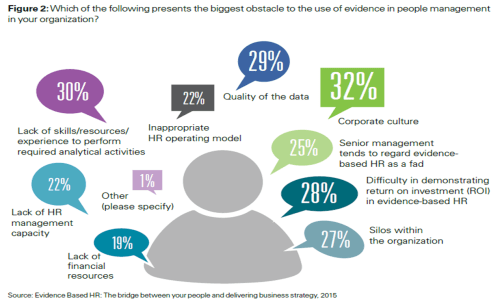
The data in the report are presented appealingly. Here’s one graph:

KPMG April 21 2015 An interesting finding is that the biggest obstacle to the use of evidence in people management is corporate culture. Not HR’s reputation, but corporate culture. Also new and maybe worth considering.

KPMG’s concludes the report with this, “…the days of basing people decisions on the whims or personal motives of one person at the helm are about to end. Organizations that acknowledge that inevitability already have a substantial head start.” That’s more a message to CEOs than it is to CHROs. More a message to the C-Suite than to HR practitioners. I just hope CHROs and HR practitioners are ready when the message is received!

2 Comments

Filed under Big Data, C-suite, China Gorman, Data Point Tuesday, HR Analytics, HR Data, KPMG

CEO Insights: The Bumpy Road to ALWAYS ON

data point tuesday_500

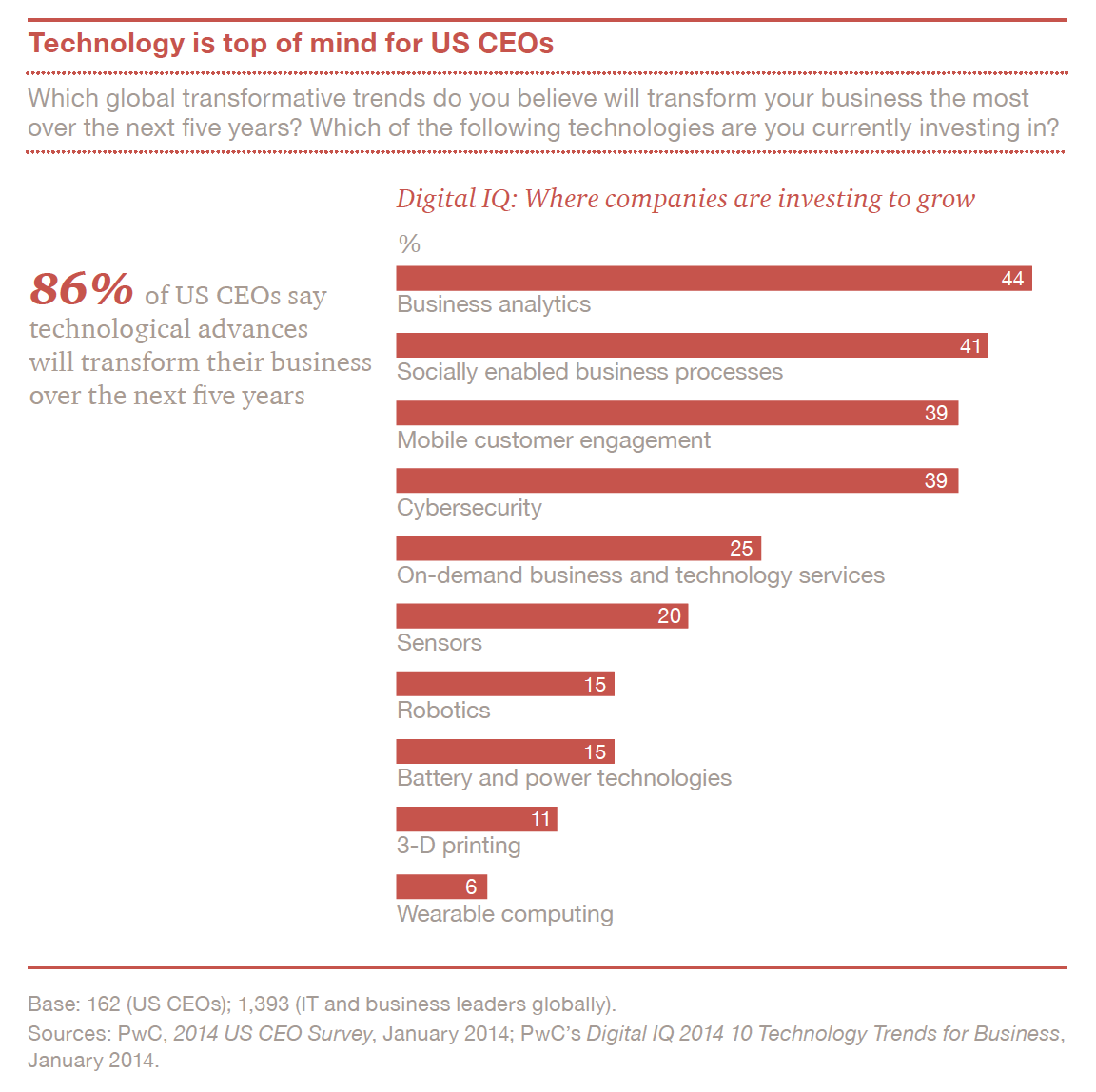
PWC’s 17th annual global CEO report “Good to Grow: 2014 US CEO Survey”, provides a thorough snapshot of executive leadership perspectives and approaches at the current moment. PWC’s report includes perspectives from over 1,300 CEOs from 68 countries, including 162 CEOs with US-headquartered organizations. It’s clear from the responses that, globally, CEOs are making many changes within their organizations. For example, 86% of CEOs stated that advancing technologies are going to transform their businesses over the next five years. Positively, PWC’s data also suggests that CEOs are finding reasons to be more confident in many places (89% of US CEOs are fairly sure their companies will deliver revenue growth this year). In this period of rapid change though, what approaches are CEOs taking, and what insights can they offer?

The majority of CEO’s interviewed reported that “five great forces of transformation” are reshaping business as we know it:

  • Technology is making an impact across the whole enterprise.
  • CEOs are reinventing the operating model towards an “always on customer experience.”
  • CEOs are seeking new ways to work together in joint ventures and alliances to capture disruptive technologies faster.
  • In some cases, the business model is being innovated.
  • There are rising concerns about talent.

As organizations undeniably shift into a period of growth (62% expect to hire more people this year, the highest level of anticipated headcount expansion in the past five years for this survey), how do these five great forces of transformation come into play?

All CEOs seem to agree, that technology is what propels business, and will continue to do so. PWC states that, in part, “Technology” is a watchword for 2014 because CEOs use it when talking about both core innovation and information technology (IT). Technology has become an essential part of strategy in all areas – for organizations pursuing new business models, meeting new customer expectations, remaking their operating model, forging new alliances, or tackling talent challenges.

pwc-Technology


CEOs are reshaping business models though innovation. They are taking cues from the technology industry that has paved the way by creating value for customers in a multitude of new ways. Organizations are looking to create increased profit for what they offer beyond step-by-step product innovation, and they are stepping out of the box to innovate in ways such as turning a product into a service, or vice versa. New approaches to innovation and R&D are part of an increased strategy by many US CEOs in 2014. For example, some organizations report funding innovation incubators to foster rapid prototyping of new ideas, while others report wanting to join up with emerging market innovators who are developing low-cost products.

PWC’s survey also indicates that customer strategies will get a serious makeover in 2014, with 52% of CEOs reporting that they are planning to change their customer growth and retention strategies. As creating a positive and personal customer experience only continues to increase in value (and as a standard of expectation) more organizations will see CEOs leading them toward a strategy of customer interaction. This will move away from stand-alone transactions to a sustainable “always on” relationship with customers. While CEOs plan out such new strategies, they are also discovering that most current capabilities are “fair game for reinvention.” The vast majority of CEOs are already debuting a fair number of change initiatives with a focus on moving away from rigid structures towards more nimble, adaptable operations.

pwc-reinventing-operations

Business alliances and joint ventures also appear as a CEO noted trend for 2014 – within the U.S. and globally. 42% of CEOs surveyed report that they plan to enter a business alliance/joint venture this year while only 4% expect they’ll exit an existing relationship. CEOs are also looking at acquisitions, with 39% of US CEOs planning to complete a domestic acquisition in 2014 and 28% planning on a cross-border deal.

A last trend to note from this survey is in regards to talent. I’ve talked about the talent acquisition “crisis” or “war on talent” in past posts, and unfortunately, PWC’s CEO survey does nothing to dispel this issue. 70% of US business leaders report being concerned about the availability of key skills. This compares to 54% that said so in 2013.

pwc-skill gaps

Despite continued economic uncertainty both within the U.S and globally, PWC reports that the number of US CEOs who believe that global growth is returning has more than doubled since last year, perhaps indicating that organizations are successfully finding a path forward. It is also clear from the research though, that this is a time of intense transformation, which encompasses a wide range of organizational areas and strategies. The ability to navigate such transformational trends is vital for organizational success. So while the overall sentiment is positive for growth, the ride to get there is going to bumpy. Are you and your teams ready to be “always on?”

1 Comment

Filed under 100 Best Companies to Work For, Business Success, China Gorman, Connecting Dots, Data Point Tuesday, Engagement, HR, HR Data, Information Technology, Talent pipeline

Leadership Challenges, Critical Skills and the Importance of Gender Diversity

Data Point Tuesday
Development Dimensions International (DDI)
and The Conference Board have recently released a report, “Global Leadership Forecast 2014|2015.” This report, the seventh of its kind published by DDI, includes survey responses from 13,124 leaders, 1,528 global human resource executives, and 2,031 participating organizations. The volume of respondents allowed DDI to look at findings from a variety of perspectives – multinational vs. local corporations, spans four leadership levels and leaders/HR professionals of different genders, ages, 48 countries, and 32 major industry categories. The report is comprehensive and contains more than one blog post’s worth of data and insight, so I’ll just pull a few of the highlights here… But if you find the data interesting make sure to take a look at the full report for more information!

Let’s start by looking at top challenges of leadership cited in the report. According to the research, the top four CEO challenges are Human Capital, Customer Relations, Innovation, and Operational Excellence. When responding CEOs were asked to identify strategies to address the human capital challenge, four of the top strategies cited included a focus on leadership:

  • improve leadership development programs,
  • enhance the effectiveness of senior management teams,
  • improve the effectiveness of frontline supervisors and managers, and
  • improve succession planning

Though the top three cited strategies for combating the human capital challenge were to: provide employee training and development, raise employee engagement, and improve performance management processes and accountability, the fact that a focus on leadership was present among the top 10 strategies suggests that leaders recognize that organizations cannot develop and retain highly engaged, productive employees without effective leadership and leadership development programs.

Top CEO ChallengesCEOs surveyed also identified the leadership attributes and behaviors they perceived as most critical to success as a leader:

  • retain and develop talent
  • manage complexity
  • lead change
  • lead with integrity, and
  • have an entrepreneurial mind-set.

Unfortunately, no more than 50% of leaders assessed their own readiness to address such tasks as “very prepared.” And HR leaders’ perceptions were even more grim, with only 9% indicating their leaders were “very ready” to address the human capital challenge.

When HR professionals were asked to rank two critical leader skills for leaders’ success in the next three years, and how much their organization’s current development programs focuses on them, the level of focus of most skills corresponded to how critical the skills were perceived to be for the future. However, there were some interesting exceptions:
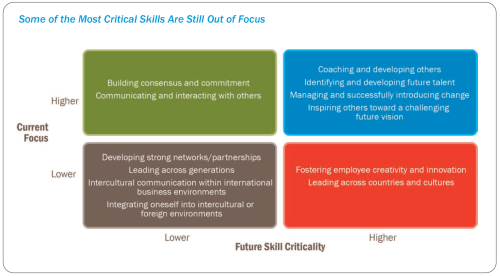
Critical SkillsAs you can see in the above graphic, two skills that were listed by HR as most critical (fostering employee creativity and innovation/leading across countries and cultures) are not actually being focused on, while building consensus and commitment/communicating and interacting with others are two skills not listed by HR as highly critical to the future yet are being heavily focused on. DDI informs us that because these are foundational skills it’s easy for HR to either overemphasize or undervalue them, which supports the data we see in the graphic.

While DDI and The Conference Board’s report is chock full of fascinating data like those mentioned above, it has been getting wide attention for a particular section of the report: the section on gender diversity. The report indicates that organizations with better financial performance have more women in leadership roles. Organizations in the top 20% for financial performance report 37% of all leaders are women vs. organizations in the bottom 20%, which report that only 19% of all leaders are women.
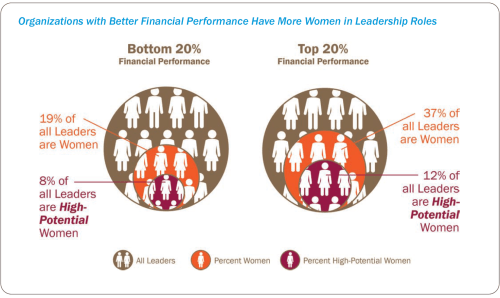
Women in LeadershipWhile this clearly points to the positive benefits of gender diversity, at the same time, it highlights how disturbingly imbalanced the gender demographics still are when it comes to leadership. DDI’s survey explains this imbalance in several ways. There was no significant difference between the men and women in the study when it came to leadership skills or ability to handle management and business challenges, however, a noted difference between sexes were their levels of confidence. Women were less likely than men to rate themselves as effective leaders, as having completed international assignments, lead across geographies or countries, or lead geographically dispersed teams. The study cites these global or more visible leadership experiences as key missed opportunities, because leaders who had access to these experiences were far more likely to be promoted and to advance more quickly in their organizations.
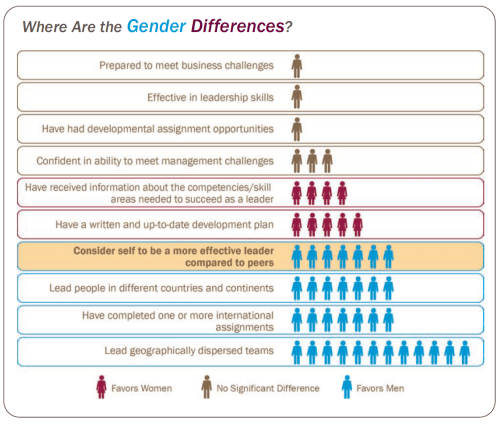
Gender DifferencesThe bottom line is that this data supports what we know about diversity in its entirety: fostering and encouraging diversity in the workplace is always something to strive for as it inherently leads to more diversity of ideas, problem solving, productivity and financial success!


2 Comments

Filed under China Gorman, Critical Skills, Data Point Tuesday, Development Dimensions International, Gender Diversity, HR, HR Data, Human Resources, Leadership, Leadership Challenges, The Conference Board, Workplace Studies

Longing for Leadership

Data Point Tuesday
Last week I discussed one of the trends (reskilling HR teams) called out in Deloitte’s annual Global Human Capital Trends Report for 2014. Recently released and influenced by the work of Bersin by Deloitte, the report examines 12 trends that represent the way employees today are driving their organizations to innovate and transform human capital practices. The report, as usual, is full of interesting data on human capital management trends and observations about the impact of those trends. It is definitely worth a read.

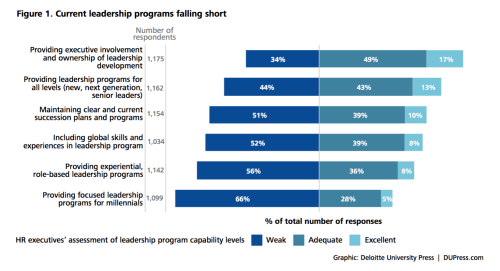
This week I’d like to look at another top talent issue facing organizations around the world as identified by Deloitte: leadership. Leadership is cited as the number one talent issue organizations today face, with 86% of respondents surveyed citing leadership as “urgent” or “important”. This is compared with a meager 13% of the same respondents that claim they are doing an excellent job developing leaders at all levels. So of all the trends discussed in Deloitte’s survey, this marks the largest “readiness gap”. Developing the next generation of leaders is urgent, yet very few report meeting the challenge.

When it comes to organizational strategies, most are requiring some significant tweaks due to the increasingly global, tech-savvy, interconnected, and diverse people that are the 21st century workforce, and leadership development is not exempt from this. Organizations are facing challenges such as developing multiple generations of leaders – not just Millennials, developing leaders with high flexibility and global fluency, and ensuring that leaders have the skills to understand and adapt to rapidly changing technologies. Essentially, leadership is taking on a much broader meaning than it did previously, where it may have described simply developing the next CEO or company C-Suite executive.

Looking at responses from executives who participated in Deloitte’s survey paints a clear picture of perceived leadership gaps. 66% reported believing that they are “weak” in their ability to develop Millennial leaders and just 5% rated themselves as “excellent”. Additionally, 51% of executives have little confidence in their ability to maintain clear, consistent, succession programs and just 8% feel they have “excellent” programs to build global skills.

Global Human Capital Trends Report for 2014It becomes clear then that as the global recovery continues to strengthen and organizations start to execute on growth strategies, that these gaps can only be filled by intentional focus and commitment to leadership development and training programs at all levels. Deloitte’s report suggests that companies should start by engaging their own top executives to develop leadership strategies and actively participate in them; refresh previous leadership strategies to link with evolving business goals; and implement a unique leadership program. They recommend that organizations focus on three aspects for developing leaders: developing at all levels, developing global leaders locally, and developing a succession mindset.

If companies want to grow in a global world, they need to grow global leaders. And Deloitte’s research shows clearly that this doesn’t happen accidentally.

Leave a comment

Filed under Bersin, China Gorman, Data Point Tuesday, Deloitte, HR, HR Data, Human Capital, Leadership