Good News From Your L&D Department!

Data Point Tuesday

A 2014 report from Bersin by Deloitte, “The Corporate Learning Factbook 2014: Benchmarks, Trends, and Analysis of the U.S. Training Market” relays some positive information regarding investment in employee development. Businesses increased training budgets by an average of 15% last year, reflecting the highest growth rate in this area in the last seven years, and also likely that as the economy continues to mend, organizations are able to reinvest in areas that experienced significant cost cutting during the downturn. At a time when there is discussion of a lack of specified skills in the talent pool, this would appear to be welcome news, particularly because this investment applies not only to short term training. For mature organizations this training budget involves identifying capability gaps now and into the future and combats them by developing a “supply chain” of skills to fill gaps in the long term.Bersin by Deloitte

How much are organizations spending on these increased L&D budgets? On average in 2013, businesses across the United States spent $1,169 per learner. This amount varies by company size and industry, with tech firms leading the pack in terms of amount invested per learner (spending an average of $1,847). As far as which areas of training and development organizations are focusing their increased budgets on, leadership development takes the largest share, with 35 cents on average of each training dollar going to leadership development at all levels. This certainly suggests this is an important strategic investment for companies in the coming year. As the study reports, “more than 60% of all companies cite leadership gaps as their top business challenge”.

Spending on L&D initiatives is likely to be higher for organizations with a more “mature” L&D function. Those ranked at either 3 or 4 on Bersin by Deloitte’s maturity model spent an average of 37% more on training and development than the least mature organizations. Here at Great Place to Work, we can certainly attest to the fact that organizations on the FORTUNE 100 Best Companies to Work For list invest significantly in training and development programs. In 2013, companies on the list offered 66.5 hours of training annually for salaried employees and 53 hours of training for hourly employees, with close to 70% of those hours devoted to employees’ current roles and nearly 40% focused on growth and development. Though they display impressive training and development programs, many of these Best Companies cited employee development as remaining an area of focus, with 3 key areas highlighted: Leadership Development (reflecting the data from Bersin by Deloitte), Career Road-mapping, and Diversity Development.

This investment trend is good news for employers and employees alike. Employers will have greater inventories of skills in-house and may not have to turn to the marketplace as often – or expensively – in coming years to support basic business operations. Additionally, by providing skills development to younger workers who are arriving with significant skills deficits, employers may be staunching the early talent drain from their organizations. And employees of all ages continue to need growing support to expand their knowledge and skill bases as the world of work continues to evolve and certain skills het harder and harder to find.

But the opportunity to develop management and leadership skills may be the most valuable investment for both sides of the employee-management relationship. It prepares the next generation of organizational leaders, it communicates a commitment to employees’ futures and it strengthens the ties between these two sides of the employment equation. That high performing employers are spending 40% of corporate learning dollars on their future leadership talent would be a compelling component of any employer’s employee value proposition.

2 Comments

Filed under Bersin, China Gorman, Data Point Tuesday, Deloitte, Great Place to Work, Leadership, Learning/Development, Skills Gap, Talent development

HR and Sustainability: Where’s the Beef?

Data Point Tuesday
According to results from an annual sustainability survey by BSR and GlobeScan “State of Sustainable Business Survey 2013” which provides insights into the world of sustainable business and tracks the successes and challenges faced by corporate sustainability professionals, HR is one of the least engaged corporate functions when it comes to sustainability. Respondents of the survey ranked HR as 34% engaged when it came to their companies’ CSR and sustainability commitments in 2013. This is a 3% drop in engagement levels since 2011. However, HR is not the only corporate function recording low engagement when it comes to sustainability. Finance ranked the lowest in levels of engagement with sustainability activities, with product development, R&D, strategic planning and marketing not far behind. Respondents overall ranked marketing as only 28% engaged when it came to sustainability initiatives at their organizations and this engagement level has dropped 14% since 2011. External facing corporate functions, like corporate communications, public affairs, and the CEO’s office showed high levels of engagement with sustainability (corporate communications ranked highest in engagement levels at 77%).

It’s potentially concerning however that departments like HR and marketing, which have important relationships with both internal and external stakeholders, are showing such low levels of engagement with sustainability initiatives. Why are we not seeing higher engagement with these corporate functions?

At a time when many organizations are placing greater emphasis on their role as a socially conscious company, we find many highly successful companies leading by example. Despite the obvious reasons for shining a light on sustainability practices like showing strong ethics and helping others/the planet, there are other incentives to highlighting such practices. Reports show that young workers more often choose employers that are socially conscious and align with their own values. Additionally, we’re seeing more and more successful companies “going green” and injecting sustainability deeply into their business strategy, using it to create value for their employees and customers. Given that today’s job seekers are looking for their work to provide them with a sense of meaning, it would seem only logical for HR to engage more completely with such initiatives – and perhaps even take the lead. But this does not appear to be the case.

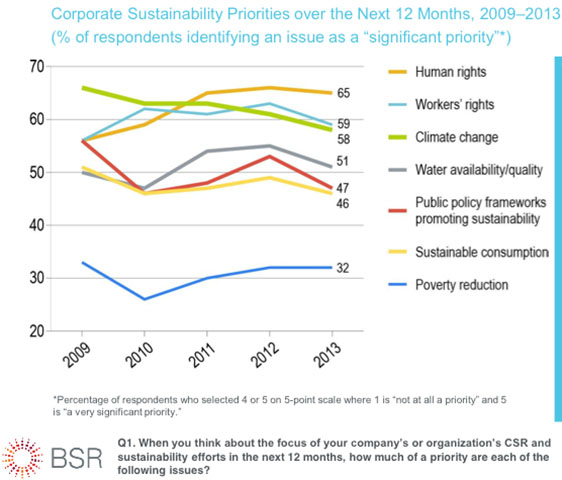
BSR/GlobeScan report that only one in five companies has fully integrated sustainability into business strategy and practices, and from this data it appears that company-wide collaboration on sustainability is still the exception rather than the norm. When asked about the most important leadership challenge of business today, 62% of respondents cited the integration of sustainability into core business functions. This is a significantly higher percentage than the next leading answer, “convincing investors that sustainability enhances value’” at only 28%. Climate change and public policy frameworks promoting sustainability were ranked highest when asked what sustainability issues need collaboration the most. Consider the sustainability/social initiatives at your organization. Is there a collaborative engagement in these practices across all departments? Or do only the most external facing functions show high levels of engagement? And where is HR in the discussion at your organization? Leading? Participating? Or waiting for another function to step up?

BSR Chart

1 Comment

Filed under BSR, China Gorman, Data Point Tuesday, GlobeScan

Failure to prepare…

Data Point Tuesday


…is preparing to fail. – John Wooden, legendary NBA player and UCLA Head Coach

We constantly see media coverage discussing the business world’s negative perceptions of younger workers. At times it seems like an unfair piling on for a generation that’s been bombarded with negative labels like entitled, unwilling to pay their dues, and unprepared. The good news is that much of the coverage is now discussing the reasons why such labels persist based on research, analysis and facts rather than a common starting point of “…when I was starting out…”

In a study released last Tuesday by Bentley University and KRC Research, which examined the preparedness of Millennial workers by surveying over 3,000 business decision-makers, corporate recruiters, young workers, students, parents and higher education influentials, 51% of business professionals who participated stated that their companies tend not to invest in young workers’ development because of the perception that they are likely to leave the job soon and aren’t worth the investment. This is a startling example of one of the perceptions perpetuating negative views of Millennial workers:  they are short-timers. It’s a real Catch-22 – it’s hard for a business to invest in the skill development of employees they believe to be short-timers. Where’s the ROI in that investment? But thinking through to the next question, “what can we do to increase the likelihood of retaining this cohort?” is occurring more and more. Orlando Barone, from the Wharton School of Business, is quoted in the study as believing that Millennials “perceive themselves as more loyal to their values than to a particular company…” And this gets to the heart of the Millennials vs. the Business World grudge match that many observe.

If, as in great workplaces all over the world, an organization’s values were in sync with the values of all of its employees, investment in skill development would be a no brainer because it would be ensuring the longer tenure of its entire workforce – not just its Millennials. It would be an investment in the bottom line as measured by lower turnover costs, lower talent acquisition costs, greater innovation and higher productivity.

Bentley University and KRC ResearchThe Bentley study shows clearly that business shares the accountability for lower retention of Millennials. However, this is not to say that everything we hear about young workers is unfounded. After all, the consensus from Bentley University’s study (as observed by both business professionals and Millennials themselves), is that Millennial workers are less prepared than other generations to enter the workforce. However, this unpreparedness is not necessarily due to a broad lack of passion, feeling of entitlement, or poor work ethic of the younger generation as many assume. This quote from the study sums up the idea well: “Despite the view of Millennials as the “it’s not my fault” generation, nearly four in ten grade their own personal preparedness as a “C” or lower”.  It comes down to a mutual shouldering of blame for why young workers are unprepared. While recent college graduates admit that unpreparedness is a problem among their own cohort, 49% of higher education influentials give colleges and universities a “C” or lower on how well they are preparing recent college graduates for their first jobs and 51% of business decision-makers give the business community a “C” or lower on how well they are preparing students for their first jobs. So everyone involved believes that many young people entering the economy for the first time are unprepared for success and unprepared to make a contribution.

A surprising outcome of this study is that 35% of business leaders give recent college graduates that they have hired a “C” or lower in being prepared for the job. Businesses are clearly not be connecting the dots as the study also reveals that 51% of business professionals are not investing in the development of young workers. Knowingly (one would assume) hiring an unprepared young worker and then knowingly (again) not investing in their development seems like missing the obvious to me. And pretty simple to solve: if you hire unprepared workers you have to be prepared to provide opportunities to ensure their preparedness or they will be gone in the business equivalent of sixty seconds.

The bottom line is this:  we must hop off the label bandwagon and jump on the training train. Millennials are faced with a different set of challenges than earlier generations as they enter the workforce, but current judgments of their work ethic or values are shortsighted and misinformed bases for non-investment in their development once they arrive in our organizations. It’s long past time for all stakeholders (higher education influential, business leaders and decision makers, students and their parents) to remedy the problem of unpreparedness vs. being a catalyst for it. Business leaders in particular can step up and begin to deliver development programs that will result in young employees who are more productive and more aligned. And if you’re worried about young workers “jumping ship” remind yourself that investment in their development could be just what they’re looking for to stick with you for the long haul.

3 Comments

Filed under Bentley University, China Gorman, Data Point Tuesday, Millennials

Job Seekers: Look to Best Companies!

data point tuesday
I discussed a few posts ago how companies on the FORTUNE 100 Best Companies to Work For list are experiencing huge amounts of growth in headcount. That post focused on how these outstanding workplaces are combating growing pains and dealing with rapid expansion. Being ranked one of the best workplace cultures in the US certainly helps feed the cycle of growth, as job seekers apply in droves.

The good news for job seekers? The Best companies are hiring and they are hiring a lot! FORTUNE reports that at least 24 companies on this year’s 100 Best Companies to Work For list are planning to fill at least 1,000 (and for some, even more!) jobs in the coming year. From big tech companies like Google (ranked #1), Intel, and Cisco, to medical organizations like Houston Methodist, retail stores like Nordstrom, and markets like Whole Foods and Wegmans, the “we’re hiring” sign is posted out front.

What are these companies looking for in a new hire, and who is getting hired? At Great Place to Work, the research and analysis firm that produces the lists, we’ve pulled together some hiring statistics from this year’s Best Companies to provide a little perspective.  The 100 Best Companies last year filled 6,297 positions, on average, for both new and already existing positions. The average number of these positions filled internally was nearly 30%. The average number of new hires referred by current employees was 28%. This corroborates what we already assume, that internal referrals add significant weight to applications, so before all else, reach out to potential contacts! There can be big benefits for the person referring you as well, so don’t automatically assume people might view it as a hassle. The average maximum bonus paid for a single referral at best companies in the last 12 months was $3,595!

How to impress in an interview? According to recruiters from best companies that are hiring (via FORTUNE), top ways to impress include: being able to articulate your alignment with the company’s mission and values (and explain why they resonate with you), doing exceptional “homework” and truly understanding the business and key competitors going into an interview, being able to discuss how you plan to impact the company, and demonstrating passion, curiosity, and (a big one!) innovation.

For new college grads the numbers may seem a bit less optimistic, out of the average new hires in the last year (6,297) the average number of new graduates hired was 496, and the average percent of positions filled by college students at this year’s best companies is 9.9%. However, this shouldn’t discourage new graduates from applying, as they are automatically equipped with several highly valued skills beyond a basic degree. Examples I’ve touched on in previous blogs include that college students and Millennials are more likely to be passionate about social responsibility and attuned with an organization’s mission and values, be highly aware of technology and social media and able to quickly assimilate with a company’s use of such tools. No matter who you are, however, if you are looking to find a new job consider these stats, and check out this year’s FORTUNE 100 Best Companies to Work For list– you may be very glad you did.

Best Companies Hiring

1 Comment

Filed under 100 Best Companies to Work For, China Gorman, Data Point Tuesday, FORTUNE Magazine, Great Place to Work, Great Place to Work Institute, Hiring, Millennials

Empowering Business Leaders as Talent Leaders

Data Point Tuesday
A new research brief by Aberdeen Group looking at Human Capital Management trends for 2014 highlights that talent acquisition, specifically the scarcity of talent available in the external marketplace, is the biggest driver of HCM strategy today. In 2013 we saw a lot of discussion around talent acquisition (in another report by Aberdeen shortages of key skills were cited as a top challenge by 64% of respondents, up 55% from 2011) and as the economy continues to recover in 2014 it appears this trend will continue. What are organizations doing to combat this? According to the report, the most commonly cited strategy by respondents involved developing front-line business leaders as talent leaders to create a vital connection between talent strategy and business execution. The reasoning plays out in a connect-the-dots, A to B, the knee-bone’s connected to the hip-bone, fashion. If employees with the greatest ability to see both business needs and the skills/capabilities of the talent on the ground (front-line leaders) are empowered as talent leaders, it ensures communication between HR and business leaders around talent initiatives and increases the chance of identifying gaps in business strategy.

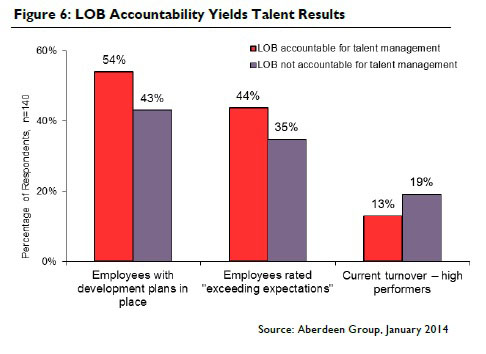
There’s data to back up this strategy. A study conducted by Aberdeen last year found that top-performing organizations were 73% more likely than all other organizations to have dedicated learning programs for front-line leaders and committed 40% more of their training time to leadership skills. As the brief points out though, for the strategy to succeed it is important front-line leaders are given the necessary support and tools to handle talent processes as well as day-to-day business goals. Technology and automated performance tools provide a plausible solution to this concern, offering greater efficiency to workforce processes. Currently, 56% of organizations report that line of business leaders are accountable for talent management initiatives such as hiring, developing, and performance management within their teams. As you can see in the below graphic, this accountability pays off, increasing businesses likelihood of having employee development plans in place, offering a higher number of employees that exceed performance expectations, and seeing greater retention of high performers (which is especially important at a time when talent scarcity is a top concern).

Accountability Yields Talent Results

1 Comment

Filed under Aberdeen Group, China Gorman, Data Point Tuesday, Human Capital, Talent Acquisition

Rapid Growth and Great Workplaces

Data Point Tuesday
The 2014 FORTUNE 100 Best Companies to Work For list announcement is just days away and here at Great Place to Work we just can’t wait to share some of the awesome 100 Best Companies Trends from this year’s list! In true Data Point Tuesday fashion, I’ve compiled some noteworthy stats from our 2014 100 Best Companies Trends whitepaper to share with you, (the full trends report as well the Fortune 100 Best Companies list will be available here on Thursday) enjoy the sneak peek!

One of the most prominent trends we’ve seen with Best Companies this year is growth. For 2014 100 Best Companies with available revenue data, revenues in the last 24 months have risen an average of 22.2% and headcount is increasing to match that. The number of employees at the 2014 100 Best Companies increased by an average of 6.1% since 2012 and 15.4% since 2011 which, according to Current Employment Statistics from the Bureau of Labor Statistics, is nearly five times the growth rate of U.S. companies overall in the same two-year period. This significant increase in headcount, while positive for companies, undoubtedly also raises concerns. During times of rapid growth organizations can experience a number of challenges including: inadequate skills and pipeline of leaders, loss of top talent and leaders, scaling and developing new systems, assimilating new employees both socially and process-wise, bringing new and longer tenure employees together, balancing cultural norms of past with the need to grow quickly and be a company of the future, and burn out and disaffection of existing employees. With such challenges in mind, how are these Best Companies managing such rapid growth, and, what exactly are they doing to avoid growing pains?

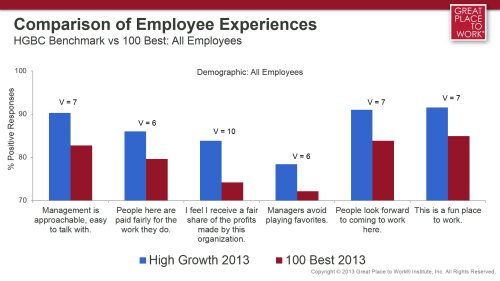
In 2013 Great Place to Work compiled a benchmark group of great workplaces experiencing high growth (+20% employee population) while appearing on the Best Companies list between 2011-2013. The group was used to study the relationship between rapid growth and the employee experience at the 100 Best and included several Best Companies, such as Chesapeake Energy, Hilcorp Energy Company, NetApp, Quicken Loans, Rackspace Hosting, salesforce.com, and World Wide Technology, Inc. Results of the study indicated an exceptionally high level of trust at Best Companies experiencing rapid growth, with 94% of employees at such companies stating that “taking everything into account, I would say this is a great place to work” vs. 91% of employees at Best Companies not experiencing such rapid growth. Additionally, employees at high growth Best Companies displayed a 4% higher average score on all trust index statements compared with employees at Best Companies not experiencing rapid growth. Trust index scores correspond to statements such as: “management is approachable, easy to talk with”, “this is a fun place to work”, “I feel I receive a fair share of the profits made at this organization”, and “people look forward to coming to work here”. It’s noteworthy too that these high trust index scores at Best Companies experiencing rapid growth come from both new hires as well as tenured employees (2+ years tenure).

Great Place to Work Chart
We can take away from this data a better understanding of how Best Companies are handling the growth trend. Marcus Erb, Associate Vice President of Research, and the leader of the 2013 study on the relationship between high growth and the employee experience at the 100 Best sums it up well: “Our research shows that as far as the employee experience is concerned, companies with a strong foundation of trust, a robust leadership pipeline, and a firm commitment to the company’s culture are far better at navigating the challenges that come along with growth and change.”

Make sure to check out the 2014 FORTUNE 100 Best Companies list on January 16th

7 Comments

Filed under 100 Best Companies to Work For, China Gorman, Data Point Tuesday, FORTUNE Magazine, Great Place to Work, Great Place to Work Institute

Good Ethics = Good Business

data point tuesday

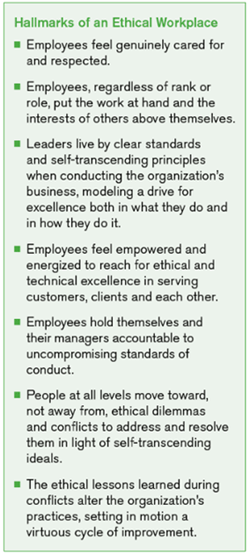
We’ve officially kicked off the New Year –happy 2014! With the New Year comes the tradition of resolutions, which we hear a lot about in these first few weeks of the year. I’ll be honest, I’m not so big on New Year’s Resolutions, but I do think there’s value in paying close attention to the questions that resolutions stem from, like “what can I do to better my business/life/relationships?” I prefer to call it continuous self-improvement because it’s likely that many of these resolutions are things we should always be aiming to improve, and not just in the space of one defined year. In the spirit of the tradition though, I’ll pose this to you: if you were to make one resolution this year that would impact the lives of your employees and the financial performance of your organization, what would it be? My answer: be an ethical business. This is the most fundamental attribute of a great workplace, the foundation that must exist to build all other important parts of a great workplace. And while it might seem obvious thing to aim for, nearly HALF of all U.S. employees report witnessing unethical or illegal conduct in their workplace each year (according to a 2013 Effective Practice Guideline’s report from the SHRM Foundation) with the majority of these events going unreported and unaddressed!

SHRM-Foundation-EthicsBe an ethical workplace because this statistic is alarmingly high; be an ethical workplace because good ethics = good business. The SHRM Foundation’s report explains that an organization’s culture is the strongest predictor of how much market value that firm will create for every dollar invested by shareholders. In fact, the stock price growth of the 100 most ethical firms (based on the most widely used measure of ethical workplace culture) outperformed stock market and peer indices by nearly 300%. Looking from 1998-2011 the annualized returns of FORTUNE’S “100 Best Companies to Work For” in the United States were 11.06% versus 4.36% for the Russell 3000 and 3.38% for the S&P 500. There’s a flip side to this too though. If good ethics = good business, then bad ethics = bad business, and in a BIG way. More than 50% of the largest corporate bankruptcies have happened due to unethical business practices. And what was the cost of these bankruptcies to owners and the economy? $1.228 trillion, or, as the EPG reveals, nearly 10% of the U.S gross domestic product in 2011!

Now, I don’t disregard that many of the statistics we see on a daily basis fall into a kind of grey area. It’s likely we’re aware of the many variables that affect their legitimacy, like intent of the company producing the report or maybe the lack of a wide enough demographic representation, and so we use them more as guiding than supporting evidence. The statistics on ethical business though, seem pretty black and white to me.

I’ll say it one more time. Be an ethical workplace. Be an ethical workplace because the statistic that almost 50% of employees witness unethical behavior each year is alarmingly high. Be an ethical workplace because good ethics = good business. Be an ethical workplace because it’s a New Year and it’s a resolution to always have; but most importantly, be an ethical business because it’s the right thing to do.

Leave a comment

Filed under China Gorman, Data Point Tuesday, Ethics, Great Place to Work, Great Place to Work Institute, SHRM, SHRM Foundation

Employee Recognition

Data Point Tuesday

The Gift That Keeps on Giving

Employee recognition is an important form of positive feedback (who doesn’t love being recognized for their efforts after all?!) and a 2013 study by Globoforce gives us even more reason to institute this type of feedback in our organizations. The study examines the growing intersection between recognition and employee performance and has some noteworthy points. Where recognition is concerned, perhaps the most important point made is that recognition directly impacts business results. Out of 708 randomly-selected fully employed persons in the United States (aged 18 or older) who are employed at organizations with a staff size of 500 or more employees,  those who were recognized with values-based recognition reported a positive change in their productivity. Additionally, 49% of respondents who had experienced values-based recognition indicated a positive change in relationships, 43% indicated a positive change in their customer service efforts, and 82% stated that being recognized for efforts at work motivated them in their job.

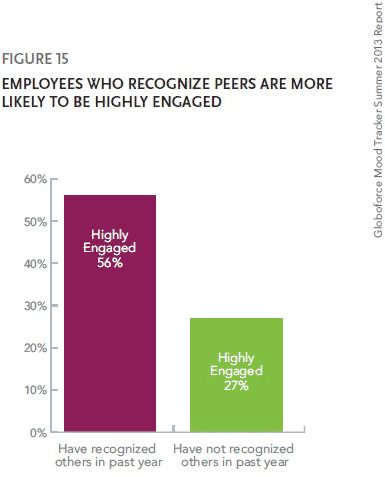
These statistics reinforce the value and importance of recognizing employees, but what I found particularly interesting and a less obvious benefit of employee recognition was how the ability to give vs. receive recognition affected employees. The study found that employees who are empowered to recognize other employees at their organizations were twice as likely to identify themselves as highly engaged; highlighting that value should be placed on allowing employees to give recognition as much as it is placed on making sure employees receive recognition. Another interesting and less obvious result of employee recognition is the link between recognition and alignment with organizational culture and values. Of respondents surveyed, 48% indicated that receiving recognition when they did something right served to align them with their organization’s values and culture. As I discussed in another recent post, employees who feel strongly aligned with company values and mission are more satisfied with and likely to remain at a job, so this relationship between values and employee recognition is a valuable one to explore.

globoforce

Employee recognition can also influence employees’ perception of performance reviews. Globoforce’s study found that 76% of respondents thought recognition data would make reviews better, and 75% of respondents who had been recognized recently stated that they enjoyed their reviews. We can attribute these changes in perception toward reviews to the attributes like engagement and connection with company values, but also to another idea. As the study points out, peer and managerial recognition act as a form of social crowdsourcing, a familiar and comfortable concept for employees who most likely use crowdsourcing programs like Yelp or Amazon regularly. 80% of respondents felt that crowd sourced (manager plus crowd sourced peer feedback) to be more accurate. With employee recognition serving as a form of crowd sourced feedback it makes sense then that employees who were recently recognized felt more comfortable in reviews. But why does it matter if employees enjoy their reviews? The research shows that employees who are satisfied with reviews are more highly engaged, less susceptible to job poaching, and more satisfied with their job.

This data show that creating a system that gives employees feedback from peers as well as from managers – feedback that is values-based – is the gift that keeps on giving. To employee engagement, to higher retention, to financial performance. Who doesn’t want that gift under the tree on Wednesday?

What does employee recognition look like in your organization? Do you have recognition programs in place? Do you encourage employees to recognize others as well as for managers and supervisors to give recognition? Use this data as a catalyst to examine how recognition plays a role in your business. Ramping up the positive feedback could just be the key to a healthy domino effect, creating employees that are more engaged, more productive, more connected to company values, and more satisfied with their reviews.

Leave a comment

Filed under China Gorman, Data Point Tuesday, Employee Engagement, Employee Recognition, Globoforce, Great Place to Work, Great Place to Work Institute

The Trustworthy Leader

Data Point Tuesday
More Mindfulness for the Holiday Season

The holiday season is upon us, and many of us have been relishing the traditional cheer, treats, gifts and parties that accompany this time of year. It’s likely we’ve been reflecting on, and giving thanks for the joy in our lives, our family, friends and loved ones; or maybe we’ve been getting into the holiday spirit by donating to or helping out at our favorite philanthropic organizations. These are effective trustworthy leader practices to embrace during the holidays, and practices that, realistically, we should attempt to embrace year-round! For me, a specific practice comes to mind that we should give some serious extra “oomph” to during the holidays – mindfulness.

While practicing increased mindfulness during the holidays can be helpful for everyone, it’s an especially great practice for business and HR leaders. With so much focus on holiday celebrations and cheer, it can be easy to miss that for some of our colleagues the holidays prove to be the most stressful or difficult time of year. According to statistics from a poll by the American Psychological Association, 69% of people feel increased stress during the holidays from a perceived lack of time, 69% feel increased stress from a perceived lack of money, and 51% of respondents also experienced stress during the holidays from the perceived pressure to buy and give gifts. While financial worry seems an obvious stressor during the holidays, there are other stresses that the holiday season can amplify, such as feelings of loneliness or sadness (especially for those who may not have a strong support system or close-knit family). And during a time of year when we celebrate family and loved ones, it can be particularly difficult for those who have experienced loss.

Keeping this in mind, aim for increased mindfulness and awareness in your workplace this holiday season. Consider checking in with employees more frequently, whether it’s with a phone call, email, or an in-person visit. As we all know, sometimes something as simple as asking “how are you doing?” can brighten a day. Also consider making sure lines of communication are extra clear. It’s important to remember that no matter how someone may appear, we can never assume what is going on in their life. If you’re willing to help or have tools and resources and available for employees in need, make this known.  Reminding employees that their Employee Assistance Programs are easily accessible could encourage those who need support to seek it out. Asking for assistance can be difficult or feel shameful, and knowing that someone is willing to help could mean the difference between obtaining assistance, and suffering in silence.

Though “tis the season,” we’re not necessarily exempt from stress, and the holidays may even be amplifying worry. Perhaps it’s feeling a little anxiety about what the final year-end financial results will look like, or that the 2014 budget isn’t as perfect as we’d like, maybe it’s serious financial stress, or maybe there’s no stress at all. Whatever the case may be, work to be the true trustworthy leader who brings an increased mindfulness to your colleagues, your friends and family, and those around you this holiday season.

2 Comments

Filed under American Psychological Association, China Gorman, Data Point Tuesday, holiday

The B2T Revolution

data point tuesday_500

Employees (And Prospects) Are Consumers When it Comes to HR Technology

Mobile devices and apps are no longer the hot new craze. The B2C (Business-to-Consumer) sectors have taken care of that. Mobile devices have become an essential item for communication and internet access, and as Cisco reports, by the end of this year (in three weeks!) the number of mobile-connected devices will exceed the number of people on earth. By 2017, it’s predicted there will be nearly 1.4 mobile devices per capita. We’re now seeing companies like Lenovo, the world’s largest PC maker, selling more mobile devices than PCs. And as you’re undoubtedly aware, smartphones are a huge part of this mobile device equation. The growth of smart phone usage in 2012 was 81% and has only increased since. We’re using our smartphones for MUCH more than phone-calls though. Downloading applications, checking email, accessing the internet, getting directions, making dinner reservations, paying for purchases and meeting Mr./Ms. Right are just a few examples of ways smart-phones and mobile devices are being used today by people all ages from all walks of life. The bottom line is people are living their lives on mobile. And as long as the product is intuitive, easy to use and fast, the potential for success on mobile devices is huge.

HR Technology applications are no exception. A 2013 Mobile Consumer Report from Nielsen found that 82% of U.S smartphone users browse the web on their smartphone, and 63% use smartphones for social networking sites like LinkedIn, Facebook, and Twitter. According to Talent Management Headquarters, one billion (1,000,000,000) job searches are conducted on mobile devices each month! Mobile recruiting is well on its way to being the next big thing for talent acquisition. This makes sense when we consider that we can use mobile devices during short moments of down time, on a bus or during a lunch break.  As career sites and job postings become increasing mobile friendly, it’s likely that both passive and active job seekers will turn to their mobile devices before they turn to their desktop to hunt for jobs or job search related information.  And mobile recruiting offers organizations the benefit of exposure to job seekers who may not own or be frequent users of computers.

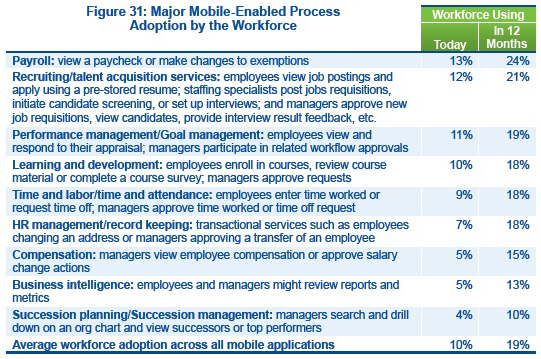
More importantly, with so many employees working from mobile devices, it has become increasingly critical for employers to provide HR information through vendors with easy to use, native mobile apps. Perhaps this is the new focus:  B2T – Business to Talent! Mobile HR applications offer employees (as well as HR managers) instantaneous interaction and engagement with HR Data like payroll and benefits information, recruiting/talent acquisition services, performance/goal management, and time and labor information – even more so than using a laptop or desktop. And in the day and age when all of us are used to instant access when we are living our non-work related lives, having these important processes and data easily accessible are becoming a must-have not a nice-to-have. In 2011, the ADP Research Institute looked at how mobile technology could make HR mobile solutions a game-changer. Respondents reported a significant benefit in using HR mobile solutions, citing improved workforce satisfaction, improved real time decision making, and improved workforce productivity. So the B2T revolution is here.

Mobile technology has revolutionized much in our lives and for HR leaders and employees there is more change to come. User friendly HR applications for mobile devices will prove an effective way to increase efficiency for managers and employees, just as the popularity of job searching on mobile devices will undoubtedly impact how we recruit. Communicating with talent – current and future – via mobile really could be a game changer for employers, employees, job seekers and HR technology providers.

The B2T bottom line:  employees are consumers. And they expect to have consumer-like experiences with the technology and software at work and about work. And if you aren’t providing it for them, they’ll likely use their smartphone to find another employer!

Mobile-Enabled Process Adoption

*This post is part of SilkRoad’s first annual #HRTechTrends Blog Carnival. A recap of all participants will be posted on SilkRoad Ink on December 20, 2013.

1 Comment

Filed under #HRTechTrends, ADP Research Institute, Business to Talent, China Gorman, Data Point Tuesday, HR, HR Technology, Mobile Devices, SilkRoad, Talent Management Headquarters