
Is Your Workplace Engaged?

My friends at Achievers are collecting applications for inclusion in the 2012 Achievers 50 Most Engaged Workplaces™ Awards. As an HR business leader you should think about applying. Today. Because time is running out.

The process is not onerous and even if you don’t win – it’s a highly competitive and influential list – the process of answering the application questions will get you thinking and focusing on what you need to do create an engaging workplace.
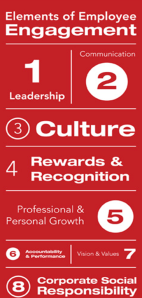
Achievers, the leading next-gen solution provider in the Rewards & Recognition space, has identified Eight Elements of Employee Engagement™:

  1. Leadership
  2. Communication
  3. Culture
  4. Rewards and Recognition
  5. Professional and Personal Growth
  6. Accountability and Performance
  7. Vision and Values
  8. Corporate Social Responsibility

The questions in the application survey ask employers to comment on their programs, policies and structure around each of the eight elements. In some cases, as in the Vision and Values section, the survey asks how your organization handles behavior that is NOT in line with a core value.

Each answer can be no more than 250 words, so the survey won’t take hours to complete – but will require thought in order to be both comprehensive and brief.

Previous winners have included organizations as diverse as ADP, Walt Disney World Swan and Dolphin Resort, North Shore-LIJ Health System, Glassdoor.com and E&A Credit Union.

The winning organizations will be notified on August 20 and the public announcement will be on August 27th, with the awards galas on October 25th in San Francisco (U.S. list) and November 14th in Toronto (Canada list).

Achievers has a strong history of research and analysis in the engagement arena and is a strong go-to source for current data and thinking on how engaged workforces outperform their unengaged peers.  Check out these white papers here and here.

Winning an award like this is great. Being able to declare to your talent community and other stakeholders that you are an organization publicly recognized for its effective focus on creating a culture and environment focused on employee engagement is pure gold. Apply here before time runs out to be included in the 2012 list. And good luck!

*Full disclosure: I’m one of 6 judges who will determine the final winners.

Leave a comment

Filed under 50 Most Engaged Workplaces Award, Achievers, Business Success, Engagement, HR, Razor Suleman, Talent Community, Talent pipeline

A Day in the Life…

One of many things that SHRM does well is to try to evaluate the services it provides to its members. So I wasn’t surprised that SHRM sent me an invitation to evaluate my experience at this year’s Annual Conference in Atlanta. And I tried to be honest. But really, how do you give feedback to an organization that executes its biggest event so well – year in and year out?

But I’ve been thinking about the question that asked what I would recommend for future Annual Conferences.  I gave a quick answer.  And I’ve been thinking about it more and I’d like to expand on my answer.

I suggest having a series of sessions called “A Day in the Life of…”  When I answered the question I was specific: engage one of the CHROs in the Fortune 100 to describe what their job and life are really like as an example for emerging HR leaders to see. We don’t see many CHROs on any stage at SHRM. I understand all the reasons why we don’t see them, but I think SHRM needs to try harder. Presenting a role model in the flesh would be high impact.

But as I’ve been thinking about it, why not also have sessions with CHROs from a privately held company with 5,000 employees, from a public company with 25,000 employees, from a large education institution, from a think tank, from a large national non-profit, and from a pre-IPO tech start-up? Not a panel discussion. A session by each of them, individually.

Not everyone in HR wants to be the CHRO of GE, but some do. Not everyone in HR wants to be the CHRO in a privately-held company, but some do. Show them what it’s like. Show them what it takes to get there – and stay there.

And then I thought, well, how about other functions? What’s it like to be the Chief Marketing Officer in the Fortune 100 – and what do they think about and want from HR?

How about a day in the life of the CFO of a global public retailer – and what they think about and want from HR?
How about the Chief Information Officer at a large privately-held technology company?

And how about the head of Total Rewards in a Fortune 250 company – how did they get there?

The head of Talent Acquisition in a Fortune 500 company – how did they get there?

The Chief Learning Officer in a global hospitality company – how did they get there?

You get my drift. A series of “A Day in Life of…” would put real leaders on the podium to share what works for them and what doesn’t work for them.  How they got there and what they’d do over again and what they would skip. And from everyone:  what advice for emerging or aspiring HR leaders.

Not only would this be interesting for intentional HR professionals, it would be helpful for those who got here by accident and aren’t sure where to go, whether or not to stay, and what is possible.  Holding successful HR (and other) leaders up for conference attendees to hear from and get coaching from might be the next big step in speaker impact that SHRM is looking for.

As with most good ideas, this came out of several conversations I had with HR leaders in Atlanta. Thanks. You know who you are.

8 Comments

Filed under China Gorman, Conferences, HR, HR Conferences, SHRM, SHRM Annual Conference

Is HR in a Bad Mood?

Results from The Fifth Annual Talent Management Study by Knowledge Infusion and Human Resource Executive® were published recently in HR Executive by Mike Brennan and some of the findings were surprising.

I didn’t find it surprising that 63% of the respondents report that they have trouble filling jobs and that they can’t find the right candidates. That’s been reported frequently.

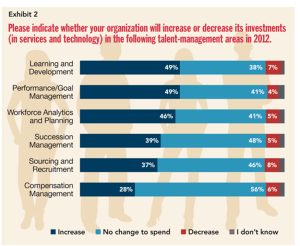
It also doesn’t surprise me that more organizations than not will be increasing their investments in Learning/Development, Performance/Goal Management and Workforce Analytics/Planning services and technology. That’s obvious.

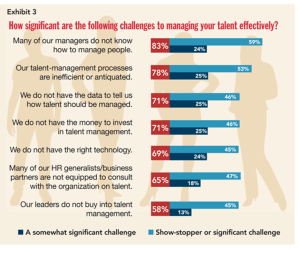
What really does surprise me is that 58% of HR executives believe that peer leaders in their organizations “do not buy into talent management.”

Lordy, I hope this isn’t the furniture conversation. And I’m willing to believe it isn’t because 83% of the respondents also believe that “many of our managers do not know how to manage people.” Additionally, 65% of the respondents believe that “many of our HR generalists/business partners are not equipped to consult with the organization on talent.”

Ouch. Either the HR respondents to this survey were all in a colossally bad mood, or they’re starting to look clear-eyed at their organizations and re-calibrate their challenges.

It’s clear that many organizations need to look at legacy systems and programs in the talent management arena (can you say annual performance review system?) and, according to this survey, they are. But focusing on leadership understanding and managerial effectiveness in talent management might be a strong first step.

It’s a great day for HR if the results of this survey mean a new focus on talent management effectiveness – at the top, in the middle, and most importantly, in HR.

But if it was just a systemic bad mood, we’re sunk. Because, in the words of one of my favorite movie characters in one of my favorite movies, “we have serious problems to solve, and we need serious people to solve them.”

7 Comments

Filed under American President, China Gorman, HR, HR Credibility, HR Executive Magazine, HR Technology, Knowledge Infusion, Managerial Effectiveness, Talent Management

It’s a Wrap!

Well…another SHRM Conference is in the can. In Atlanta. In the Georgia World Congress Center. More than 13,000 attendees – with more than 1,000 from outside the U.S.

Here’s my assessment:  no one does HR conferences like SHRM. Period.

  • More than 200 concurrent sessions
  • High profile keynote speakers
  • World class entertainment
  • More than 800 exhibitors in the Expo Hall
  • Social media integrated throughout
  • Involvement of more than 700 local SHRM member volunteers
  • More than 350 SHRM employees

The SHRM Annual Conference is the single largest gathering of HR professionals anywhere in the world – year in and year out. And it’s motivating and exciting to be a part of that.

And while the mechanics are impeccable, the content engaging, and the crowds impressive, the real value of a gathering like this aren’t the mechanics, content and crowds. The real value of SHRM is the personal connections we make, the conversations we have, the meeting IRL of people we only know through social media, the meeting IRL of people we read about in HR Magazine, the private coaching from our mentors, the chance meetings of people who will be new personal and professional friends.

On second thought, it’s not actually a wrap, my friends. It’s a hug. It’s a hug from our profession. It’s a hug from our colleagues, our heroes, our game changers.  And who doesn’t need a hug from time to time?

4 Comments

Filed under China Gorman, Conferences, HR Conferences, SHRM, SHRM Annual Conference

HR Talent Shortage

SHRM has just released a new report in its series on The Ongoing Impact of the Recession. The current release focuses on the Manufacturing Industry.  Previous reports have focused on the Federal Government, State and Local Government and the Finance Industry.

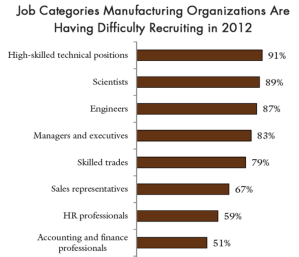
This report clearly shows the continued strong degree of difficulty in hiring professionals with STEM education backgrounds – as well as mangers and executives, the skilled trades, sales professionals, HR professionals and accounting/finance professionals. It should come as no surprise to any business leader or talent management professional that finding professionals in the U.S. with STEM backgrounds is difficult.  The U.S. education infrastructure is not producing enough graduates in these disciplines. See my posts here and here.

It is surprising to note, however, that in addition to reporting a high degree of difficulty in finding STEM professionals and skilled trade workers, manufacturing employers are also having a difficult time finding managerial and executive talent, and sales, HR and accounting/finance talent.

Hmmmm.  A shortage of HR talent. Is this good or bad news?

2 Comments

Filed under Education Deficit, Hiring Difficulty, HR, SHRM, STEM, Talent pipeline

What a Difference 3 Years Makes!

Three years ago in at its Annual Conference in New Orleans SHRM took a tiny, tentative baby step into the land of Social Media by fielding a concurrent session on HR Blogging.  It was called “HR Bloggers: who are they and why should I care?”  Four HR bloggers, 2 SHRM members and two (then) non-SHRM members) were featured in a panel discussion.  There was only one guideline:  no cussing.

The panelists, Kris Dunn (www.hrcapitalist.com), Lance Haun (www.lancehaun.com), Jessica Lee (www.fistfuloftalent.com) and Laurie Ruettimann (www.thecynicalgirl.com), spoke in language not recognized by most HR professionals about social media, tweeting and social community.  The most interesting part of the conversation to me was the discussion on whether or not bloggers should be held to commonly accepted journalistic ethical standards.

Also noteworthy about this session was the fact that it was live-streamed, a first-ever event at a SHRM conference.

And that was it. Well, if tentatively, received.  Tiny baby steps.

Flash forward 3 years and WOW!

A micro site on the SHRM website dedicated to the conference experience called The Buzz.

A social media lounge for bloggers – and there are lots of them.  The Hive – a 3,000 square foot social media hub/genius bar/meeting spot/training ground – prominently positioned and staffed by true HR social media experts to help attendees get started in social media or get more effective at social media.

Want to set up a Twitter account?  They’ll help you do it on the spot.  Want to change your FaceBook profile? They’ll help you do it on the spot.  Can’t figure out how to share a profile on LinkedIn?  They’ll help you do it on the spot.  Want to fill out your profile on SHRMConnect and get started?  They’ll help you do it on the spot.

Curtis Midkiff (@SHRMSocMedGuy), head of SHRM’s social media efforts has conceived and produced a brilliantly elegant approach to adding social media to the fabric of the conference experience.  If you’re a newbie, his team at The Hive will get you started.  If you’ve started but need help reaching the next level, his team at The Hive will get you there.  If you’re an expert, you’re welcome in the social media lounge – but beware. You will feel honor-bound to write a blog post and publish it immediately.  (Sort of like this one.)

Couple these efforts with free WiFi connectivity in the convention center and you have a benchmark, 21st century social media enabled conference.  Well done, Curtis and team.  Well done!

1 Comment

Filed under Conferences, HR Conferences, SHRM, SHRM Annual Conference, Social Media, The Hive

Certificates: the New Associate’s Degree?

Georgetown University’s Center on Education and the Workforce has published a new report:  Certificates: Gateway to Gainful Employment and College Degrees. I’m a big fan of a previous report from these authors, Help Wanted: Projections of Jobs and Education Requirements Through 2018 and wrote about it here.

This new report gives a clear look under the hood of one of the staples of our post-secondary education infrastructure: the certificate.

Take a look. It’s not a hard read.

Uniquely American, certificates are widely varied in their positive impacts and largely ignored by private, public and government socioeconomic surveyors. The study’s authors contend that if certificates “with a demonstrated labor market value” were counted in official post-secondary surveys as “credentials” they would improve the U.S.’s post-secondary completion position from 15th to 10th among industrialized nations (OECD countries).

And 1 million certificates were awarded in 2010 – up from 300,000 in 1994.

Interesting data from the report include:

  • Certificates are the fastest growing form of post-secondary credentials in the U.S. increasing from 6% in 1980 to 22% today
  • 20% of certificate holders go on to get two-year degrees
  • 13% of certificate holders go on to complete four-year degrees
  • Workers with certificates earn an average 20% more than workers with just high school degrees

As talent management and HR professionals continue to struggle to find “qualified” workers to fill their openings, perhaps a new look at the experience and credentials they require might open a large segment of fully qualified workers – those with certificates instead of college degrees.

Something to think about.

5 Comments

Filed under Career Planning, Certificates, China Gorman, Demographics, Education Deficit, Employment Data, Post-secondary education, Talent Management, Talent pipeline, Unemployment

Maximizing Your Conference Investment

This is an updated post from August 2010.

The 2012 SHRM Annual Conference is just around the corner.  Word has it that there will be many first-timers in attendance.  This is for them — and for other attendees who want to be sure they maximize the financial and time investments they’re making.  Here are three proven strategies for making sure you get your money’s worth.

Sessions

Conferences generally have 3 types of content sessions:

  1. General Sessions:  these are sessions that are intended for the full complement of attendees.  The speakers are typically big names in the industry who speak on universal topics relevant to the conference theme or they are big celebrity names meant to draw your attendance to the conference.  SHRM does both — and usually always has a movie star or TV personality on the big stage.  Big names sell tickets, folks.  Think of them as the motivational part of the conference.
  2. Concurrent Sessions:  these are the main content tracks that are scheduled throughout the conference.  Each time slot will hold multiple options for your consideration.  Designed for smaller subsets of the conference attendees, these tend to be led by consultants, academics and a few practitioners and are focused content of a practical nature.  Think of them as the skill building part of the conference experience.
  3. Sponsor Highlights:  these are sessions that feature a sponsor or exhibitor’s product or service, are marketing-focused in nature, and come as part of their sponsorship/exhibitor fee.  SHRM doesn’t do this very often — but the exhibitors frequently hold mini-sessions in their booth space in the expo hall.  Don’t dismiss them.  You can get great information about what’s new and cutting edge as well as scope out potential new partners.  (I’ll be conducting mini sessions in the Achievers booth on Sunday and Monday.  Come over and say “hi.”)

In a typical two-and-a-half- or three-day conference, it’s important to select wisely the sessions you want to attend – and in advance.  But it’s also important not to over-schedule yourself (more on that later). I recommend attending all the General Sessions.  The big names generally have value and the celebrity speakers are usually engaging, entertaining and motivating.  Then attend concurrent sessions in about 60-75% of the time slots.

Save Time For Networking

One of the particular values of attending a conference in person (as opposed to an online conference or a series of webinars) is the opportunity to meet other like minded people.  Look at the list of presenters.  Look at the list of sponsors/exhibitors.  Find out who else will be attending.  Then target 4-8 people that you’d really like to meet and talk with – and find them at the conference.  Leaving time in your session schedule to set short appointments when you find people on your target list will allow you to be thoughtful in creating new relationships.  Don’t pass up the opportunity to learn from industry pros – who, by the way, also want to network and meet people just like you!

You know how to network, right?  You prepare for these opportunities in advance by identifying what you’d like to talk about with each target and prepare 2 or 3 questions to get the conversation rolling.  You can ask everyone the same questions, or you can customize your approach to each person.  Your confidence will be strong as you introduce yourself to these folks and you’ll be surprised how amenable perfect strangers are to meet and talk with you.

If you aren’t on Twitter or FaceBook, now would be a good time to start accounts.  Many of the people you want to meet are using social media to connect with new and old friends.  I’ll be there.  Connect with me.  On Twitter I’m @ChinaGorman and it’s easy to friend me on FaceBook.  Just mention #SHRM12 in the invitation and I’ll accept.  Social media will be prevalent in Atlanta.

Nothing is More Attractive Than a Smile

As you walk the conference halls and expo aisles, make sure your demeanor and body language is open.  And smile.  Intentionally.  You’ll appear open, friendly, not intimidating or intimidated.  Really, there’s nothing more attractive than a smiling face.  And there’s nothing that builds your confidence to approach strangers than acting open and welcoming.

Attending a conference and getting your money’s worth isn’t hard.  But it takes some forethought and planning.  Both you and your organization want to realize the investment it took to get there.  Make sure you get the full value of the experience.

5 Comments

Filed under Achievers, China Gorman, Conferences, HR, HR Conferences, SHRM, SHRM Foundation, Talent Management

The Wisdom of CEOs

Booz & Company recently published its 12th annual CEO Succession Survey. It’s fascinating reading:

  • As the economy gets stronger, the numbers of CEOs leaving their jobs are rising to pre-recession rates
  • CEO turnover is highest at the largest companies
  • CEO turnover is highest in market sectors that face the most challenges
  • Outsider CEOs returned to historical averages
  • Insider CEOs bring higher returns
  • Insider CEOs serve longer
  • The combined chairman-CEO model continues to decline

With average CEO tenure declining, the survey’s data are clear that new CEOs – whether they come from the inside or the outside – are under historically high pressure to perform quickly.  (Can you say Leo Apotheker?)  And concerned boards are more frequently appointing the outgoing CEO as board chairman to provide a sort of “apprenticeship” experience in the early months of a new CEO’s tenure.  Interesting stuff.

This year, the study focused on the new CEO’s first year.  Booz & Co. interviewed a number of CEOs from around the world and asked their advice for incoming CEOs.  There were 7 common recommendations:

  1. Deal with the obvious executive team changes as early as possible
  2. Be wary of changing strategy too quickly, even if you think the current strategy is wrong
  3. Make sure you understand how every part of the company operates and how it is performing
  4. Build trust though transparency
  5. Be selective in listening to advice
  6. Find a sparring partner with whom you can discuss plans openly
  7. Manage your time and your personal life with care

The survey provides a great deal of background data and commentary on these 7 “tips” for succeeding as a new CEO — and I encourage you read it.  But I’m thinking this is great advice for any new executive at any level.

And I’m really thinking this list is great coaching for HR.

6 Comments

Filed under Booz & Company, Business Success, C-suite, CEO Tenure, CEOs, China Gorman

The CEO – HR Disconnect: Understandable? Yes. Defensible? No.

The furniture conversation (see my post on that subject here) that HR is so fond of having is, at its heart, a lament about HR not having strategic business credibility. I don’t buy that HR lacks strategic business credibility. I do buy that HR isn’t communicating mission critical data to the C-suite and that creates a credibility challenge.

New data will be published shortly by Achievers that highlights the disconnect between what HR and CEOs believe about key elements of employee engagement in their organizations:   feedback, managerial communication and recognition.  And it’s pretty eye-opening!

When we designed a survey to evaluate how employees rate the current state of these workplace dynamics in their organizations and whether CEOs and HR professionals are in touch with what employees want, we found an added dimension in comparing the differences between the perceptions of CEOs and HR professionals.

  • For example, when we asked CEOs and HR professionals whether they agreed that their employees believe that their organization inspires them to do their best work every day, 61% of CEOs strongly agreed or agreed, while only 31% of HR professionals strongly agreed or agreed.
  • When we asked CEOs and HR professionals whether they agreed that their employees rated their organization culture as positive, strong and motivating, 67% of CEOs strongly agreed or agreed and 37% of HR professionals strongly agreed or agreed.

Wait.  It gets worse.

  • When we asked employees if they agreed that the feedback they received from their managers was constructive and useful, 79% of CEOs believed that their employees would strongly agree or agree while only 33% of HR professionals believed that their employees would strongly agree or agree.
  • When we asked employees how frequently they received feedback from their manager, 56% of CEOs believed that employees would report receiving feedback immediately or on-the-spot.  HR professionals?  11% believed that employees would report receiving feedback immediately or on-the-spot.

These are just four examples in the survey that show the continental divide between how CEOs and HR professionals evaluate crucial aspects of their employees’ engagement.  With these results that underscore the CEO – HR disconnect, we could hypothesize that CEOs have a more optimistic view of their workforce because any time they interact with employees, employees are on their best behavior – trying to impress the boss.  HR, on the other hand, frequently interacts with employees when they are not at their best:  exit interviews, investigations, disciplinary situations, etc.  It’s understandable that HR might have a more pessimistic view of their employee population.

Absent data to the contrary, why shouldn’t CEOs be optimistic? If there were issues, surely, they might think,  HR would share the data.  But when the employee engagement data is consistently less positive than CEOs’ perceptions, it”s clear that CEOs aren’t getting data that informs them of the reality of their workforce. And who has this data?  Well, that would be HR.

So why isn’t this data – and their ramifications – being shared with the C-suite? For HR to understand the workforce and know what is working and what isn’t clearly isn’t enough.  Communicating mission critical data and serving up cost effective solutions are HR’s opportunity. Heck.  Most would say that’s HR’s job!  For certain, they are the ticket to strategic business credibility.

If we needed tangible proof of the CEO – HR disconnect, this survey’s results confirm it.  You’ll be able to download it on June 12 from the Achievers website.

14 Comments

Filed under Achievers, C-suite, CEOs, HR, HR Credibility