Tag Archives: Data Point Tuesday

Maybe Engagement Doesn’t Really Matter

data-point-tuesday_5002

When Gallup released the most recent State of the American Workforce Report the engagement news was not good. Here’s what the report said:

“Currently, 30% of the U.S. workforce is engaged in their work, and the ratio of engaged to actively disengaged employees is roughly 2-to-1, meaning that the vast majority of U.S. workers (70%) are not reaching their full potential — a problem that has significant implications for the economy and the individual performance of American companies.”

Because the basic premise is that organizations with highly engaged workforces produce better results than those with less engaged workforces, I was surprised that the press didn’t make more of this data. I wrote about it here, but it was about creating the business case for caring about whether or not employees are or are not engaged. I guess the overall sad state of engagement in the U.S. is a given and not newsworthy anymore.

But I saw some new Galllup survey data that, frankly, raises new questions for me, and makes me wonder if “engagement” is really what we should be measuring. And if “engagement” and stronger financial performance really are causal, as Gallup implies.

The survey question was “If you won $10 million in the lottery, would you continue to work, or would you stop working?” So a rational person might think, “Well, if 30% of the workforce is engaged and 70% of the workforce is not engaged, then probably 70% of the workforce would quit their jobs if they found themselves $10 million richer.” Wouldn’t you think that? I certainly did.

So imagine my surprise to see that the response to this survey question is exactly the opposite of what we would have expected! 68% of polled working adults said they’d keep working and 31% said they would quit. Exactly the opposite!
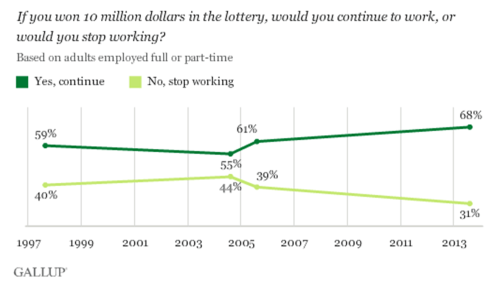
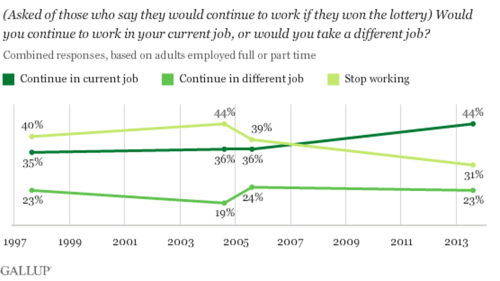
Gallup win the lottery 1I’m confused. But then I thought I had it figured out when I looked at the next question, which asked those who said they’d continue working if they’d stay in the same job or take a different job. “Aha!” I thought to myself. “The people who said they’d continue to work would surely take another job – a job in an organization that would be more engaging since they’re all not engaged.” But no. Nearly half of those said they’d even stay in the same job!
Gallup win the lottery 2

Now I’m really confused. Maybe it’s financial. Except that the positive trajectory to stay in the same job started way before the recession of 2009. So it may not be financially motivated. In fact, $10 million buys a lot less in 2013 than it did in 2005 – and still the percentage of workers saying they’d stay in the same job has grown substantially.

So what’s the deal? Does engagement even matter? If 67% of the population will continue to work after winning $10 million – and fully half of those will stay in the job they currently have, why do we care about engagement scores? Does engagement really matter?

Enquiring minds want to know!

18 Comments

Filed under China Gorman, Data Point Tuesday, Engagement, Gallup, Winning the Lottery

How About a Seat at the Spreadsheet?

data point tuesday_500

HR professionals worry a lot about whether their CEO thinks they are strategic business leaders. Turns out it isn’t the CEO that HR professionals need to worry about. It’s the CFO.

This is according to global survey data collected from three Oracle/IBM sponsored research reports produced by the Economist Intelligence Unit in April and May 2012. CEOs made up 57% and CFOs made up 43% of the 235 respondents.

The resulting infographic is one of the more readable and useful ones of its type that I’ve seen. Among the data points:

  • 80% of CEOs and CFOs want the head of HR to be key in their company’s strategy planning
  • Only 38% of those CEOs and CFOS say that is currently the case
  • Only 10% say the head of HR is “extremely” key in strategic planning right now
  • Only 37% of CEOs and CFOs say their relationship with the head of HR is “close and trustful”
  • Just 28% of CEOs and CFOs say their relationship with the head of HR is among their “most valued” professional relationships

But here are the real zingers:

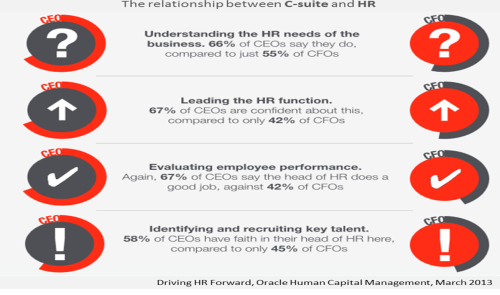
Oracle Driving HR Forward Infographic March 2013

Ouch!

But here’s the real irony:  CFOs are more confident about HR’s understanding the needs of the business than they are about the business of HR! Low confidence by CFOs that HR can lead the HR function, can evaluate employee performance or can identify and recruit key talent.

That’s not good news – especially since CFOs spend significantly more time with CEOs than CHROs do. I wonder what the CFO and CEO are talking about with regard to HR? Is the CFO supporting the CHRO? Given this survey data, I wonder.

Maybe CEOs aren’t HR’s biggest challenge after all. Maybe CFOs are the ones toward whom HR professionals should be aiming their strategic attention. Maybe instead of pining after furniture HR should be pining after spreadsheets!

4 Comments

Filed under C-suite, CEOs, China Gorman, CHROs, Data Point Tuesday, IBM, Oracle

Who Knows More About Culture than HR?

data point tuesday_500

The importance of culture in making or breaking a merger/acquisition has long been an interest of mine. After spending 25 years at the top outplacement/career transition business, I’ve seen the best and worst of people practices in M&A – and the best and worst of culture awareness in M&A. So I read with interest the recent whitepaper by Mercer, Culture in M&A: We Know It’s Important, So Now What? And I found some interesting nuggets.

We all know this, but Mercer’s survey data show that “failure to address corporate culture is the key barrier in up to 85% of failed M&A transactions.” 85%. I’ll bet even your gut is surprised by that high percentage. Good to have hard data on that one, right?

This is a short report, as whitepapers go, so if there’s a merger or acquisition in your future, I encourage you to download the report here because the data are pretty compelling that culture should be a primary driver during due diligence and integration execution in a successful integration.

And who knows more about culture than HR?

Mercer Org Culture Tops Elements Critical to Deal Success

The relative importance of corporate culture as a driver of deal success as compared to customer relationship management, human resources, IT and regulatory compliance could be shocking to some – but not to leaders who have been on the wrong end of one of these deals. And by wrong end I mean a due diligence process and integration execution plan that ignored the importance of culture and people, focusing solely on “cost synergies” and “accretive” value; a due diligence process and integration plan that didn’t have HR’s fingerprints all over it.

And if you need any more convincing, there’s this to consider:

Mercer Paving the Way for Deal Success

So even if your focus is on achieving operational efficiencies, addressing culture in deals is a critical success factor.

And who knows more about culture than HR?

Other topics covered (briefly) in the report include:

  • Identifying company culture

  • Understanding target company culture

  • Analyzing data on culture

  • Using surveys to engage leaders

  • Planning for integration

  • Soliciting employee feedback

  • Tracking the integration process

As you prepare for the deal, remember that although your CEO, CFO, Chief Communications Officer and head of corporate strategy may talk the talk about culture in an acquisition or merger, it’s HR (you!) that usually ends up having to walk the talk for the increasingly critical dynamic of integrating cultures. And by the way, the “cost synergies” and “accretive” value never happen if culture isn’t the centerpiece of the due diligence and integration plans.

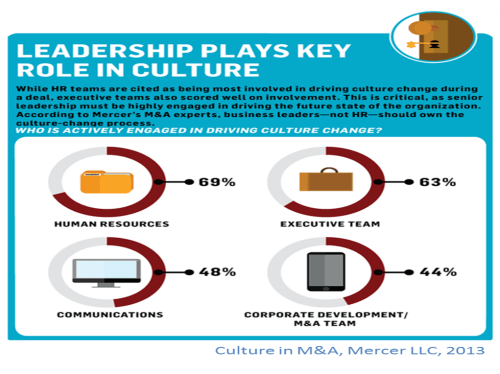
Mercer Leadership Plays Key Role in Culture

So look at it this way:  since most organizations make HR largely responsible for the cultural integration piece in M&A activity, and failure to address corporate culture is the key barrier in 85% of failed transactions, HR has an enormous opportunity to drive up the success rate of M&A activity, quantify its value and participate as a full member of the organization’s strategic leadership.

As the economy improves and M&A activity begins to ratchet up at home and globally, HR is uniquely positioned to lead real bottom- and top-line impact by taking the culture integration mantle and running with it. And by running I mean creating the business case with hard data to ensure that culture issues are pro-actively dealt with even before due diligence begins.

Because who knows more about culture than HR?

4 Comments

Filed under China Gorman, Culture, Data Point Tuesday, M&A Planning, M&A Success, Mercer

Tying Recognition to Values: Who Knew?

data point tuesday_500

Organizations that believe in driving an intentional culture – whether for engagement purposes, recruitment purposes, performance purposes, innovation purposes, or all of the above – might think it logical to tie their recognition programs directly to their values. But as it turns out, maybe not.

The new SHRM/Globoforce Employee Recognition Survey Winter 2012 Report has some interesting survey data and thought-provoking findings. The survey, sent to 6,000 SHRM members at the manager level or higher, had a response rate of 13% and a margin of error of +/- 3%. So, with 770 randomly selected HR professionals employed at organizations with more than 499 employees across North America, the sample size is large enough for the results to be interesting.

The broad findings are a little surprising – although the survey questions focused entirely on recognition, engagement and core values. (So, for example, the challenges of implementing healthcare reform don’t show up, nor do the issues of perceived talent or skills shortages.) But even within that context, these findings make me scratch my head:

#1  Employee engagement tops the list of HR challenges.

#2  Performance management remains stuck in neutral.

#3  Recognition programs fill the feedback and appreciation gap.

#4  Recognition programs have an observed positive impact on business results.

#5  Recognition aligned with core values leads to more effective managers.

#1  Employee engagement tops the list of HR challenges:  well, I do find that surprising – especially given the rest of the survey data. I might have thought that the issues of performance management done the same way it’s been done for 10-15 years (or not at all) would top the list of HR challenges. But no, employee engagement is at the top of the list. Despite (or maybe because of) the fact that most HR professionals haven’t been able to make the business case for investing in creating higher levels of engagement, it’s at the top of the list.

#2  Performance management remains stuck in neutral:  Performance management is the talent management infrastructure weak link. Most CEOs and other members of the C-Suite report that they know their system is ineffective. And what’s more they know their employees don’t like their current system either. That HR folks are “stuck in neutral” in this regard is perplexing. With the billions of dollars being spent on ineffective, unpopular legacy systems, this would seem ripe for corrective action — not being stuck in neutral.

#3  Recognition programs fill the feedback and appreciation gap:  so investing in new solutions that fill a gap rather than fixing the full system seems shortsighted to me. Don’t get me wrong. I think that there are recognition programs that powerfully engage teams, inspire individuals and create positive momentum for employers and their customers. Some of the new entrants that utilize social technology and are natively mobile are stunning. And worthy of investment. But should we be thinking bigger than filling gaps?

#4  Recognition programs have an observed positive impact on business results:  that’s research-speak for “we can’t quantify it yet but we think it’s real based on anecdotal evidence.”  ‘Nuff said.

#5  Recognition aligned with core values leads to more effective managers:  that’s it! If the data clearly support this finding, then this is the foundation for the business case that HR has been looking for. I’ve long believed that if the middle manager cohort was effectively trained and managed, the incidences of workplace drama and their resulting legal issues – and the resulting time-suck for HR – would be hugely reduced. Managers would be held accountable for managing. And HR could get to the strategic business of workforce planning and talent management leadership.

The following charts from the report show the “observed” connection between values-based recognition systems and managerial effectiveness in “acknowledging and appreciating” employees:

SHRM Globoforce Fig 8

SHRM Globoforce Fig 13

*Note:  the red circles on the charts are mine.

The finding that managers do a better job of effectively acknowledging and appreciating employees when recognition programs are directly tied to core values seems to stack up. But it also appears that managers do a better job of effectively acknowledging and appreciating employees simply by being given a recognition program to use. Either way works for me. And either way clearly works for employers and their employees.

But I’ll go out on a limb with the observable improvement in managerial effectiveness and agree that tying recognition programs to values is a winner. In fact, I’ll go so far as to opine that tying talent management in its entirety to organizational values will provide quantifiable improvement, not just observed improvement.

Interesting findings in this report. If you haven’t looked at some of the innovative new solutions in the recognition space maybe you should.

10 Comments

Filed under Achievers, Annual Performance Reviews, Business Case, China Gorman, Data Point Tuesday, Globoforce, Managerial Effectiveness, Rewards & Recognition, Talent Management

Performance and Engagement: No More Smoke and Mirrors

data point tuesday_500 I was talking with the CEO and CMO of a startup software company in the HCM space yesterday. One of the things we talked about was the ready availability of data that link organizational performance with employee engagement. No longer the stuff of smoke and mirrors, the correlation between higher revenue, lower costs and greater customer satisfaction with employee engagement is rock solid. Whether the data come from academic researchers, think tanks, research/analysis firms or other interested parties, we can cite legitimate sources to underpin our ROI calculations. (See previous posts here and here.)

Gallup’s recently released State of the American Workforce is one example of such data. In the “From the CEO” introduction, Chairman and CEO Jim Clifton says:

“Here’s what you need to know:  Gallup research has found that the top 25% of teams – the best managed – versus the bottom 25% in any workplace – the worst managed – have nearly 50% fewer accidents and have 41% fewer quality defects. What’s more, teams in the top 25% versus the bottom 25% incur far less in healthcare costs. So having too few engaged employees means our workplaces are less safe, employees have more quality defects, and disengagement – which results from terrible managers – is driving up the country’s healthcare costs.”

Here’s the corresponding chart from the report:

Gallup Engagement KPIx

You may or may not have an opinion about Gallup’s Q12  methodology, but the longitudinal nature of their data — together with their periodic meta-analysis — says to me that their findings have weight. We can take to the bank – and to our CEOs and CFOs – the relationship between higher engagement and stronger organizational performance.

This is the data of sound and persuasive business cases for investing in the well-being of our employees. Take a look at the Gallup findings. You’ll find something that will spark an ah-ha moment. Or maybe two or three.

5 Comments

Filed under China Gorman, Data Point Tuesday, Employee Engagement, Engagement, Gallup

Shooting Ourselves in the Foot Isn’t an Effective Engagement Strategy

data point tuesday_500

Recent headlines from Gallup proclaiming that college-educated Americans are less engaged on the job than other cohorts may have spurred some conversation among HR leaders and professionals. Engagement, that elusive component to organizational success, is the holy grail many employers chase. And Gallup, the grand surveyor of people on all topics, has regularly published engagement data that either convinces us that engagement is a fraud or that we have to try harder to win over our workforces.

A recent USA TODAY article, “Higher education = lower joy on job?” quoted Gallup findings as well as findings from this report: “Why Are Recent College Graduates Underemployed?” from the Center for College Affordability and Productivity. The justaposition of these two sources shows an interesting picture.

Here’s Gallup’s data:

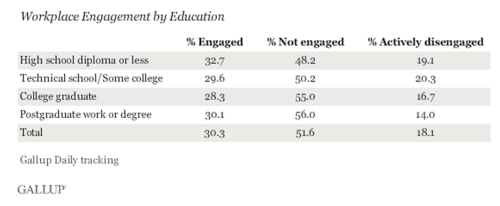
Gallup Engagement by Education 2013

So. According to Gallup, the most engaged group of workers are those who have earned a high school diploma or less.  And the least engaged group of workers are those who have earned a college degree. By themselves, the numbers are almost interesting. By themselves, the bigger news is that the numbers show that less than a third of the workforce is engaged, and more than two-thirds of the workforce is either not engaged or actively disengaged. OK. That’s interesting and cause for concern.

But put this Gallup data into the blender with this data from the Center for College Affordability and Productivity and it gets a little more interesting:

College Grads Underemployed 2013

If nearly half of all American workers with college degrees are in jobs that do not require a college degree, might that have something to do with their level of engagement? Are nearly half of our college educated workforce bored on the job?

And if they are, and if we’re concerned about engagement, why are we putting them into jobs for which they are overqualified? Would high school graduates be more engaged and perform better? Would those better performers positively impact the financial performance of their employers?

The Center also asserts that

“past and projected future growth in college enrollments and the number of graduates exceeds the actual or projected growth in high-skilled jobs, explain the development of the underemployment problem and its probable worsening in future years.”

So they believe the engagement problem will grow worse – if there really is a causal relationship between engagement levels and the over-qualification of many of our workers.

What do we make of this? Well, I do think it’s common sense to believe that people who are significantly over-educated for the jobs they hold could well be bored and unengaged. But I also think that in this economy, many are grateful to have any job, over-educated or not. What that means for engagement is unclear to me. Except that Gallup, being the last word in survey data, shows a clear line between education levels and engagement.

shoe with bullet holeWhile this might be above my pay grade, I’m willing to make a leap here and suggest that hiring overqualified workers might not be the best strategy for boosting engagement. If we truly believe that engaged workers have a demonstrably positive impact on an organization’s financial performance – and that’s been the HR mantra for a number of years – then we are probably shooting ourselves in the foot by requiring college degrees for jobs that truly don’t need them.



I’ve written this before: the over-inflation of job requirements in job descriptions isn’t putting the unemployed in this country back to work. And now we know it isn’t helping organizational performance. Hmmm…

I’ll bet we can agree on this:  shooting ourselves in the foot isn’t an effective engagement strategy.

5 Comments

Filed under Center for College Affordability and Productivity, China Gorman, Data Point Tuesday, Education Deficit, Engagement, Gallup, Job Descriptions

2013 HR Tech Conference: Just Around the Corner!

data point tuesday_500

This isn’t a usual Data Point Tuesday. No data to review. Rather, I want to encourage you to consider attending the HR Technology Conference this fall. And not just because it’s in #VegasBaby.

HR Tech Logo 2

HR Tech is one of the top HR conferences in the world  – and gets stronger every year. This is the 16th year of HR Tech, and Bill Kutik – the conference founder and co-chair – says that it’s the best place to learn how to get the business benefits from technology. And I have to agree with him. Here’s what I wrote after attending HR Tech for the first time in 2011,

“One conference treats HR people like they impact the bottom line.  Like they are business leaders capable of making business decisions. … Unlike the nonprofit conferences of all sizes and the smaller unconferences, HRTech is a place where business gets done.”

And it certainly was the same – only better – in 2012. Here’s what I wrote about last year’s conference:

“The HR Technology Conference is the one conference to attend to find out how to make your HCM infrastructure more productive, more efficient, more cost effective and more future oriented. … It’s the one conference to attend to get a glimpse of what will be possible in the future to ensure organization success.”

And knowing Bill, and his recently announced successor, Steve Boese, here’s what I’m looking forward to this year, from the conference agenda:

  • Presentations from senior execs at world-class organizations including Cigna, Cisco, GE, GM, Hilton, Johnson & Johnson, Microsoft, Procter & Gamble and many more
  • Keynotes from Don Tapscott and Jason Averbook
  • Innovative and entertaining General Sessions including “The HR Tonight Show Starring Bill Kutik” and “Awesome New Technologies for HR” produced by Steve Boese
  • New “HR Tech Talks,” short, rapid-fire presentations by industry leaders about work, technology, management and some surprising topics
  • Provocative panel discussions, including Collaborative Enterprises Get Work Done!, NextGen Influencers and International Recruiting
  • An Expo Hall filled with the most innovative HR technology solutions available – and some that are just being brought to the market
  • Guaranteed face-time with industry luminaries – Naomi Lee Bloom, Josh Bersin, Gartner’s Ron Hanscome, IDC’s Lisa Rowan and more – in intimate, small-group discussions

The last bullet alone is worth the price of admission!

Let’s face it. Technology is part of every HR professional’s job. Whether you’re an entry-level generalist, a manager/director-level functional expert, or the most senior HR leader in your organization:  you have to be smart about HR technology. Short of returning to school to earn another degree, the HR Technology Conference is the place to learn about the intersection of people, business and technology. It’s the place to meet real thought leaders in person. It’s the place to talk with vendors about potential solutions to your productivity issues. It’s the place to learn about cloud-based SaaS solutions to replace your costly and ineffective legacy systems. It’s the place to learn how HR really can solve business problems.

Even though you can’t put a price tag on this kind of learning, readers of Data Point Tuesday can get a $500 discount on their conference registration. That means you pay only $1,395 instead of $1,895! You’re more efficient already! Register here for the conference and use Promo Code CHINA13 to get the discount. And get this:  for readers of Data Point Tuesday, this Promo Code doesn’t expire until the conference ends on October 9!

There are no guarantees in life. But if you join me at the 2013 HR Technology Conference in Las Vegas, October 7-9 at the Mandalay Bay, you will be smarter, more connected, more effective and more attractive when you leave.

9 Comments

Filed under Bill Kutik, China Gorman, Data Point Tuesday, HR Conferences, HR Technology Conference, Steve Boese

High Cost of ‘Mal-employment’

data point tuesday_500

Professor Andrew Sum from the Center for Labor Market Studies at Northeastern University has done a great deal of research on the effect of the most recent recession on the youngest cohorts in our economy.  (I wrote about other of his research here.)

A recent CNNMoney article highlighted some interesting data from Dr. Sum’s most recent research efforts. And it has to do with the ability of recent college graduates to enter the economy in jobs that require their degrees.

Recent college gradsWith unemployment still above 7%, it’s not hard to understand that young people armed with a newly minted degree and little experience are having a hard time connecting to jobs. People with degrees and lots of experience are having a hard time connecting to jobs.

While we know that the data regarding the lifetime earnings differential for college graduates is a compelling argument for college attendance, the “mal-employment rate” together with the student debt-load most graduating college seniors are burdened with might be making young people have second thoughts about investing in a four year degree. And that’s bad news.

The Lumina Foundation tracks our progress towards attaining the national goal that 60% of Americans obtain a high-quality postsecondary degree or credential by 2025. And in 2011, the last year for which the data are complete, the percentage of Americans between the ages of 25 and 64 with two- or four- year college degrees was 38.7%. Our goal is 60%. Our current level is 38.7%. That’s really bad news.

Add to this the expectation that 65% of U.S. jobs will require some kind of postsecondary education by 2020 – and it’s really, really bad news.

These are difficult data points at the intersection of jobs, education and the talent pipeline. And they should be motivating us – all of us, in or out of HR – to think better about our workforce. Our organization’s workforce and our nation’s workforce.

Mal-employment might be the least of our worries in 2020.

4 Comments

Filed under China Gorman, Data Point Tuesday, Education Deficit, Job Creation, Talent pipeline

The Hidden Job Market is Alive and Well — and That’s Not Good News!

data point tuesday_500

Last week I wrote about matching the number of job openings to the number of unemployed people by industry. The numbers were arresting. I used data from the Economic Policy Institute’s Heidi Shierholz.

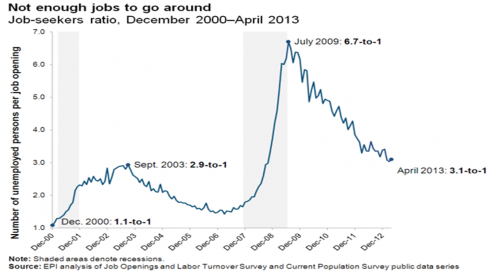
In that post, Unemployed Workers Still Far Outnumber Job Openings in Every Major Sector, Shierholz provided this graph showing the Job-Seekers ratio from December 2000 through April 2013 based on data from the BLS JOLTS Survey and Current Population Survey:

Not enough jobs to go around June 2013

This is an incredible view of the last 13 years. The Jobs-to-Seekers ratio in December 2000 was 1 to 1.1:  pretty much full employment. The unemployment rate that month was 3.9%, which means that even people who didn’t want to work were working.

As I read the data, though, it looks a little odd:  the CPS (Current Population Survey) and the JOLTS Survey together show that in April while there were 3,737,000 reported job openings, 4,425,000 workers were hired and 4,279,000 workers were separated for a net employment increase of 146,000. Which means that  688,000 more workers were hired than there were job openings. Even if these April hires were from the March job openings (3,875,000), there were still 550,000 more hires than openings.

So the hidden job market must be alive and well if we’re hiring more than half-a-million more workers than there are reported openings. Think about that. And think about the reported skills shortages. And think about the difference between structural and cyclical unemployment (which I wrote about here).

The reason our unemployment rate continues to stay at an unacceptable and economy-stopping 7%+ may not be so related to the lack of new job creation – we appear to be filling more than the reported number of job openings every month! – but to the scarcity of specific skills and talent. So maybe the skills gap is real and the 9,000,000+ workers who are unemployed will stay that way until they acquire new skills or further lower their job targets.

Either way, that’s not good news for employers with openings they can’t fill, workers who can’t find jobs for the skills they have, or our economy which can’t get out of 2nd gear.

The hidden job market is very much alive. Too bad that’s not good news.

2 Comments

Filed under Bureau of Labor Statistics, China Gorman, Data Point Tuesday, Hidden Job Market, HR Data, Job Creation, Structural Unemployment, Unemployment Rate

Forget the Skills Deficit: How About Filling Open Jobs?

data point tuesday_500

So the unemployment rate went up a little in May, from 7.5% to 7.6%. The Bureau of Labor Statistics deems this increase as “essentially unchanged.” Despite 175,000 more people working. How does this math work?

I’ve written about the how the unemployment rate in the U.S. is determined here and here. But here’s another slice of data to consider. It’s the number of job openings. The Job Openings and Labor Turnover Survey (JOLTS) published each month alongside the unemployment numbers, shares really interesting data each month. Along with the data about quits and hires, are data about job openings. Fascinating. Really.

JOLTS June 2013

So, although there were 3,757,000 job openings in April (down 118,000 from March, or “little changed” as the BLS describes it) the difference between hires and total separations was just 146,000 month over month. So on the surface, a net of 175,000 new jobs is curious.

More curious is matching the number of job openings to the number of unemployed people by industry. Economist Heidi Shierholz published a piece for the Economic Policy Institute last week that shows in stark relief that unemployed workers still significantly outnumber job openings in every major sector.  Based on analysis of the JOLTS and other data, the following chart is a snapshot of current job openings numbers by industry and the numbers of unemployed workers in those industries. It’s rather eye popping and raises lots of questions.

Unemployed far outstrips available jobs June 2013

Ouch! So think about this data when you read about employers not being able to find the right skills for their openings. Is it really skills they can’t find? Or something else? How hard are they looking? What BFOQs are they using that overlook millions of job seekers?

Curious, yes?

There are so many data points around employment, job openings, quits, hires, workers, unemployed workers, discouraged job seekers, skills, education levels, education spending… The data points come from bonafide sources (like the U.S. Bureau of Labor Statistics and  the Georgetown University Center on Education and the Workforce), quasi bonafide sources with bias (like the Economic Policy Institute, SHRM, U.S. Chamber of Commerce and AARP), vendor sponsored research and white papers, and millions of blogs and other media sources.

Lots of sources. Lots of data points. Lots of analysis. Lots of conflicting findings and conclusions.

The best we can do is be pro-active in finding sources that are transparent about their data and analysts who seem unbiased. And then be persistent in looking at all sides of an issue and smart in believing what you read.

On the issues of skills, jobs and unemployment, though, it seems that we don’t know what we’re doing. We may not even really know what the truth is. Except this:  we’ve got to do better at matching job openings with available talent. It’s clear that we haven’t figured this out. Not government, not business/employers, not education providers, not workers, not vendors, not recruiters.

Forget the skills deficit. What about filling the open the jobs?

5 Comments

Filed under Bureau of Labor Statistics, China Gorman, Data Point Tuesday, Economic Policy Institute, Employment Data, HR Data, Job Creation, SHRM, Skills Shortage, Structural Unemployment, U.S. Department of Labor, Unemployment