Category Archives: China Gorman

Leadership Challenges, Critical Skills and the Importance of Gender Diversity

Data Point Tuesday
Development Dimensions International (DDI)
and The Conference Board have recently released a report, “Global Leadership Forecast 2014|2015.” This report, the seventh of its kind published by DDI, includes survey responses from 13,124 leaders, 1,528 global human resource executives, and 2,031 participating organizations. The volume of respondents allowed DDI to look at findings from a variety of perspectives – multinational vs. local corporations, spans four leadership levels and leaders/HR professionals of different genders, ages, 48 countries, and 32 major industry categories. The report is comprehensive and contains more than one blog post’s worth of data and insight, so I’ll just pull a few of the highlights here… But if you find the data interesting make sure to take a look at the full report for more information!

Let’s start by looking at top challenges of leadership cited in the report. According to the research, the top four CEO challenges are Human Capital, Customer Relations, Innovation, and Operational Excellence. When responding CEOs were asked to identify strategies to address the human capital challenge, four of the top strategies cited included a focus on leadership:

  • improve leadership development programs,
  • enhance the effectiveness of senior management teams,
  • improve the effectiveness of frontline supervisors and managers, and
  • improve succession planning

Though the top three cited strategies for combating the human capital challenge were to: provide employee training and development, raise employee engagement, and improve performance management processes and accountability, the fact that a focus on leadership was present among the top 10 strategies suggests that leaders recognize that organizations cannot develop and retain highly engaged, productive employees without effective leadership and leadership development programs.

Top CEO ChallengesCEOs surveyed also identified the leadership attributes and behaviors they perceived as most critical to success as a leader:

  • retain and develop talent
  • manage complexity
  • lead change
  • lead with integrity, and
  • have an entrepreneurial mind-set.

Unfortunately, no more than 50% of leaders assessed their own readiness to address such tasks as “very prepared.” And HR leaders’ perceptions were even more grim, with only 9% indicating their leaders were “very ready” to address the human capital challenge.

When HR professionals were asked to rank two critical leader skills for leaders’ success in the next three years, and how much their organization’s current development programs focuses on them, the level of focus of most skills corresponded to how critical the skills were perceived to be for the future. However, there were some interesting exceptions:

Critical SkillsAs you can see in the above graphic, two skills that were listed by HR as most critical (fostering employee creativity and innovation/leading across countries and cultures) are not actually being focused on, while building consensus and commitment/communicating and interacting with others are two skills not listed by HR as highly critical to the future yet are being heavily focused on. DDI informs us that because these are foundational skills it’s easy for HR to either overemphasize or undervalue them, which supports the data we see in the graphic.

While DDI and The Conference Board’s report is chock full of fascinating data like those mentioned above, it has been getting wide attention for a particular section of the report: the section on gender diversity. The report indicates that organizations with better financial performance have more women in leadership roles. Organizations in the top 20% for financial performance report 37% of all leaders are women vs. organizations in the bottom 20%, which report that only 19% of all leaders are women.

Women in LeadershipWhile this clearly points to the positive benefits of gender diversity, at the same time, it highlights how disturbingly imbalanced the gender demographics still are when it comes to leadership. DDI’s survey explains this imbalance in several ways. There was no significant difference between the men and women in the study when it came to leadership skills or ability to handle management and business challenges, however, a noted difference between sexes were their levels of confidence. Women were less likely than men to rate themselves as effective leaders, as having completed international assignments, lead across geographies or countries, or lead geographically dispersed teams. The study cites these global or more visible leadership experiences as key missed opportunities, because leaders who had access to these experiences were far more likely to be promoted and to advance more quickly in their organizations.

Gender DifferencesThe bottom line is that this data supports what we know about diversity in its entirety: fostering and encouraging diversity in the workplace is always something to strive for as it inherently leads to more diversity of ideas, problem solving, productivity and financial success!

2 Comments

Filed under China Gorman, Critical Skills, Data Point Tuesday, Development Dimensions International, Gender Diversity, HR, HR Data, Human Resources, Leadership, Leadership Challenges, The Conference Board, Workplace Studies

It’s all About: Trust, Honesty, and Transparency

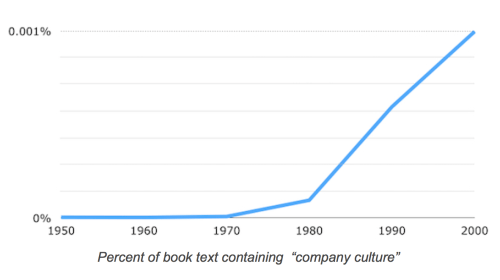
Data Point TuesdayCompany cultures, the good, the bad, and – well in the interest of being nice we’ll leave it at that – have been the focus at Great Place to Work® for the last 25 years, since Robert Levering and Milton Moskowitz researched their book The 100 Best Workplaces in America. What their research revealed is that the key to creating a great workplace revolves not around the building of a certain set of benefits and practices, but through the building of high-quality relationships in the workplace, relationships characterized by trust, pride, and camaraderie. What we call a great company culture. As Erin Osterhaus, researcher for HR technology reviewer Software Advice, points out in her blog about a recent survey, the term “company culture” has seen an astronomical rise in use since 1980, due in part to publications like The 100 Best Workplaces in America, as well as companies’ recognition that culture has a direct impact on how happy, and healthy employees are– and, how well they perform. With the rise in attention to the topic of company culture, enter the adoption of roles created specifically to focus on company culture. As Osterhaus points out, Google, #1 on the FORTUNE 100 Best Companies to Work For List for the last three years, was one of the first companies to adopt such a position (Chief Culture Officer) in 2006.

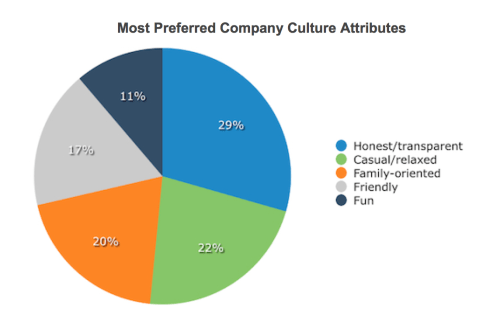
company culture over timeConsidering all the research and data that surround the term “company culture” today, Software Advice surveyed 886 U.S. adults to learn how they define company culture, and to better understand what culture means to the group it impacts the most: employees and job seekers. What did they discover? Most survey takers described “company culture” as a value, belief, or habit of employees that worked at an organization, or the overall feeling of the environment at that company. The majority of respondents listed their ideal company culture as “casual or relaxed” followed by “family oriented,” “fun,” “friendly,” and “honest and transparent.” However, when asked which of these five attributes would most likely convince them to apply at company, respondents stated that “honesty and transparency” would be the biggest influencer.

So while “casual/relaxed” and “fun” ranked over honesty as the most common definition of an ideal company culture, the fact that “honesty and transparency” are the bigger influencers on whether a prospective candidate actually applies at a company highlights what we’ve known about company cultures all along… that trust and values matter most.

ideal company cultureSoftware Advice’s data prove once again that it is fostering trust and building honesty and transparency that ultimately create a sense of camaraderie amongst employees and the fun, family feel environments that respondents report as their “ideal company culture.” As Leslie Caccamese and Katie Popp state in Great Place to Work’s recent whitepaper, Five Lessons for Leaders as they Build a Great Workplace, “What people often think makes a great workplace isn’t actually what makes it so.” While great amenities like workout facilities, foosball tables, and 4 star catered meals may initially come to mind when people think “great company culture,” it’s ultimately evidence of trust-based interactions between leaders and their employees that Great Place to Work looks for when evaluating companies for our Best Companies to Work For lists in nearly 50 countries around the world.

I’ll leave you with another quote from our recent whitepaper: “…by all means, install slides and fi­reman poles; scatter about lava lamps and bean bag chairs. Bring in the manicurist and the barista, and cater to people’s pets. Just make sure these things aren’t happening in lieu of deeper, more substantial practices like involving employees in workplace decisions, keeping them informed of important issues, tending to their ongoing professional development, and sharing profi­ts fairly. These types of practices will go much further in helping employees feel that theirs is a great workplace.”

11 Comments

Filed under 100 Best Companies to Work For, Business Success, China Gorman, Culture, Data Point Tuesday, Great Place to Work, Great Place to Work Institute, Great Rated!, Relationships, Trust

What are your Sources of Hire?

Data Point Tuesday
A recent report from CareerXroads, “Sources of Hire 2014: Filling the Gaps” by Gerry Crispin and Mark Mehler, aims to continue the conversation about the data collection issues, source of hire trends, and challenges related to the recruiting supply chain. The report looks at 50 large firms (all with well-known brands) that filled 507,425 openings in the U.S. last year. This was the work of ~6000 recruiters and sourcers (80+ openings filled by each).

  • 4% of these companies had fewer than 1,500 full time U.S employees,
  • 8% had between 1,005-5,000 employees
  • 18% between 5,001-10,000 employees
  • 28% between 10,001-25,000 employees
  • 10% between 25,001-50,000 employees
  • 14% between 50,001-100,000 employees
  • 8% between 10,001-200,000 employees
  • 10% had more than 200,000 employees

An initial trend observed was that at 40% of these firms the Talent Acquisition function does not match the full ‘Scope’ of full time hiring. While 62.5% of the surveyed firms’ Talent Acquisition functions agree that they “touch or know about EVERY F/T hire or move,” 8.3% don’t hire for union positions, 18.8% don’t hire hourly workers in their manufacturing facilities, 16.7% don’t hire hourly workers for store level, 14.6% don’t hire for every function (i.e. field sales), 10.4% don’t hire for every location, and 8.3% don’t hire for every division.

Additionally, when asked about employees that are not full time (i.e. contract or contingent workers) firms noted that 1 in 6 employees (or 17.7%, weighted average) were contingent and generally not tracked by talent acquisition or talent management. We’ve seen the hiring and retention of contract workers increasing at many organizations, and while whether this is a positive or negative trend can really only be decided by how a company manages its contingent workers, CareerXroads does pose the question: “Do we even know where purchasing ‘sourced’ these ‘not-employees’? How can employers build strategy without oversight of ALL those who work at the firm?” If you’re at an organization that hires many contingent workers, it’s a good question to ask.

In terms of who is recruiting talent for organizations, recruitment process outsourcing seems to be a popular choice for organizations today. Over 50% of the firms surveyed in CareerXroad’s report stated that they use RPO services in some form:

Chart
Are companies hiring globally? 80% of the firms surveyed report that they do hire globally, though only 41% state that they have access to source of hire information that would allow them to benchmark by country.

The #1 source of hire for organizations, though, is through internal promotion and movement. 41.9% of all openings are filled this way. Of the firms surveyed in 2013, 191,425 openings were filled internally. Interns are another interesting source of hire. Surprisingly, CareerXroads data highlight that organizations aren’t exactly seeing a strong ROI in this area. Only 32% of all interns organizations would want to hire after their internships accept positions. Other hiring trends that are continuing include incorporating sourcing (60.5% of organizations stated that they do have a separate full time sourcing group) and social media. With the rise of social media (and LinkedIn specifically) use of resume databases has declined. When looking at LinkedIn’s impact by sources of hire, it is perceived as a vital sourcing tool:

china2
Like the title of their report, CareerXroads offers some good data here to help “fill the gaps.” Keep this in mind when considering you organization’s approach to talent acquisition, talent management, and sources of hire.

Leave a comment

Filed under CareerXroads, China Gorman, Data Point Tuesday, Hiring, HR, Recruiting, Recruiting Technology, Talent Acquisition

Friendships at Work

Data Point Tuesday
Censuswide
and LinkedIn recently partnered up to explore how friendships at work impact employees’ experiences and perspectives of their workplaces. Their study, titled “Relationships @Work,” surveyed more than 11,500 full-time professionals between the ages of 18-65 in 14 countries, including the U.S, Sweden, India, Canada, Australia, Hong Kong, Singapore, Spain, the Netherlands, Malaysia, Italy, Indonesia, Brazil and the U.K. What did they find? A large percentage of professionals surveyed (46%) admit that work friendships play a role in their overall happiness, and it’s clear from the research that the amount of value placed on workplace friendships, and the level of confidence (or how personal they were) varies significantly depending on the generation. For example, while 46% of respondents stated that work friendships play a role in their overall happiness, this data point increased for millennial respondents, age 18-24, up to 57%. Respondents in this age group also felt that work friendships were motivating (50%) and made them more productive (39%).

The research also found Millennials to be much more likely to share personal details with friends at work. 67% of Millennial respondents stated that they share details of their lives such as salary, relationships and family issues with work buddies. This is a major shift from the days where mentioning salaries or details of one’s personal life was taboo. Millennials’ potential “over sharing” doesn’t seem to be rubbing off on colleagues, however; only 3% of baby boomers admit being likely to share details of their personal lives with work friends. Millennials’ casual approach to communication with work friends is also reflected in their relationships with managers. LinkedIn and Censuswide’s research found that one in three, or 28%, of millennials have texted a manager out of work hours for a non-work related issue. This is compared to only 10% of baby boomers.

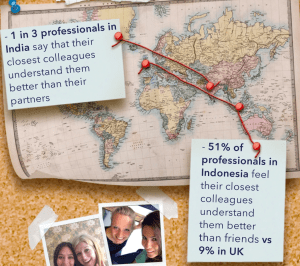
global friends at workWhy are Millennials gushing to buddies at work? It may not be so much a facet of their generation’s personality, but a genuine attempt to grow and further their career. One third of Millennials versus 5% of baby boomers stated that they think socializing with colleagues helps them move up the career ladder. Note too, that 18% of respondents (all generations) say that friendships with colleagues make them more competitive in their careers, so while close friendships at work may be a greater trend for Millennials, it is not exclusively a trend of that generation. Additionally, 51% of respondents (all generations) say that they stay in touch with former colleagues, and while we can’t say where exactly the value of this comes from (friendship, mentor, resource, networking, etc.), we can certainly say it indicates respondents have a loyalty to past colleagues and work friendships. It seems that globally, too, workplace friendships have a high level of importance. In India, for example, 1 in 3 professionals say their closest work colleagues understand them better than their partners.

Overall, this data is a good reminder that everyone communicates differently, whether on an individual basis or by the larger personality of an age demographic. Specifically, though, when it comes to retaining Millennial employees, this desire for work friendships and casual communication could be an overlooked point of value for employees. As workplaces become increasing more generationally diverse, it becomes important (even vital) to recognize the different, and evolving, communication styles of employees.

2 Comments

Filed under China Gorman, Data Point Tuesday, Employee Engagement, Millennials, workplace happiness

The Urgency of Leadership Development

Data Point Tuesday
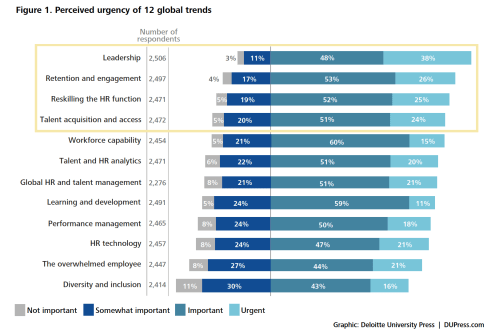
In March I discussed a few takeaways from Deloitte’sGlobal Human Capital Trends 2014” survey. After relooking through the report, I think it would be worthwhile to mention some of the other global trends for 2014. I previously discussed the need to reskill HR teams, one of the top four (out of 12) global trends that survey respondents perceived as most urgent. I did not, however, discuss the top trend perceived as most urgent by responders, that is, the need to build global leadership. Fully 38% of respondents rated this as “urgent,” 50% more than the next trend identified as “urgent.” At the time of the study, companies reported generally low levels of readiness to respond to the global trends mentioned in the report, and despite the fact that at least 60% of respondents identified these global trends as “important” or “urgent,” in all, 36% of respondents reported being “not ready” to respond to the trends. This is a significantly higher percentage than those reporting they were ready to respond to the trends (at only 16%). With us now more than half way through 2014, I’m hoping this particular statistic has shifted a bit, but we don’t have that data yet!

Deloitte urgency graph

We do know that building better leadership is a “hot-topic” trend we’ve seen repeated recently in many reports or white-papers; it’s certainly not unique to only this report. I think with trends like these it’s important to reflect on the proposed reasons: why is building better leadership perceived as so highly important now? Did we have better leadership in the past? Are leaders lacking necessary skills today, or are we simply lacking in an adequate bench of leadership? Deloitte’s study offers some insightful points. “In a world where knowledge doubles every year and skills have a half-life of 2.5 to 5 years, leaders need to constantly develop.” Consider, as well, globalization and the speed (not to mention breadth) of technological change and development, which highly fuel this need to constantly develop. Perhaps another point that highlights the reason that “leadership” remains the #1 talent issue facing organizations today is that this term encompasses leadership at every level of an organization (we’re not solely talking about developing the next CEO or the C-Suite pipeline). “21st-century leadership is different. Companies face new leadership challenges, including developing Millennials and multiple generations of leaders, meeting the demand for leaders with global fluency and flexibility, building the ability to innovate and inspire others to perform, and acquiring new levels of understanding of rapidly changing technologies and new disciplines and fields”.

According to those surveyed in Deloitte’s report, only 13 percent of companies rate themselves “excellent” in providing leadership programs at all levels—new leaders, next-generation leaders, and senior leaders. Furthermore, 66% of respondents believe they are “weak” in their ability to develop Millennial leaders (only 5 percent rate themselves as “excellent”) and only 8% believe they have “excellent” programs to build global skills and experiences. 51% of respondents have little confidence in their ability to maintain clear, consistent succession programs. In terms of skills, Deloitte’s research shows that foundational along with new leadership, these skills are in high demand: business acumen, the ability to collaborate and build cross-functional teams, global cultural agility (the ability to manage diversity and inclusion), creativity, customer-centricity, influence and inspiration, and the ability to develop people and create effective teams.

Deloitte leadership programs graph

With this data in mind, we can then ask the question how can organizations “get ready” to address the trend of building global leadership. Deloitte offers four potential starting points:

  1. Engage top executives to develop leadership strategy and actively govern leadership development,
  2. Align and refresh leadership strategies and development to evolving business goals,
  3. Focus on three aspects of developing leaders (develop leaders at all levels, develop global leaders locally, develop a succession mindset),
  4. Implement an effective leadership program.

While all of these approaches will likely involve a significant investment of time and resources along with a commitment to leadership from the board and executive team, they are doable – companies both small and large on our Best Companies to Work for Lists are a testament to this!

2 Comments

Filed under China Gorman, Data Point Tuesday, HR, Leadership, Learning/Development

Working Parents Feel More – Not Less – Stress

Data Point Tuesday
Bright Horizons
recently conducted a national study, “The Modern Family Index” that explores what it means to be a working parent today. The study revealed some insightful points, including that working parents still perceive that their responsibilities with their family may cause them to experience significant challenges at work. Bright Horizon’s research highlights that much has changed towards how parents approach family obligations and the level of conflict they experience. But how positive are those changes when, overall, many employees still feel like they can’t be honest with their supervisors about family responsibilities?

Perhaps the most obvious example of change toward family obligations in 2014 is that work/family balance is not only an issue for mothers. Fathers report being nearly just as stressed and insecure about work and family conflicts as mothers (46% of dads say that one of their daily stressors is child care needs during the workday, vs. 52% of moms) and are likely to be just as nervous as women to tell their bosses about some of their big family commitments (63% of men vs. 68% of women). Additionally, for fathers, work/life integration ranks just as highly as other top stressors like saving for retirement and managing personal health. Additionally, telling their bosses that they need to take time off for a family matter is just as stressful (39%) as telling a boss they’ve made a mistake on a work project (36%). When it comes to flexible scheduling, one in three fathers (34%) report asking their employers for more flexibility or modification of their work schedule to meet obligations to their children (compared to 42% of moms).

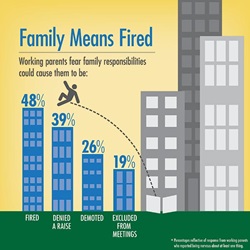
While the increased balance of family obligations between men and women represents a positive trend, it’s still concerning that working parents so highly perceive that family obligations can negatively impact their career – or actually cause them to be demoted and fired. Bright Horizons Family Means Firedreports that 60% of working parents have at least one work-related concern caused by family responsibilities, and 48% admit one of their concerns due to their family responsibilities is that they could get fired! If there’s any statistic to highlight in this report, I think it’s probably this one: nearly 50% of working parents are concerned about getting fired for having family obligations! Additionally worrisome data follow this statistic, including:

  • 39% of parents fear being denied a raise because of family responsibilities
  • 37% fear they will never get promoted again, and
  • 26% worry about a demotion because of family responsibilities.

And to make sure family obligations don’t impact work time? Parents report spending 51% of paid time off dealing with family responsibilities instead of taking a trip or relaxing at home.

Bright Horizon’s research unfortunately pulls the rug out from under the belief that discussions of work/life integration and family obligations are commonplace today. Certainly they are more common than they were in the past, but this study indicates that we might not be taking the leaps and bounds that all the headlines around work/life integration suggest. Employees today remain just as nervous bringing up key family-related issues (51%) as important work-related problems (52%) with employers, and 23% of working parents (almost a quarter) admit to lying or bending the truth to their boss about family responsibilities that get in the way of work:

  • 31% of working parents have faked being sick to meet family obligations
  • 39% admit that one of the things they would be nervous to tell their boss is that they need to miss a work event for a family commitment
  • 56% (more than half!) of working parents report that one of the topics they would hesitate to ask their boss about is reducing hours, working remotely or placing boundaries on responding to calls or emails.

This would be a good time to consider what work/life integration programs your organization offers – as well as the attitude senior management has towards employees with families. Does senior management walk the talk or are family friendly policies just lip service? Make sure working parents are aware of programs that are in place to help them balance their work and family responsibilities, and, perhaps more importantly, make sure it is emphasized that it is OKAY, and expected, that working parents utilize those programs. Creating family friendly policies in one thing. Encouraging their use and ensuring that parents’ careers are not jeopardized for using them is an entirely other thing. Where does your organization net out?

1 Comment

Filed under Bright Horizons, China Gorman, Data Point Tuesday, Work Life Balance, Work/Life Integration

#GenMobile: State of Mind Not Function of Age

Data Point Tuesday

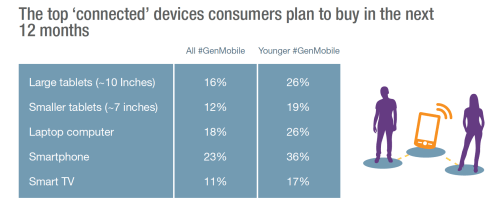
We’re at a turning point with mobile technology. For many users, tablets and smartphones are no longer a convenience or entertainment tool, but a necessary part of their working lives. A recent survey by Aruba Networks identifies these users as “generation mobile.” The research, conducted to take stock of mobility’s increasing prominence in people’s working lives, examines survey responses from over 5,000 members of the public across the USA, UK, France, Spain, Germany, Sweden, South Africa, Saudi Arabia and UAE. Several characteristics define “generation mobile,” including believing in working anytime and anywhere, and in a more connected world (from cars to clothing). And while 18-35 year olds do account for the highest mobile users, generation mobile spans all age groups.

Aruba Network’s research found that 86% of respondents owned at least two connected devices (devices with the ability to connect to the internet). Non-traditional working hours and the option of flextime were also identified as highly important values to generation mobile people. It should be noted though, that while the ability to hop on Wi-Fi and access work related materials during non-traditional work hours appeal to gen mobile, this value is not driven by laziness (45% of respondents report that they work most efficiently before 9am and after 6pm). Additionally, over half of those surveyed said they’d prefer to work from home or remotely two to three days a week than receive a 10% higher salary. This indicates that instituting flexible scheduling could not only increase productivity for employees and create a happier culture, but could be an opportunity for companies to create cost savings. Across the globe we see this move towards flexible work arrangements being reflected, with working out of office on the rise, and 37% of respondents expecting this trend to continue (with just 4.5% foreseeing a decrease).Types of Tech

How vital is your mobility? 64% of respondents report that their mobile devices make them more productive at work, and 63% (over two-thirds) think their mobile devices help them manage their lives better. Looking just at hours spent, mobile devices play a huge role in people’s daily lives: 1/3 of us spend over 1/3 of our day on these devices, and while people still value ‘disconnected’ time (63%), such devices are obviously valuable to us – I’d wager you’ve felt the sting of forgetting one of these devices before. Why, as an organization, is it important to recognize the expectations and values of this generation mobile group? Despite the fact that this group is only likely to get bigger as we continue along in this uber-connected world, as I’ve discussed in other posts, understanding the values and motivators of your employees – and conveying that you value these too, is a huge part of building a great place to work.

Employers should know that 28.9% (over a quarter of those surveyed in Aruba Network’s research), feel it is their company’s responsibility to provide them with a smartphone or a tablet. Furthermore, 29.2% report that though they would rather buy their own, they see these devices as a workplace necessity. It’s also important to note that the overwhelming majority of respondents want Wi-Fi over wired connectivity. This raises though, an important concern for employers. Organizations should make sure networks are secure and that the correct security measures are in place for employees storing company information on mobile devices.

How #genmobile is your workforce? In the quest to retain talent, do you account for these kinds of expectations? Have you spent any time thinking about how important mobile devices are to you and those around you – a little? a lot? And have you used this insight to avoid the assumption that mobile devices and the high mobility they provide are only valued by younger, millennial employees?

Turns out #GenMobile is a state of mind, not a function of age.

2 Comments

Filed under Aruba Netoworks, China Gorman, Data Point Tuesday, Mobile Devices, Work Life Balance, Workflex

I’m Not Crazy: Let’s Talk About Paternity Leave!

Data Point Tuesday

Perhaps it was the Father’s day celebrations that happened a few weeks back that sparked this week’s blog topic… a subject that stills seems rarely addressed: paternity leave, and workplace policies for new fathers. On the flip side, there are oodles of studies and piles of data on maternity leave and programs/policies for new mothers. While traditional social roles are still very influential and probably the biggest underlying factor for such discrepancies, at a time when working mothers are just as common as working fathers and gender equity is not something to strive for but a necessity in a great workplace, we owe it to ourselves to discuss paternity leave in the same light, and with the same vigor, as maternity leave. A 2014 study by the Boston College Center for Work and Family “THE NEW DAD: Take Your Leave” provides great perspectives on paternity policies at leading organizations, as well as an insightful global look at policies for fathers, incorporating interviews and surveys taken by ~3,000 dads.

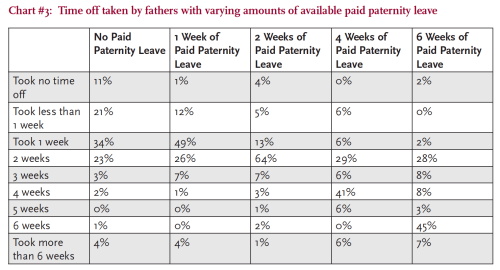
When it comes to paid leave for time off directly following the birth of a child (for both women and men), the U.S is an outlier compared to nearly every other developed country in the world, offering no national policy on paid leave. In terms of paternity leave specifically, today there are 70 countries that offer paid leave in either the form of shared parental leave or paternity leave. It was perhaps most interesting to see father’s attitudes towards childcare and paternity leave. The vast majority of fathers surveyed rated their children as their top priority in life, more than 3 out of 4 fathers wished to spend more time with their children than they do presently, and more than 2 out of 3 fathers said caregiving should be a 50/50 proposition and wished to divide this evenly between spouses. When respondents were asked, in considering a new job, how important paid paternity/parental leave was in the U.S 89% indicated it was important, and more than half 60% indicated it was very important. The intensity of responses varied by generation, 93% of fathers from the millennial generation said paternity leave is extremely, very or somewhat important, Gen X fathers felt similar (slightly subdued at 88%) and Boomers felt least strongly (77%) – perhaps for obvious reasons.

The average amount of time off taken by fathers following the birth of a child is two weeks. Boston College’s study found, however, that there is a strong correlation between the supportiveness of the workplace culture and the number of weeks that fathers took off. The more encouraged new fathers were to spend time with their children, the more weeks they took off (on average). Whether leave was paid or unpaid was another big influencer on whether leave was taken. 86% of respondents said they would not make use of paternity leave or parental leave unless at least 70% of their salaries were paid, and 45% said compensation needed to be at 100%. When asked what the right amount of paternity leave/paternal leave should be in the U.S, 74% of fathers said 3-4 weeks.

Study by Boston College Center for Work and Family “THE NEW DAD: Take Your Leave”

The data clearly reflect the changing role of fathers and the expectation for men to be more involved with their children. Beyond this though, it may indicate that men have a strong desire to be more active parents, something organizations should encourage, for a number of reasons. More and more studies are acknowledging the importance of father/infant interaction. A recent paper in the Journal of Child Psychology and Psychiatry shows a correlation between behavioral disorders (the most common psychological problem affecting children) to disengaged interactions of fathers with their infants. A 2010 study cited in the Boston College report found that developing bonds with children at an early age improves the likelihood of a stronger relationship later in life. Additionally, global research has demonstrated benefits to families when fathers take paternity leave, including increased wellbeing for the new mothers. A recent study in the Journal of Business and Psychology Organizations found that men switch between four images of themselves as fathers: provider, role model, partner and nurturer and that depending on their work environment, one of these roles is always dominant. Men that work in an environment where they can talk about their children, for example, are more likely to be nurturers, whereas men who feel unable to discuss anything but breadwinning are likely to conform mostly to that role.

Organizations offering paternity leave are sending clear messages about work life integration and its values. While U.S. employers are not required by law to provide paid maternity or paternity leave, the positive impacts of these on building a culture of high trust are inescapable. As are the positive impacts on fathers, mothers and children. It gets increasingly difficult to argue against creating these kinds of policies.

Leave a comment

Filed under China Gorman, Data Point Tuesday, Employee Benefits, Paid Leave, Time off, Trust, Work Life Balance

Memo to Women in Corporate America: Pick One – Mother or Leader

Data Point Tuesday
SHRM
and the Families and Work Institute have recently released their 2014 National Study of Employers (NSE), which identifies changes in the workplace since 2008. The report sample includes 1,051 employers with 50 or more employees, with 67% of these organizations for-profit employers and 33% are nonprofit organizations. 39% operate at only one location, while 61% percent have operations at more than one location. A pretty big sample. And the trends are interesting. Some make sense. And some, well, not so much.

Workplace flexibility is top of mind for many business leaders, and the 2014 National Study of Employers notes two major trends between 2008 and 2014 related to this. First, employers have continued to increase the amount of options that allow at least some employees to better manage the times and places in which they work, including occasional flex place (from 50% to 67%); control over breaks (84% to 92%); control over overtime hours (27% to 45%) and time off during the workday when important needs arise (73% to 82%). Second, employers have reduced the amount of programs that give employees the opportunity to spend significant amounts of time away from full-time work. These include sharing jobs (29% to 18%), working part year on an annual basis (27% to 18%), and flex career options like sabbaticals (38% to 28%) and career breaks for personal or family responsibilities (from 64% to 52%). So, yes to more control over place and time while working and no to opportunities to not work.
SHRM Flexibility Chart
A continuing trend from 2008 to 2014 is “12 weeks of leave.” No doubt based on the FMLA, this is usually given for the birth of a child, adoption of a child, or serious family illness. 12 weeks has become the norm, with more employers offering this amount of time since 2008. Currently, 93% of employers offer women 12 weeks of leave after giving birth (85% in 2008), 89% of employers offer employees 12 weeks after the adoption of a child (81% in 2008), and 90% of employers offer employees 12 weeks leave to care for seriously ill family (84% in 2008). Despite these increases, it’s disappointing to note that the maximum length of caregiving leaves offered to new fathers, new adoptive parents, and employees caring for seriously ill family members, as well as disability pay, has declined since 2008. Additionally, support from employers in areas like diversity and inclusion is declining, with fewer employers training supervisors in managing employees of different ages (59% in 2008 and 52% in 2014) and fewer employers providing career counseling programs or management/leadership programs for women (12% in 2014 vs. 16% in 2008). Also along this line, fewer employers report that supervisors are encouraged to assess employee performance by what they accomplish vs. by just “face-time” (71% in 2008 and 64% in 2014). So yes to new birth mothers and no to just about everything else. Hmmm…

What support programs then, are workplaces increasing for employees? Employers are increasingly helping employees with elder care, with employers in 2014 12% more likely to report that they offer Elder Care Resource and Referral than employers in 2008. Employers are also 18% more likely in 2014 than 2008 to offer DCAPs (Dependent Care Assistance Programs) for elder care and 4% more likely to offer access to respite care. Wellness programs are also increasing, with 60% of workplaces providing wellness programs today (compared to 51% in 2008). SHRM and the Families and Work Institute’s report also noted an increase in the amount of workplaces providing Employee Assistance Programs to help with personal/family problems and pressures (78% now, compared with 58% in 2008). When it comes to healthcare, 98% of employers provide personal health insurance for full-time employees, a 3% increase from 2008. Additionally, there has been a 6% increase in employers providing more health care coverage for family members of full-time employees from 2008 to 2014 (91% to 97%), and a huge increase between 2008 and 2014 in the amount of employers providing health insurance for domestic partners (29% to 43%). Lastly, almost all employers (96% of those with 50+ employees) provide 401(k) or 403(b) retirement plans, and 80% of employers make contributions to employees’ individual retirement plans.

While it’s easy to provide reasoning for many of these trend changes (more elder care due to an aging workforce, more domestic partner coverage due to changes in legal and societal perceptions of the LGBT community, more employee assistance programs due to increasingly stressful work environments, etc.) it’s harder to pinpoint the cause of others, like the decrease in leadership programs for women. Could one conclude that that the rising incidences of providing new birth mothers time off has influenced the decrease of leadership development programs for women? Probably not, but it’s interesting to think about, isn’t? This data could support the view that corporate America may be telling women that they’ll support their role as mothers but not their roles as leaders…

Leave a comment

Filed under China Gorman, Data Point Tuesday, SHRM, Workflex

“CEO” or “Female CEO”: Bringing Awareness to “Otherness”

Data Point Tuesday

The Catalyst Research Center recently released the report “Feeling Different: Being the “Other” in U.S. Workplaces” providing interesting data and insight into perceptions of diversity and inclusion in U.S organizations. The study points out the error of common association, which can often cause individuals feelings of “otherness.” This feeling often results from our categorization of groups by their dominant group, i.e. referring to nurses who are male as “male nurses” as opposed to “nurse”, which is commonly associated with the female gender, the position’s majority group. Likewise, male CEO’s are commonly referenced as simply “a CEO” where female CEO’s experience their gender being pointed out: she is “a female CEO.”

Consistently referencing positions based on their dominant group can reinforce the belief that those people holding the position should be from that group, causing those in the minority to feel excluded, divided from the team, and set apart from power structures at the top of their organization. Catalyst’s study points out that gender and race/ethnicity are two of the common bases for feeling like “the other,” but that people of all groups – regardless of whether their racial/ethnic identity reflects that of the majority in society as a whole – can feel different from their workgroup based on race/ethnicity, and that feelings of otherness can really stem from any area of self-identification. For example, besides gender/race/ethnicity, Catalyst’s research also looks at data from LGBT and Expatriate individuals, who often reported experiencing feelings of “otherness.” The study’s findings come from a sample of 2,463 MBA graduates (33% women and 67% men) working in corporate and non-corporate firms in the United States at the time of the survey.

Data from the study highlight some surprising and troubling effects of perceiving oneself as an “other.” Women respondents who identified as feeling racially/ethnically different were the least likely to be at the senior executive/CEO level (10%) compared to men who felt different (19%) and those who did not feel different (16% women; 25% men). It’s important to note, too, that the women who identified as feeling racially/ethnically different had no less experience or qualifications than those in the position. Additionally, Catalyst’s survey identified that women who perceived themselves as “others” experienced fewer promotions: 48.2% had received two or more promotions versus 55.6% of women who did not feel racially/ethically different. 51.4% of men who felt racially/ethnically reported receiving two or more promotions versus 58.4% of men who did not feel racially/ethnically different.

Catalyst’s research also found that people who feel different from the majority in their workgroup are less likely to be mentored by C-suite or senior executives at their organizations. This is troubling considering that previous research by Catalyst found that the level of one’s mentor often predicts advancement (the more senior a mentor the more able they are to recommend for high-level/visibility positions). Of those surveyed, only 58% of women who felt racially/ ethnically different had mentors who were CEOs or Senior Executives. This is compared to 71% of women who did not feel different, 72% of men who did feel different, and 77% of men who did not feel different.

Workplace exclusion or feelings of otherness based on racial/ethnic differences can also affect individuals beyond their organizations. Women who felt racially/ethnically different (46%) were more likely to downsize their dreams and aspirations than women who did not feel different (33%) and of those who felt racially/ethnically different, women were nearly twice as likely as men (25%) to downsize their aspirations. Women who identified as feeling racially/ethnically different and had children and spouses had an even a higher likelihood of downsizing aspirations.

This data provides some serious food for thought for organizations. What is the impact to your organization if talented employees are experiencing feelings of “otherness” and exclusion? Organizations with employees experiencing this are likely missing out on enormous amounts of talent and innovation, not to mention losing important values and aspects of a great workplace culture. Use this research to keep in mind the message we send by identifying roles by the dominant group, and take a look at what policies and programs (both formal and informal) your company has in place to ensure that those with backgrounds that differ from the majority in the workgroup feel that their workplace is an inclusive environment and have equal access to mentorship at the top, fair evaluation, and promotions.

Leave a comment

Filed under Catalyst Research Center, CEOs, China Gorman, Data Point Tuesday, Diversity