Category Archives: HR Data

Candidate Experience vs. the Black Hole

data point tuesday_500

A couple of months ago I shared some data from an Aberdeen Group report about benchmarking quality of hire best practices here. It’s a great benchmark list of outcomes.  But how about the inputs?

More specifically, in terms of quality of hire, how about benchmarking the quality of the candidate experience? Call me crazy, but it seems to me that a higher quality candidate experience translates into a higher quality of hire.

As background, The Talent Board was formed in January 2011 to assist recruiting organizations in understanding and evaluating the experiences of their candidates.

“While there is an inherent dissatisfaction that comes with rejecting employment candidates, the Talent Board believes that it is possible to:

  • Treat all employment candidates with professionalism and respect
  • Shrink the recruiting “blackhole” effect on candidates.”

The Talent Board founders, Gerry Crispin, Elaine Orler and Ed Newman and their colleagues have just produced the 2012 Candidate Experience report from their survey and awards program.   In its second year, the research was based on survey responses from 90 companies (up from 57 in 2011) and more than 17,500 completed candidate surveys (up from 11,500).

To be clear, that’s 17,500 candidates for employment answering questions about their experience as an applicant in four defined phases of the talent acquisition process:

  1. Candidate attraction
  2. Expression of interest
  3.  Candidate dispositioning before the finalist stage
  4. Candidate evaluation & selection

The report gives data from the employer questionnaire as well as from the candidate questionnaire.  As examples, here are two such questions.  Interesting to note the differences between employers and their candidates.

CandE Emp #34 Cand #20

But for most, the topic of most interest is the infamous “black hole” – that old familiar experience of applying for a job by filling out an application on line, attaching a resume to an online application or email, or using snail mail to send in a resume … and never getting a response.   Worse, the black hole could happen after a phone interview.  Or after a face-to-face interview.  At the entry level.  At the professional level.  At the executive level.  Yes the black hole is everywhere. In every industry, geography and size of company.  We’ve all experienced it. And we’ve all derived meaning from it.

The 90 employers that participated in the Candidate Experience Survey last year are paying attention to the black hole.  And while a boilerplate email message from a “do not reply” address notifying an applicant that they won’t be a candidate is only a smidge better than the black hole, bad communication is better than no communication and it’s a baby step in the right direction.  The report goes on to show guarded optimism that while some employers are beginning to provide feedback to disposed candidates when asked, not many are making it a standard practice.

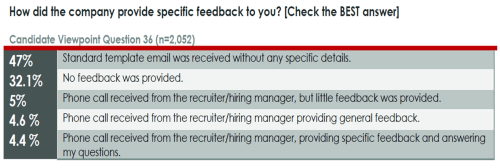
But here’s the kicker:   fully one third of candidates from employers who care about the black hole were provided no specific feedback about their application. And nearly half received a standard email template with no specific information.
CandE Candidate Question #36

One third got no feedback. Zero. Zip. Nada. That’s a massive black hole, right there. And think what meaning is derived from it about the employer’s brand, culture, management, products and services. Connecting those dots isn’t hard.

So.  While a few employers are connecting the dots between quality of hire and quality of candidate experience, it’s clearly not enough.  If your organization is beginning to look at quality of hire metrics, don’t forget the candidate experience.  I’m not sure you can improve one without improving the other.

And check out the process for participating in the 2013 CandE Awards program.  You can’t improve future performance without a clear understanding of current performance.  That includes quality of hire – which surely includes the candidate experience.  Time to get rid of the black hole!

5 Comments

Filed under Black Hole, CandE Awards, Candidate Experience, China Gorman, Connecting Dots, Data Point Tuesday, HR Data, Quality of Hire, Talent Acquisition, Talent pipeline, The Talent Board

Connecting Dots: Employee-style

data point tuesday_500

Back in July, I referenced data from the Glassdoor Q2 2012 Employment Confidence Survey.  If you’ll recall, this quarterly survey monitors four key indicators of employee confidence:  job security, company outlook, salary expectations and re-hire probability.  The Q4 2012 Survey from Glassdoor is out and the results are interesting.

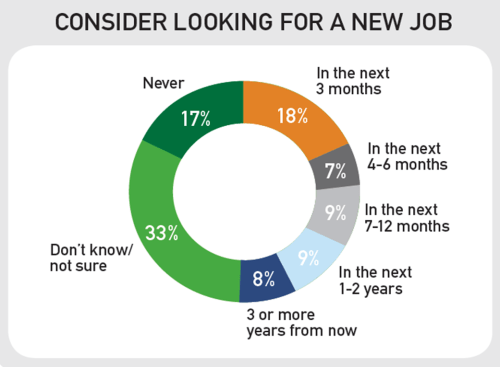
It’s probably not shocking to anyone who reads this blog that half (51%) of employees (including self-employed people) will consider looking for a new Glassdoor logojob if the state of the economy stays the same or improves, with 33% looking for a new job in less than a year and nearly one in five (18%) planning to look for a new job in the next three months.  We’re hearing that our employee base is not engaged and other sources have said that as much as 90% of the employed population will look for a new job in 2013.

Glassdoor ECS Q412 - consider looking for a new job

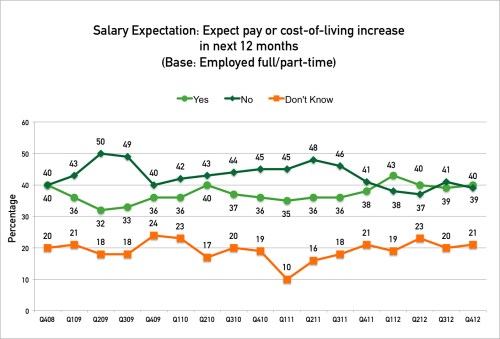
What’s interesting to me is that, if you look at other data points in this survey, it makes perfect sense that a high percentage of employees think they’ll look for work this year. Why?  Well, according to the survey, 39% of employees don’t expect a pay or cost-of-living increase in 2013 and 21% aren’t sure if they’ll get an increase this year.

Glassdoor ECS Q412 - salary-expectations (2)

So.  60% of employees don’t think – or aren’t sure – they’ll get an increase this year.  I’m thinking that has something to do with the percentage of employees who will be looking for a new job this year.  And guess what?  The most important factor these employees say that will influence their decision on whether or not to accept a job offer is…wait for it…salary and compensation!

Employees are pretty good at connecting dots:

I don’t think I’m going to get a raise this year   +

I’ll be looking for a new job this year  =

The most important factor in my decision to accept a new job will be the salary and compensation

Makes perfect sense to me.

But I also think that a majority of employees will receive raises of some sort this year.  Even small ones.  So why do so many think that there is no soup for them?

Perhaps we’re causing this supposed exodus ourselves by not communicating clearly – at the employee level – what our compensations plans for this year are.  Or, maybe we’re being extremely clear and they don’t believe us.

Either way, it’s a problem.  Either way, we should never forget that our employees are smart and know how to connect the dots.

Maybe it’s time we do the same.

2 Comments

Filed under China Gorman, Compensation, Connecting Dots, Employee Loyalty, Engagement, Glassdoor, HR Data

From the Archives: Stick a Fork in Annual Performance Review Systems

While I’m traveling, I thought I’d re-post one of the most popular Data Point Tuesday posts from 2012.  Enjoy.

Today’s data points come from two recent surveys:  one from Achievers and one from Cornerstone OnDemand.  Both surveys show clearly that annual performance review systems’ time has come.  It’s over.  Time to stick a fork in them.

Well, it’s time to stick a fork in them if you’re interested in providing the kind of feedback to your employees that is focused on growing their skills, binding them closer to the organization and engaging their full and discretionary energy.

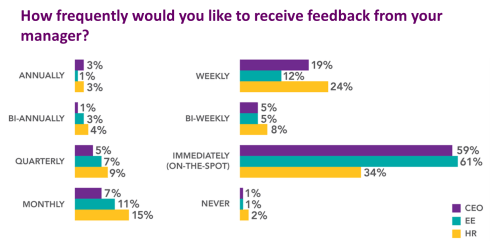
Let’s look first at the Achievers data.  As part of a survey fielded in April of this year, employees were asked how frequently they would like to receive feedback from their managers.  HR professionals and CEOs were asked how frequently they thought employees in their organizations would like to receive feedback from their managers.  Do the answers surprise you?

No surprise that employees would like to receive feedback immediately or on the spot – or at least weekly.  Maybe a bit of a surprise that both HR professionals and CEOs know this.  Here’s the question, though:  if employees, HR professionals and CEOs all know that employees don’t want feedback in an annual context, then why are the majority of performance feedback systems in use today based on an annual model?

Making matters worse, Cornerstone OnDemand published survey results from late 2011 with related findings:

  • only 37% of employees report that they’ve been given useful feedback from their manager/employer in the performance review process
  • Only 32% said that their performance goals are aligned with their company’s business objectives
  • Only 20% have established career goals with their manager/employer

So.  Annual feedback systems satisfy no one from a frequency perspective.  And feedback systems in general are not providing useful feedback for employee skill growth or engagement – or in line with business objectives.

At this point you could say, “Yikes!” and start moaning.

Or, you could say, “This looks like an opportunity for HR to make a significant contribution to the success of the business!” and start collecting similar data from your organization to identify whether this opportunity is real.  If it is real, I see the building of a compelling business case in your future – just in time for the FY2013 budget planning process.

And a new more powerful way to engage employees and manage performance in your organization could be right around the corner.

19 Comments

Filed under Achievers, Annual Performance Reviews, Business Case, Business Success, China Gorman, Cornerstone OnDemand, Engagement, HR Data, Performance Feedback

ROI of People Focused Organizations

data point tuesday_500

The holy grail in HR is providing hard, compelling data-based evidence for the ROI of investing in people.  With this data, HR is in the strategic driver’s seat of the budgeting process.  Without this data, HR is resigned to the furniture conversation.

Want some new people investment ROI data from a source that even your CEO would pay attention to?  How about The Boston Consulting Group (BCG)?  They’re a big time global business strategy consulting firm that your CEO respects.

For the third time since 2008, BCG has partnered with the World Federation of People Management Associations (WFPMA) to publish its Creating People Advantage report.  The most current, published in October, is Creating People Advantage 2012: Mastering HR Challenges in a Two-Speed World.

The findings are the result of BCG’s analysis of responses to an online survey that polled 4,288 executives from companies throughout  a number of industries, 102 countries, and six major global regions.  Additionally, 63 HR and other executives from high profile companies all around the world were interviewed.  The survey and interviews covered 22 HR topics and the report includes interesting case studies from companies like L’Oreal, Samsung, and Daimler Trucks.

It’s a fascinating – and very readable – report and the findings won’t surprise you.  In fact, the top three critical topics for HR leaders around the world remained the same as in BCG’s 2010 global survey:

  • Managing talent
  • Improving leadership development
  • Strategic workforce planning

The data are compelling and the comparisons between countries and regions of the world really are interesting.

The big bonus, though, is the report that is appended at the conclusion, From Capability to Profitability: Realizing the Value of People Management. It’s loaded with economic data that compares the HR practices of high-performing companies against those of lower-performing ones in critical areas, including talent management, leadership development, and performance management and rewards.

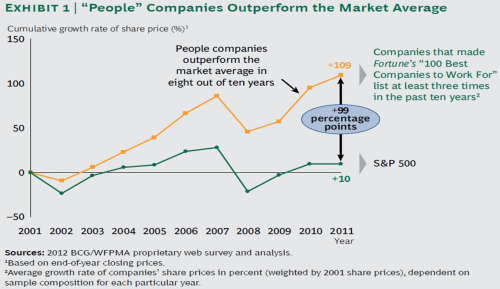
The bottom line is that companies that demonstrated proficiency in the 22 key HR areas experienced revenue growth that was up to 3.5 times higher and profit margins that were 2.1 times higher than those of less capable companies.  And guess what those increases did to their share prices?

BCG 2012 People Companies Outperform the Market Average

Think your CEO and CFO are interested in higher revenue and profit growth rates?  Think the board might be interested in higher share price growth rates?  Think they might be willing to invest in practices that would accomplish those outcomes?  Yep, me too.

The budget season has long passed, and you’re locked in to the 2013 operating plan.  But take a look at the 22 key HR practices in your organization that this report covers and start a file that will hold the data to build the people investment plan for 2014. It takes some time to gather the foundational data to build your investment business cases.

Start now.  Start tracking the data.  Start setting the benchmarks. Start thinking in business cases.

And quit talking about furniture.

1 Comment

Filed under Boston Consulting Group, Business Case, CEOs, China Gorman, Connecting Dots, HR, HR Data, Human Capital ROI, ROI, WFPMA

Fighting for a Pessimistic Workforce

data point tuesday_500

OK.  So there’s an awful lot to be pessimistic about these days.  That goes for Baby Boomers, Millennials and Xers.  That goes for your workforce.

There’s the economy, the unemployment rate, cost of benefits, the fiscal cliff, taxes, the soaring price of college educations, the high school dropout rate…  There’s a lot. And Mercer has captured some critical information about how this pessimism – that isn’t going away – is coloring the views of the future held by many of your employees.

The questions we need to ask ourselves are:  how do I engage and motivate a workforce mired in pessimism, and, how do I (we) counteract a perceived environment of scarcity?

The recently published 12th annual 2012 Mercer Workplace Survey provides results that should give any HR professional more than a momentary woah! as we think about these questions. The survey has a cross-section of active 401(k) participants who were also enrolled in their employer’s health plan.  1,656 participants were interviewed online in June of this year.

The high points include:

  • US employees are still concerned about saving enough for retirement
  • Workers over 50 are more concerned than their younger counterparts about their job security and have much lower retirement expectations
  • Workers perceive that the value of their benefits has dropped

If you haven’t surveyed your workforce lately, this report’s results might just motivate you to start asking some questions.  Questions beyond, would you recommend our organization as a good place to work?

Other nuggets from the survey:

  • 36% of the respondents over 50 are still concerned about losing their jobs, its highest level since 2007 (25%)
  • a survey record 44% of all respondents have considered delaying their retirement – with 59% of those aged 50+ considering delaying their retirement, up four points from last year
  • 62% of those over 50 believe they will have to work at least part time when they do retire vs. 48% of younger workers

Mercer Putting Off Retirement

Data like this can be helpful in knowing what questions to ask yourselves and your workforce as you deal with the talent challenges that face most organizations.

  1. If Baby Boomers are putting off retirement indefinitely, how do we keep the Millennials who want those jobs engaged and continuing to develop their skills?
  2. If all workers – and Baby Boomers in particular – are concerned about job security how do collaboration and innovation fare in a culture of perceived scarcity?
  3. If Baby Boomers believe that they’ll have to work part time once they do retire, how can we harness that experience in a win-win solution?

Pessimism is insidious.  It worms its way into your workforce and destroys your employees’ visions (and expectations) of a bright future for your organization and for them.  While it’s true that many of the concerns that are driving employee pessimism are out of your control (the fiscal cliff, taxes, politics, healthcare costs, etc.), you need to find powerful, positive evidence in the organization that will counteract the pessimism attacking from the outside:  a strong, ethical culture; authentic and transparent leadership; a focus on employee and customer engagement; commitment to learning and development – all of these can convince a workforce that, although the outside world may not be as friendly as it could be or once was, the inside world of your organization is a place worthy of the investment of time, commitment and heart.

Of course, you have to believe that first.

Leave a comment

Filed under Baby Boomers, China Gorman, Connecting Dots, Engagement, GenX, HR Data, Mercer, Millennials, Retirement Planning, Talent Management

What Gets Your Employees Out of Bed in the Morning?

SHL Talent Analytics™ has published a white paper that you need to read if you are involved with acquiring, developing or managing talent.  And that would be everyone in HR.  The SHL Talent Report: Big Data Insight and Analysis of the Global Workforce is a thorough review of the state of talent – especially leadership talent – around the world.  Using their vast global supply of data from organizational surveys, almost 4 million assessments from almost 200 countries, and the work of 300+ occupational psychologists, authors Eugene Burke and Ray Glennon provide compelling insights into the state of today’s talent as well as opportunities to prepare tomorrow’s talent for success.

The white paper covers the following talent issues with data that is deep and makes it easily understandable:

  • Leadership
  • Innovation
  • Organizational Risk
  • Diversity
  • Global Distribution of Critical Skills

Each section is compelling and could stand alone in its organizational usefulness.  At 72 pages long, though, it’s a not a tough read.

I was particularly taken with the section on Diversity.  Its discussion of gender and leadership should be required reading for all those involved in the acquisition and development of talent headed to the C-Suite.  (I wrote about that here recently.)

But even more interesting was the discussion of generational differences.  This is a topic that won’t go away for those in the talent management business –for good reason!  Burke and Glennon believe “it’s not really about gender and generations…it’s about the best person for the job and having managers who know how to leverage differences effectively.”

Right.  How many times have we heard this?  But the data they share are compelling.

I’ve seen a great deal of analysis that show that, while the values differences between generations are more a difference in  order of importance than a complete difference in values, these data show the impact of the difference in order of importance in a pretty dramatic visual:

Think about the beleaguered manager in your organization who has all three generations represented on their team.  Do you think they understand these motivational and values differences?  Do you think they interact and communicate differently with their team members in order to engage their team?  Do you think they have the skills to leverage these generational differences in ways that motivate their team to greater productivity and efficiency?  Do you think they could use these insights to become a more effective leader?

What would be the impact on turnover, engagement and performance if all the managers in your organization had these insights and knew how to leverage them?

And, oh by the way, what gets you up in the morning?

2 Comments

Filed under Baby Boomers, China Gorman, Connecting Dots, GenX, HR Analytics, HR Data, Millennials, SHL, Talent development

The 40 Hour Workweek is Alive and Well…

…said no one recently anywhere in the world.

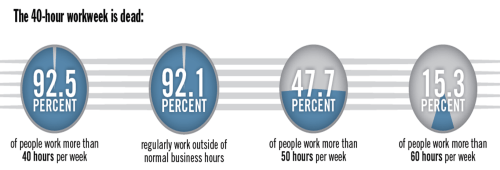
I know this will come as a shock to business people everywhere – especially those in Human Resources. But here’s the data from Hogan Assessments:

Virtually everyone (92.5%) who works a full time job around the world works more than 40 hours per week.

Virtually everyone (92.1%) who works a full time job around the world regularly works outside of normal business hours.

Nearly half (47.7%) of workers work more than 50 hours per week.

And 15.3% of people work more than 60 hours per week.

I blame technology, smart phones and social media.  How about you?  How many hours a week do you work?

1 Comment

Filed under China Gorman, Connecting Dots, Hogan Assessments, HR, HR Data

Your EVP May Not Be Enough

According to some new data from the folks at Kelly OCG, employees all over the world are planning their work lives in dramatically new ways.  In their white paper, The Autonomous and Empowered Workforce, data from the Kelly Global Workforce Index™ is presented using compelling visuals.

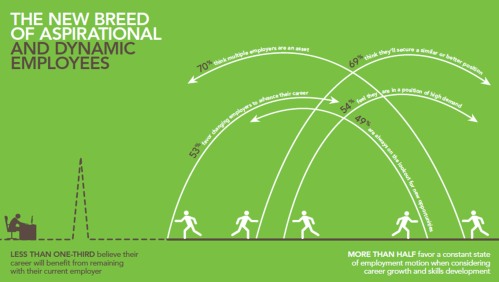
The graphic below is pretty interesting and sums up much of the data in the white paper.  The highlights are:

  • Less than a third of employees believe their career will benefit from remaining with their current employer
  • More than half favor a constant state of employment motion when considering career growth and skills development

The fine points of what today’s employees think about the future of their careers according to KellyOCG include:

  • 49% are always on the lookout for new opportunities
  • 70% think multiple employers are an asset
  • 53% favor changing employers to advance their career
  • 54% feel they are in a position of high demand
  • 69% think they’ll secure a similar or better position

From an employee engagement and retention perspective, it is interesting that employees in the Americas seem to be trailing behind employees in EMEA and APAC as it relates to the relevance of a career-for-life, with 49% of employees in the Americas agreeing that a career-for-life with one employer is relevant.  Only 29% of APAC and 21% of EMEA employees see that relevance. So hanging on to employees in APAC and EMEA is already harder than hanging on to employees in the Americas.

But for how long?

Compare that to the finding that 65% of employees in the Americas consider work experience with multiple employers to be an asset and we can imagine that the career-for-life relevance may be exiting stage left before the end of the second act.

Certainly as you read the Kelly Global Workforce Index™ you’ll find lots of interesting dots to connect that may impact the work you do in 2013 to strengthen your EVP (Employee Value Proposition).  But this data are clear that there is a shift coming more rapidly than many may think.  A shift to job changing as a proactive career management strategy as opposed to job changing as a reactive crisis coping response.

If true, this is big.  And impacts everything from talent acquisition strategies, to onboarding processes, to rewards/recognition programs, to learning and development offerings, to performance management systems and more.

If true, this is big. Really big.

2 Comments

Filed under Career Management, China Gorman, Connecting Dots, Employee Value Proposition, EVP, HR Data, Kelly Global workforce Index, Kelly OCG, Talent Management

A Funny Thing Happened on the Way to the C-Suite…

The Career Engagement Group from New Zealand recently conducted  an online survey of over 1,000 employed people ages 18-65.  The focus of the survey was to understand the career aspirations, agility and drivers of the current workforce across key demographics such as gender, age and career stage.

Maybe because the survey originated in New Zealand, some different questions were asked than the usual employee engagement surveys we see so routinely today.  It’s always good to get a different take on what’s important.

One of the subjects covered that seemed out of the ordinary was Leadership Aspiration.  Now that I think about it, I’m not sure I’ve ever been asked – in the many engagement and career development surveys I’ve taken – if I wanted to lead at the most senior level in an organization.  It’s a great question.  And the answers surprised me.  How about you?

Leadership Aspirations & Gender & Generations

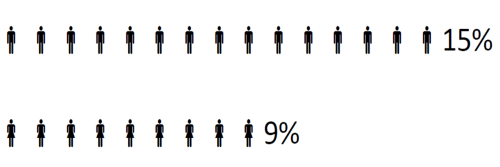
  • Only 11% of all respondents want to lead at the most senior level in an organization.
  • Women report lower leadership aspirations than men – 15% of all males aspire to senior leadership positions, while only 9% of all females had similar aspirations.
  • Younger people have higher leadership aspirations overall.

Hmmm.  Only 11% of all respondents want to lead at the most senior level in an organization!  That surprises me.  A lot.  I would have loved to have seen the breakdown in responses by age group as well as gender.  Because I might have thought that the younger generations might be less interested in the stress and costs of leadership at the top than their older colleagues, but the results say otherwise according to the Career Engagement Group.

And women being less interested in leadership at the top than men?  That’s kind of a show stopper, don’t you think?  With more and more women entering the workforce around the world, this finding should be concerning.  Many industry-leading organizations are working hard to keep women in their organizations – maybe they should also be more encouraging about the value and rewards of life at the top.  According to this survey, there aren’t a lot of people — male or female –dreaming about being the CEO and making plans to get to the top.

When the demographics are already working against us (see my posts here and here) and the C-Suite is justifiably concerned about where the next generation of leaders is coming from, perhaps what’s needed is a marketing campaign to encourage workers to reach for the top.

What do you think?

2 Comments

Filed under C-suite, Career Development, Career Planning, CEOs, China Gorman, Connecting Dots, Demographics, Engagement, HR Data, Leadership Aspiration, Talent development, Talent pipeline

Building the HRM Technology Business Case

The highly anticipated CedarCrestone 2012-2013 HR Systems Survey White Paper, 15th Annual Edition was released at the HR Technology Conference in Chicago last week.

If you have any thought of adding HRM technology to your budget next year, the data in this report can be the foundation of your business case for the investment request.  Even if you aren’t going to ask for technology investment money for FY2013 this report will give you important data for managing your technology in new ways.

In analyzing the more than 1200 survey responses to identify key common practices, the CedarCrestone team (led by Lexi Martin) used these four independently validated key financial metrics to identify the highly successful organizations:

  • Revenue per employee:  Top performers is $681,903 vs. $352,576 for all others
  • Profit per employee:  Top performers is $317,508 vs. $131,157 for all others
  • Operating income growth (EBIT):  Top performers is 61% vs. 11% for all others
  • Return on Equity:  Top performers is 23% vs. 10%

Once the pool of top performing organizations was created, the analysis for common practices began and resulted in identifying the following Seven Practices of Top Performing Organizations:

  1. Top Performers have standardized processes and sophisticated change management processes.
  2. Top Performers are more likely to already have, or be planning a move to, a SaaS HRMS.
  3. Top Performers avoid extensive customizations of their HRMS.
  4. Top Performers have higher user adoption of employees, and manager self service, and shared services.
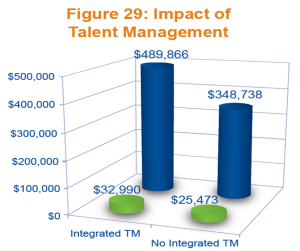
  5. Top Performers are more likely to have an integrated Talent Management system on the same platform as their HRMS solution.
  6. Top Performers have more sophisticated business intelligence solutions in place and more often put these tools in the hands of managers.
  7. Top Performers have more HR technologies in use and spent less on HR technology per employee.

The CedarCrestone 2012-2013 Survey White Paper goes into great detail about each of the seven best practices with quick characteristic overviews as well as deep data dives.  Well written and easily understood, this report is full of really useful information – whether you’re an HR department of one or one hundred.

The best practice that caught my eye was #7:  Top Performers have more HR technologies in use and spend less on HR technology per employee.

Regardless of the application category, Top Performers have more technology in place than the others.  We place each respondent in a technology application adoption quartile:  62% of Top Performers are in the top quarter of application adoption vs. 35% of the other publicly traded organizations; the categories of BI (Business Intelligence) and social applications both had 20%+ differences in adoption  between Top Performers and non-top performers.  And all of that technology still comes at a 12% lower cost per employee! 

It may seem  counter-intuitive that more technology means less cost, or that more technology means less humane-ness.  But what’s more humane than the organizational stability that comes with success?  What’s more humane than a highly profitable business that’s able to invest in talent?  What’s more humane than the organizational growth and longevity that higher levels of productivity produce?

Download the CedarCrestone report here, get a cup of coffee and spend an hour on the data and conclusions.  You won’t be sorry because these dots connect.

It’s budget season. You need the business case to invest in HRM technology and this report will give you most of the firepower you’ll need.  You could be a hero at this time next year!

1 Comment

Filed under Business Case, CedarCrestone, China Gorman, Connecting Dots, EBIT, HR Analytics, HR Data, HR Technology, HR Technology Conference, HRM Technology