Category Archives: Leadership

Good News From Your L&D Department!

Data Point Tuesday

A 2014 report from Bersin by Deloitte, “The Corporate Learning Factbook 2014: Benchmarks, Trends, and Analysis of the U.S. Training Market” relays some positive information regarding investment in employee development. Businesses increased training budgets by an average of 15% last year, reflecting the highest growth rate in this area in the last seven years, and also likely that as the economy continues to mend, organizations are able to reinvest in areas that experienced significant cost cutting during the downturn. At a time when there is discussion of a lack of specified skills in the talent pool, this would appear to be welcome news, particularly because this investment applies not only to short term training. For mature organizations this training budget involves identifying capability gaps now and into the future and combats them by developing a “supply chain” of skills to fill gaps in the long term.Bersin by Deloitte

How much are organizations spending on these increased L&D budgets? On average in 2013, businesses across the United States spent $1,169 per learner. This amount varies by company size and industry, with tech firms leading the pack in terms of amount invested per learner (spending an average of $1,847). As far as which areas of training and development organizations are focusing their increased budgets on, leadership development takes the largest share, with 35 cents on average of each training dollar going to leadership development at all levels. This certainly suggests this is an important strategic investment for companies in the coming year. As the study reports, “more than 60% of all companies cite leadership gaps as their top business challenge”.

Spending on L&D initiatives is likely to be higher for organizations with a more “mature” L&D function. Those ranked at either 3 or 4 on Bersin by Deloitte’s maturity model spent an average of 37% more on training and development than the least mature organizations. Here at Great Place to Work, we can certainly attest to the fact that organizations on the FORTUNE 100 Best Companies to Work For list invest significantly in training and development programs. In 2013, companies on the list offered 66.5 hours of training annually for salaried employees and 53 hours of training for hourly employees, with close to 70% of those hours devoted to employees’ current roles and nearly 40% focused on growth and development. Though they display impressive training and development programs, many of these Best Companies cited employee development as remaining an area of focus, with 3 key areas highlighted: Leadership Development (reflecting the data from Bersin by Deloitte), Career Road-mapping, and Diversity Development.

This investment trend is good news for employers and employees alike. Employers will have greater inventories of skills in-house and may not have to turn to the marketplace as often – or expensively – in coming years to support basic business operations. Additionally, by providing skills development to younger workers who are arriving with significant skills deficits, employers may be staunching the early talent drain from their organizations. And employees of all ages continue to need growing support to expand their knowledge and skill bases as the world of work continues to evolve and certain skills het harder and harder to find.

But the opportunity to develop management and leadership skills may be the most valuable investment for both sides of the employee-management relationship. It prepares the next generation of organizational leaders, it communicates a commitment to employees’ futures and it strengthens the ties between these two sides of the employment equation. That high performing employers are spending 40% of corporate learning dollars on their future leadership talent would be a compelling component of any employer’s employee value proposition.

2 Comments

Filed under Bersin, China Gorman, Data Point Tuesday, Deloitte, Great Place to Work, Leadership, Learning/Development, Skills Gap, Talent development

“Thank you for saving my life” … what every non-profit board member wants to hear

Most business leaders give back.  They make financial donations, they volunteer, they serve on boards.  I’m no different.

I’ve been on a number of non-profit boards through the years.  All the organizations I supported had missions focused on the development of people, on making our talent pipeline more robust.  I was on the board of an organization that promoted the hiring of people with disabilities.  I was on the board of an organization that provided leadership development programs for young people.  I was on the board of the SHRM Foundation.

Currently, I serve as Chair of the Board of CAEL, the Council for Adult and Experiential Learning.  CAEL works at all levels within the higher education, public, and private sectors to make it easier for people to get the education and training they need.  It does critical policy and research work to ensure that working adults get access to lifelong learning.  An uphill road for sure.

And I’m on the executive committee of the board of JAG, Jobs for America’s Graduates.  JAG is a state-based national non-profit organization dedicated to preventing dropouts among young people who are most at-risk.  In more than three decades of operation, JAG has delivered consistent, compelling results – helping more than three-quarters of a million young people stay in school through graduation, pursue post-secondary education and secure quality entry-level jobs leading to career advancement opportunities.

JAG has provided infrastructure and support that has enabled more than 800,000 at-risk high school kids to graduate and move on to a job, college or the military.  JAG is changing lives pure and simple.

Here are just some of the results from the Class of 2010 – kids who graduated from high school last June:

  • The JAG graduation rate was 93%
  • Overall job placement rate was 54%
  • Full-time jobs rate of those working was 67%
  • Full-time placement rate was 88% (percentage of graduates engaged in full-time employment or a combination of employment and post-secondary education)
  • Further education rate was 47%

93% graduation rate.  That doesn’t exist anywhere.  But it does in JAG programs in 32 states and the U.S. Virgin Islands.  Routinely.

This program has worked for more than 30 years.  And you know what?  2011 was the toughest funding year in JAG’s history.  2012 will be even more difficult.  Deep budget cuts at the state level for education programs were the norm in 2011 and will be more draconian in 2012.  Sharp budget cuts of federal funding to Governors adversely impacted 9 of 32 states in 2011 with more to come in 2012.

I find this astonishing.  The education of our nation’s youth is one of the biggest issues we face.  If we’re to be competitive in the global economy we must focus on the development of the talent we have.  And it all starts in our elementary, junior and high schools.

Last week I attended the yearly JAG Leadership Awards luncheon in Washington, D.C.  More than 450 JAG high school students raised money to travel to D.C. to attend this event and the follow-on conference.  Some of these kids flew on a plane for the first time last week.  Many of them wore a suit for the first time.  Most of them had never been to our nation’s capital.

These kids are the future of the United States.  And most of these kids would have been dropped by our education system had it not been for JAG.  This was made very clear to me at the end of the lunch.

I was caught in the crush of students headed to the escalators.  A young man looked at my badge and said, “You look important.”  I responded, “No more important than you!”  He then asked if I knew Ken Smith, the President and founder of JAG.  I told him I did indeed know Ken.  The young man then held out his hand to me and introduced himself:  “I’m Ken Watkins from South Carolina.  Would you introduce me to Ken Smith?”

We reversed our direction and headed to the front of the banquet room.  When we got there, I introduced the two Kens.  The student from South Carolina looked at the President of JAG and said, “I asked to meet you because I wanted to thank you for saving my life.”

It was a quick conversation and the elder Ken quite naturally told the young man that it was really his own commitment and perseverance that saved his life – and to keep up the hard work.  I think the younger Ken understood, but it was clearly important to him to thank the man who founded the organization that provided his safety net.  It was a very moving moment – for all of us.

So I think of the other 799,999 students like young Ken from South Carolina who, over 30+ years, have responded to the opportunities created by JAG and who have entered our economy as educated, hard working citizens and contributed to the economic success of the United States and their families.

It’s important to know that in these times of political dysfunction and lack of political leadership ,that there are people and organizations who keep the prize in mind.  Who keep moving us forward.  Organizations like JAG and CAEL.

So the next time a non-profit asks you to get involved, to make a donation or to serve on their board, please seriously consider their request.  We’re adding to the talent pipeline.  We’re educating our nation.  We’re saving lives.  And if you have jobs that young people could perform, find the JAG organization in your state and interview some JAG kids.  You’ll probably hire them all!

5 Comments

Filed under CAEL, JAG, Leadership, Non-profit Board service, Talent development, Talent pipeline, Uncategorized

Memo to HR: Raise Your Hands!

Several times this year I’ve given the wrap-up keynote speech at HR conferences.  This particular speech is titled, “HR Wake Up Call.”  The message is simple:  HR professionals have far more business savvy and leadership opportunities than they are given credit for.

One of the ways I prove this is to quiz the audience on a range of business related topics, testing their savvy and knowledge.  Nearly every question I ask gets an almost unanimous positive answer.  The questions cover topics like the current unemployment rate, the current U.S. GDP and the topics of current business books.

When I ask how many in the audience have ever been responsible for a sales quota, 70-80% of the audience raises their hands.  And when I ask how many have managed a P&L, between 80 and 95% of every audience raises their hands.

After the quiz is over and we discuss the answers in detail I ask how many of their executive teams know that they’ve been responsible for a sales quota or managed a P&L.  Astonishingly most do not.

I find that remarkable.  No.  Actually, I find it disturbing.  HR professionals routinely lament their lack of standing in the strategic workings of business, and yet when they’ve got the golden ticket they ignore it.

So here’s the deal:  if you want to be an HR professional who focuses solely on the tactical and compliance parts of HR, then don’t let on that you’re a business person.  Not letting your C-suite know that you’ve managed a business will ensure that you stay off their radar and can focus on the day-to-day stuff.

If, however, your organization can benefit from your business insight and experience, and you want to operate at a strategic level – not just the tactical level – MAKE SURE YOUR FULL BACKGROUND AND EXPERIENCE ARE KNOWN!

That is all.

4 Comments

Filed under Business Language, Business Success, HR, Leadership, Uncategorized

HR and Furniture

Normally, I agree with everything Laurie Ruettimann says.  Not because I’m a robot, but because she’s right 99% of the time.  .9% of the time we just see things through different lenses.

And .1% of the time we just disagree.

And this falls in that .1%.

I think that when you’re in HR you have to speak the language of business.  I think speaking HR in business is the kiss of death – or irrelevance, which is really the same thing.

It’s not about furniture, it’s about influence.  And when you’re influential you speak the language of those you influence.

Business people are everywhere in organizations.  They’re in Finance (where they speak finance and business).  They’re in Marketing (where they speak marketing and business).  They’re in Operations (where they speak operations and business).  They’re in R&D (where they speak r&d and business).  They’re in Sales (where they speak sales and business).  They’re in IT (where they speak technology and business).

Business people are most definitely at the top of the organization where the only language spoken is business.  So if you want to influence the people at the top of the organization – all those people whose job titles start with a great big “C” — you have to speak to them in their language, not yours.

This quote from Frank Romer says it all:

People will sit up and take notice of you if you will sit up and take notice of what makes them sit up and take notice.

The bottom line is that language is important.  Using language your target audience doesn’t understand ensures that you won’t be understood.  It also ensures that you will have no influence.  None.  Zero.

So if HR is to be influential and interact with a certain type of furniture it has to be fluent in the language of business.

Actually, I’m pretty sure Laurie Ruettimann will agree with me.

18 Comments

Filed under Business Language, Business Success, HR, Leadership

If I could change one thing about HR…

My friend Michael Carty and his colleagues at Xpert HR in the U.K. (whom I have never met!) invited me to contribute to their blog series: If I could change one thing about HR…

Please visit my guest post there at http://www.xperthr.co.uk/blogs/employment-intelligence/2010/12/china-gorman-if-i-could-change.html


1 Comment

Filed under Business Success, China Gorman, HR, Leadership, Uncategorized, Xpert HR

Urgency vs. the status quo

I’m noticing that something powerful is going on within the HR space.   It’s organic.  It’s energetic.  It feels urgent.  It’s about getting HR people more intimately connected with each other.  It’s about gaining confidence and strength through closer relationships.  And it might be turning the conference world on its ear.

HR conferences organized by groups likes SHRM (including SHRM global and its 52 state councils), ASTD, WorldatWork, ERE, LRP and others have done a very strong job of creating traditional conference experiences that provide content, continuing education credits, vendor showcases and limited networking experiences. 

But well-executed as they are, well-attended as many of them are, and well-marketed as they are, they don’t provide something that seems to be getting more and more valuable to a certain subset of HR leaders:  the opportunity to have intimate discussions with thought leaders.  And there’s a growing sense of immediacey about what’s missing.  So what’s my evidence?

Well, first there is HRevolution.  An early entrant in the HR “un-conference” space, two HRevolutions have been held and the third is in the planning stages.  Organized by Trish McFarlane, Ben Eubanks, Steve Boese and others, this grass roots gathering gets HR folks together to wrestle with each other on topics relating to the relevance of HR.  Facilitators lead discussions rather than speakers giving presentations.  It’s been given high marks for engaging its attendees, but questions of “what’s next?” persist.

The “Tru” un-conferences in Europe appear to be similar to HRevolution in that they have sprung from concerned and committed individuals in the HR space rather than from organizations in the HR space.  I’ll know more after attending the TruLondon conference in February.

RecruitFest! organized by RecruitingBlogs.com also joined the “un-conference” space, but mixed it up in 2010 with a different approach.  Instead of discussion groups, thought-leaders held conversations for the viewing audience (75 in studio; almost 4,000 through the live stream) to listen and watch.  It got the thought leader discussion piece right with some engagement of attendees and it also got high marks.  But again, “what do I do now?” questions followed.

The HRevolution, TruEvents and RecruitFest! unconferences are broad in their reach.  They engage interested professionals from all over the world to attend either in person or virtually. 

Now here’s a new twist:  the HR Reinvention Experiment held last Thursday for senior HR leaders in the state of Nebraska.  Jason Lauritsen, a senior HR executive in Lincoln asked himself “what’s next?” after attending the last HRevolution.  He assembled a small group of like minded business leaders in the HR space in Omaha and Lincoln and they gathered nearly 70 senior leaders from across Nebraska to talk with each other and begin to address challenges in Nebraska that need HR’s leadership.  And with the support of several local sponsor organizations, the HR Reinvention Experiment began to take shape.

A combination of traditional and un-conference organizing approaches, the HR Reinvention Experiment included tailored keynote presentations (me and Jason Seiden), small group discussions led by true thought leaders (Paul Hebert, Joe Gerstandt, William Tincup and Roger Fransecky) and a couple of traditional “concurrent session” topics (Chris Bryant and Greg Harris).  Limited to 75 attendees from a specific geographic area, HRRE was a day full of challenging content, discussion and engagement, all with a local focus.   

To further underscore its difference from traditional conference approaches, HRRE was held in the open spaces of the Hot Shops Art Center, an art center (and former mattress factory) consisting of working art studios, showrooms and gallery spaces.  Attendees, surrounded by the creative process, carried their folding chairs from space to space throughout the day so that gathering spots magically opened up in places like pottery and glass blowing studios as well as galleries.

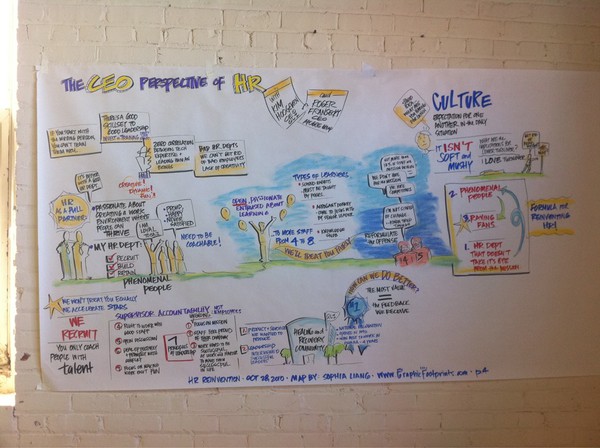
Instead of PowerPoints and handouts, the HRRE organizing team hired the graphic genius of Sophia Liang (Graphic Footprints) to make a graphic recording of the keynote sessions, as well as several of the discussion sessions.  This is the recording of the lunch keynote, “The CEO Perspective of HR,” a discussion between two CEOs: Roger Fransecky and Kim HoogeveenThe additional recordings will be shared on the HRRE website soon.

It was a full day to say the least.  I participated as the opening keynoter giving the attendees an “HR Wake-Up Call” as well as attending as a participant for the full day’s activities.  The experience was challenging, fun, engaging and thought-provoking.  It brought together many of Nebraska’s HR leaders for a day of thoughtful and personal engagement and pushed them to ask new questions and assume different outcomes.

But while the “what’s next?” question persists, I have a feeling that there will indeed be a “next” in Nebraska.  These business leaders seem ready to take action.  HRRE felt like a catalyst that will start to move the discussions into action.  Time will tell, of course, but the framework exists to launch a new kind of self-driven professional community. 

Professional organizations catering to HR leaders should be taking note of the grass roots efforts to connect in new and more impactful ways.  Whether it’s learning and conferences or advocacy and membership, there are unmet needs that are becoming urgent in the HR world.  The frequency and level of innovation happening in this space suggests that the current infrastructure is becoming less relevant to a portion of the population.  And this portion of the HR population has the commitment, skills and intellectual curiosity to do something about it.  We should all stay tuned….

6 Comments

Filed under China Gorman, Conferences, HR, HR Conferences, Leadership, Uncategorized

Talent Development and U.S. Energy Policy

It’s pretty clear that the U.S. is overly dependent on foreign oil.  We don’t have adequate domestic exploration and production capability and so we buy our oil from other nations – many of them hostile to our way of life.  Sure, it’s business; but the fact remains that many of the governments from whom we buy oil aren’t our close allies.  This has implications on so many fronts:  on the availability of oil (think Hugo Chavez); on the price of oil (think OPEC); and on the costs of finding new oil (think BP and the Gulf of Mexico).  But ultimately, it’s a failure of energy policy.  By not having a vision of internal sustainability and not investing in new domestic sources of energy and experimental technologies, we’re dependent on the kindness of some not-so-nice strangers.  These may, and some would say already have, ultimately threaten our national security.

It occurred to me the other day that many of our organizations are proceeding down the same path as it relates to talent management policy.  If we think of the skills and talents of our employees as our organization’s energy, then how many of us are investing in new domestic sources of skills and talent?  Rather, aren’t many of our organizations overly dependent on foreign sources?  On hostile sources?  This may not be national security, but it certainly is business survival.

By not investing in the internal talent pipeline to increase engagement and reduce the dependency on foreign (outside) hires, aren’t we going down the same path?  Many of our organizations will soon find themselves held hostage by the confluence of the following forces:

  • Rapidly declining U.S. worker productivity (U. S. Department of Labor Q2, 2010)
  • The rising level of job dissatisfaction in the U.S.  For the first time more of our workers are dissatisfied than satisfied. (Conference Board, 2010)
  • Surveys showing that between 40-95% of U.S. workers are or will be looking for a new job before the end of the year. (Spherion 2010 Labor Day Workforce Survey, Regus)
  • The continued projected decline of educational levels together with the exit of large numbers of baby boomers from the economy will put US organizations at a competitive disadvantage. (SHRM research, 2010)
  • Baby Boomers are ready to negotiate a different kind of employment “deal” because they need to work longer than anticipated. (McKinsey Quarterly)
  • The cost of buying talent on the open market is rising.

Seal of the U.S. Department of Energy

It looks to me like we’re doing the same thing with talent that the U.S. has done with oil:  we haven’t invested in the future by exploring new domestic technologies; our practice of buying what we need from outside sources has made us vulnerable to our “competitors”; and the internal sources we do have seem less productive and desirable. 

Whoah.  Bottom line?  I hope HR is able to get out in front of the talent pipeline by creating a compelling vision for the long-term benefits of investing in the development of our current energy supply.  Unless that happens quickly, many of our organizations will find themselves cut off from the lifeline of their business sustainability:  the skills and talent they need when they need them, where they need them.

6 Comments

Filed under China Gorman, HR, Leadership, Talent development, Uncategorized

Fear and Loathing in Orlando

I’ve just returned from the SHRM-affiliated HR Florida state conference. What an experience!  Organized and executed entirely by SHRM chapter volunteers, this conference had over 1,400 attendees in a beautiful and roomy resort in Orlando.  Carol MacDanielLori Goldsmith , Stephen M. Geraghty-Harrison and the entire team did a remarkable job in bringing a content-laden and interactive experience to the attendees.  Truly a terrific experience.

Here’s something that was validated for me in Orlando about HR professionals and social media.  Of the 1,400+ attendees at the conference in Orlando, maybe 200 were engaged actively in social media.  That’s 14%.

Knowing that this would be an issue, the folks at HR Florida did a superb job of providing sessions, support and encouragement for the attendees to start to engage with social media.  A very robust effort.

Trish MacFarlane over at HR Ringleader noticed it too.  And I agree with her identified reason for the lack of engagement:  fear.   I’m not sure what they’re afraid of, but here are some suggestions to those of us who do “get it”:

  • be encouraging
  • be role models
  • be generous with your time
  • teach and mentor
  • be patient
  • BE LEADERS

Despite the conventional wisdome that social media is only for the younger generations, a post on The Social Graf blog by Erik Sass gave some interesting data about the adoption of social media by those who aren’t young.  Here’s what it says about survey data collected from Princeton Survey Research Associates on behalf of the Pew Internet & American Life Project:

  • Among Internet users ages 50+ overall, social network use increased from 22% in April 2009 to 42% in May 2010. To boot, 10% of the 50+ cohort uses Twitter or a similar “status update” service, either to post updates or check other people’s updates.
  • Looking at specific age cohorts, social network use among Internet users ages 50-64 surged from 25% to 47%, with 20% of this group saying they check into social networks on a daily basis — up from 10% last year.
  • By contrast, social network use among Internet users ages 18-29 appears to be reaching saturation, growing from 76% in April 2009 to 86% in May 2010.

There’s a message here for HR professionals.  It says more of our employees are engaged in social media than aren’t — and not just the folks we assumed were engaged!  We have a real opportunity, perhaps even an obligation, to get out in front of our employees.

Because if they’re using social media at home they’re using social media at work.

But I get it.  It’s scary.  I held my breath when I jumped into social media when I was the Chief Operating Officer of SHRM.  And guess what?  I lived.  More to the point, SHRM lived.  My adoption of social media paved the way for greater engagement of members and non-members alike.  And it also paved the way for SHRM to begin to step up organizationally to the opportunities active social media involvement creates.  Their new public relations campaign, We Know Next, has significant social media outreach strategies embedded in it.

As a profession, we need to be able to lead the social media policy discussions, not abdicate them to the legal department or the marketing department.  As business leaders, we need to understand the implications of the use (and misuse) of social media on our corporate and employer brands.  As HR leaders, we need to be out in front of our employees and understand the impact of social media on employee engagement and our cultures.

This is the work of Human Resources.  It’s new (for most).  It involves technology.  It’s scary.  So let’s step up and support our colleagues in learning these new applications for engaging our employees and building stronger cultures.  Let’s not let fear paralyze our profession from doing its essential work:  providing strategic business leadership that positively impacts employee and customer satisfaction.

After all, isn’t that our job?

8 Comments

Filed under Business Success, China Gorman, Culture, HR, HR Conferences, Leadership, Social Media

Don’t believe your own press!

I’ve spent the last few days trying to make sense of a couple of things that happened within the same 24 hour period. 

First was my response to the PR announcement about my role as a track leader at RecruitFest! in Boston in October.  It made me really uncomfortable.  The announcement made me sound like the leader of the free world of HR – which I’m not.  I know we’re trying to drive attendance, and I know there are some folks who think I have important things to say (and I’m grateful for that), but I was uncomfortable being lauded at such great lengths. 

Not that I haven’t accomplished some pretty terrific things in my leadership career.  I have.  But.  I didn’t accomplish any of them in a vacuum.  I always had a team of exceptional colleagues who worked with me and alongside me to accomplish great things.  It’s called being a leader.  And I think that – especially today – successful leaders need equal doses of healthy egos and equally healthy humility.  The healthy ego part is the part that makes us think we can be leaders.  That we do know where to go and how to get there.  The healthy humility part is the part that makes us human; that makes us authentic; that enables us to engage our teams in the work and vision for the future.  And keeps us grounded in the knowledge that we’re not terribly unique and can be replaced at any time.

So when I read with sadness about Mark Hurd’s dismissal from HP I thought to myself, “here’s another leader who got the humility part of leadership wrong.”  Because it’s the lack of humility that tells leaders the rules don’t apply to them.  It’s the lack of humility that leads them to believe the stuff their PR departments publish. 

By all accounts Mark Hurd was thought to be a good guy.  Fudging expense reports isn’t on the same level as Charlie Rangel’s alleged improprieties, or Ken Lay and Jeffrey Skilling’s criminal looting of Enron, or Eliot Spitzer’s total moral collapse – or is it?  I think the case could be made that fudging expense reports is the conscious choosing of ego over humility that says:  I’m more important than anyone else; what I want is more important than anything else.  More important than being honest; more important than my integrity; more important than the the organization I lead.  Even if he hadn’t been caught, wasn’t this the first step to a total disregard of the humility required to be an authentic leader?  

It seems to me that too many leaders (in business as well as politics) start to believe their own press and then start to believe that they’re so special/so effective/so beloved/so famous that the rules don’t apply to them.  Humility is subsumed by ego and the ability to lead evaporates. 

So the question remains:  why do so many powerful and effective leaders start to believe their own press when the consequences are so clear? 

The learning for me as I look for my next leadership job is this:  I don’t believe my own press today and I won’t believe it tomorrow.  I promise. 

(But still come to RecruitFest!.  It will be awesome!)

26 Comments

Filed under Business Success, China Gorman, Leadership, Uncategorized

Why isn’t your culture a tourist attraction or a profit center?

If you’re reading this blog post, you’re either a participant in the world of social media, or you’re my mom.  (Hi, Mom!)   If you’re a participant in the world of social media, you’ve heard of Zappos.  Because Zappos has been the poster child for the effective use of social media to drive sales through customer satisfaction for the last 3 or 4 years, they’re mentioned in every presentation on social media I’ve ever seen.  Heck, even I referenced them in a talk I gave to the Human Resource Policy Institute at Boston University last year.   It seems as if Zappos is everywhere in social media and more and more in traditional media – and I hear that HR professionals are starting to tire of hearing about Zappos’ success with all things social media, its engaging culture, the free tours of its headquarters (which they do 4 times a day!), and their 10 core values. 

It does seems as if Zappos and its CEO, Tony Hseih, are everywhere in the traditional print and social media scenes these days.  (Check out the current Harvard Business Review article, “How I did it…Zappos’s CEO on Going to Extremes for Customers.”)  And the topic is always the same:  Tony’s conviction that culture drives organizational success.  Period.  

Since I moved back to Vegas last month, I took the opportunity to go on the Zappos tour, meet some of their leaders, and do a little poking around.  I can understand HR folks being skeptical after all the coverage.  Usually when something seems too good to be true, it is.  But before you throw them overboard, ask questions.  Go visit.  Test them.  Don’t decide not to talk about them because you think they’re overexposed.   Because here’s the thing:  what they’re doing is working.  The hype matches the reality.

The leadership of the company is singularly focused on creating a culture based on 10 core values and it’s clear when you visit that the employees know them and live them.  Check out this video.  And you can see and hear CEO TonyHsieh talk about the culture here.   

And the results and stats are impressive.  Their turnover is low, their customer satisfaction (which they track daily through net promoter scores) is enviable, it’s harder to get a job there than it is to get in to Harvard, and they’ve successfully weathered being acquired by Amazon.  Here’s a memo the CEO sent to his colleagues last week at the one year anniversay of that acquisition.  (Note that he tweeted the public availability of this memo after posting it internally.)

You’ve seen all this before.  But here’s where the rubber meets the road.  Not only is the culture the foundation for their success, they’ve created a new company, Zappos Insights, to share their learnings, provide support, and create a community of culture focused leaders.  In other words, they’ve turned their successful culture into a profit center.

I attended a Zappos Insights Gold one-day event last month.  There were 13 of us in the group:  three leaders of a small tech firm that had just been purchased by a major telcom company; two leaders from a hip shoe business in New York City; a team of seven (including the Director) from the customer service division of a major cruise line; and me.  It was an illuminating day to say the least.  We got to talk to HR and recruiting folks, the pipeline (training) leader, managers from the Customer Loyalty Team (call center), with lots of time for interaction and Q&A.  We started, of course, with the tour of the headquarters and got to see the Zapponians at work in their natural habitat. 

I’ll be honest.  I was skeptical.  But I have to tell you the culture was palpable.  There was a positive energy in the place that I haven’t felt for some time.  With a 36 year old CEO and over 400 people in the call center, it wasn’t surprising that the average age felt like it was well under 30.  But to be fair, it felt good.  Really good. 

I had read Tony Hsieh’s new book, Delivering Happiness, before the event, so I was current on the Zappos history (which is so important that there’s a course on it in the pipeline (training) curriculum).  And I attended as a participant, but also as an observer of this phenomenon.  Gang, they’re doing great stuff.  The participants of that one day event came away with concrete information – right from the source – about how to select employees and treat customers to create a culture of success.  Adding membership to the experience keeps you in touch with others who are trying to achieve the same results and gives you a constant influx of interviews, how to’s, and other useful, practical information from the Zappos leadership team. 

So I don’t know about you, but I think there’s something to this.  Creating a culture that’s so strong it draws tourists and can be turned in to a profit center seems like a good thing to me.  What do you think?

20 Comments

Filed under Business Success, Culture, Customer service, HR, Leadership, Uncategorized