Category Archives: Uncategorized

Good news for the talent pipeline

I’ve long been concerned about the state of the talent pipeline in the United States.  That’s why I serve on the boards of CAEL (the Council for Adult and Experiential Learning) and JAG (Jobs for America’s Graduates).  These two non-profit organizations work on opposite ends of the education pipeline.  CAEL works to make lifelong learning available and affordable to working adults of all economic backgrounds.  JAG works to eradicate high school dropouts.  Both organizations are doing amazing work.  Visit CAEL’s website here and JAG’s website here.

 I’ve been very concerned (well, worried is a more accurate description) about the employability of young people entering the economy for the first time.  The data stream is robust in describing most high school and many college graduates as lacking in essential workplace skills.  Skills like reading and writing English, math, collaboration and teamwork, and dealing appropriately with the public appear to be lacking in these young people.  Additionally, real world abilities to take direction from a boss, arrive to work on time and carry out job assignments are in question.

 I was believing the data that said the U.S. was doomed.

 And then I was asked to speak at a career management conference last week for 60 college students at my alma mater, Principia College in the Midwest.  Initially I was to give a presentation titled Job Search and Social Networking.  I did that.  But because another conference presenter was unable to attend at the last minute, I also did sessions on Resumes and Cover Letters and Interviewing.

 While these 60 liberal arts college juniors and seniors may not be representative of the more than 1.6 million seniors who will graduate in 2011, they give me hope.  Lots and lots of hope!

 These kids were articulate and curious.  They asked great questions.  They spoke well, they wrote well (we had a resume writing lab from 7:30-11:30 one evening!), they were confident and they worked hard.  They were smart, charming, funny, engaged and had a strong, positive sense of their future. 

 More impressive to me was their understanding that the beginnings of their professional lives weren’t going to be a cake walk.  They had a real sense of the reality of the job market as well as the requirements of building a career through hard work.  These young people are going to show up for work and actually work!  I would be proud to have any of these young men and women on my staff. 

 I share this because my experience with these young people belie all the data that we’re seeing.  It’s easy for business leaders to get discouraged by focusing on the surveys that point out the shortcomings of those entering the workforce for the first time.  It’s easy for us to throw up our hands and start to send jobs to other regions of the world because we believe that their talent pipelines are more robust.

 But I encourage you to take another look.  And I really encourage you to spend some time with the career offices at colleges and universities near you.  Lend your real world expertise to these students when they need it most:  as they’re planning their first career steps.  Help them make wise choices.  Support their understanding about how the world of work really works. 

 You’ll make a huge impact and I think you’ll sleep a little easier.  And who knows, you might just find some talent that will fit your organization!

10 Comments

Filed under Principia, Talent development, Talent pipeline, Uncategorized

Estate planning or legacy creation?

I love it when convergence happens.  I’ve been wrestling with something for the last few weeks and it all came together for me yesterday. 

For the past few weeks my husband and I have been doing something we should have done about 10 years ago:  we’re doing estate planning that includes updating our wills, establishing a trust, selecting trustees, the whole nine yards. 

 We interviewed attorneys, consulted with friends, asked questions:  all the things rational people do when they start a rational process like this.  What no one told us about was the emotional side of this process.  More than figuring out to whom we should leave what things, we were planning for a future that neither of us wanted.  We were making decisions that would be implemented if I pass before my husband.  Or if he passes before me.  Or if we go together.  No matter how you look at it, we were spending time doing rational planning for an unsatisfactory future with a hugely negative, emotional component.  

 And it was hard, not at all fun and stressful.  And it culminated in a fight – something we rarely do.  What helped us got over the fight quickly was the realization that we weren’t fighting over how to divide stuff between our two families if we went out together; rather, we had allowed fear to overshadow our thinking and our emotions.  Fear of a life without the other and all that meant.  We gave in and lashed out.  Dumb.  But human.  And then we recovered and moved forward quickly and harmoniously making the right rational decisions to get this process finished. 

 But I was missing something.  And that nagged at me.

 So here’s the convergence.  Yesterday I attended a fundraising luncheon for the YWCA of Silicon Valley expertly organized by a dear friend.  It was an outstanding event.  We heard from people whose lives had been saved or restored by this agency’s outstanding work.  The stories were inspiring testimonies of the results of caring and the power of a second chance.  And they had something else in common:  these survivors were working on something bigger.  They were capitalizing on their second chances by making sure their lives have real meaning for their families and their communities.  They are purposefully creating a lasting positive legacy.

 These stories were followed by a keynote speech given by Doris Kearns Goodwin, historian of U.S. presidents.  She is an extraordinarily powerful speaker who talked about LBJ, FDR and Eleanor, and Abraham Lincoln.  She talked about them in terms of what they thought about their legacies.  She shared stories about LBJ and his profound sadness that the failures of Viet Nam wiped out, in his mind, the civil rights progress that were gained during his presidency.  She discussed Eleanor Roosevelt’s tireless work to support and even create her husband’s legacy and as well as her own place in history.  And she detailed Lincoln’s stubborn recovery from deep depression and potential suicide because he had not yet created an impact that would leave proof of his life in history. 

 And I began to connect the dots.

 Over dinner last night a good friend and I discussed this concept of legacy.  And it created an entirely different context for the estate planning process my husband and I have been going through.  In addition to getting our physical legacy in order, we really should be focused on getting our meta-physical legacy in order.  We should be thinking about how we add value to the lives of the people we love and how we want to do more of that before we’re gone.  We should be thinking about the legacies we want to leave in our professional lives and in our communities.  That’s true estate planning.  And that’s what we’re really working on.

 Money is just money.  But the outcomes of being an influence for good last longer.  Stuff is just stuff.  But the impact on people’s lives of a life lived ethically that is focused on leaving each situation better than it was found can be profound.  That’s the estate we want to continue to build.  That’s the legacy we want to leave. 

 In the grand scope of things, I hope that our physical estate will provide some joy and financial stability to our loved ones.  But that’s not the legacy that matters to me.  Our true legacy is the productive and moral lives lived by the student athletes my husband has coached throughout his career.  Our true legacy is the enriched and productive lives lived by those I have led and whose careers I have supported through my leadership career. 

 The stuff and money will be short lived and impact a few.  It’s my hope that our true legacy will live in big and small ways in all the individual lives we’ve been blessed to touch.  That’s my kind of estate planning.  And it doesn’t seem so negative and stressful any more.

7 Comments

Filed under Estate Planning, Uncategorized

Urgency vs. the status quo

I’m noticing that something powerful is going on within the HR space.   It’s organic.  It’s energetic.  It feels urgent.  It’s about getting HR people more intimately connected with each other.  It’s about gaining confidence and strength through closer relationships.  And it might be turning the conference world on its ear.

HR conferences organized by groups likes SHRM (including SHRM global and its 52 state councils), ASTD, WorldatWork, ERE, LRP and others have done a very strong job of creating traditional conference experiences that provide content, continuing education credits, vendor showcases and limited networking experiences. 

But well-executed as they are, well-attended as many of them are, and well-marketed as they are, they don’t provide something that seems to be getting more and more valuable to a certain subset of HR leaders:  the opportunity to have intimate discussions with thought leaders.  And there’s a growing sense of immediacey about what’s missing.  So what’s my evidence?

Well, first there is HRevolution.  An early entrant in the HR “un-conference” space, two HRevolutions have been held and the third is in the planning stages.  Organized by Trish McFarlane, Ben Eubanks, Steve Boese and others, this grass roots gathering gets HR folks together to wrestle with each other on topics relating to the relevance of HR.  Facilitators lead discussions rather than speakers giving presentations.  It’s been given high marks for engaging its attendees, but questions of “what’s next?” persist.

The “Tru” un-conferences in Europe appear to be similar to HRevolution in that they have sprung from concerned and committed individuals in the HR space rather than from organizations in the HR space.  I’ll know more after attending the TruLondon conference in February.

RecruitFest! organized by RecruitingBlogs.com also joined the “un-conference” space, but mixed it up in 2010 with a different approach.  Instead of discussion groups, thought-leaders held conversations for the viewing audience (75 in studio; almost 4,000 through the live stream) to listen and watch.  It got the thought leader discussion piece right with some engagement of attendees and it also got high marks.  But again, “what do I do now?” questions followed.

The HRevolution, TruEvents and RecruitFest! unconferences are broad in their reach.  They engage interested professionals from all over the world to attend either in person or virtually. 

Now here’s a new twist:  the HR Reinvention Experiment held last Thursday for senior HR leaders in the state of Nebraska.  Jason Lauritsen, a senior HR executive in Lincoln asked himself “what’s next?” after attending the last HRevolution.  He assembled a small group of like minded business leaders in the HR space in Omaha and Lincoln and they gathered nearly 70 senior leaders from across Nebraska to talk with each other and begin to address challenges in Nebraska that need HR’s leadership.  And with the support of several local sponsor organizations, the HR Reinvention Experiment began to take shape.

A combination of traditional and un-conference organizing approaches, the HR Reinvention Experiment included tailored keynote presentations (me and Jason Seiden), small group discussions led by true thought leaders (Paul Hebert, Joe Gerstandt, William Tincup and Roger Fransecky) and a couple of traditional “concurrent session” topics (Chris Bryant and Greg Harris).  Limited to 75 attendees from a specific geographic area, HRRE was a day full of challenging content, discussion and engagement, all with a local focus.   

To further underscore its difference from traditional conference approaches, HRRE was held in the open spaces of the Hot Shops Art Center, an art center (and former mattress factory) consisting of working art studios, showrooms and gallery spaces.  Attendees, surrounded by the creative process, carried their folding chairs from space to space throughout the day so that gathering spots magically opened up in places like pottery and glass blowing studios as well as galleries.

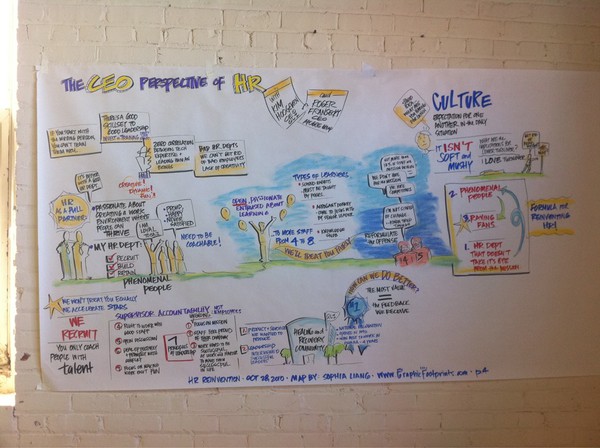
Instead of PowerPoints and handouts, the HRRE organizing team hired the graphic genius of Sophia Liang (Graphic Footprints) to make a graphic recording of the keynote sessions, as well as several of the discussion sessions.  This is the recording of the lunch keynote, “The CEO Perspective of HR,” a discussion between two CEOs: Roger Fransecky and Kim HoogeveenThe additional recordings will be shared on the HRRE website soon.

It was a full day to say the least.  I participated as the opening keynoter giving the attendees an “HR Wake-Up Call” as well as attending as a participant for the full day’s activities.  The experience was challenging, fun, engaging and thought-provoking.  It brought together many of Nebraska’s HR leaders for a day of thoughtful and personal engagement and pushed them to ask new questions and assume different outcomes.

But while the “what’s next?” question persists, I have a feeling that there will indeed be a “next” in Nebraska.  These business leaders seem ready to take action.  HRRE felt like a catalyst that will start to move the discussions into action.  Time will tell, of course, but the framework exists to launch a new kind of self-driven professional community. 

Professional organizations catering to HR leaders should be taking note of the grass roots efforts to connect in new and more impactful ways.  Whether it’s learning and conferences or advocacy and membership, there are unmet needs that are becoming urgent in the HR world.  The frequency and level of innovation happening in this space suggests that the current infrastructure is becoming less relevant to a portion of the population.  And this portion of the HR population has the commitment, skills and intellectual curiosity to do something about it.  We should all stay tuned….

6 Comments

Filed under China Gorman, Conferences, HR, HR Conferences, Leadership, Uncategorized

How to open an HR conference!

 I’m that voice that’s been saying “Really? Movie stars as keynoters at HR conferences?  Really?  How’s this going to help me be a more strategic business leader?” 

 While I was at SHRM I was successful in influencing the team to select more keynoters who had real connections to business and HR success.  Business thought leaders like Jack Welch, Anne Mulcahy, Ted Childs, John Kotter and Steve Forbes.  I’ve never understood the fascination with movie and tv stars as keynoters at HR conferences – other than everyone loves movie and tv stars.  I’ve held the position that HR conferences should bring relevant business content from real thought leaders to the attendees.  So when I saw that HR Southwest’s opening keynote was a two person comedy/juggling act, I thought, “Oh brother.  Here we go…”

 But here’s the thing:  they were fabulous!  Let me paint the picture.  We’re in Fort Worth.  It was 8:15 on Monday morning.  It was Columbus Day — a holiday in many workplaces.  Both the Rangers and the Cowboys had played at home the day before – and lost.  And it’s a commuter conference (a large majority of the 2,000+ attendees drive to the conference each day from home).  So to describe the energy in the room as the session opened as lethargic would be understating the case. 

And then The Passing Zone arrived.  Amazing jugglers, smart comedians, these two guys kept the witty patter going through 75 minutes of their act while continuously linking their actions to the HR world.  Trust, cooperation, communication, juggling priorities:  these were cleverly woven into their act in a refreshing, funny and entertaining way.  We were laughing, we were clapping, we were gasping, we were cheering.  The energy was thumping, the good humor was flowing and the conference was off to the races.  Brilliant!

 So I stand corrected.  When planning conference keynoters understand the likely mindset of the audience you are supporting.  And if it’s first thing Monday morning, wake ’em up!  The planners at HR Southwest did just that and came up with a real winner.  Well done!

3 Comments

Filed under HR, HR Conferences, Uncategorized

HR Southwest: the Real Deal


Here’s what I love about HR conferences:  the attendees.  I’m a big fan of HR professionals.  I think they’re smart.  I think they know their business.  I think they contribute daily to the success of their organizations.  I think they grab on to learning wherever they can find it.  And I think that today, like no other time before, they are caught between the proverbial rock of a fragile and unpredictable economy and the combined hard places of the current legislative/regulatory agenda, continued globalization and the need, as always, to do more with less.

 So as I attend the SHRM-affiliated HR Southwest Conference in Fort Worth, Texas today through Wednesday, I am again impressed with the way these 2,000+ dedicated HR pros are approaching this ultimate learning experience.  And make no mistake:  HR Southwest is an ultimate learning experience.  The concurrent session line-up is among the best I’ve ever seen.  The keynoters are very strong.  The exhibition hall is incredible.  And the attendees themselves are focused on making the most of the three days before them. 

 I respect the hell out of these folks.  I see a determination in their eyes as they check the conference program to chart their course through the conference.  They’re engaging with the vendors in the exhibition hall and not just collecting swag.  They’re improving their ability to serve their organizations and their communities.  They’re working on expanding both their functional expertise and their strategic leadership abilities.  What they learn here will absolutely make their organizations more competitive. 

 So, kudos to the conference team that produces HR Southwest.  It’s smart; it’s professional; it’s the real deal.  Now.  Don’t you wish you were here?

Leave a comment

Filed under Conferences, HR, HR Conferences, Uncategorized

Re-imagining the Conference Experience

 I speak at a lot of HR-related conferences.  I started this as part of my job responsibilities when I was Chief Operating Officer of SHRM (the Society for Human Resource Management).  Supporting SHRM state conferences by being a keynote speaker was a great part of my job.  It got me (and by extension, SHRM) close to our members in a very personal way and was useful to create stronger relationships and to know what was on the minds of our members. 

 And through my SHRM experience where the very talented Meetings & Conferences department was part of my responsibility, I know a lot about the mechanics of putting on successful conferences for as few as 200 and as many as 20,000 attendees.  While the execution is extremely challenging, the formula for success has been pretty simple:

  1. Contract outstanding and well known keynote speakers that motivate people to attend.  (Typically these folks fly in to speak and fly out after their book signing.  They have almost no personal interaction with the participants.)
  2. Offer a wide range of breakout/concurrent sessions focused on knowledge development and skill building.  (These sessions are led by content experts and experienced practitioners who focus on practical applications in traditional classroom style.  PowerPoint presentations abound.)
  3. Engage a set of high profile corporate sponsors to underwrite the conference so attendee registration fees can be kept low and sponsors’ visibility is high.  (The sponsors are kept at arm’s length so the programmatic content isn’t “tainted” by the commercial nature of that relationship.)
  4. Create multiple networking activities so that people can connect in person and carry those relationships forward.
  5. Select an attractive and affordable city and conference/convention venue.  (The focus is on making the participants comfortable in the physical surroundings.)
  6. Execute a strong plan to market the conference to the universe of potential participants.  (Most conference organizers use traditional marketing methods.  Some have stuck a toe into the social media marketing world; most haven’t figured out how to do that yet.)

 I had the privilege of participating in last week’s RecruitFest! in Boston organized by RecruitingBlogs.com and Monster.  And it’s clear that the effectiveness of this conference has the potential to change how conferences are conceptualized and experienced going forward.  In fact, I might go so far as to say if other conference organizers in the HR space aren’t paying attention to what these folks accomplished, they may well be selling buggy whips next year when they go to market. 

 I have to hand it to Eric Winegardner at Monster and Jason Davis, Miles Jennings and Ashley Saddul at RecruitingBlogs.com for having a startlingly new vision and risking it all to try something substantially different in the world of conferences.  These folks went way beyond “thinking outside the box” and “pushing the edge of the envelope.”  They re-imagined the experience from top to bottom.  Let me give you some examples.

  • There were no keynote presentations or concurrent sessions.  It was a series of important conversations between thought leaders.  Unrehearsed, substantive, sometimes controversial, sometimes argumentative, and always informed and thoughtful, these discussions between two, three, four and five experts explored issues and practices that matter to business leaders and talent management professionals.
  • The thought leaders were asked to participate in the entire day – in fact the day started with each of the 12 of us giving a brief overview of the reasons we were participating and our particular point of view; the day ended with each of the 12 of us sharing what was the most impactful learning we experienced during the conference.  Additionally, each of us participated in one or two of the live discussions and asked questions of our colleagues in the other discussions.  We also were part of the studio audience so we were seated side by side with the live audience throughout the day.
  • There were almost no PowerPoint slides.  Really.  The focus was on having real discussions and exploring different points of view.
  • Participants were encouraged to weigh in and agree/disagree or ask questions.  The comments came from the studio audience where a microphone was available as well as from the remote participants via telephone, Twitter and a chat box on the RecruitFest! Live web site.
  • The focus on the “participant experience” covered both the live attendees and the remote attendees – with an emphasis on the experience of the 3,800+ remote attendees.  The technology employed to ensure a rich remote experience included a 3-camera video team, a web site that offered the live stream, a chat box and question box, and the call in telephone number.
  • The sponsors were all involved in creating the experience.  They suggested speakers, they participated in crafting the discussion agenda, they were in the audience and participated in the Twitter stream and through their blogs.
  • The marketing was almost exclusively conducted through social media:  Twitter, blog posts, FaceBook pages and LinkedIn updates.  In a matter of 2 weeks the number of registered attendees grew from just over 100 to the nearly 3,900 participants (from 38 countries).
  • The venue was more TV studio than conference classroom venue.  The newly re-constructed Paramount Theatre (part of Emerson College) and stage gave the conference a look and feel that felt contemporary and useful and made the live streaming feel natural. 
  • The entire day was recorded and will be shared with anyone who would like to experience this next step in the evolution of conferences.  (Click here to enter your email address so you may receive the url.)

 Although it was a tremendous and exciting experience, it wasn’t a perfect experience.  Clearly the financial model needs some more thought.  And the studio audience could have been engaged even more.  But I have to tell you, after managing conferences, attending conferences, and being a keynote speaker at conferences, this was more fun, more engaging, more interesting, more exciting and more impactful from a learning perspective than any other conference in which I’ve played a part.  And I’ve been involved in a lot of conferences. 

 So again.  Kudos to the Monster and RecruitingBlogs.com organizations for stepping off the precipice into the future.  They’ve created something remarkable.  I can’t wait till the next RecruitFest!

13 Comments

Filed under China Gorman, Conferences, HR Conferences, Social Media, Uncategorized

A Tale of Two Conferences

How lucky can a gal get?  I’m speaking at RecruitFest! on Thursday (October 7) in Boston and attending HR Southwest in Fort Worth the following week (October 10-13).  Two great conferences, two great organizations, two great cities  – all focused on providing up to the minute content for the development of HR professionals.  That’s  5 conference days in 7.  Whew!

First up, RecruitFest! put on my the good folks at Recruiter.com (formerly RecruitingBlogs.com) and Monster.  And they’re cooking up something really new and special.  Here’s the deal:  they’ve collected a group of thought leaders in the Recruiting space to engage in important discussions for the benefit of the attendees.  Stars like

 And here’s the really interesting part:  there will be audience participation – questions from the live audience, questions from those watching the live stream, and questions from those listening in and participating in the Twitter back channel.  Pretty exciting stuff!  If you haven’t signed up, click here to attend in person or virtually.

Next up is HR Southwest, the largest SHRM state conference.  The organizing team is expecting nearly 2,000 live participants at the Fort Worth Convention Center!  That’s big!  That also makes HR Southwest second only to the SHRM Annual Conference in the world of SHRM conferences. 

 I remember in the early ‘90s, when I lived in Dallas and managed the southwest region of a global HR consulting firm, the cornerstone of our marketing plan every year was supporting HR Southwest.  I still have pictures (somewhere) of our booth and the team that staffed it.  We connected with our customers and showed our support for our friends in the HR profession by supporting this important event.  I wouldn’t have dropped this important event from our budget – ever!

 The keynote speakers this year look outstanding:  Ambassador Nancy G. Brinker, founder of Susan G. Komen for the Cure®; Chad Hymas, world-class wheelchair athlete; and Jon Wee and Owen Morse, otherwise known as The Passing Zone.  With more than 110 concurrent sessions and the ability to earn as many as 20.75 recertification credits from the HR Certification Institute, this conference is going to set a new standard for HR conferences.

 I’ll be tweeting at HR Southwest, so be sure to follow the #HRSWC10 hashtag and to follow me on Twitter at http://twitter.com/ChinaGorman.  See you at the conferences!

1 Comment

Filed under China Gorman, HR, HR Conferences, Social Media, Uncategorized

What’s an unconference like, anyway?


I’m really getting jazzed about RecruitFest! in Boston on October 7th and 8th.  RecruitingBlogs.com has put together a track leader line-up that looks outstanding, Monster is the big sponsor, and it’s Beantown!  How much better could it possibly get?

I have a sense of what an unconference is like and I’m eager to experience it for the first time.  I’m expecting lots of smart recruiting and talent management professionals to roll up their sleeves and dig in to some really important topics with energy and passion.  The power of focused, collective experience to generate new ideas can be awesome.  Hope we get some of that going.

 Here’s what I hope we don’t do:  have the same endless and pointless discussions about whether HR is ever going to get a seat at the table (man, I hate that phrase), or whether recruiting should be part of HR. 

 I hope we focus more positively…more hopefully…more meaningfully on what we actually can do differently to impact the performance of our organizations.  I hope we focus on what is in our power to control:  our intentions, our behavior, our risk taking.  Because if all we’re going to do is lament our lack of power and our inability to catch the eye or ear of the CEO we’ll have wasted precious time and energy. 

 I’m interested in having conversations that change behavior, that improve performance and that make us (whoever we are) more powerful.  That will be a great investment of time and energy.  That will be a great unconference. 

 Are you with me?  If so, then you should click here and register right this minute!  Because if you register before the end of the week, you’ll get a discount (use the code “chinagorman”) and you also might win the Monster VIP hotel package!  What a deal. 

I hope you’ll join us, roll up your sleeves and contribute to two days that really could change HR.  Who wouldn’t want to do that?

4 Comments

Filed under Business Success, China Gorman, Culture, Engagement, HR, HR Conferences, Uncategorized

Talent Development and U.S. Energy Policy

It’s pretty clear that the U.S. is overly dependent on foreign oil.  We don’t have adequate domestic exploration and production capability and so we buy our oil from other nations – many of them hostile to our way of life.  Sure, it’s business; but the fact remains that many of the governments from whom we buy oil aren’t our close allies.  This has implications on so many fronts:  on the availability of oil (think Hugo Chavez); on the price of oil (think OPEC); and on the costs of finding new oil (think BP and the Gulf of Mexico).  But ultimately, it’s a failure of energy policy.  By not having a vision of internal sustainability and not investing in new domestic sources of energy and experimental technologies, we’re dependent on the kindness of some not-so-nice strangers.  These may, and some would say already have, ultimately threaten our national security.

It occurred to me the other day that many of our organizations are proceeding down the same path as it relates to talent management policy.  If we think of the skills and talents of our employees as our organization’s energy, then how many of us are investing in new domestic sources of skills and talent?  Rather, aren’t many of our organizations overly dependent on foreign sources?  On hostile sources?  This may not be national security, but it certainly is business survival.

By not investing in the internal talent pipeline to increase engagement and reduce the dependency on foreign (outside) hires, aren’t we going down the same path?  Many of our organizations will soon find themselves held hostage by the confluence of the following forces:

  • Rapidly declining U.S. worker productivity (U. S. Department of Labor Q2, 2010)
  • The rising level of job dissatisfaction in the U.S.  For the first time more of our workers are dissatisfied than satisfied. (Conference Board, 2010)
  • Surveys showing that between 40-95% of U.S. workers are or will be looking for a new job before the end of the year. (Spherion 2010 Labor Day Workforce Survey, Regus)
  • The continued projected decline of educational levels together with the exit of large numbers of baby boomers from the economy will put US organizations at a competitive disadvantage. (SHRM research, 2010)
  • Baby Boomers are ready to negotiate a different kind of employment “deal” because they need to work longer than anticipated. (McKinsey Quarterly)
  • The cost of buying talent on the open market is rising.

Seal of the U.S. Department of Energy

It looks to me like we’re doing the same thing with talent that the U.S. has done with oil:  we haven’t invested in the future by exploring new domestic technologies; our practice of buying what we need from outside sources has made us vulnerable to our “competitors”; and the internal sources we do have seem less productive and desirable. 

Whoah.  Bottom line?  I hope HR is able to get out in front of the talent pipeline by creating a compelling vision for the long-term benefits of investing in the development of our current energy supply.  Unless that happens quickly, many of our organizations will find themselves cut off from the lifeline of their business sustainability:  the skills and talent they need when they need them, where they need them.

6 Comments

Filed under China Gorman, HR, Leadership, Talent development, Uncategorized

Conference Attendance 101

So.  You took advice from my last blog post and decided which conference to attend.  Congratulations.  But now you want to be sure that you leverage your investment by making the most of your attendance.  Here are three proven strategies for making sure you get your money’s worth.

Sessions

Conferences generally have 3 types of content sessions:

  1. General Sessions:  these are sessions that are intended for the full complement of attendees.  The speakers are typically big names in the industry who speak on universal topics relevant to the conference theme or they are big celebrity names meant to draw your attendance to the conference.  Here in Orlando where I’m attending the SHRM affiliated HR Florida conference, the opening general session featured Henry Winkler.  (He was terrific, by the way.)
  2. Concurrent Sessions:  these are the main content tracks that are scheduled throughout the conference.  Each time slot will hold multiple options for your consideration.  Designed for smaller subsets of the conference attendees, these tend to be led by practitioners, consultants or academics and are focused content of a practical nature. 
  3. Sponsor Highlights:  these are sessions that feature a sponsor or exhibitor’s product or service, are marketing-focused in nature, and come as part of their sponsorship/exhibitor fee.

In a typical two and a half day conference, it’s important to select the sessions you want to attend wisely – and in advance.  But it’s also important not to over-schedule yourself (more on that later). I recommend attending all the General Sessions.  The big names generally have value and the celebrity speakers are generally engaging, entertaining and motivating.  Then attend concurrent sessions in about 75% of the time slots.

Save time for Networking

One of the particular values of attending a conference in person (as opposed to an online conference or a series of webinars) is the opportunity to meet other like minded people.  Look at the list of presenters.  Look at the list of sponsors/exhibitors.  Find out who else will be attending.  Then target 4-8 people that you’d really like to meet and talk with – and find them at the conference.  Leaving time in your session schedule to set short appointments when you find people on your target list will allow you to be thoughtful in creating new relationships.  Don’t pass up the opportunity to learn from industry pros – who, by the way, also want to network and meet people just like you!

You know how to network, right?  You prepare for these opportunities in advance by identifying what you’d like to talk about with each target and prepare 2 or 3 questions to get the conversation rolling.  You can ask everyone the same questions, or you can customize your approach to each person.  Your confidence will be strong as you introduce yourself to these folks and you’ll be surprised how amenable perfect strangers are to meet and talk with you.

Nothing is more attractive than a smile

As you walk the conference halls and expo aisles, make sure your demeanor and body language is open.  And smile.  Intentionally.  You’ll appear open, friendly, not intimidating or intimidated.  Really, there’s nothing more attractive than a smiling face.  And there’s nothing that builds your confidence to approach strangers than acting open and welcoming.

Attending a conference and getting your money’s worth isn’t hard.  But it takes some forethought and planning.  Both you and your organization want to realize the investment it took to get there.  Make sure you get the full value of the experience.

23 Comments

Filed under China Gorman, HR Conferences, Uncategorized