Where’s the Trust?

Data Point Tuesday
According to the American Psychological Association’s 2014 Work and Well-Being Survey released last Wednesday, only half of U.S employees believe their employer is open and upfront with them, indicating that despite the mending U.S economy and the return of many organizations’ profitability employees are still struggling to trust their organizational leaders. This distrust comes with serious negative consequences. The APA reports that trust and engagement play important roles in the workplace, accounting for 50.8% of the variance in employee well-being. In predicting trust, the dimensions of employee involvement, recognition, and communication predicted 54% of the variance. Employees reported having greater trust in companies when the organization endeavored to recognize them for their contributions, provide opportunities for involvement, and communicate effectively. In predicting work engagement, employees’ positive perceptions of their employer’s involvement, growth and development opportunities, and health and safety efforts accounted for 27.1% of the variance.

An interesting and positive finding from the APA survey, is in strong contrast to the recent reports that have suggested upwards of 70% of employees in the U.S. are not engaged or are actively disengaged. APA’s Work and Well-Being Survey finds approximately 50% of working Americans reporting average levels of engagement, with around a quarter reporting low or very low levels and just under a quarter reporting high or very high levels. The mean engagement score for working Americans was 3.62 on a six-point scale (zero representing never being engaged and six representing always being engaged). Additionally, the survey finds that 70% of U.S workers report that they are satisfied with their jobs, however, just 47% continue to be satisfied with employee recognition practices and 49% with growth and development opportunities offered by their organizations.

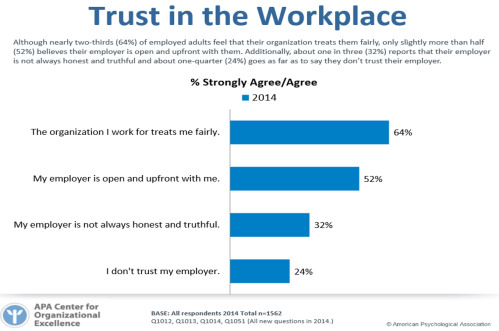
Taking a closer look at the statistics on trust, about one third of respondents say their employers are not always honest and truthful, and nearly a quarter say they don’t trust their employers. Interestingly though, this lack of trust does not necessarily correlate to feelings of unfair or bad working environments. The survey found that 64% of employed adults feel that their organization treats them fairly, despite that only 52% believe their employer is open and upfront with them. Does this mean as an organization you can cultivate fair and honest practices without any transparency? Does this mean that leaders get a pass on being trustworthy as long as they provide safe working environments? These are interesting data to be sure. But perhaps the bigger question is how productive are employees who don’t trust their leaders? What levels of discretionary effort and personal development will employees expend who feel physically safe but don’t trust their leaders? As a leader, the question I would ask is “how long can I rely on an employee population that doesn’t me?”
APA Center for Organizational Excellence April 2014
The APA’s findings come after surveying 1,562 adults aged 18+ who reside in the U.S. and who are employed full time, part time, or self-employed.

4 Comments

Filed under American Psychological Association, China Gorman, Data Point Tuesday, Employee Engagement, Employee Recognition, Managerial Effectiveness, Rewards & Recognition, Worplace Trust

The Stress Test: Most Employers Fail

Data Point Tuesday
We all know that a stressful work environment can impact employees’ mental, physical, and emotional health, as well as impact their engagement and productivity, but a new study from Monster reveals just how many employees are saying no to “sticking it out” in stressful work environments, and seeking jobs elsewhere. Monster’s international “Workplace Stress” study surveyed nearly 1,000 job seekers on the Monster database via an online survey which ran from March 12, 2014 to March 18, 2014. The study revealed that 42% of US respondents have left a job due to an overly stressful environment, these respondents stating: “I have purposely changed jobs due to a stressful work environment.” An additional 35% have contemplated changing jobs due to a stressful work environment. 42% of people have purposely changed jobs because of stress! This seems like a frightening number of people and begs the question, what are U.S organizations doing to change such work environments? Monster’s study reports that 55% of their respondents experience very stressful lives, and 57% of people experience very stressful work environments –more than half of respondents. Comparably, only 3% of respondents report experiencing no stress in their work life.

On the international front, employees in France and the UK experience the most workplace stress, with 48% (a 6% increase from US respondents) reporting that they have left a job due to stress. Employees in India are least likely to leave a job due to stress, with only 19% of respondents reporting that they have ever left a job because it was too stressful.

What exactly is stressing out the workforce? Monster’s study found that the most commonly reported workplace stressors are: supervisor relationship (40%), amount of work (39%), work-life balance (34%), and coworker relationships (31%). The study also found that the 84% of respondents claim that their stressful job has impacted their personal lives, with 26% reporting sleepless nights, 24% reporting depression, 21% reporting family or relationship issues, and 19% reporting physical ailments. When respondents were asked what their office does to help alleviate stress in the workplace, 13% reported “extra time-off”, 11% reported the “ability to work from home”, and dishearteningly, 66% answered “nothing.”

Monster Job Changes Due to Stress
While many of the figures in this study may seem shockingly high, when we consider all the data that surrounds us about the amount of work/life balance challenges American’s face, the high percentage of workers leaving jobs due to stress makes a little more sense. However, though it might make more sense, it doesn’t mean pushing employees to their limits, and fostering stressful work environments, is right. In fact, at Great Place to Work we have 20 years of data proving that fostering a transparent, safe, and fun workplace culture creates an incredibly more satisfying and productive environment than a high-stress/high pressure one. Check it out!

4 Comments

Filed under Change, China Gorman, Data Point Tuesday, Employment Data, Great Place to Work, Great Place to Work Institute, Leadership, Monster, Stess, Turnover, Work Life Balance

HR & Video: A Match Made in Heaven?

Data Point Tuesday
A recent global survey “Global View: Business Video Conferencing Usage and Trends,” conducted by Redshift Research on behalf of Polycom, Inc. dives into recent shifts in the way HR is communicating and shaping business culture. Data for the report was collected from 1,205 business decision makers in four regions and twelve countries. Major discoveries of the report included the ways Human Resource executives perceive and are using video and video conferencing technology. The data suggests that a move towards video provides advantages for talent management, staffing, training, productivity and flexible work enablement.

Screen Shot 2014-04-11 2Data from the survey tells us video is widely used by HR departments across the world. Polycom’s study found that video conferencing ranked as a top-three tool for communications, with HR respondents ranking email as the number one preferred communications tool (88%), followed by voice-conference calls at 62% and video conferencing at 46%. Interestingly, HR executives who use video at work today said they would prefer video collaboration to email as their top method of business communication within three years. HR executives that participated in the study saw clear benefits of using video communication tools over other forms of communication – with 98% of the Human Resources executives surveyed reporting that video conferencing helps companies work through issues of distance and cultural barriers to ultimately improve productivity amongst their teams.
Aberdeen Group Research 2014Respondents from the survey who use video conferencing today stated that the top advantages of this method of communication are: better collaboration between globally dispersed colleagues (54%), greater clarity of topics being discussed (45%) and more efficient meetings (44%). 76% respondents report that they use video conferencing at work and 83% of respondents (nearly 90% of those in their 20’s and 30’s) use consumer video conference solutions at home today. Laptops and desktops were the most popular form of business video conferencing, followed by conference rooms, and then mobile devices.
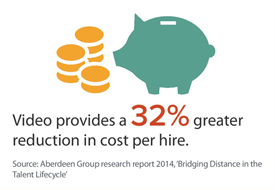
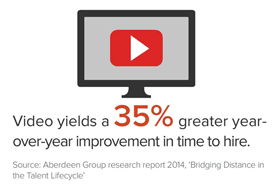
Inside and outside of the workplace, we’re seeing a movement towards video as the newest trend in keeping us better connected. Whether this is the addition of video features to major social media platforms, or businesses using video conferencing more frequently, it’s clear that video is on the rise. When you add in the increased focus on workplace flexibility by many organizations and a workforce that places increasingly more importance on the ability to be mobile and highly connected, integrating video communication tools in the workplace makes a lot of sense.

1 Comment

Filed under #HRTechTrends, China Gorman, Data Point Tuesday, HR, HR Technology, Human Resources, Polycom

The best recruitment strategy? Being a Great Place to Work®!

Data Point Tuesday
A look at LinkedIn’s recently released “Talent Trends 2014” report provides some interesting data about what’s on the minds of today’s professional workforce. As the study confirms, we live in an age of unprecedented transparency: “More job opportunities are viewable online, and the available context – information on the company, its culture, and the team including the hiring manager – has never been richer.” LinkedIn’s platform itself proves this point, and this ever increasing transparency is certainly changing the landscape of talent acquisition. It asks to us to consider how the talent, people, are approaching and considering new careers. Perhaps one of the biggest changes has been a move towards proactively seeking the best talent for the position. LinkedIn’s 2014 report surveyed over 18,000 fully employed workers in 26 countries, to shed light on professional attitudes towards job seeking, job satisfaction and career evaluation.

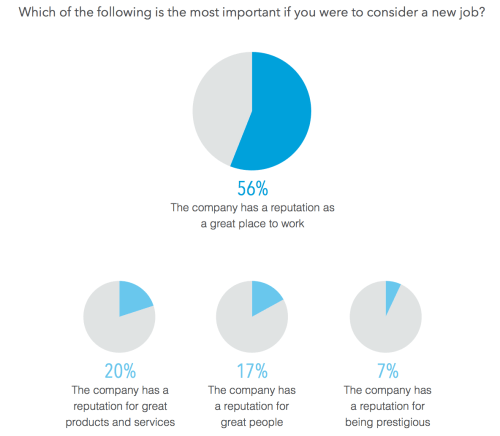
The report dives into many areas of the professional workplace’s approach toward careers, one such area being the importance of talent brand to professionals. Globally, professionals agree that the most important factor in considering a new job is whether their prospective company is perceived as a great place to work or not. (And to be clear, LinkedIn’s definition of “great place to work” does not synch up completely with the Great Place to Work Institute’s definition.) When respondents of LinkedIn’s report were asked which of the following was most important if they were to consider a new job, 56% said “the company has a reputation as a great place to work”, while 20% said “the company has a reputation for great products and services”, 17% said “the company has a reputation for great people”, and 7% said “the company has a reputation for being prestigious.” When looking at countries where talent brand/being a great place to work is most (100%) and least (0%) important, the global average was 56%, with high outliers being Denmark at 62%, Brazil at 61%, and the U.S. at 60%. Low outliers included Japan at 39%, Turkey at 35%, and China at 33%.

Talent brand, which LinkedIn equates with being a great place to work, is clearly important to today’s labor pool when planning a career or a job change. This line of thought underscores why it’s more necessary than ever to communicate and share a corporate mission and values. People want their work to have meaning to them, to be “more than just a job.” They want to trust their leaders and have a sense of camaraderie or family with their co-workers. The majority of people surveyed in LinkedIn’s report (85% of active job seekers ad 90% of passive job seekers) responded that they are passionate about the work they do. Additionally, 85% of active and 91% of passive job seekers stated that they are constantly learning and growing at work, and 84% of active and passive job seekers reported that they are comfortable promoting themselves and their ideas at work.

Linkedin Talent Profile

The clear results of this data are that professionals today care deeply about their work, and want the companies they work for to support this passion. Being a great place to work is a strong factor in their search for new jobs and careers – and besides being a critical selection criteria, being a great place to work is an essential foundation for success in today’s talent acquisition and retention challenges.

Leave a comment

Filed under China Gorman, Data Point Tuesday, Great Place to Work, Great Place to Work Institute, Hiring, HR, Recruiting, Talent Acquisition

Streaming Live: 2014 Great Place to Work Conference®!

Data Point Tuesday

I’m going to deviate from my normal Data Point Tuesday this week to offer you an invitation to attend the streaming keynote sessions from our 2014 conference. The 2014 Great Place to Work® Annual Conference kicks off this Thursday in New Orleans, and we’re very excited to share some of the great learning opportunities of the conference virtually! This year’s conference has sold out with 1,150 registered attendees from more than 400 companies. 39 out of our 45 keynote speakers and concurrent session leaders are business leaders (20) and senior HR practitioners (19). This is the only national event that teaches, inspires and connects professionals across industries and functions to strengthen workplace culture through building trust.

We’re thrilled to bring a packed agenda with a wealth of engaging speakers to those attending in New Orleans this year. If you’re not attending however, don’t worry! We will have free live streaming of our conference keynote sessions here this Thursday and Friday (April 3rd and 4th). Our keynote speakers this year include Bill Emerson, CEO of Quicken Loans, Terri Kelly, President and CEO at W.L. Gore & Associates, Victoria B. Mars, Member, Board of Directors at Mars, Inc., Blake Nordstrom, President at Nordstrom Inc., and Jeffrey Pfeffer, Thomas D. Dee II Professor of Organizational Behavior at the Graduate School of Business at Stanford University. We’re very excited to allow all of you to join us virtually and we hope you’ll take advantage of a great opportunity to take away actionable ideas and learn about best practices from experts at companies recognized for building trust, pride and camaraderie in the workplace! See you there!

Watch the 2014 Great Place to Work® Conference Keynotes Live Here

1 Comment

Filed under 100 Best Companies to Work For, China Gorman, Culture, Data Point Tuesday, Great Place to Work, Great Place to Work Institute, Hiring, HR, HR Conferences, Human Capital ROI, Leadership, Leadership Aspiration, Learning/Development

Longing for Leadership

Data Point Tuesday
Last week I discussed one of the trends (reskilling HR teams) called out in Deloitte’s annual Global Human Capital Trends Report for 2014. Recently released and influenced by the work of Bersin by Deloitte, the report examines 12 trends that represent the way employees today are driving their organizations to innovate and transform human capital practices. The report, as usual, is full of interesting data on human capital management trends and observations about the impact of those trends. It is definitely worth a read.

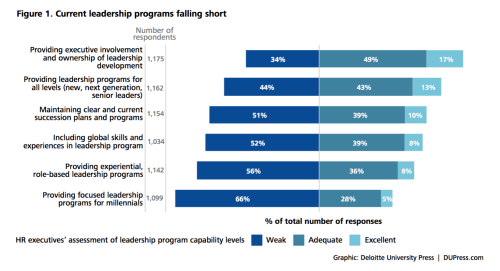
This week I’d like to look at another top talent issue facing organizations around the world as identified by Deloitte: leadership. Leadership is cited as the number one talent issue organizations today face, with 86% of respondents surveyed citing leadership as “urgent” or “important”. This is compared with a meager 13% of the same respondents that claim they are doing an excellent job developing leaders at all levels. So of all the trends discussed in Deloitte’s survey, this marks the largest “readiness gap”. Developing the next generation of leaders is urgent, yet very few report meeting the challenge.

When it comes to organizational strategies, most are requiring some significant tweaks due to the increasingly global, tech-savvy, interconnected, and diverse people that are the 21st century workforce, and leadership development is not exempt from this. Organizations are facing challenges such as developing multiple generations of leaders – not just Millennials, developing leaders with high flexibility and global fluency, and ensuring that leaders have the skills to understand and adapt to rapidly changing technologies. Essentially, leadership is taking on a much broader meaning than it did previously, where it may have described simply developing the next CEO or company C-Suite executive.

Looking at responses from executives who participated in Deloitte’s survey paints a clear picture of perceived leadership gaps. 66% reported believing that they are “weak” in their ability to develop Millennial leaders and just 5% rated themselves as “excellent”. Additionally, 51% of executives have little confidence in their ability to maintain clear, consistent, succession programs and just 8% feel they have “excellent” programs to build global skills.

Global Human Capital Trends Report for 2014It becomes clear then that as the global recovery continues to strengthen and organizations start to execute on growth strategies, that these gaps can only be filled by intentional focus and commitment to leadership development and training programs at all levels. Deloitte’s report suggests that companies should start by engaging their own top executives to develop leadership strategies and actively participate in them; refresh previous leadership strategies to link with evolving business goals; and implement a unique leadership program. They recommend that organizations focus on three aspects for developing leaders: developing at all levels, developing global leaders locally, and developing a succession mindset.

If companies want to grow in a global world, they need to grow global leaders. And Deloitte’s research shows clearly that this doesn’t happen accidentally.

Leave a comment

Filed under Bersin, China Gorman, Data Point Tuesday, Deloitte, HR, HR Data, Human Capital, Leadership

Business Leaders Don’t Think HR is Up to Snuff

Data Point Tuesday

Deloitte’s annual Global Human Capital Trends Report for 2014 is out. Influenced by the work of Bersin by Deloitte, it examines 12 trends that represent the way employees today are driving their organizations to innovate and transform human capital practices. The report, “Global Human Capital Trends 2014: Engaging the 21st Century Worker” surveyed 2,532 business and HR leaders in 94 countries around the world over several months, also drawing upon past research on global business challenges in HR, leadership, and talent management. The result of the report is a wealth of data on human capital strategies in the 21st century workplace that can be examined for perspective and insight into our own organizations and strategies. The year’s 12 critical human capital trends were categorized into three broad categories. “Transform and Reinvent” examines the need to reskill HR teams, capitalize on cloud based HR tech, implement HR analytics as a means to achieving business goals, and create a global HR platform that is robust and flexible enough to adapt to local needs.

So. Reskilling HR teams. Really? Why is this a critical trend? According to the report, less than 8% of HR leaders have confidence that their teams have the skills needed to meet the challenge of today’s global environment and consistently deliver innovative programs that drive business impact. Business leaders unfortunately corroborate this statistic, with 42% believing that their HR teams are “underperforming” or “just getting by”. This is compared to the 27% of business professionals who rate HR as excellent or good when assessing HR and talent programs. At a time when CEO’s are reporting human capital strategies as one of the top priorities for growth, it’s important that HR departments have the skills necessary to acquire, develop, and retain top talent as well as engage employees at all levels. And with a workforce that is increasingly global, tech-savvy, highly connected and demanding, HR departments face the challenge of doing all of this with increasingly creative strategies that meet the needs of this 21st century workforce. While such skills are highly necessary, the statistics indicate that HR departments are not as equipped with them as organizations would like.

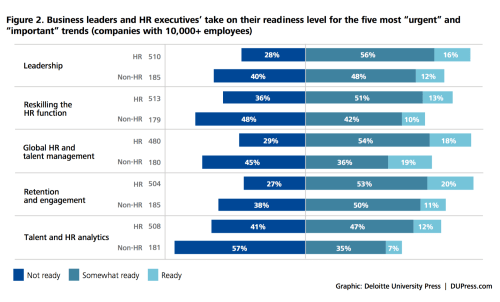
Of further interest, Deloitte’s report discusses how many organizations are reporting seeing a “disruption” of the CHRO role in their organizations. This disruption consists of a refocusing HR as a “business contribution” function with deeper skills in data/analytics as well as MBA-level business capabilities. When it comes to organizations’ readiness to respond to the 12 global human capital trends there is a discrepancy between business professionals’ and HR professionals’ perceptions. For the five most urgent trends identified (leadership, reskilling HR, global HR and talent management, retention and engagement, and talent and HR analytics) business executives report that their companies are less ready to address these issues than HR leaders report. For the issue of reskilling HR, 48% of business respondents reported that HR is “not ready,” compared to 36% of HR respondents.

Deloitte’s report links this perceived lack of HR skills to some basic attributes such as the fact that many organizations do not invest in developing the business skills of their HR teams and to the fact that more than 70 percent of all HR professionals enter the field without a specific degree or certification in business or human resources. Of respondents surveyed from Deloitte’s report, 43% stated that their companies are “weak” when it comes to providing HR with appropriate training and experiences.

While disappointing, data like this are great because they clearly identify perceived areas of weakness and allow organizations to challenge their own programs and strategies for HR, as well as draw conclusions more specific to their organization and strategies for transforming, reinventing, and reskilling the HR team.

The bad news? Business leaders think HR isn’t up to the people challenges of the 21st century. The good news? Now we know and can get to work!

Deloitte Human Capital Trends 2014

3 Comments

Filed under Bersin, China Gorman, Data Point Tuesday, Deloitte, HR, Human Capital

Diversity: No longer just the right thing to do

Data Point Tuesday

A recent study by the Economist Intelligence Unit, sponsored by SAP and SuccessFactors, explores the challenges of managing an increasingly diverse workforce while highlighting the importance of diversity as a strategic business advantage. The global study, Values-based Divesity, surveyed 228 executives responsible for designing and developing their organization’s human resources strategy, where 53% of respondents were very senior – either CEO’s or board members. As the study explains, many diversity initiatives in the last two decades involved a focus on demographic factors, such as gender and race, or “inherent” diversity. Today there is a wider awareness that the diversity focus should also consider values like cultural fluency, global mindset, language skills etc., or “acquired’ diversity. This shifting awareness, represented in EIU’s survey results, appears to represent a wider shift in organizational perception of diversity.

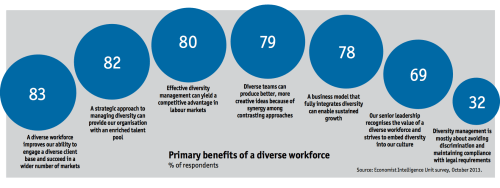
When respondents were asked about the primary benefits of a diverse workforce 83% of executives reported that a diverse workforce improves their firm’s ability to capture and retain a diverse client base; 82% agreed that a strategic approach to managing diversity can help access a rich talent pool; and 80% viewed diversity management as yielding a competitive advantage in labor markets. While the case for diversity has changed over the years, from a social initiative (it’s the right thing to do) to a strategic argument for supporting and creating new innovation, the bottom line remains the same – it’s always been about business success and competitive market advantage. With the increasingly diverse and multigenerational workforce that exists today however, certain organizational strategies will require greater adjustment. According to the EIU study, the top workforce characteristic that will require the greatest change in HR strategies over the next three years (cited by 57% of executives) was a “lack of interest in assimilating organizational values” followed by “conflicting values of a multi-generational workforce” (51%) and thirdly “educational differences among employees” (50%).

Values Based Diversity EIU

Given the strategic benefits of a diverse talent pool cited by executives, what strategies are organizations using to support and engage diverse talent? The top four strategies listed by respondents focused almost exclusively on learning and development: “mentoring of new and high potential employees”, “exposing high potential employees to diverse business situations”, “opportunities for international careers”, and “opportunities for diverse teams to address strategic business challenges”. When asked about the technologies used to manage diverse workforces, 35% of respondents cited human resources information systems (HRIS) as the highest adopted technology, followed by e-learning systems at 31%, and videoconferencing at 25%. Interestingly given the amount of hype and energy around social media, the adoption of enterprise social networks as a means to manage a diverse workforce was low, with only 20% of respondents reporting this as an adopted tool.

The data from this report clearly indicates that executives recognize the importance and benefits of having a diverse workforce, but also recognize that maximizing the potential of a diverse talent pool requires a strategic approach. Whether this approach means augmenting previous diversity initiatives, or developing new strategies altogether, approaches will likely be specific to each organization and the level of understanding and commitment by its leaders. The information does suggest that this will be an area of focus for many organizations now and into the future as the workforce becomes more globally mobile, multi-generational and flexible.

1 Comment

Filed under China Gorman, Data Point Tuesday, Diversity, Economist Intelligence Unit, EIU, SAP, SuccessFactors

Work-Life Balance is a Myth

Data Point Tuesday
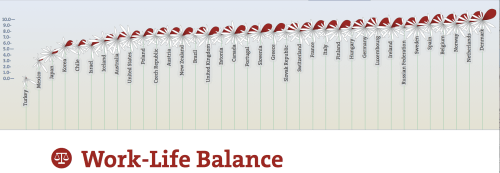
According to the 2013 Better Life Index by OECD (the Organization for Economic Co-Operation and Development) we’re still fighting the battle to find balance between work and our personal lives. Out of the 36 countries ranked on the 2013 Better Life Index the United States came in at 28 for work-life balance, behind almost all the countries in Europe as well as Brazil, New Zealand, and Canada. Australia fell just behind the U.S at 29. The top three countries for work like balance were Denmark at #1, the Netherlands at #2, and Norway at #3. What’s the reason for the U.S ranking so poorly when it came to work-life balance? Perhaps the most obvious factor is one we are probably very familiar with hearing about – American’s work long hours! According to the Index, 11.13% of employees work “very long hours” each week, or fifty plus hours on average. This percentage has held fairly steady since 2004 save a minute decrease (the study ranks the average annual increase since 2004 at -0.4%). For comparison purposes, approximately 9.7% of people in all other countries reported working “very long hours” and in Denmark the percentage of employees working very long hours each week was only 1.97%.

There are other influencers to the United States’ ranking when it comes to work-life balance. Gender roles still heavily influence the distribution of tasks within the family, with women spending an average of 4.3 hours a day on domestic work where men spend only 2.2 hours a day. Additionally, Americans devote less time to leisure and personal care than the OECD average; likely due to the simple fact that the more people work the less time they have to spend on other activities. Sadly, the U.S is the only OECD country without a national paid parental leave policy. The study explains that though total public spending on child welfare and education in the U.S is above the OECD average, most of this money is spent later in a child’s life (on public compulsory education). This reflects that early investment in childcare and support for families during and after pregnancy could have a greater focus. Though increasing parental leave policies would raise employers’ costs, evidence shows that women who take the full leave they are offered are more likely to return to work than women who do not, an incentive for employers to increase leave policies. OECD reports that female employment in the U.S has been falling over the last decade, despite the U.S having better career opportunities for women than most other OECD countries.

Overall, compared to most other countries on the 2013 Better Life Index, Americans work longer hours, spend less time on leisure and personal care, and take less vacation days. How’s that working for your business? How’s that working for you?

Work Life Balance

1 Comment

Filed under Better Life Index, China Gorman, Data Point Tuesday, Organization for Economic Co-Operation and Development, Work Life Balance, Workflex

Show Some Workplace Volunteering Love!

Data Point Tuesday

Many companies have health and wellness programs in place for employees, whether it be through cash based wellness-incentives or physical programs like exercise classes, challenges, or health seminars, and this trend is on the rise. According to a 2013 report from Fidelity and the National Business Group on Health, 86% of employers offered wellness-based incentives to employees in 2013, a figure up 29% from 2009. It’s hugely positive that companies are emphasizing a focus on employee health and wellness, and what’s even better news? It’s likely many businesses have programs in place that they may not even know serve to keep their employees healthy!

Volunteering is one such program. A recent study by UnitedHealth Group examines the benefits of volunteering on an individual’s health, and the result? Doing good is good for you. The 2013 survey involved a representative sample of adults across the country, the young, old, in good health and in poor health and recorded that people who volunteer feel better physically, mentally, and emotionally. Out of those surveyed who had volunteered in the last 12 months, 94% of people reported that volunteering improves their mood, 76% stated that volunteering has made them feel healthier, and 78% said that volunteering lowers their stress levels. Additionally, volunteers are more likely than U.S. adults overall to report that they felt calm and peaceful most of the time, and that they had a lot more energy most of the time, over the past four weeks.

Employers should be able to directly see the value of employees’ volunteering, and by virtue of that, reap the benefits of having healthier employees. Healthier employees reduce health care costs, and less stressed employees are likely to be more engaged and productive. With this in mind, businesses that support volunteering programs in their workplace are likely to experience even deeper benefits than organizations with employees who volunteer solely on their own prerogative. UnitedHealth Group reports that four out of five employed people who volunteered through their workplace in the past 12 months felt better about their employer because of the employer’s involvement in volunteer activities. 81% agreed that volunteering together (as a workplace) has strengthened relationships and collaboration among colleagues.

In the end, when it comes to health and wellness it may be true that nothing beats the basics of healthy eating and exercise. However, research shows us that there sure are many additional things we can do in our lives to promote healthy living, such as volunteering. Consider that non-profit you’ve donated to, or find one that does work you admire; do they have a volunteer day you could check out? And if you’re an employer looking to add some edge to the health and wellness programs in your company, consider showing some love to workplace volunteering programs!

2 Comments

Filed under China Gorman, Data Point Tuesday