Category Archives: China Gorman

Moving the HR Industry Forward

data point tuesday_500I love finding new sources of information that shine a light on how organizations can achieve better business results through Key Interval Analysts 2better people practices. This month I found a new source – although the principals are old friends – that is going to make important contributions in the use of HR technology in the improvement of business outcomes. If you haven’t heard of Key Interval Research, you most certainly have heard of John Sumser and William Tincup, the founders and principal analysts. And if you haven’t seen the first of their monthly research reports, let me introduce you to “The Ideal Vendor Relationship.”

The report is based on a survey of 1106 HR and Recruiting professionals conducted in December 2014 and January 2015. The survey respondents were from a broad cross section of titles in HR functions from organizations of all sizes. The survey itself had 85 subject matter questions and 35 demographic questions and the answers were collected online through several methods.

The incidence of “ah ha!” moments are so numerous in this report that sets out to explore, understand and illuminate how HR practitioners and their administrative players work successfully together with HR technology vendors and their administrative players to achieve organizational goals. These are crucial insights because, as William and John believe, “today’s work world requires that HR Departments accomplish their work through outside people and tools.” As we all know, more and more of those people are vendors and those tools are software.

The report is full of surprising findings:

  • The software lifecycle drives relationships
  • Only a small fraction of HR practitioners are dissatisfied with their HRTech tools
  • A majority of respondent companies have terminated an HRTech vendor for cause, but
  • Nearly 80% of respondents like their HR Software
  • The HRTech vendor-practitioner relationships are surprisingly healthy
  • The most important factor in the long term relationship with a vendor is the time required to get an answer

And there are more. Many more surprising findings. I won’t give away most of the good stuff, these guys are in business and want you to buy this report, but the myth busting section was particularly interesting. One of the myths they bust is that what matters most to the customer is schedule and budget. That’s right. A myth. User Satisfaction is significantly more important. This would be important for every vendor to understand and for every customer to own. Here’s the graph explaining…

April 7 2015 Customer MythThe report covers the software lifecycle, discoveries – including the busting of long held beliefs, easily digested findings, notable vendors and a pocket guide. Also included in the report are 4 cases from HR practitioners managing HR software vendor relationships and working on important business issues. The takeaways are critical. (Note: not all of the outcomes are positive.)

These are smart guys asking smart questions that maybe no one else is asking. And the answers aren’t what I expected. They aren’t even the answers they expected. And that’s what makes this report so refreshing and so useful: answers to questions that aren’t being asked and insightful analysis into the surprising answers. Worth the price of admission. Check it out here.

2 Comments

Filed under #HRTechTrends, China Gorman, John Sumser, Key Interval Research, William tincup

The Rise of HR

data point tuesday_500

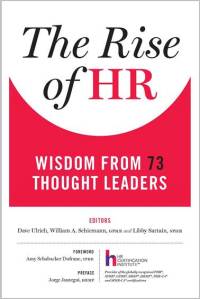
I recently had the honor of participating in an effort to crowd source real business wisdom about how Human Resource Rise of HR front coverpractices sit at the center of some of the most important decisions in business and are rapidly impacting the workplace, talent, culture and business success. Three titans in the HR space, Dave Ulrich, Bill Schiemann and Libby Sartain – together with the support of the HR Certification Institute – invited a who’s who of HR from business, academia, government, consulting and the non-profit world to weigh in on what business leaders need to know to be effective in creating sustainable, long-term growth for their organizations. The 73 essays included in The Rise of HR provide a blueprint for business leaders and HR leaders alike to successfully face the challenges looming ahead of us.

The seven broad categories of essays are:

  • Context To Strategy
  • Organization
  • Talent Supply
  • Talent Optimization
  • Information & Analytics
  • HR Governance
  • HR Professionals

And with authors like Josh Bersin, Wayne Cascio, Ian Ziskin, Sue Meisinger, Diane Gherson, Arvind Agrawal – and too many other true thought leaders to list – this collection of essays should be on the top of the reading list of every CEO and every CHRO – and every person who aspires to be a CHRO.

My essay on page 179, “CEOs Want Better Performance. Great Culture Can Make It Happen,” draws from my own experience as a CEO as well as the research and analysis from the Great Place to Work Institute. I think you’ll find it compelling if you’re trying to improve your organization’s performance.

Check out The Rise of HR. Unlimited copies are available in PDF and EPUB which are sharable on nearly every device. If you read one essay a day for the next 73 days you will be so much smarter and will be able to identify solutions to the issues that are fast piling up on all of us. This crowd-sourced collection is a win-win-win-win for the HR profession, for HR professionals, for business leaders and for employees everywhere.

Leave a comment

Filed under China Gorman, HR Certification Institute, The Rise of HR

Deloitte’s HR Wake Up Call

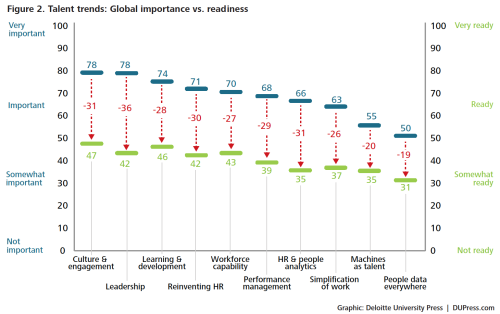
data point tuesday_500Deloitte recently released its 2015 Global Human Capital Trends report, their annual comprehensive study of HR, leadership, and talent challenges compiled using data from surveys and interviews taken by 3,300+ HR and business leaders in 106 countries around the world. The report identifies 10 major trends that emerged from the most current research, and cites the capability gap (measuring the distance between the importance of an issue and organizations’ readiness to address it) associated with each, as well as practical ideas for how to help organizations combat theses challenges. Ranked by importance, the top ten talent challenges reported for 2015 are: culture and engagement, leadership, learning and development, reinventing HR, workforce on demand, performance management, HR and people analytics, simplification of work, machines as talent, and people data everywhere.

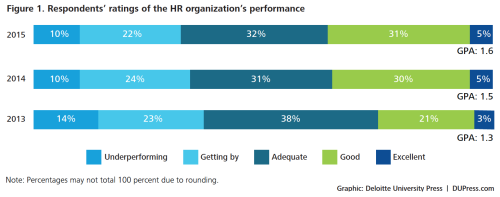
Deloitte’s data highlight considerable gaps in capability among all 10 trends, with the majority of capability gaps getting larger compared to last year. Global Importance vs. ReadinessLet’s take a look at the top five talent issues for 2015: Culture and Engagement ranked as the #1 issue overall for 2015 (not a surprise to us at Great Place to Work®), barely edging out leadership, which ranked as the #1 issue in 2014. This highlights organizations’ recognition that understanding their culture and focusing on building great cultures is a critical need in the face of a potential retention and engagement crisis. Building Leadership ranks as the #2 talent issue for 2015, with close to 9 out of 10 respondents citing the issue as “important” or “very important.” Despite this, Deloitte’s data show that organizations have made very little progress towards meeting this challenge since last year. Learning and Development jumped to the #3 talent challenge in 2015, up from the #8 spot last year. And while the number of companies rating learning and development as important has tripled since 2014, the readiness to address it has actually gone down (!?). Reskilling HR came in as the 4th most important talent issue for the year, with business leaders rating HR’s performance 20% lower than HR leaders’ ranking (and that is with both HR and business leaders ranking HR performance as low on average). Workforce on Demand was the #5 talent challenge for 2015, with 8 out of 10 respondents citing workforce capability as “important” or “very important” in the year ahead.

Through data analysis and extensive conversations with organizations around the world about these challenges, Deloitte arrived at six key findings that give us a bird’s eye view of how organizations are approaching talent and work:

  1. “ ‘Softer’ areas such as culture and engagement, leadership, and development have become urgent priorities.”
  1. “Leadership and learning have dramatically increased in importance, but the capability gap is widening.”
  1. “HR organizations and HR skills are not keeping up with business needs.”
  1. “HR technology systems are a growing market, but their promise may be largely unfulfilled.”
  1. “Talent and people analytics are a high priority and a tremendous opportunity, but progress is slow.”
  1. “Simplification is an emerging theme; HR is part of the problem.”

Each chapter in Deloitte’s report takes a deep dive view into the 10 talent trends they uncovered through their research with some interested findings. For example (in looking at the #4 trend, reskilling HR) Deloitte notes that nearly 40% of new CHRO’s now come from business, not from HR. Why are CEOs bringing in non-HR professionals to fill the role of CHRO? The answer may lie in their sinking belief in HR’s capabilities and abilities to provide solutions to people-related business problems.HR Performance

Deloitte puts it bluntly: right now HR is just not keeping up with the pace of business, and a reskilling of HR professionals while reinventing the role of HR is becoming critical. This need however, also creates an unprecedented opportunity for HR to play a big role at the highest levels of business strategy. But where do organizations start? Deloitte offers the following advice:

  • “Redesign HR with a focus on consulting and service delivery, not just efficiency of administration. HR business partners must become trusted business advisors with the requisite skills to analyze, consult, and resolve critical business issues.”
  • “Rather than locating HR specialists in central teams, embed them into the business—but coordinate them by building a strong network of expertise. Recruitment, development, employee relations, and coaching are all strategic programs that should be centrally coordinated but locally implemented.”
  • “Make HR a talent and leadership magnet… Create rigorous assessments for top HR staff and rotate high performers from the business into HR to create a magnet for strong leaders.”
  • “Invest in HR development and skills as if the business depended on it… Focus on capabilities such as business acumen, consulting and project management skills, organizational design and change, and HR analytical skills.”

There are very useful insights in this report – as there are every year. But this year the insights also serve as a warning to HR. A warning that it’s losing the confidence of CEOs and other C-Suite executives. That 40% of all CHROs are coming from functions other than HR should be sobering. That the top capability gaps are growing larger, not smaller, should be cause for concern. Without bringing furniture into the conversation, this report is a credible and important HR wake up call!

8 Comments

Filed under China Gorman, Culture, Data Point Tuesday, Global Human Capital, HR, Human Resources, Leadership, Learning/Development

Who Really Cares About Employer Branding?

Data Point TuesdayIn a recent report by Universum, a tactical view of how organizations are attracting talent and combating problems is given with some fresh insight. The report: State of Employer Branding is part one a four-part 2020 Outlook series, based on responses from 2338 interviews conducted in the winter of 2014 in 18 different countries. Respondents represented a variety of industries and job functions with more than 50% working within HR, 16% being the CEO of their respective organization, and 23% working for organizations with more than 1000 employees in the country. Universum’s report starts by posing a necessarily blunt question to its readers, “How long have executives argued over the need to make talent attraction a corporate strategy rather than an HR strategy?” Point taken, talent acquisition remains an ongoing point of struggle for organizations, but is a critical strategy for organizations to remain competitive.

March 10 2015 Talent Acquisition Concerns

As Universum makes clear, we’ve known this for a while, so what are organizations doing to step up to issues relating to talent? Let’s take a look at the meaty details of Universum’s report….

Talent acquisition and retention is a complex equation involving (among other things) talent management and development, employer branding, and analytics to measure effectiveness. Part of the problem with employer branding is where responsibility lies:

  • 60% of CEO’s feel they own employer branding.
  • 58% of HR executives, 63% of talent acquisition executives, and 57% of recruiting executives say HR owns employer branding.
  • 39% of marketing executives point to HR owning the role and 40% to the CEO owning the role.

Why all this variability? Universum underlines repeated studies that have shown CEOs don’t believe HR is up to the task, as well as studies that say HR itself is not confident in their current approach, or do not feel their approach is innovative. Greater stakeholder cooperation is another broadly identified need when it comes to employer branding efforts:

  • 70% of senior executives see a closer need for stakeholder cooperation in the next 5 years.
  • 77% of HR executives see a closer need for stakeholder cooperation.
  • 53% of CEO’s see stakeholder cooperation as a growing need.

Though this is an identified need, without changing CEOs’ confidence in HR to solve strategic talent challenges, HR will be hard pressed to effect change in this area.

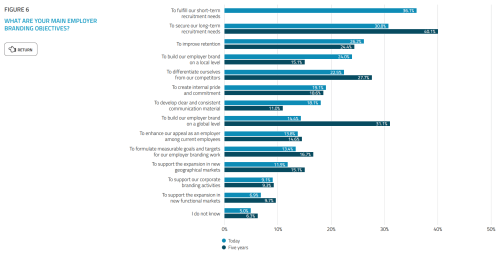
Universum asked respondents about their employer branding objectives, and how these objectives will change in the next five years.March 10 2015 Employer Branding Objectives

Interestingly, of all the objectives listed, none earns much more than one third of respondents’ votes. The most critical need is “to fulfill our short-term recruitment needs” but is claimed by just 36%. This should lead us to ask why so few executives (and CEOs in even lower numbers) are prioritizing such objectives? Universum offers the following explanations

  • Organizations face a lack of clarity about which objectives matter most
  • There is a perceived lack of ownership for the discipline of employer branding
  • Employer branding is not viewed as a critical priority when organizations face many other pressing challenges

To better understand their commitment, Universum studied how organizations are currently investing in employer branding:

March 10 2015 Employer Branding Budget

Overall, we see that organizations are overwhelmingly focused on external employer branding efforts. KPIs, however, often measure almost inclusively internal factors (presenting another potential issue).

Organizations also face a perceived gap when it comes to the association between consumer and employer brands. Recently there has been a concerted effort to more closely align employer and consumer brands, yet when executives were asked how closely they feel these are aligned, the responses indicated there’s still much work to be done:

  • 19% say their employer and consumer brands are the same
  • 36% say “there is a connection today”
  • 17% say there is no connection at all

When marketers were asked this question though, the answers were remarkably different, with marketers much more likely to report a connection between the employer and consumer brand.

How do organizations more forward with an employer branding and talent strategy when there appears to be little consensus about how to do so? Universum’s report cites from PwC’s global CEO survey, which reports that while 93% of CEOs say they know they need to change their strategy to attract and retain talent, 61% say they have not taken steps to do so yet. The first step towards addressing “the talent gap” may just be to get organizations to accurately recognize areas of misalignment and differing perceptions. Employer branding, as we see from this data, is certainly one of these areas. Organizations must also commit to an investment strategy; as Universum states: “If talent is as important to competitive might as capital, it must be managed and measured with the same disciple applied to financial planning and management.”

This report makes me think we have a massive showdown coming between HR and CEOs. I don’t know about you, but I think I know who’s going to win unless something big happens. And the only thing big I see happening is Marketing swooping in to save the day. HR, if you think you’re hearing footsteps, you probably are!

Leave a comment

Filed under China Gorman, Data Point Tuesday, Employer Branding, Talent Acquisition, Universum

The Recognition Landscape Isn’t Changing Much

Data Point TuesdayRecognition programs are vital tools in an organization’s total rewards strategy, but beyond the knowledge that “recognizing employees is a good thing to do” we can look to data that back up recognition programs as an important part of an organization’s culture. WorldatWork and ITA Group’s Trends in Employee Recognition 2013, is a good example of a data driven look into why recognition programs are important. Their report summarizes the results of a survey sent globally to 5,520 WorldatWork members, which aimed specifically to measure specific types of recognition programs and the impact on the workforce. Respondents were randomly selected members who had designated responsibilities at the executive, top or senior level and members that specified total rewards as their specific function area.

While many functions and structures of the workplace are shifting as the world of work becomes more global, tech-enabled, and demographically diverse, recognition programs remain steady as a utilized tool among organizations.

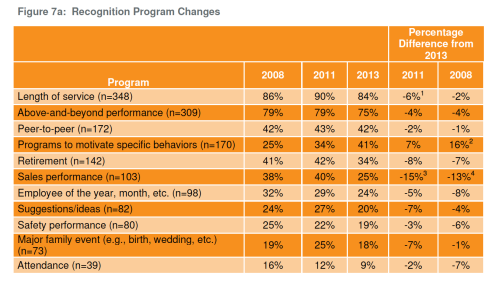
% orgs with recognition programsWhat shifts in the landscape of recognition programs is not the use of programs themselves (as we see from the percentage of organizations using recognition programs remaining steady over a 5 year period) but the types of programs used. Of the top 5 recognition programs in 2013, the top 3 remained the same (length of service, above-and-beyond performance and peer-to-peer recognition) but programs that motivate specific behaviors moved to the 4th spot for most used programs, with a 7% increase over 2011 to 41% (a statistically notable change since 2008). Also notable is the drop in retirement recognition programs as a prevalently used program. As WorldatWork states in the report, the data seem to indicate organizations are moving away from legacy recognition programs towards programs that can drive results (how much and fast is the landscape changing, though?).

ecognition Program ChangesWhile fresh-off-the-press data is valuable, looking at data like this (with a bit of hindsight) is also valuable in that it reminds us that data and reports around organizational culture can accurately predict trends in upcoming years, and allows us fact-check theories and perspectives. WorldatWork’s data pointed to organizations moving towards recognition programs that can be leveraged to have a more direct impact on business results (like peer-to-peer recognition, programs to motivate behaviors, and above-and-beyond performance) vs. recognition programs like length-of-service and retirement recognition programs which have been in use for many years. They note that programs to motivate specific behaviors grew every year by 16 percentage points since they survey was first instituted in 2008. We’ve seen such trends hold true, with organizations in today’s increasingly fast-paced and competitive context instituting recognition programs that can more quickly impact strategic goals. Workplace wellness programs are another type of recognition program that WorldatWork’s survey points to which we’ve seen adopted at a growing pace. In 2011 and 2013, respondents noted wellness rewards programs as “other recognition programs” that their organization use.

Some other nuggets of data to consider from WorldatWork’s report included:

  • In 2013, the top 4 recognition goals remained primarily unchanged from past years and were recognizing years of service, creating a positive work environment, creating a culture of recognition, and motivating high performance.
  • The most common types of recognition awards reported in 2013 were: certificates/plaques, cash, gift certificates, company logo merchandise, and food.
  • Organizations in 2013 budgeted an average of 2% of their payroll budget to be used for recognition programs (the same as 2011).
  • Only 12% of organizations in 2013 reported training managers on recognition programs.
  • 46% of respondents in 2013 reported management perceiving recognition programs as an investment vs. an expense.
  • Only 34% of respondents in 2013 said they believed recognition programs had a positive impact on retention.

The fact that organizations have consistently utilized recognition programs over the years reminds us that this is an important part of creating a great organizational culture and a great total rewards strategy. But are organizations reworking recognition programs to be as impactful as possible, or are they just sticking with “tried and true” methods? Do plaques, gift cards and food motivate employees to stay engaged and on board? Perhaps the respondents in this survey, only 34% of whom believe recognition programs had a positive impact on retention, are on to something. Perhaps sincere appreciation from trusted leaders and peers are more meaningful than a certificate. Perhaps a hand written thank you note from the CEO for above and beyond performance creates more stickiness than a $25 gift card. Or maybe a video message from a senior leader on a milestone employment anniversary date motivates greater engagement than a plaque.

We at Great Place to Work® certainly see positive correlations between lower levels of turnover and great workplace cultures. So if leaders don’t associate recognition programs with lower levels of turnover, there’s more work to be done. Maybe ditching the plaques and adding some human touches to your recognition programs might be something to consider. One thing is certain: everyone – regardless of generation – wants to be appreciated for their contributions by leaders they trust. It’s really not that hard to understand. But how do we make it happen?

2 Comments

Filed under China Gorman, Data Point Tuesday, Employee Recognition, Great Place to Work, Recognition Programs

Automated Workforce Planning: Tactical or Strategic?

Data Point Tuesday

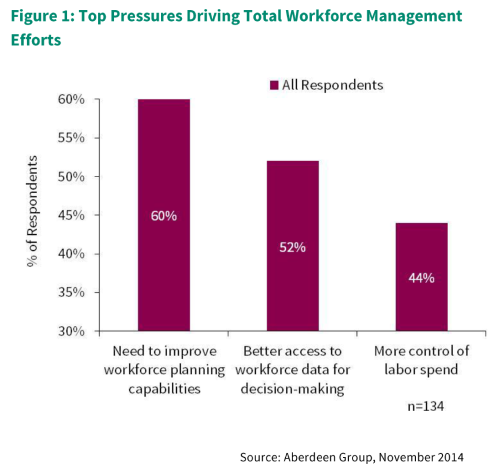
An organization’s most critical assets are its employees. No one bothers to argue against that point any more. An organization’s workforce is also, however, its most expensive asset, and workforce management (the development of employees, retention of skilled talent, etc.) is consistently cited as one of the top issues facing organizations today. In a recent Aberdeen report, 60% of all organizations reported a need to improve workforce planning capabilities as a driver of their total workforce management efforts.

Pressures Driving TWM

Improving workforce planning capabilities took the top spot for pressures driving workforce management efforts, but better access to workforce data (in order to improve decision-making) was close behind, 60% vs. 52%. In our current “golden age of technology” there are ample workforce management technology solutions that can help organizations with workforce management, from timekeeping and leave of absence management to labor forecasting and analytics. The adoption of automated workforce management solutions though (as with other tech solutions) has been slow among organizations. Aside from the fact that the global workforce is rapidly driving towards a place where technology and automated workforce solutions will be a necessity for companies to remain innovative and successful, we have data that show – on a much simpler level – that workforce management technology is a good investment because it offers organizations multiple financial benefits.

Research shows that the use of automated time, attendance, and scheduling solutions results in 8% to 20% lower replacement costs (as a percentage of annual pay) for hourly workers, which can be attributed to the reduced cost of administration needed to manually manage such functions. Aberdeen’s research also found that average revenue per full time employee increased four times in organizations with automated absence/leave management technology and two times for organizations with automated scheduling, time, and attendance technology.

Automation Impact GraphOrganizations that automate scheduling, time/attendance and leave/absence management also saw increases in customer satisfaction levels ranging from 9.2% to 10.4% (compared to a 2.9% to 6.2% range of improvements for organizations that did not have automated solutions).

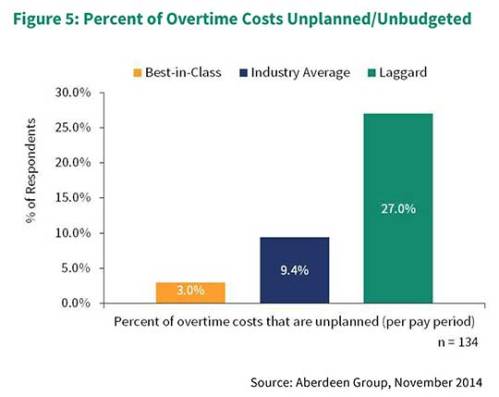
Automated workforce management solutions can also help to reduce unplanned overtime. While it’s expected of organizations to experience some overtime, having an inaccurate idea of what employees schedules will look like can quickly increase an organization’s spending. Best in class organizations experience less than 4% of unplanned overtime costs in comparison with 27% for laggard organizations. Automated solutions can help managers with critical scheduling accuracy, freeing them to give more time and attention to core business needs.

Unplanned-Overtime-Costs

Another benefit for organizations that use automated time and attendance software is greater workforce capacity utilization. These companies have employees who, on average, work at 12% more their capacity than those who rely on manual processes or spreadsheets (83% vs. 74%). Automated leave and absence management additionally helps to lower costs by accurately tracking employees’ time off, making sure PTO is recorded as it is taken (ensuring for example, that employees are not owed leave at the end of the year they’ve earned but not taken) and by providing organizations with software to properly submit and track leave and absence requests (mitigating the impact of planned/unplanned losses).

A May 2014 report by Aberdeen found that optimizing scheduling is a key attribute of leading firms. These firms experienced consecutive years of improvement in customer satisfaction by 17.8% compared to firms who did not have a focus on optimizing scheduling and actually lowered their customer satisfaction rates by an average of -3.9%. This should be the key take-away for organizations when it comes to automated workforce management solutions – we know that automated workforce management software can drastically help organizations to improve and optimize scheduling, and this is a key attribute of successful companies. And if the slow adoption of automated solutions comes from a concern that instituting such software could turn into a micro-managing nightmare, organizations should note that, as with all tools, its about how you introduce them and support their adoption. The potential benefits of automated solutions far out-way any cons, so dipping a foot in the automated solutions pool seems well worth the risk, even if it may require an investment in training and change management. We’re already witnessing the expansion of HR and administrative roles within organizations; these functions are providing organizations with instrumentally more strategic value than they have in the past. Free up these departments time and energy from consuming workforce management tasks like monitoring attendance/leave and scheduling, and see what happens when tactical, manual roles become automated and enable more strategic data analysis and insight to enter the mix!

2 Comments

Filed under #HRTechTrends, Aberdeen Group, China Gorman, Data Point Tuesday, Workforce Management, Workforce Planning, Workplace Studies

Why Diverse Organizations Perform Better: Do We Still Need Evidence?

You’ve probably heard that organizations with a focus on diversity have stronger organizational cultures – they have happier and more productive employees, and are more socially ethical than other organizations. You might have also heard that organizations with a focus on diversity perform better financially than organizations that do not invest energy in diversity programs, or in fostering a diverse workplace. Why, exactly, is this the case though? McKinsey & Company’s 2014 report, “Why Diversity Matters” answers just this, looking at the reasons why organizations with a focus on diversity simply do better, financially and otherwise, shining some data driven light on, well, why diversity matters.

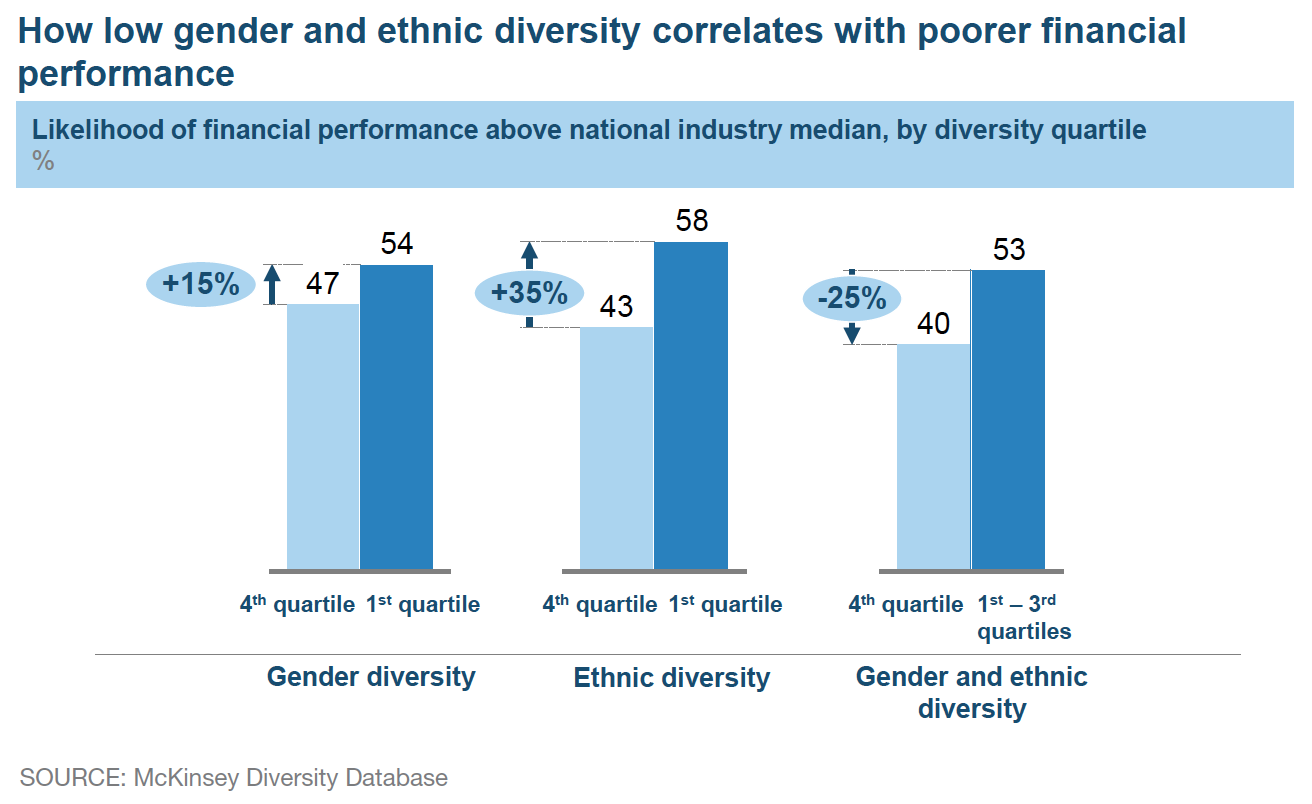
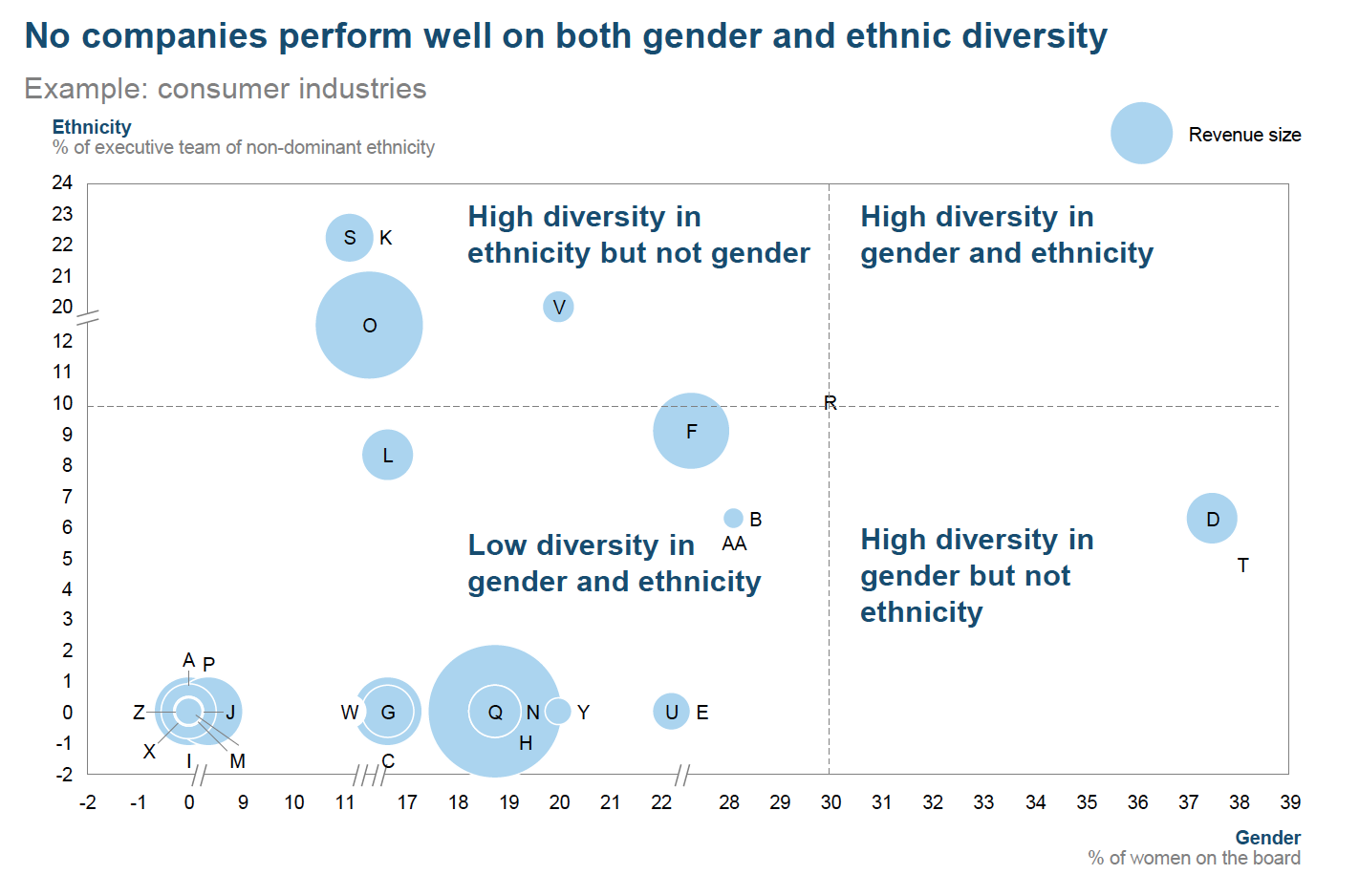
McKinsey’s report examines the relationship between the level of diversity (defined as a greater share of women and a more mixed ethnic/racial composition in the leadership of large companies) and company financial performance (measured as average EBIT 2010–2013). Their research is based on leadership demographics and financial data from hundreds of organizations and thousands of executives in the United Kingdom, Canada, Latin America, and the U.S, allowing for “…results that are statistically significant and…. the first [analysis] that we are aware of that measures how much the relationship between diversity and performance is worth in terms of increased profitability.” Analysis of the data collected from 366 companies disclosed a statistically significant connection between diversity and financial performance, with organizations in the top quartile for gender diversity 15% more likely to have financial returns above their national industry median and organizations in the top quartile for racial/ethnic diversity 30% more likely to have financial returns above their national industry median. This pattern also held true in reverse, with organizations in the bottom quartile for gender or racial/ethnic diversity more likely to fall below the performance of the top-quartile companies and organizations in the bottom quartile for both gender and ethnicity underperforming (not just “not performing” but lagging) in comparison with the other three quartiles.

Feb 17 2015 Poor Diversity Poor Performance

McKinsey’s research also noted a positive relationship between financial performance and diversity in leadership, although this varied by country, industry, and type of diversity (gender or ethnicity). The U.S, for example shows no statistically significant correlation between gender diversity and performance until women make up at least 22% of a senior executive team. Even once that point is reached, the relationship observed for US companies is still of relatively low impact: for every 10% increase in gender diversity there is an increase of 0.3% in EBIT margin. The UK boasts a much more significant relationship between gender diversity and performance, experiencing ten times the impact for their focus on gender diversity than U.S organizations (even after they’ve reached the 22% tipping point). The correlated benefit is an increase of 3.5% in EBIT for every 10% increase in gender diversity in the senior executive team (and 1.4% for the board). It is also interesting to note that while U.S. companies have made efforts in recent years to up the number of women in executive positions (progress is limited but measurable), the data show that less attention has been given to the attainment of racial and ethnic diversity.

Feb 17 2015 Women in Executive Roles

Above-median financial performance was achieved by a higher percentage of companies in the top quartile than the bottom quartile for ethnic diversity in all the countries and regions McKinsey investigated. The message that diverse organizations perform better is clear, but as we asked earlier, why? McKinsey & Company offers the following supported hypotheses that diversity helps to:

  •  Win the war for talent
  • Strengthen customer orientation
  • Increase employee satisfaction
  • Improve decision making
  • Enhance an organization’s image

In the war for talent, diversity increases not only an organization’s sourcing pool but attracts talent that has shown to place significant value on diversity (such as Millenials). Additionally, because groups targeted by diversity efforts are usually underrepresented, they are often great sources of desirable talent. McKinsey & Company’s report cites a recent study that found, on average, lesbian, gay, bisexual, and transgender (LGBT) recruits tend to be more highly skilled and more likely to have advanced degrees. By focusing on diversity, organizations align themselves with an increasingly heterogeneous customer base, enabling stronger bonds with customers. Workplace diversity increases employee satisfaction and fosters positive attitudes and behaviors and creates better decision making through combining diverse groups of thinkers. These organizational aspects that diversity bolsters ultimately make up the foundation for organizations that perform better financially.

As the workforce becomes increasingly global, diversity is only going to increase in importance. Regulators in some European countries have already introduced diversity targets for boards, such as those set out in the UK Equality Act 2010. Despite the importance of diversity, many companies’ approaches are still very one-dimensional, opting for just a single diversity program to cover all aspects of diversity: racial/ethnic, gender, and sexual orientation. This may be why, on a large scale, companies often make progress in only one area of diversity.

Feb 17 2015 Gender and Ethnic Diversity Performance

McKinsey & Company’s research suggests that this one-dimensional approach to diversity results in a focus on a particular category rather than the opportunity as a whole. They advise that organizations should instead adopt tailored programs and make more targeted efforts within specific areas of diversity, believing that these will be necessary to make measurable progress and ensure relevance to business goals.

It does seem odd that we’re still making a statistical case for what everyone knows to be true:  diverse thought, experience, outlooks and cultures make for stronger solutions, more rapid innovation, more engaged employees and customers, and better all around performance. I guess more evidence doesn’t hurt.

1 Comment

Filed under 100 Best Companies to Work For, Business Case, China Gorman, Company Culture, Corporate Social Responsibility, CSR, Data Point Tuesday, Diversity, EBIT, Great Place to Work Institute, McKinsey, War for Talent

Candidates First, Employees Second and Customers Third?

Data Point Tuesday
The candidate experience is a growing priority. Between 2013 and 2014, organizations increased their amount of focus on building strong relationships with candidates by more than five times. But the Aberdeen Group opines in their recent report, “Why the Candidate Experience Needs to be a Priority ASAP,” organizations still need to up their ante. No matter the industry, a candidate’s application experience should be a top priority simply because their perceptions of the process (whether they get the job or not) can have a serious impact on an organization’s brand, customers, and success. In this hyper-connected age of social media, it can take only one voice to significantly damage a big brand…

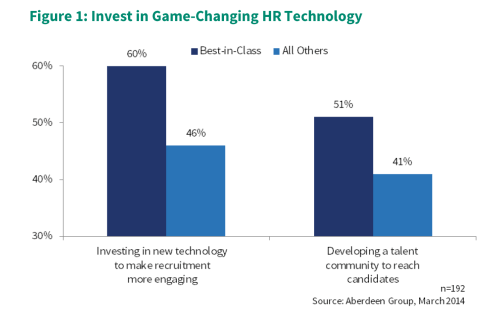
The importance of the candidate experience is not lost on Best-in-Class organizations. These companies are 30% more likely to invest in new technologies such as social, mobile and video to make recruiting engaging for candidates, in comparison with all other organizations (60% vs. 46%).

Game Changing TechIt’s also more likely that Best-in-Class organizations (compared with all other organizations) will focus on the development of a talent community to reach candidates and improve the candidate experience. Talent Communities, groups of active potential candidates that can regularly engage with the organization through technology (online portals, email, mobile etc.) are one of the fastest growing areas of talent acquisition. Aberdeen reports that 40% of organizations (respondents from a recent talent acquisition survey) plan to increase their investment in talent communities over the next twelve months.

Aberdeen’s research finds that besides overcoming the skills gap in today’s talent pool, improving the candidate experience is ranked by businesses, overall, as the most critical talent acquisition issue. How this knowledge is reflected within organizations, however, is a different story. Just 21% of companies in Aberdeen’s report indicated that the candidate experience/building strong relationships with candidates were a top priority for 2014, although this was a significant jump from 2013 where only 4% of organizations reported this.

Besides the perception of an organization, having a great candidate experience process can also mean improved cost-per-hire. Aberdeen’s study found that organizations prioritizing the candidate experience are twice as likely to improve their cost-per-hire and are expected to have a larger budget for talent acquisition efforts in the coming year (compared to organizations who do not prioritize the candidate experience).

 Budget ImpactCandidates expect much of the same things as consumers, for example, in ease of use and clear user-interfaces. In a 2013 study by Aberdeen, 62% of Best-in-Class organizations reported giving candidates visibility into their application status through resources like automated emails and online platforms like candidate career portals (although just 33% of organizations feel they have an engaging career portal). According to another 2013 study from Aberdeen, candidates who start as customers of the companies they apply to are 3.2 times more likely to describe their relationship as an applicant as positive rather than negative.

A good way to think about whether or not your organization is prioritizing the candidate experience may be to ask if candidates are treated with a comparable amount of respect and attention as customers. If they are, it likely means that the candidate experience it something that’s planned ahead for, as an organization would plan for potential customers. Most organizations do not plan ahead when it comes to the candidate experience however, with Aberdeen citing 60% of organizations only recruit talent when there is an opening, instead of having a talent community of active candidates that can be tapped into as needed. Organizations should take heart that creating a focused and engaging candidate experience does not need to be a difficult process. Contemporizing the process with technology (building a talent community and active pipeline) is an important step, but organizations can start also to prioritize the experience by changing the system they have in place now. This could mean catering to the highly connected, tech savvy candidates of today by not only reaching out to them post-application and interview, but also soliciting feedback from them during the application process (helping organizations better understand holes in their candidate experience). Sometimes it’s the simplest aspects of an application process that have the most impact. Respondents of a recent candidate experience survey by Aberdeen reported that the best, candidate friendly companies:

  • Send a thank you note after an application is completed
  • Ensure candidates can effectively exhibit their qualifications
  • Share next steps (whether that’s moving forward or a courteous decline)
  • Allow candidates to provide feedback about the overall experience

The work that Gerry Crispin, Elaine Orler and Ed Newman have done notwithstanding, does your organization really care about “the candidate experience”? Does creating a talent community really matter when you need to fill positions? Will treating job applicants like customers really make a difference in your ability to attract, hire and deploy the talent you need to meet your organizations strategic objectives? The data are beginning to provide clear evidence that, to paraphrase Vineet Nayar, perhaps candidates come first, employees second and customers third….

4 Comments

Filed under Aberdeen Group, CandE Awards, Candidate Experience, China Gorman, Data Point Tuesday, Workplace Studies

Key Drivers & Changes in New Ways of Working

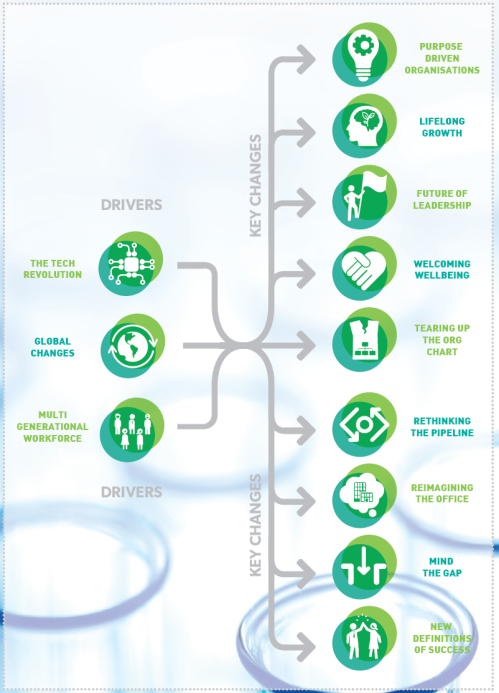
Data Point Tuesday“New Ways of Working,” a report released last month by The B Team and Virgin Unite, offers up some provoking insights by businesses and The People Innovation Network (a group of 30+ global businesses passionate about re-defining work) on better ways of doing business, for the wellbeing of people and the planet. The report explains the key drivers that are changing the way we work, and the key changes resulting from those drivers. These “key drivers” for new ways of working should likely come at no surprise, as they are: The Tech Revolution (allowing us to work anytime/anywhere, massively redefining scale, and creating new ways to problem solve), Global Changes (population growth, climate change/resource degradation, megacities and shifting economic powers) and the Multi-Generational Workforce (Millennials expected to make up 50% of the workforce by 2020; mature workers staying in the workforce longer than ever). However while these key drivers may come as no surprise, some of the key changes resulting from these drivers (and their implications) may not be as obvious, making this report a great read for anyone interested in workplace trends and organizational culture. Let’s explore a few key changes…

Drivers and Changes

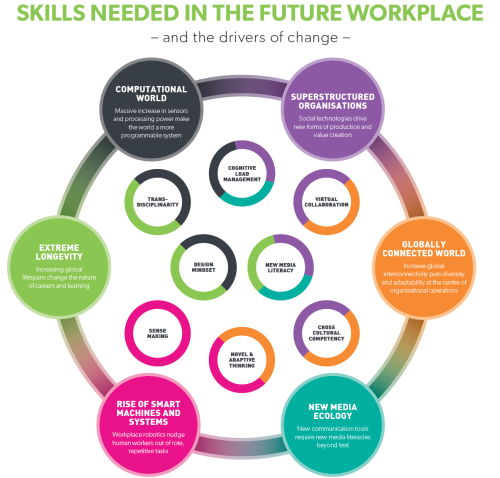
One key change will be the need for organizations to adopt a “life-long growth” mentality about skills and talent vs. traditional qualification based, fixed ability concepts. The B Team describes this as a shift from a push model of learning to a pull model of learning. Where traditionally organizations have employees engage in training and development programs where skills development is “pushed,” today’s generation source skills and knowledge as needed by leveraging technology (search engines and MOOC’s – massive online open courses). For the younger workforce traditional methods of training and development will quickly seem antiquated/unnatural and future training will move towards a continuous process versus planned or remedial courses. The B Team cites Charles Jennings’s book The 70:20:10 Frame Work Explained as an example of this approach, which considers that 70 percent of learning comes from doing tasks on the job, 20 percent from other people’s feedback and peer-to-peer learning, and 10 percent from formal training.
Skills NeededAs training and development shifts to a more continuous process, it’s likely that employees will also desire more continuous feedback, talking performance at an annual review will no longer cut it. The B Team also anticipates that the sharing economy in tandem with increasingly people-centric organizations will see mentoring as a major part of skills development in the future. Mentoring is a significant way to empower employees, and in the multi-generational workforce it won’t be traditional one-way mentoring. Young employees will mentor older colleagues (as much as the other way around), mentors may not even belong to the same organizations, and as CSR continues to increase in importance, the mentorship of students at schools and colleges by organizations will also increase.

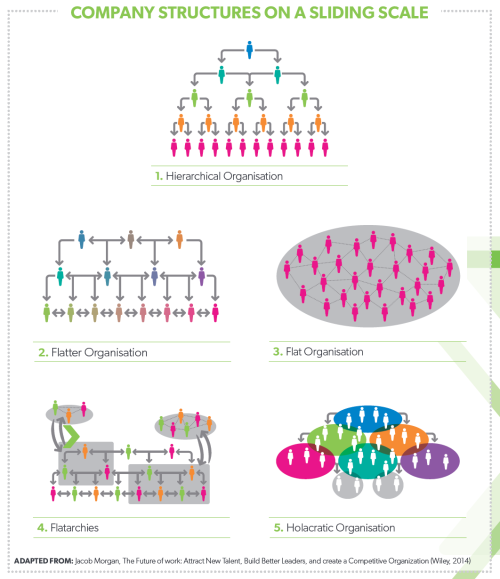
“Tearing Up the Org Chart” is another interesting key change that The B Team’s report looks into. In the past, organizations have assumed a one-size-fits-all, top-down structure to be the most efficient but this is already changing, with the evolving workforce exposing new methods of information sharing and collaboration. While The B Team’s report cautions that we’re still not at a point where traditional hierarchical organizations no longer exist, forward-thinking companies are already changing shape and flattening out, allowing better channels for innovation, decision making, and making sure everyone’s voice is heard. For most organizations “Flattening” won’t mean removing all structure, but certainly giving employees more ways and power to communicate and make decisions across the company. The report offers a radical example of flattening – building a Holacracy, a model being implemented now by Tony Hseih at Zappos.

This is defined as a distributed authority system that uses a set of rules to knit the empowerment of individual employees into the core of an organization. Teams organize themselves by using regular task and governance meetings to identify backlogs and conflicts and employees find which projects need their support based on their agreed job role, not by their job title or by being assigned projects.
Company Structure on a Sliding ScaleA final key change that I’ll mention from the report is “Minding the Gap,” an important point that may be considerably less discussed than others among the ways technology is re-shaping work. The workforce of the future envisions a huge demand for high-skilled tech talent, and not everyone can fill this role. This presents a troubling opportunity for the disparity between “good” and “bad” jobs to grow rapidly and leave little middle ground. It will be essential for organizations to innovate to make sure this chasm doesn’t widen. Ideas must work to not just make “good jobs” great, but to reframe roles around people versus accepting the trade-off between low prices and good jobs. The B Tem sums it up well: “As businesses get ever-more Purpose-driven, making sure the benefits and innovations they offer filter down to all levels of the workforce will become essential.”

Make sure to check out Team B’s full report to learn about more key changes in the ways of people and work and organizations.

Leave a comment

Filed under China Gorman, Data Point Tuesday, Professional Development, The B Team, The People Innovation Network, Virgin Unite

The Global Workplace of 2030

Data Point Tuesday

CBRE and Genesis recently released a report “Fast Forward 2030: The Future of Work and the Workplace,” which provides meaningful insight on the behaviors, ideas, and trends, that will shape work and the workplace in 2030. Their report analyzes responses from 220 experts, business leaders and young people from Asia Pacific, Europe and North America who shared their views on how the current workplace is evolving. That report’s focus was to look towards the future and identify trends that will change the way we work over the next 15 years globally, with a key focus on China and Asia. CBRE and Genesis aimed to capture the thoughts and aspirations of this next generation by holding focus groups, instead of traditional surveys or interviews, in 11 cities worldwide, where “more than 150 corporate youth between the ages of 23-29 gave their frank opinions about current work practices, and in particular, what is and isn’t working for them and more importantly how they would like this to change in the future.”

What will work look like in 2030? Through questions considering the nature of society and corporations, CBRE and Genesis ask respondents to identify what the big game changers will be for shaping the workplace between now and 2030. Major game changing trends and ideas included:

  • The Holistic Worker
  • Lean, Agile, and Authentic Corporations
  • The Sharing Economy

“The Holistic Worker” was an idea echoed many times throughout respondents’ answers. This is a trend that we’re already seeing today, probably most prominently in the increasing attention to social responsibility among organizations. CBRE and Genesis report that “The Holistic Worker” will continue to be a significant influencer of change in the workplace. Their research shows an increasing belief that work should be “joyous and more full-filling,” and that within work there should be many opportunities to make meaningful contributions to the organization as well as society. Essentially, the data show that lines between work and life are blurring. People are more and more often expecting the freedom to choose how, where, and when they work, and these attitudinal shifts are slowly, but surely, creating a major change in workplaces and societies.

In CBRE and Genesis’s report, 78% of youth indicated that happiness was as important as financial success. 70% of Korean parents felt happiness for their children was more important than educational and financial success and in Japan, young employees in the focus group echoed the same sentiments, talking about a way of work totally different than the traditional ways of their parents. They spoke to workplace flexibility, going home to spend time with family, and working at many organizations over their career. Thai participants in youth focus groups said they would be willing to be paid 20% less if they could work in vibrant environments with the freedom and choice about how and where they get work done. Workplace flexibility and the desire for CSR are global trends, and certainly not limited to western culture. With the desire for work to having meaning and purpose, quick impact will be key. CBRE and Genesis anticipate that in 2030: “most work will be broken down into small, discreet, comprehensible components. Each component will have a clear purpose and teams delivering will have significant autonomy and control, responding to the many of the desires of the holistic worker.”

Another game changer for 2030, will be the need for organizations to be lean, agile and authentic – specifically, authentic. If organizations cannot be true to their values and contribute to society beyond the bottom line, their main source of talent, the holistic worker (and by virtue, also holistic consumers) will be extremely limited. CBRE and Genesis predict that technology and “artificial intelligence” will be huge game changers for organizations that can leverage them correctly. Organizations with 20-40 people can be just an impactful as large corporations, and by leveraging technology while being “unhindered by legacy processes and mindsets,” they will easily disrupt existing corporate models. The growth of technology, while being extremely beneficial for workplaces, is also a worrisome concept. CBRE and Genesis’s report points out it’s predicted that 50% of the occupations in corporations today will not exist in 2030, and points to evidence that in the U.S technology is already destroying more jobs than it is creating:GDP vs. Employment Growth
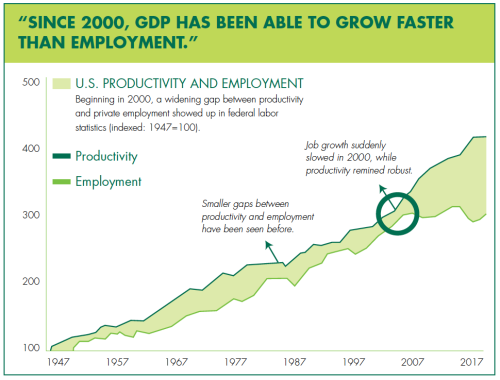
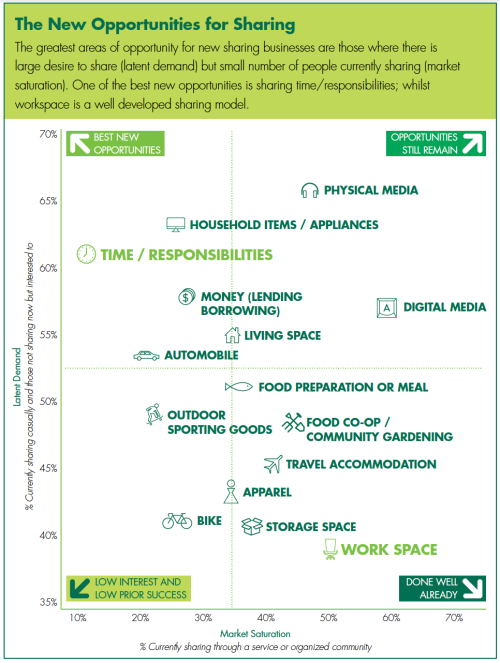
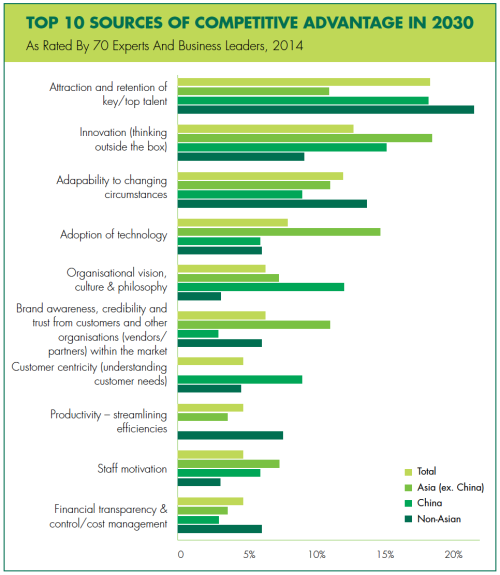
“The Sharing Economy” was another major underlying theme in CBRE and Genesis’s research. They define this as a socio-economic system built around the sharing of human and physical resources, whose emergence reflects changing attitudes in societies about ownership and collaborative consumption, fuelled by technology and apps that allow people to rapidly match supply and demand – person to person. Expert respondents in Beijing reported that the sharing economy would have significant impact to the future of work and the workplace in 2030, and used a research study by consultancy Latitude in the US71 as a framework for discussing how the sharing economy might impact real estate: Jan 27 2015 New Opps for SharingCBRE and Genesis also asked respondents about competitive advantage in 2030, and although answers covered a wide range, 10 top sources emerged, with attraction and retention of key/top talent as the number one source of competitive advantage followed by innovation. Jan 27 2015 Top 10 Sources of Competitive Advantage
When talking about innovation, respondents reported that for the future of the workplace “there will be constant innovation and support of entrepreneurial behaviors: micro-innovation within the organization”.

In several past posts I’ve discussed how the workplace is going increasingly global, yet to date most of the research in the area of work and the workplace remains from a western perspective. CBRE and Genesis’s report specifically widens the research to include not only western perspective but also those of developed and developing Asian nations, providing new and unique perspectives on a geographic level. Such perspectives can provide surprising results, such as the determination and excitement of young employees in Shanghai, Beijing and Tokyo to rethink the experience of work and push their superiors to change, vs. more conservative opinions than expected in New York and London. Youth Appetite for Change
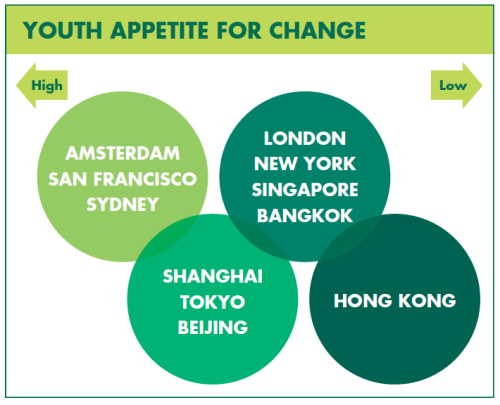
The bottom line? The youngest cohort of our employees – worldwide – are describing their preferences for work and the “office” of the not so very distant future as radically different than most work environments today. Those organizations desirous of developing their cultures to attract and retain today’s Millennials might take these findings into account. We Baby Boomers won’t be around forever. And that’s probably a good thing.

Be sure to check out CBRE and Genesis’ full report here.

1 Comment

Filed under CBRE, China Gorman, Corporate Social Responsibility, Data Point Tuesday, Genesis, Millenials, Work Life Balance, Workplace Studies