Category Archives: HR

Data Point #1: Unemployment Rate vs. Layoff Data

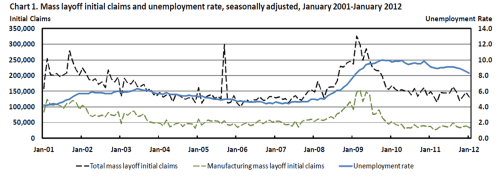
The U.S. Bureau of Labor Statistics published a mixed bag of news week before last.  While the unemployment rate fell from 8.5% in December to 8.3% in January, the number of mass layoff events in January grew by 50 over the previous month.  (A mass layoff event  involves at least 50 workers from a single employer.)  The total number of employees involved in these events, however, was reduced month-over-month by 15,728.  So while more employers were downsizing in January, fewer employees were impacted.  Good news, right?  Maybe…

Looking at the trend lines in the chart below, HR professionals may scratch their heads and wonder what is different in January 2012 from April 2008?  The number of initial claims are similar:  128,643 in April 2008 vs 129,920 in January 20102.  But the unemployment rate is significanttly dissimilar:  5% unemployment in April 2008 vs. 8.3% unemployment in January 2012.  What’s going on?

Clearly, the lagging effects of the economic downturn which began to gather steam in the 3rd and 4th quarters of 2008 are still being felt.  The resulting embedded base of unemployed workers continues to weigh heavily on the U.S. economy and the unemployment rate despite the falling numbers of layoff events and impacted workers.

So how is this data useful for HR professionals?  Simple.  Putting the long-time unemployed back to work has to be job #1 in our organizations and our communities.  As your organization plans to grow its employee base — whether with contract, temporary or full-time employees — what are your plans to target the long-term unemployed for inclusion in the talent pipeline?

3 Comments

Filed under Bureau of Labor Statistics, China Gorman, Data Point Tuesday, Employment Data, HR, Talent pipeline, U.S. Department of Labor, Uncategorized

Memo to HR: Raise Your Hands!

Several times this year I’ve given the wrap-up keynote speech at HR conferences.  This particular speech is titled, “HR Wake Up Call.”  The message is simple:  HR professionals have far more business savvy and leadership opportunities than they are given credit for.

One of the ways I prove this is to quiz the audience on a range of business related topics, testing their savvy and knowledge.  Nearly every question I ask gets an almost unanimous positive answer.  The questions cover topics like the current unemployment rate, the current U.S. GDP and the topics of current business books.

When I ask how many in the audience have ever been responsible for a sales quota, 70-80% of the audience raises their hands.  And when I ask how many have managed a P&L, between 80 and 95% of every audience raises their hands.

After the quiz is over and we discuss the answers in detail I ask how many of their executive teams know that they’ve been responsible for a sales quota or managed a P&L.  Astonishingly most do not.

I find that remarkable.  No.  Actually, I find it disturbing.  HR professionals routinely lament their lack of standing in the strategic workings of business, and yet when they’ve got the golden ticket they ignore it.

So here’s the deal:  if you want to be an HR professional who focuses solely on the tactical and compliance parts of HR, then don’t let on that you’re a business person.  Not letting your C-suite know that you’ve managed a business will ensure that you stay off their radar and can focus on the day-to-day stuff.

If, however, your organization can benefit from your business insight and experience, and you want to operate at a strategic level – not just the tactical level – MAKE SURE YOUR FULL BACKGROUND AND EXPERIENCE ARE KNOWN!

That is all.

4 Comments

Filed under Business Language, Business Success, HR, Leadership, Uncategorized

HR and Furniture

Normally, I agree with everything Laurie Ruettimann says.  Not because I’m a robot, but because she’s right 99% of the time.  .9% of the time we just see things through different lenses.

And .1% of the time we just disagree.

And this falls in that .1%.

I think that when you’re in HR you have to speak the language of business.  I think speaking HR in business is the kiss of death – or irrelevance, which is really the same thing.

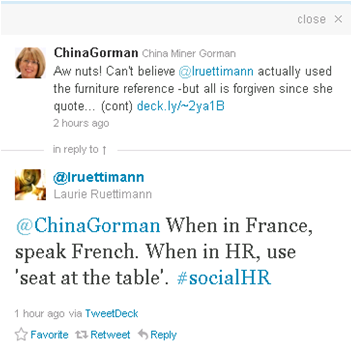
It’s not about furniture, it’s about influence.  And when you’re influential you speak the language of those you influence.

Business people are everywhere in organizations.  They’re in Finance (where they speak finance and business).  They’re in Marketing (where they speak marketing and business).  They’re in Operations (where they speak operations and business).  They’re in R&D (where they speak r&d and business).  They’re in Sales (where they speak sales and business).  They’re in IT (where they speak technology and business).

Business people are most definitely at the top of the organization where the only language spoken is business.  So if you want to influence the people at the top of the organization – all those people whose job titles start with a great big “C” — you have to speak to them in their language, not yours.

This quote from Frank Romer says it all:

People will sit up and take notice of you if you will sit up and take notice of what makes them sit up and take notice.

The bottom line is that language is important.  Using language your target audience doesn’t understand ensures that you won’t be understood.  It also ensures that you will have no influence.  None.  Zero.

So if HR is to be influential and interact with a certain type of furniture it has to be fluent in the language of business.

Actually, I’m pretty sure Laurie Ruettimann will agree with me.

18 Comments

Filed under Business Language, Business Success, HR, Leadership

If I could change one thing about HR…

My friend Michael Carty and his colleagues at Xpert HR in the U.K. (whom I have never met!) invited me to contribute to their blog series: If I could change one thing about HR…

Please visit my guest post there at http://www.xperthr.co.uk/blogs/employment-intelligence/2010/12/china-gorman-if-i-could-change.html


1 Comment

Filed under Business Success, China Gorman, HR, Leadership, Uncategorized, Xpert HR

Urgency vs. the status quo

I’m noticing that something powerful is going on within the HR space.   It’s organic.  It’s energetic.  It feels urgent.  It’s about getting HR people more intimately connected with each other.  It’s about gaining confidence and strength through closer relationships.  And it might be turning the conference world on its ear.

HR conferences organized by groups likes SHRM (including SHRM global and its 52 state councils), ASTD, WorldatWork, ERE, LRP and others have done a very strong job of creating traditional conference experiences that provide content, continuing education credits, vendor showcases and limited networking experiences. 

But well-executed as they are, well-attended as many of them are, and well-marketed as they are, they don’t provide something that seems to be getting more and more valuable to a certain subset of HR leaders:  the opportunity to have intimate discussions with thought leaders.  And there’s a growing sense of immediacey about what’s missing.  So what’s my evidence?

Well, first there is HRevolution.  An early entrant in the HR “un-conference” space, two HRevolutions have been held and the third is in the planning stages.  Organized by Trish McFarlane, Ben Eubanks, Steve Boese and others, this grass roots gathering gets HR folks together to wrestle with each other on topics relating to the relevance of HR.  Facilitators lead discussions rather than speakers giving presentations.  It’s been given high marks for engaging its attendees, but questions of “what’s next?” persist.


The “Tru” un-conferences in Europe appear to be similar to HRevolution in that they have sprung from concerned and committed individuals in the HR space rather than from organizations in the HR space.  I’ll know more after attending the TruLondon conference in February.

RecruitFest! organized by RecruitingBlogs.com also joined the “un-conference” space, but mixed it up in 2010 with a different approach.  Instead of discussion groups, thought-leaders held conversations for the viewing audience (75 in studio; almost 4,000 through the live stream) to listen and watch.  It got the thought leader discussion piece right with some engagement of attendees and it also got high marks.  But again, “what do I do now?” questions followed.

The HRevolution, TruEvents and RecruitFest! unconferences are broad in their reach.  They engage interested professionals from all over the world to attend either in person or virtually. 

Now here’s a new twist:  the HR Reinvention Experiment held last Thursday for senior HR leaders in the state of Nebraska.  Jason Lauritsen, a senior HR executive in Lincoln asked himself “what’s next?” after attending the last HRevolution.  He assembled a small group of like minded business leaders in the HR space in Omaha and Lincoln and they gathered nearly 70 senior leaders from across Nebraska to talk with each other and begin to address challenges in Nebraska that need HR’s leadership.  And with the support of several local sponsor organizations, the HR Reinvention Experiment began to take shape.

A combination of traditional and un-conference organizing approaches, the HR Reinvention Experiment included tailored keynote presentations (me and Jason Seiden), small group discussions led by true thought leaders (Paul Hebert, Joe Gerstandt, William Tincup and Roger Fransecky) and a couple of traditional “concurrent session” topics (Chris Bryant and Greg Harris).  Limited to 75 attendees from a specific geographic area, HRRE was a day full of challenging content, discussion and engagement, all with a local focus.   

To further underscore its difference from traditional conference approaches, HRRE was held in the open spaces of the Hot Shops Art Center, an art center (and former mattress factory) consisting of working art studios, showrooms and gallery spaces.  Attendees, surrounded by the creative process, carried their folding chairs from space to space throughout the day so that gathering spots magically opened up in places like pottery and glass blowing studios as well as galleries.

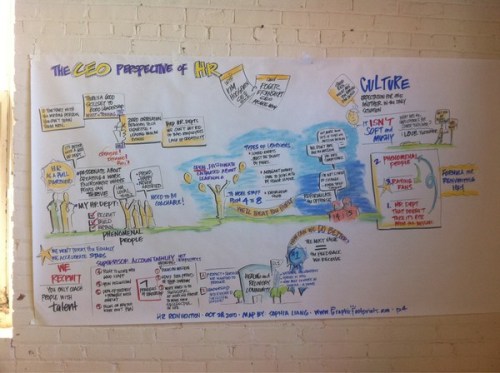
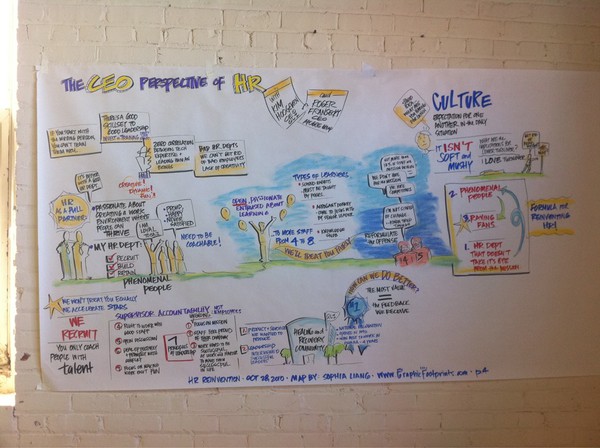
Instead of PowerPoints and handouts, the HRRE organizing team hired the graphic genius of Sophia Liang (Graphic Footprints) to make a graphic recording of the keynote sessions, as well as several of the discussion sessions.  This is the recording of the lunch keynote, “The CEO Perspective of HR,” a discussion between two CEOs: Roger Fransecky and Kim HoogeveenThe additional recordings will be shared on the HRRE website soon.

It was a full day to say the least.  I participated as the opening keynoter giving the attendees an “HR Wake-Up Call” as well as attending as a participant for the full day’s activities.  The experience was challenging, fun, engaging and thought-provoking.  It brought together many of Nebraska’s HR leaders for a day of thoughtful and personal engagement and pushed them to ask new questions and assume different outcomes.

But while the “what’s next?” question persists, I have a feeling that there will indeed be a “next” in Nebraska.  These business leaders seem ready to take action.  HRRE felt like a catalyst that will start to move the discussions into action.  Time will tell, of course, but the framework exists to launch a new kind of self-driven professional community. 

Professional organizations catering to HR leaders should be taking note of the grass roots efforts to connect in new and more impactful ways.  Whether it’s learning and conferences or advocacy and membership, there are unmet needs that are becoming urgent in the HR world.  The frequency and level of innovation happening in this space suggests that the current infrastructure is becoming less relevant to a portion of the population.  And this portion of the HR population has the commitment, skills and intellectual curiosity to do something about it.  We should all stay tuned….

6 Comments

Filed under China Gorman, Conferences, HR, HR Conferences, Leadership, Uncategorized

How to open an HR conference!

 I’m that voice that’s been saying “Really? Movie stars as keynoters at HR conferences?  Really?  How’s this going to help me be a more strategic business leader?” 

 While I was at SHRM I was successful in influencing the team to select more keynoters who had real connections to business and HR success.  Business thought leaders like Jack Welch, Anne Mulcahy, Ted Childs, John Kotter and Steve Forbes.  I’ve never understood the fascination with movie and tv stars as keynoters at HR conferences – other than everyone loves movie and tv stars.  I’ve held the position that HR conferences should bring relevant business content from real thought leaders to the attendees.  So when I saw that HR Southwest’s opening keynote was a two person comedy/juggling act, I thought, “Oh brother.  Here we go…”

 But here’s the thing:  they were fabulous!  Let me paint the picture.  We’re in Fort Worth.  It was 8:15 on Monday morning.  It was Columbus Day — a holiday in many workplaces.  Both the Rangers and the Cowboys had played at home the day before – and lost.  And it’s a commuter conference (a large majority of the 2,000+ attendees drive to the conference each day from home).  So to describe the energy in the room as the session opened as lethargic would be understating the case. 

And then The Passing Zone arrived.  Amazing jugglers, smart comedians, these two guys kept the witty patter going through 75 minutes of their act while continuously linking their actions to the HR world.  Trust, cooperation, communication, juggling priorities:  these were cleverly woven into their act in a refreshing, funny and entertaining way.  We were laughing, we were clapping, we were gasping, we were cheering.  The energy was thumping, the good humor was flowing and the conference was off to the races.  Brilliant!

 So I stand corrected.  When planning conference keynoters understand the likely mindset of the audience you are supporting.  And if it’s first thing Monday morning, wake ’em up!  The planners at HR Southwest did just that and came up with a real winner.  Well done!

3 Comments

Filed under HR, HR Conferences, Uncategorized

HR Southwest: the Real Deal


Here’s what I love about HR conferences:  the attendees.  I’m a big fan of HR professionals.  I think they’re smart.  I think they know their business.  I think they contribute daily to the success of their organizations.  I think they grab on to learning wherever they can find it.  And I think that today, like no other time before, they are caught between the proverbial rock of a fragile and unpredictable economy and the combined hard places of the current legislative/regulatory agenda, continued globalization and the need, as always, to do more with less.

 So as I attend the SHRM-affiliated HR Southwest Conference in Fort Worth, Texas today through Wednesday, I am again impressed with the way these 2,000+ dedicated HR pros are approaching this ultimate learning experience.  And make no mistake:  HR Southwest is an ultimate learning experience.  The concurrent session line-up is among the best I’ve ever seen.  The keynoters are very strong.  The exhibition hall is incredible.  And the attendees themselves are focused on making the most of the three days before them. 

 I respect the hell out of these folks.  I see a determination in their eyes as they check the conference program to chart their course through the conference.  They’re engaging with the vendors in the exhibition hall and not just collecting swag.  They’re improving their ability to serve their organizations and their communities.  They’re working on expanding both their functional expertise and their strategic leadership abilities.  What they learn here will absolutely make their organizations more competitive. 

 So, kudos to the conference team that produces HR Southwest.  It’s smart; it’s professional; it’s the real deal.  Now.  Don’t you wish you were here?

Leave a comment

Filed under Conferences, HR, HR Conferences, Uncategorized

A Tale of Two Conferences

How lucky can a gal get?  I’m speaking at RecruitFest! on Thursday (October 7) in Boston and attending HR Southwest in Fort Worth the following week (October 10-13).  Two great conferences, two great organizations, two great cities  – all focused on providing up to the minute content for the development of HR professionals.  That’s  5 conference days in 7.  Whew!

First up, RecruitFest! put on my the good folks at Recruiter.com (formerly RecruitingBlogs.com) and Monster.  And they’re cooking up something really new and special.  Here’s the deal:  they’ve collected a group of thought leaders in the Recruiting space to engage in important discussions for the benefit of the attendees.  Stars like

 And here’s the really interesting part:  there will be audience participation – questions from the live audience, questions from those watching the live stream, and questions from those listening in and participating in the Twitter back channel.  Pretty exciting stuff!  If you haven’t signed up, click here to attend in person or virtually.

Next up is HR Southwest, the largest SHRM state conference.  The organizing team is expecting nearly 2,000 live participants at the Fort Worth Convention Center!  That’s big!  That also makes HR Southwest second only to the SHRM Annual Conference in the world of SHRM conferences. 

 I remember in the early ‘90s, when I lived in Dallas and managed the southwest region of a global HR consulting firm, the cornerstone of our marketing plan every year was supporting HR Southwest.  I still have pictures (somewhere) of our booth and the team that staffed it.  We connected with our customers and showed our support for our friends in the HR profession by supporting this important event.  I wouldn’t have dropped this important event from our budget – ever!

 The keynote speakers this year look outstanding:  Ambassador Nancy G. Brinker, founder of Susan G. Komen for the Cure®; Chad Hymas, world-class wheelchair athlete; and Jon Wee and Owen Morse, otherwise known as The Passing Zone.  With more than 110 concurrent sessions and the ability to earn as many as 20.75 recertification credits from the HR Certification Institute, this conference is going to set a new standard for HR conferences.

 I’ll be tweeting at HR Southwest, so be sure to follow the #HRSWC10 hashtag and to follow me on Twitter at http://twitter.com/ChinaGorman.  See you at the conferences!

1 Comment

Filed under China Gorman, HR, HR Conferences, Social Media, Uncategorized

What’s an unconference like, anyway?


I’m really getting jazzed about RecruitFest! in Boston on October 7th and 8th.  RecruitingBlogs.com has put together a track leader line-up that looks outstanding, Monster is the big sponsor, and it’s Beantown!  How much better could it possibly get?

I have a sense of what an unconference is like and I’m eager to experience it for the first time.  I’m expecting lots of smart recruiting and talent management professionals to roll up their sleeves and dig in to some really important topics with energy and passion.  The power of focused, collective experience to generate new ideas can be awesome.  Hope we get some of that going.

 Here’s what I hope we don’t do:  have the same endless and pointless discussions about whether HR is ever going to get a seat at the table (man, I hate that phrase), or whether recruiting should be part of HR. 

 I hope we focus more positively…more hopefully…more meaningfully on what we actually can do differently to impact the performance of our organizations.  I hope we focus on what is in our power to control:  our intentions, our behavior, our risk taking.  Because if all we’re going to do is lament our lack of power and our inability to catch the eye or ear of the CEO we’ll have wasted precious time and energy. 

 I’m interested in having conversations that change behavior, that improve performance and that make us (whoever we are) more powerful.  That will be a great investment of time and energy.  That will be a great unconference. 

 Are you with me?  If so, then you should click here and register right this minute!  Because if you register before the end of the week, you’ll get a discount (use the code “chinagorman”) and you also might win the Monster VIP hotel package!  What a deal. 

I hope you’ll join us, roll up your sleeves and contribute to two days that really could change HR.  Who wouldn’t want to do that?

4 Comments

Filed under Business Success, China Gorman, Culture, Engagement, HR, HR Conferences, Uncategorized

Talent Development and U.S. Energy Policy

It’s pretty clear that the U.S. is overly dependent on foreign oil.  We don’t have adequate domestic exploration and production capability and so we buy our oil from other nations – many of them hostile to our way of life.  Sure, it’s business; but the fact remains that many of the governments from whom we buy oil aren’t our close allies.  This has implications on so many fronts:  on the availability of oil (think Hugo Chavez); on the price of oil (think OPEC); and on the costs of finding new oil (think BP and the Gulf of Mexico).  But ultimately, it’s a failure of energy policy.  By not having a vision of internal sustainability and not investing in new domestic sources of energy and experimental technologies, we’re dependent on the kindness of some not-so-nice strangers.  These may, and some would say already have, ultimately threaten our national security.

It occurred to me the other day that many of our organizations are proceeding down the same path as it relates to talent management policy.  If we think of the skills and talents of our employees as our organization’s energy, then how many of us are investing in new domestic sources of skills and talent?  Rather, aren’t many of our organizations overly dependent on foreign sources?  On hostile sources?  This may not be national security, but it certainly is business survival.

By not investing in the internal talent pipeline to increase engagement and reduce the dependency on foreign (outside) hires, aren’t we going down the same path?  Many of our organizations will soon find themselves held hostage by the confluence of the following forces:

  • Rapidly declining U.S. worker productivity (U. S. Department of Labor Q2, 2010)
  • The rising level of job dissatisfaction in the U.S.  For the first time more of our workers are dissatisfied than satisfied. (Conference Board, 2010)
  • Surveys showing that between 40-95% of U.S. workers are or will be looking for a new job before the end of the year. (Spherion 2010 Labor Day Workforce Survey, Regus)
  • The continued projected decline of educational levels together with the exit of large numbers of baby boomers from the economy will put US organizations at a competitive disadvantage. (SHRM research, 2010)
  • Baby Boomers are ready to negotiate a different kind of employment “deal” because they need to work longer than anticipated. (McKinsey Quarterly)
  • The cost of buying talent on the open market is rising.

Seal of the U.S. Department of Energy

It looks to me like we’re doing the same thing with talent that the U.S. has done with oil:  we haven’t invested in the future by exploring new domestic technologies; our practice of buying what we need from outside sources has made us vulnerable to our “competitors”; and the internal sources we do have seem less productive and desirable. 

Whoah.  Bottom line?  I hope HR is able to get out in front of the talent pipeline by creating a compelling vision for the long-term benefits of investing in the development of our current energy supply.  Unless that happens quickly, many of our organizations will find themselves cut off from the lifeline of their business sustainability:  the skills and talent they need when they need them, where they need them.

6 Comments

Filed under China Gorman, HR, Leadership, Talent development, Uncategorized