Tag Archives: Data Point Tuesday

Why Do We Ignore the Tip of the Spear?

data-point-tuesday_500

I’ve written here before that middle managers are the tip of the spear, organizationally speaking, for everything. Productivity? Check. Change management? Check. Communication? Check. Culture? Check. Engagement? Check. Talent development? Check. Retention/turnover? Check. Everything.

I ran across a good little white paper from Grovo, a workplace learning company, that underscores this point, yet again. Good Manager, Bad Manager:  New research on the modern management deficit and how to train your way out of it, is a quick read and reminds us yet again that training middle management might be the most critical item on your training and development agenda.

“Management isn’t like riding a bike, where you learn it once and you’re set for life.”

This opening statement frames the discussion in this paper which reports that 99% of companies do offer some sort of management training and 93% of middle managers frequently attend it. These statistics notwithstanding, Grove has found that this training is deficient in three key ways:

  • Not comprehensive: 98% of middle managers believe that the managers in the organization need more training
  • Not timely: 87% of middle managers wish they had received more training when they first became a manager
  • Not habitual: 61% of managers report that training is offered only a few times each year and 11% report training being offered only once a year.

Grove has survey data that suggests that 98% of managers believe that key performance metrics would improve if managers were trained to be effective more quickly:
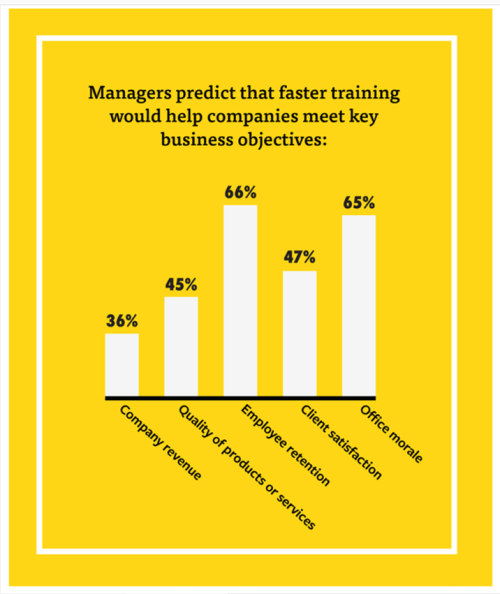
grovo-1

With $15 billion spent by U.S. organizations every year on leadership development, it seems we could really ramp up the ROI on that investment by getting to new leaders faster, with more frequent and engaging training. Looking at it another, way, Michelle McQuaid predicts that better, more capable middle managers can save organizations $360 billion annually in productivity increases.

This report is full of gold as you plan your 2017 training/development activities and budget. I’d encourage you to take a look. Maybe you can capture some of the $360 billion in productivity increases in your organization while you sharpen the tip of your spear.

Leave a comment

Filed under China Gorman, Data Point Tuesday, Employee Development Program, Grovo, Learning/Development, Managerial Effectiveness, Performance, Productivity, Training

Next Up On The Workforce Landscape: Independence Pass

data-point-tuesday_500

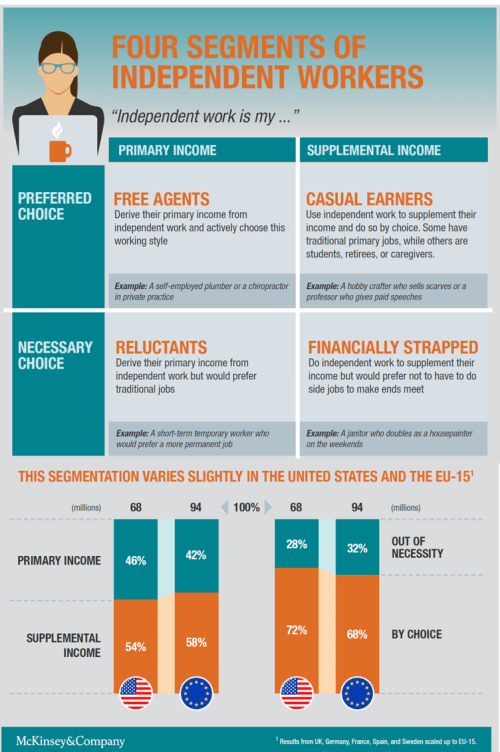
Independent Work:  Choice, Necessity, and the Gig Economy, published this week by the McKinsey Global Institute, is fascinating reading. If you’re in HR, Talent Acquisition or are a leader of people, you’ve probably been paying attention to the coverage of the “Gig Economy” or the “Contingent Workforce.” Mary Meeker wrote about it in this year’s Global Internet Trends report, and I wrote about it here. But this white paper really delves into the phenomenon of independent work and it’s hard to look away. The report is 148 pages of fun and the Executive Summary is a mere 24 pages. They both pack a punch with data and graphs galore. Let’s just focus on the Executive Summary. If you like that, you can dig even deeper into the full report.

The premise of looking at the why of independent working arrangements is quite compelling. We all know that there are people driving for Uber or Lyft because they can’t connect back to the world of full-time employment following the Great Recession. McKinsey calls them “Reluctants.” We also know there are lots of people driving for those organizations because they want to pick up some extra cash; they are the “Casual Earners.” The “Financially Strapped” are those who would never choose this arrangement but for their financial situation. But we’re also probably aware that there are more and more people in the economy who are choosing to be “Free Agents,” who are intentionally leaving traditional employment models behind and reveling in their freedom.

There are a number of insights here that are worth noting:

  • Independent work has three defining features: autonomy; payment by task, assignment, or sales; and a short term financial relationship.
  • 20-30% of working adults in the U.S. and the EU-15 are independent workers of one kind of another. That’s up to 162 million workers! (54-68 million of them in the U.S.)
  • Free Agents (independent by choice as a primary source of revenue) report greater satisfaction with their work lives than those in traditional jobs.
  • Currently only 15% of independent workers use digital platforms like Uber, Airbnb and Etsy – although their use is growing rapidly.
  • 1 in 6 workers in traditional jobs would like to become primary independent workers. (That’s your 1 in 6.)
  • Independent workers who sell goods (Etsy) or lease assets (Airbnb) are more likely to use digital platforms than those who provide labor services (TaskRabbit).

mgi-1-oct-2016

The Executive Summary ends with a discussion of the future:  the impact of a continued shift toward independent work and noting that benefits, income security protection, and other worker protections need to be addressed. The stakeholders of these issues are not currently known to work well with each other, however policy makers, economic intermediaries and innovators, organizations and the workers themselves clearly need to work through critical dynamics to prepare consumers, employers, governments and workers to create a more workable framework for independent work success.

As you wonder which of the 16% of your workers is planning to step into the gig economy full-time and by choice, you may want to start addressing some cultural relics that are accelerating their choice to work independently. This report has some great data and insights to help you think it through.

Leave a comment

Filed under China Gorman, Contingent Workforce, Data Point Tuesday, Gig Economy, Independent Workers, McKinsey Global Institute

It’s Tough Being a Recruiter

data point tuesday_500

The new JobVite 2016 Recruiter Nation survey analysis is in. (I wrote about last year’s survey here.) And, as usual, it’s interesting. The JobVite folks surveyed 1,600 recruiters – customers and non-customers — from the U.S. This is the ninth such annual survey of recruiting professionals and most of the answers and analysis are what you would expect. Competition is fierce; there’s a talent shortage; culture fit is becoming more important for employers; hiring is increasing.

But there were a few surprises:

  • 86% of recruiters don’t believe their companies will make layoffs within the next 12 months
  • Only 10% of recruiters think their companies will replace jobs with “robots” in the next 2-3 years
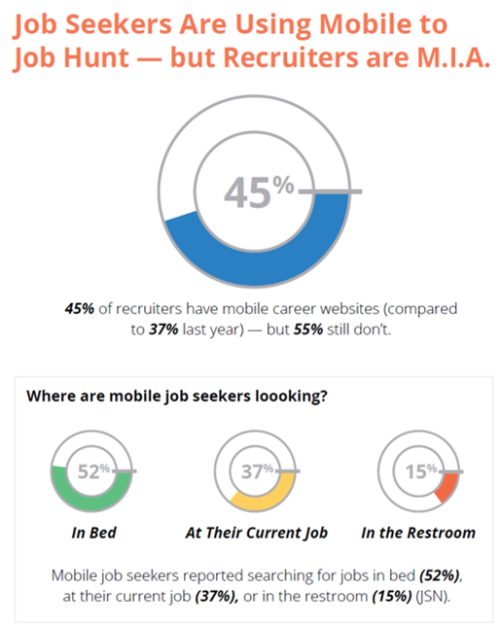
  • Only 42% of recruiters said their company’s career site supports mobile
  • Just 43% of recruiters leverage Facebook in the recruiting process

It’s interesting that recruiters think that layoffs aren’t coming at their companies – and neither are robots. I wonder if that’s wishful thinking? I wonder if recruiters are involved in those kinds of decisions.

It is surprising, however, that with all the readily available date about job seeker behavior that more companies aren’t investing in mobile apply. This chart shows clearly the rationale for that investment:

jobvite-1-2016

And while 67% of job seekers use Facebook to research companies and their cultures, only 47% of recruiters use Facebook to vet candidates during the hiring process. Missed opportunity? Probably.

jobvite-2-2016

These are just a couple of the gems in this year’s Recuiter Nation survey. Enjoy!

Leave a comment

Filed under China Gorman, Data Point Tuesday, JobVite, Recruiter Nation, Recruiting Trends

Business Depends on Learning

data point tuesday_500

Every year, the Deloitte Human Capital Trends report is a treasure trove of insight into organization behavior and opportunities for success. You can go back to it multiple times and get something new each time. This is true for the 2016 report as it was for previous reports.

I was re-reading the chapter on Learning:  Employees Take Charge, and was taken, again, with the evaluation of where organizations are today and where they will have to be in the short term in order to attract, retain and deploy the talent they need.

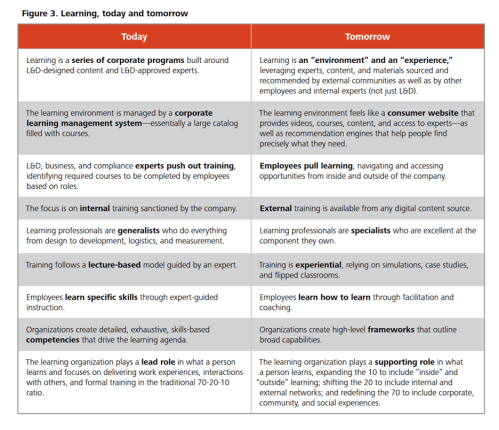
This chart says it all, and should be required reading – not just for HR, but all leaders who hope to hang on to their team long enough to develop them!

deloitte-learning-trends-2016

Deloitte believes that the C-suite really does understand that in order to execute their business plans they need to constantly upgrade skills and focus on quickly developing leaders. I wish I had their faith in the C-suite!

This chapter in the larger trends reports ends with recommended starting points for organizations:

  • Recognize that employee-learners are in the driver’s seat
  • Become comfortable with the shift from push to pull
  • Use design thinking
  • Use technology to drive employee-centric learning
  • Realign and reengage
  • Adopt a learning architecture that supports an expanded vision for development
  • Adopt a learning architecture that supports continuous learning

If you haven’t downloaded the full report yet, do it now. You don’t have to read the whole thing in one sitting. Take it in bite sized pieces. You’ll be glad you did.

1 Comment

Filed under C-suite, China Gorman, Data Point Tuesday, Deloitte, Employee Development Program, Global Human Capital, Learning/Development

Is Your Organization An ACE?

data point tuesday_500

I rarely do book reviews here at Data Point Tuesday. When I do, it’s because the book is written specifically for my readers, HR professionals in the trenches, and because I know and respect the author. Today I’d like to recommend just such a book.

fulfilled-schiemannFulfilled! Critical Choices:  Work, Home, Life, written by William A. Schiemann, will be available on October 1. Lucky me, I got an advance copy and loved it! If you’re active in SHRM, then you have probably heard Bill speak at the Annual conference or at one of many state conferences where he continuously supports the HR profession. I saw Bill two weeks ago at the KYSHRM conference where we both keynoted. He’s a Ph.D. researcher, writer and consultant bringing evidence-based research into practical and useful focus for organizations of all types and sizes.

Fulfilled! Is a guidebook as well as a workbook – it helps you organize and chart the steps to find meaning in your life and your work, as well as supporting your organization in creating a culture where every employee can find that meaning. It’s full of true individual examples of people achieving real meaning as well as examples of people who missed the waypoints along the way and never achieved true fulfillment.

From an organizational perspective the organizing concept is ACE: alignment, capability and engagement, which Bill calls “People Equity.” Bill’s consulting firm, Metrus Group, has found that organizations with high People Equity have:

  • Higher profits or reach their goals more effectively
  • More loyal customers who buy more
  • High employee retention
  • Higher quality output

“The organizations that achieve high People Equity (high alignment, capabilities, and engagement) have a distinct advantage over their competitors. And the individuals who apply this concept to their live also win…”

I really appreciated both the individual and organizational discussions about alignment, capabilities and engagement. They are simple and easily understood – and so impactful. This is one “How-To” book that ought to be on every HR leader’s bookshelf.

I don’t want to give away the good stuff – the book is available on Amazon on October 1 and you should get it. But here’s a final view at the final chapters of the book, Life Lessons:

Lesson 1:  Keep the end in mind

Lesson 2:  Nurture your body

Lesson 3:  Build a social network (but have at least one fantastic friend)

Lesson 4:  Always seek things you are passionate about

Lesson 5:  Take reasonable risks

Lesson 6:  Never stop learning – never!

Lesson 7:  Stick to your values and spirituality

Lesson 8:  Resilience – find the silver lining

Lesson 9:  Give and get

Lesson 10:  Check in with yourself regularly – force it!

You may think to yourself, I’ve read this book before. But I assure you, you haven’t. Bill brings to life real people who made good decisions as well as mistakes; who risked it all and who played it safe; who learned and who never learned. And the organizing principle of People Equity is truly a new view backed by years of research and real life practice.

And after you’ve read Fullfilled!, take it with you to your next HR conference. Chances are good that Bill will be keynoting and you can get him to autograph it for you!


Leave a comment

Filed under Balance, Business Success, China Gorman, Culture, Data Point Tuesday, Engagement, Happiness at Work, HR, HR Books, Human Resources, Performance, Productivity

Davos and HR Data

data point tuesday_500

You’ve heard of “Davos,” the annual meeting of the global movers and shakers of business, held in Davos, Switzerland. But you might not be aware that the convener of that event, The World Economic Forum, is committed to “improving the state of the world and is the International Organization for Public-Private Cooperation.” “Davos” gets lots of press, but the ongoing work of the organization provides a trove of data, analysis and information for any leader, in any organization, anywhere in the world.

I recently downloaded a January, 2016 report, The Future of Jobs:  Employment, Skills and Workforce Strategy for the Fourth Industrial Revolution, and had a great time wandering through the massive (167 pages) report. Don’t let the length deter you from downloading and skimming the content. There’s something there for everyone who is thinking about and strategizing the future of their workforce.

The analysis in the report is from a survey of CHROs, other CXOs as well as functional HR leaders representing 13 million employees in 15 developed and emerging economies. A total of 371 companies from 9 broad industry groupings are represented in the data.

The report is organized into two parts:

Part One:  Preparing for the Workforce of the Fourth Industrial Revolution

  • The Future of Jobs and Skills
    • Drivers of change
    • Employment trends
    • Skills stability
    • Future workforce strategy
  • The Industry Gender Gap
    • The business case for change
    • Gaps in the female talent pipeline
    • Barriers to change
    • Women and work in the fourth industrial revolution
    • Approaches to leveraging female talent

Part Two:  Industry, Regional and Gender Gap Profiles

  • Industry profiles
  • Country and regional profiles
  • Industry gender gap profiles

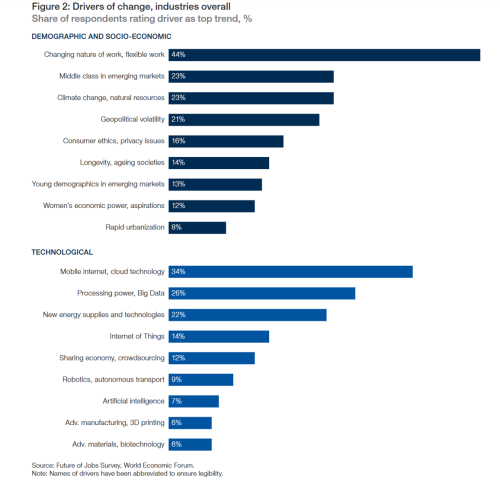
The Drivers of Change section is a primer on what employers are facing from a demographic and socio-economic perspective, as well as from a technological perspective. I talk to HR leaders all the time who have a hard time balancing strategic responses to these two drivers of change. This chart shows the global top drivers in each of these two buckets and how they rank with the survey respondents.

WEF Fig 2

This is just one of a number of useful analyses in the the report.

And an analysis such as this wouldn’t be complete without recommendations for action. The short term focus areas for action are not surprising:

  • Reinvent the HR function
  • Make use of data analytics
  • Talent diversity – no more excuses
  • Leverage flexible working arrangements and online talent platforms

Everyone performing research and analysis, as well as writing about macro trends in the talent space agrees with these four areas of immediate focus.

The longer term recommended actions are not quite as well socialized, and in many ways, are the most critical strategies we can and should begin to deploy NOW:

  • Rethink education systems
  • Incent lifelong learning
  • Accelerate cross-industry and public-private collaboration

This report came to me via Facebook, of all places. WEF posts a continual stream of global reports, videos and links to data and analysis of value to HR and leaders in all functions. Check them out.

1 Comment

Filed under Analytics, Big Data and HR, China Gorman, Data Point Tuesday, Davos, Global HR, Human Capital, World Economic Forum

Quality of Hire and Data

data point tuesday_500

“Quality of Hire” is one of those terms – like “engagement” – that we all use and all mean different things when we use it. And there is no standard definition. Directionally, we’re probably all in the same ballpark. But there is no precise, function-wide, commonly agreed-upon, global definition.

That’s why I read with interest Joe Murphy’s Quality of Hire:  Data Makes the Difference. It was published by Wiley in the Summer 2016 issue of Employment Relations Today.

Joe believes that Quality of Hire is not an abstraction or a myth. He believes that “It is a practical measure, comprising core talent acquisition processes and hiring outcome variables. Its factors can be identified, tracked, and reported in both qualitative and quantitative terms.” And then he shows how.

There’s a wealth of critical information in this article if you are not really comfortable with analytics – including predictive analytics. It breaks it down simply. I like the Talent Analytics Maturity Model and the way it is introduced:

Shaker 1

There are 4 phases in the model that progressively advance in terms of the analytics

Primitive

“Primitive analytics is the use of simple methods to organize random, text-based data.” Like that from a resume.

Evaluative

“Evaluative analytics is the mathematical analysis of relevant data.” Assigning numerical values to experience, or skills, or employers and adding them up.

Speculative

“Speculative analytics involves the complex analysis of largely random data and some element of relevant work-related data.” Like that from analyzing “verbal responses, converting spoken words to text to explore patterns and relationships.”

Predictive

“This method is characterized by experiment design and the conducting of correlational analysis with two or more sets of highly structured, job-relevant data.” These can be collected through work product samples and surveys about experience and work style.

The bottom line is this:

The growing use of data and analytics in all stages of the hiring process helps companies make more educated decisions about the people they hire and lessen the randomness of personal judgement in making these hiring decisions.

Moving beyond trying to make sense of random data (like resumes, LinkedIn profiles and notes from an interview) to using relevant data and advanced analytics really will make a difference in hiring outcomes and improve the quality of your hiring. Take a look at this article. Joe does a great job of making the case for the use of analytics to improve quality of hire – and to do it consciously and continuously.

Leave a comment

Filed under Analytics, Big Data and HR, China Gorman, Data Point Tuesday, Hiring, HR Analytics, HR Data, HR Trends, Joe Murphy, Quality of Hire, Recruiting, Shaker

Talent Acquisition Systems

data point tuesday_500

Aptitude Research Partners recently published a thorough analysis of the Talent Acquisition landscape. It is a thing of beauty. If you’re looking for an ATS, if you’re thinking about your talent acquisition processes, if you’re wondering who does what to whom in the talent acquisition space, this report is a must-read. It’s meaty, it’s thorough, it’s a complete overview of the providers in the space.

It identifies 10 trends that you must know if you’re tinkering with your processes and systems:

  1. The need for simplicity
  2. Interview scheduling is a “must have”
  3. Do not leave the platform
  4. Recruitment marketing is a critical investment
  5. Not enough candidate feedback
  6. Reporting must be simple
  7. Services integrated into the technology deal
  8. More collaboration between recruiters and managers
  9. High volume is still a differentiator
  10. The marketplace is confusing

While some of those topics are a little opaque, you’ll be glad you investigated them.

But my favorite part of the report was the graphic showing the full HR technology landscape. Take a look:

Aptitude Research 1

This is one of the best one picture overviews of the HCM landscape. While you’re working on the talent acquisition sliver. Don’t lose sight of the rest of the pie!

Madeline Laurano and her analysts have outdone themselves. And they’ve done you a big solid. Take a look at the full report. You’ll be glad you did.


Leave a comment

Filed under Aptitude Research Partners, China Gorman, Data Point Tuesday, HR Technology, HRM Technology, Madeline Laurano, Mollie Lombardi, Recruiting Technology, Talent Acquisition

People Are Fuel

data point tuesday_500

A couple of weeks ago I wrote about the astonishing shift in corporate valuations (here) – from overwhelmingly reliant on tangible assets to overwhelmingly reliant on intangible assets. I wasn’t alone in noticing this research. Aon Hewitt did as well. And mentioned it in an interesting executive brief, People Fuel Growth, The Role of Human Capital in Maximizing Growth.

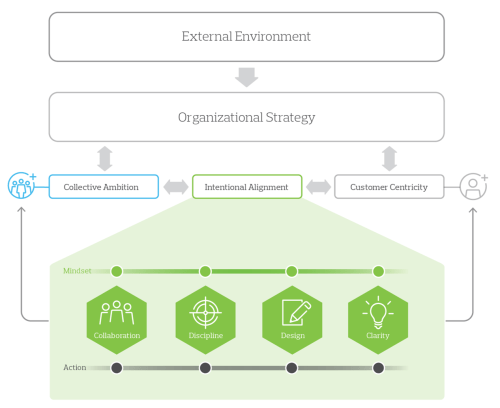
What’s noteworthy about this brief, that reports findings from their recent study, is its organizational growth model that makes organizational strategy less of a focus than the people strategy. In other words, “people (culture) eat strategy for breakfast.”

Take a look at their simple growth model:

Aon Hewitt 1

Two of the external environment challenges noted in the brief are worth mentioning:

  • 70% of FORTUNE 1000 companies have disappeared in the last 70 years
  • Corporate profits peaked in 2015 and appear to be trending downward

These, together, with the results of pretty dramatic demographic shifts mean that as people are the driving force of corporate value, they are becoming themselves more valuable and more important to business growth. It’s pretty inescapable that people do, in fact, drive growth – and not through execution alone.

I look forward to seeing the complete study analysis that will expand on the conclusions in this brief.

1 Comment

Filed under Aon Hewitt, business strategy, China Gorman, Corporate Valuation, Data Point Tuesday

Gender Equity And The Great Manager Divide

data point tuesday_500

Gender equality in the workplace is a topic much discussed today:  politically, socially, economically and demographically. Women everywhere wonder “what’s it going to take?” to be paid on par with men for doing the same work. Visier’s new Viser Insights™ Report:  Gender Equity gives some new insight into the demographic and economic side of this situation. It’s great data and will give you some new avenues to pursue as you lead your organization to more equitable compensation outcomes.

The analysis started with a subset of Visier’s database of anonymized, stardardized workforce data, representing over a million active employees. The subset included:

  • 165,000 U.S.-based employees
  • 31 Blue Chip companies
  • 11 of which are Fortune 1000

The organizations included are from a range of industries, such as Energy, Financial Services/Insurance, Healthcare, Manufacturing, and Technology with employees ranging from less than 999 to 50,000 employees.

The key findings broaden the context from a purely social context and include the following:

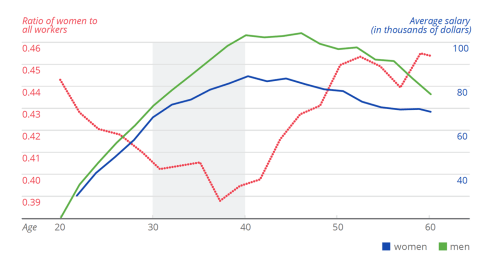
  • There is an increase in voluntary turnover and a pronounced dip in the percentage of women in the workforce between the ages of 25 and 40 (from 43% to 39%), the same age range in which women commonly have childre

  • The gender wage gap widens at age 32, starting with women earning 90% of the wages of men, and decreasing to women earning 82% of the wages of men by age 40

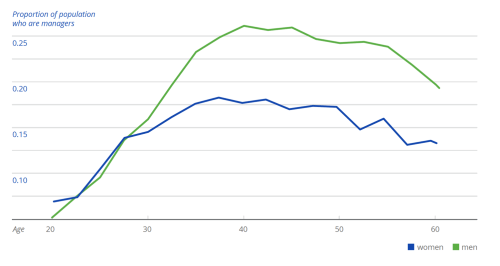
  • Women are underrepresented in manager positions from age 32 onwards – the same age at which the wage gap between men and women broadens

  • Manager wages are, on average, 2 times that of non-manager wages

  • Having the same representation of women in manager positions as men would reduce the gender wage gap to 10% across all age groups – an improvement most notable for the age 32 and older population

The graphs lay out this argument beautifully and are easily understood. For example,

Visier 1

What the analysis shows is that the gap in promotions/hiring to manager-level positions starts to widen at around age 32 between women and men. And this is exactly when women start leaving the workforce to focus on family and children. Makes total sense. This is what Visier has dubbed the Manager Divide. And, according to Viser’s data, the Manager Divide is a primary driver of wage inequality.

Visier 2This is a pretty clear picture of the divide. Conclusions include:

  • Removing the Manager Divide would reduce the gender wage gap by just over one third for workers over age 32

  • Removing both the Manager Divide and removing gender pay disparity in manager positions would cut the gender wage gap by one half for employees over age 32

The report continues by discussing the reality that even if organizations paid men and women equally for like positions, but had a lack of gender equity in filling manager positions, gender pay equity would not be reached in the aggregate. What follows is a convincing discussion about the childcare years that starts with this data point:

“Between the ages of 25 and 40 there is a notable and steady decline in the percent of women in the workforce. At the same time, the percent of women (out of the total workforce) in manager positions declines steeply.”

I encourage you download this report and get a broader understanding of the key factors impacting the wage gap. I think Visier is on to something important through the analysis of the data. The Manager Divide is real. It’s not just about women leaving the workforce to care for children. It’s most certainly also about gender equity in managerial promotion opportunities.


3 Comments

Filed under Analytics, China Gorman, Data Point Tuesday, Gender Equity, Pay Equity, Visier