Tag Archives: HR

Best-in-Class Engagement Metrics

The Aberdeen Group just published a fascinating report, The Rules of Employee Engagement:  Communicating, Collaborating and Aligning with the Business, that looks at what best-in-class organizations are doing about engagement and why they’re doing it.  Author Madeline Laurano takes a pretty deep dive into the subject and her analysis reveals some pretty intriguing conclusions.  What hooked me from the start were the three metrics for performance criteria to distinguish best-in-class companies for employee engagement:

  • 71% of employees exceeded performance expectations, compared to 14% of Laggard organizations
  • 85% of 1st choice candidates accepted an offer, compared to 8% of Laggards
  • 72% of employees rated themselves highly engaged, compared to 9% of employees of Laggard organizations

Most of the statistics we see about the value of engagement focus on tying engagement scores to financial outcomes.  No question:  we need that.  Data about the outcomes of engagement are helpful in building business cases for investing in the employee experience.

But tying other types of outcomes to higher engagement scores can also be helpful – like the number of 1st choice candidates accepting employment offers.  If a talent shortage truly is the number 1 concern of CEOs and their boards around the world, as the latest Lloyd’s Risk Survey suggests, then strategies that effectively raise the likelihood of securing the top talent you go after should be of interest. And it makes sense that A+ talent likes to affiliate with other A+ talent.

And connecting the dots between engagement outcomes and high levels of individual employee performance also makes sense.  I’ve long wondered at the value of trumpeting the engagement scores of every employee — when we all know that it’s the most effective employees’ opinions we care most about.  Linking employee performance and engagement scores makes a great deal of sense to me.

Take a look at the report.  I think you’ll find the data extremely useful.

2 Comments

Filed under Business Case, Business Success, China Gorman, Connecting Dots, Economist Intelligence Unit, Engagement, HR, HR Data, Lloyd's, Performance Feedback

HR Stakeholders

I was doing some research for a keynote speech I’ll be giving and I took another look at the SHRM Foundation’s Effective Practice Guideline on CSR.  I wrote about it here, and was reading it again, thinking “Gee this is great stuff.”  (Stuff, being a highly technical term that data geeks use a lot.)

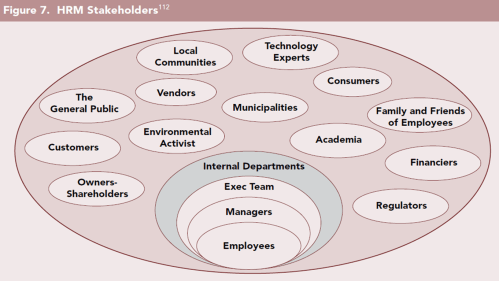
I came across this graphic of the stakeholders HR professionals need to connect with when designing and promoting CSR approaches and programs within their organizations.   As I reviewed it, I thought it was a good reminder of the breadth of the stakeholders that HR needs to factor into all of its work – whether it’s CSR, talent acquisition, talent management, benefits administration, strategic planning, learning and development – or yes, even the planning of the annual company picnic.

As I looked over the graphic, the only missing stakeholder group that I noted was the Board of Directors – but I’m pretty sure the authors include them the Owners-Shareholders group.  With the growing regulation of business and the focus on board oversight, I’d call them out as a separate group.  What do you think? Would you add any other distinct groups?

7 Comments

Filed under China Gorman, Corporate Social Responsibility, CSR, HR, HR Data, HR Stakeholders, SHRM Foundation

Paycheck Pessimism

Most people in the HR space know Glassdoor™ as a social media site that gathers anonymous information about employers from current and former employees.  Users can leverage their Facebook network to uncover connections at a company, view current openings, as well as review proprietary information that includes salary reports, company reviews, interview questions, CEO approval ratings and more.  It’s an incredibly useful site for job seekers to get the real skinny on a potential employer from the people who know it best:  its employees.

Of course, for employers and HR professionals, the site offers a full array of branding and recruitment-oriented services including the ability to create enhanced company profiles, Facebook career profiles, targeted job ads and more.

But for our purposes at Data Point Tuesday, we like Glassdoor™ because of its Quarterly Employment Confidence Survey.  Couple this report with monthly BLS reports and you get a robust picture of workforce and employer confidence and other dynamics.

For example, the Glassdoor Employment Confidence Survey surveys employees on their confidence in the areas of pay raises, job market expectations, company outlook and job security.  It’s great data and it’s presented in a highly consumable format.

The most recent survey was conducted by Harris Interactive between June 12 and 14 of 2,208 adults 18 years or older and was published on July 6.  Generally the data show improving or holding steady opinions on workplace confidence dynamics by employees with the exception of optimism in pay raises.  This dropped since last quarter to 40% (from 43%), while 37 % do not expect a pay increase – a low since the survey began in Q4 2008.

At first glance this seems a little off.  Expectations for a raise are at the lowest point since the 4th quarter of 2008 – and lower than the 4th quarter of 2008 when the economy was at its worst? Aren’t we starting to feel better about the economy?  Well, some of us are and some of us clearly are not!  The report says this:

  • Employee optimism in pay raises has dropped slightly since last quarter to 40%, while 37% reported they do not expect a pay increase…
  • The gender gap is closing around expectations for a pay increase over the next 12 months; 41% of women expect an increase compared to 40% of men.  However, men’s optimism around pay has declined five percentage points since last quarter while women’s optimism crept up one percentage point.
  • Younger workers are significantly less optimistic about pay raises than last quarter; 37% of 18-34 years olds expect pay raises in the next 12 months whereas nearly half (49%) expected raises last quarter.  All of the other age ranges have increased 2-4% from last quarter – 48% of 35-55, 42% of 45-54 and 36% of 55+ year olds.

So, if I read this right, men and young people under 35 report strong declines in optimism about pay increases while women report slight increase in optimism.

Men:  down 5%

Young people:  down 12%

Women:  up 1%.

How does this track with your turnover and engagement data?  Tracking turnover data by gender and age demographic is common.  How about engagement data?  Can you make connections between this lack of reported paycheck optimism among males and young people to the engagement data in your organization?  It might be worth a look.

And it might be worth keeping an eye on during the coming quarters – particularly in relation to the election in November.  Young people played a very active and pivotal role in the last presidential election.  Is their level of paycheck pessimism such that they won’t participate as strongly?  Or will it motivate them to even higher levels of activism?  And how will that translate to your organization’s turnover and engagement rates?

This is what’s so great about data.  They let you connect import dots.  Also, they always raise more questions than answers – but if you’re interested and aware you’ll start asking more of the right questions and connecting critical dots.  And who knows?  That could lead to formulating more effective people management and business risk mitigation strategies.

Isn’t that what HR is all about?

7 Comments

Filed under Bureau of Labor Statistics, Connecting Dots, Engagement, Glassdoor, HR, HR Data, Turnover

Is Your Workplace Engaged?

My friends at Achievers are collecting applications for inclusion in the 2012 Achievers 50 Most Engaged Workplaces™ Awards. As an HR business leader you should think about applying. Today. Because time is running out.

The process is not onerous and even if you don’t win – it’s a highly competitive and influential list – the process of answering the application questions will get you thinking and focusing on what you need to do create an engaging workplace.

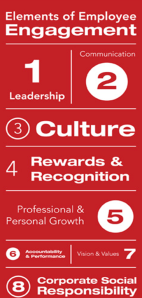
Achievers, the leading next-gen solution provider in the Rewards & Recognition space, has identified Eight Elements of Employee Engagement™:

  1. Leadership
  2. Communication
  3. Culture
  4. Rewards and Recognition
  5. Professional and Personal Growth
  6. Accountability and Performance
  7. Vision and Values
  8. Corporate Social Responsibility

The questions in the application survey ask employers to comment on their programs, policies and structure around each of the eight elements. In some cases, as in the Vision and Values section, the survey asks how your organization handles behavior that is NOT in line with a core value.

Each answer can be no more than 250 words, so the survey won’t take hours to complete – but will require thought in order to be both comprehensive and brief.

Previous winners have included organizations as diverse as ADP, Walt Disney World Swan and Dolphin Resort, North Shore-LIJ Health System, Glassdoor.com and E&A Credit Union.

The winning organizations will be notified on August 20 and the public announcement will be on August 27th, with the awards galas on October 25th in San Francisco (U.S. list) and November 14th in Toronto (Canada list).

Achievers has a strong history of research and analysis in the engagement arena and is a strong go-to source for current data and thinking on how engaged workforces outperform their unengaged peers.  Check out these white papers here and here.

Winning an award like this is great. Being able to declare to your talent community and other stakeholders that you are an organization publicly recognized for its effective focus on creating a culture and environment focused on employee engagement is pure gold. Apply here before time runs out to be included in the 2012 list. And good luck!

*Full disclosure: I’m one of 6 judges who will determine the final winners.

Leave a comment

Filed under 50 Most Engaged Workplaces Award, Achievers, Business Success, Engagement, HR, Razor Suleman, Talent Community, Talent pipeline

A Day in the Life…

One of many things that SHRM does well is to try to evaluate the services it provides to its members. So I wasn’t surprised that SHRM sent me an invitation to evaluate my experience at this year’s Annual Conference in Atlanta. And I tried to be honest. But really, how do you give feedback to an organization that executes its biggest event so well – year in and year out?

But I’ve been thinking about the question that asked what I would recommend for future Annual Conferences.  I gave a quick answer.  And I’ve been thinking about it more and I’d like to expand on my answer.

I suggest having a series of sessions called “A Day in the Life of…”  When I answered the question I was specific: engage one of the CHROs in the Fortune 100 to describe what their job and life are really like as an example for emerging HR leaders to see. We don’t see many CHROs on any stage at SHRM. I understand all the reasons why we don’t see them, but I think SHRM needs to try harder. Presenting a role model in the flesh would be high impact.

But as I’ve been thinking about it, why not also have sessions with CHROs from a privately held company with 5,000 employees, from a public company with 25,000 employees, from a large education institution, from a think tank, from a large national non-profit, and from a pre-IPO tech start-up? Not a panel discussion. A session by each of them, individually.

Not everyone in HR wants to be the CHRO of GE, but some do. Not everyone in HR wants to be the CHRO in a privately-held company, but some do. Show them what it’s like. Show them what it takes to get there – and stay there.

And then I thought, well, how about other functions? What’s it like to be the Chief Marketing Officer in the Fortune 100 – and what do they think about and want from HR?
How about a day in the life of the CFO of a global public retailer – and what they think about and want from HR?

How about the Chief Information Officer at a large privately-held technology company?

And how about the head of Total Rewards in a Fortune 250 company – how did they get there?

The head of Talent Acquisition in a Fortune 500 company – how did they get there?

The Chief Learning Officer in a global hospitality company – how did they get there?

You get my drift. A series of “A Day in Life of…” would put real leaders on the podium to share what works for them and what doesn’t work for them.  How they got there and what they’d do over again and what they would skip. And from everyone:  what advice for emerging or aspiring HR leaders.

Not only would this be interesting for intentional HR professionals, it would be helpful for those who got here by accident and aren’t sure where to go, whether or not to stay, and what is possible.  Holding successful HR (and other) leaders up for conference attendees to hear from and get coaching from might be the next big step in speaker impact that SHRM is looking for.

As with most good ideas, this came out of several conversations I had with HR leaders in Atlanta. Thanks. You know who you are.

8 Comments

Filed under China Gorman, Conferences, HR, HR Conferences, SHRM, SHRM Annual Conference

Is HR in a Bad Mood?

Results from The Fifth Annual Talent Management Study by Knowledge Infusion and Human Resource Executive® were published recently in HR Executive by Mike Brennan and some of the findings were surprising.

I didn’t find it surprising that 63% of the respondents report that they have trouble filling jobs and that they can’t find the right candidates. That’s been reported frequently.

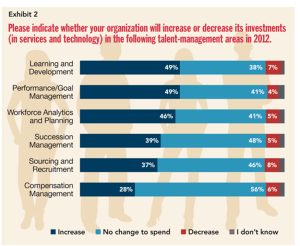
It also doesn’t surprise me that more organizations than not will be increasing their investments in Learning/Development, Performance/Goal Management and Workforce Analytics/Planning services and technology. That’s obvious.

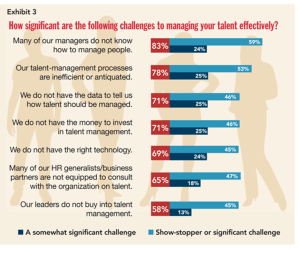
What really does surprise me is that 58% of HR executives believe that peer leaders in their organizations “do not buy into talent management.”

Lordy, I hope this isn’t the furniture conversation. And I’m willing to believe it isn’t because 83% of the respondents also believe that “many of our managers do not know how to manage people.” Additionally, 65% of the respondents believe that “many of our HR generalists/business partners are not equipped to consult with the organization on talent.”

Ouch. Either the HR respondents to this survey were all in a colossally bad mood, or they’re starting to look clear-eyed at their organizations and re-calibrate their challenges.

It’s clear that many organizations need to look at legacy systems and programs in the talent management arena (can you say annual performance review system?) and, according to this survey, they are. But focusing on leadership understanding and managerial effectiveness in talent management might be a strong first step.

It’s a great day for HR if the results of this survey mean a new focus on talent management effectiveness – at the top, in the middle, and most importantly, in HR.

But if it was just a systemic bad mood, we’re sunk. Because, in the words of one of my favorite movie characters in one of my favorite movies, “we have serious problems to solve, and we need serious people to solve them.”

7 Comments

Filed under American President, China Gorman, HR, HR Credibility, HR Executive Magazine, HR Technology, Knowledge Infusion, Managerial Effectiveness, Talent Management

HR Talent Shortage

SHRM has just released a new report in its series on The Ongoing Impact of the Recession. The current release focuses on the Manufacturing Industry.  Previous reports have focused on the Federal Government, State and Local Government and the Finance Industry.

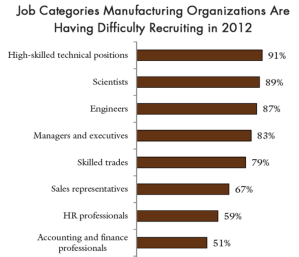
This report clearly shows the continued strong degree of difficulty in hiring professionals with STEM education backgrounds – as well as mangers and executives, the skilled trades, sales professionals, HR professionals and accounting/finance professionals. It should come as no surprise to any business leader or talent management professional that finding professionals in the U.S. with STEM backgrounds is difficult.  The U.S. education infrastructure is not producing enough graduates in these disciplines. See my posts here and here.

It is surprising to note, however, that in addition to reporting a high degree of difficulty in finding STEM professionals and skilled trade workers, manufacturing employers are also having a difficult time finding managerial and executive talent, and sales, HR and accounting/finance talent.

Hmmmm.  A shortage of HR talent. Is this good or bad news?

2 Comments

Filed under Education Deficit, Hiring Difficulty, HR, SHRM, STEM, Talent pipeline

The CEO – HR Disconnect: Understandable? Yes. Defensible? No.

The furniture conversation (see my post on that subject here) that HR is so fond of having is, at its heart, a lament about HR not having strategic business credibility. I don’t buy that HR lacks strategic business credibility. I do buy that HR isn’t communicating mission critical data to the C-suite and that creates a credibility challenge.

New data will be published shortly by Achievers that highlights the disconnect between what HR and CEOs believe about key elements of employee engagement in their organizations:   feedback, managerial communication and recognition.  And it’s pretty eye-opening!

When we designed a survey to evaluate how employees rate the current state of these workplace dynamics in their organizations and whether CEOs and HR professionals are in touch with what employees want, we found an added dimension in comparing the differences between the perceptions of CEOs and HR professionals.

  • For example, when we asked CEOs and HR professionals whether they agreed that their employees believe that their organization inspires them to do their best work every day, 61% of CEOs strongly agreed or agreed, while only 31% of HR professionals strongly agreed or agreed.
  • When we asked CEOs and HR professionals whether they agreed that their employees rated their organization culture as positive, strong and motivating, 67% of CEOs strongly agreed or agreed and 37% of HR professionals strongly agreed or agreed.

Wait.  It gets worse.

  • When we asked employees if they agreed that the feedback they received from their managers was constructive and useful, 79% of CEOs believed that their employees would strongly agree or agree while only 33% of HR professionals believed that their employees would strongly agree or agree.
  • When we asked employees how frequently they received feedback from their manager, 56% of CEOs believed that employees would report receiving feedback immediately or on-the-spot.  HR professionals?  11% believed that employees would report receiving feedback immediately or on-the-spot.

These are just four examples in the survey that show the continental divide between how CEOs and HR professionals evaluate crucial aspects of their employees’ engagement.  With these results that underscore the CEO – HR disconnect, we could hypothesize that CEOs have a more optimistic view of their workforce because any time they interact with employees, employees are on their best behavior – trying to impress the boss.  HR, on the other hand, frequently interacts with employees when they are not at their best:  exit interviews, investigations, disciplinary situations, etc.  It’s understandable that HR might have a more pessimistic view of their employee population.

Absent data to the contrary, why shouldn’t CEOs be optimistic? If there were issues, surely, they might think,  HR would share the data.  But when the employee engagement data is consistently less positive than CEOs’ perceptions, it”s clear that CEOs aren’t getting data that informs them of the reality of their workforce. And who has this data?  Well, that would be HR.

So why isn’t this data – and their ramifications – being shared with the C-suite? For HR to understand the workforce and know what is working and what isn’t clearly isn’t enough.  Communicating mission critical data and serving up cost effective solutions are HR’s opportunity. Heck.  Most would say that’s HR’s job!  For certain, they are the ticket to strategic business credibility.

If we needed tangible proof of the CEO – HR disconnect, this survey’s results confirm it.  You’ll be able to download it on June 12 from the Achievers website.

14 Comments

Filed under Achievers, C-suite, CEOs, HR, HR Credibility

Data Point #11: Talent optimism vs. realism

We’re surrounded by all kinds of data points about the talent/skill shortage.  I wrote about it here and here.  Today we have two data points:  one comes from SHRM’s Q2 2012 Jobs Outlook Survey Report and the second comes from the BLS 2012 Occupational Outlook Handbook.

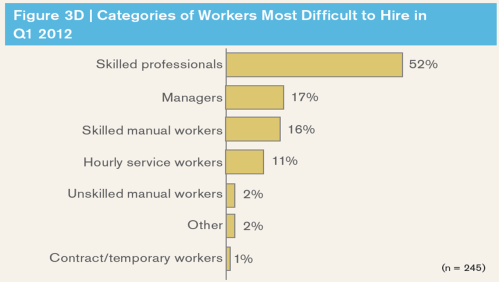
SHRM’s Jobs Outlook Survey has some interesting data from a small sample of its 250,000+ members.  (This particular survey was sent to 3,000 randomly selected SHRM members with 336 members responding, for an 11% response rate.)  These quarterly JOS surveys ask HR professionals interesting questions about optimism in job growth, planned changes in total staff levels, categories of workers companies will hire and categories of workers most difficult to hire in the previous quarter.

I was particularly interested in the responses to the question asking which categories of workers were most difficult to hire in the 1st Quarter of this year.  The sample is small (n=246), so the data are directional at best, but do line up with other data sources.

This data is congruent with BLS (U.S. Bureau of Labor Statistics) data relative to education level attainment and the corresponding unemployment rates in April.  The higher the unemployment rate, the lower the difficulty to hire:

  • Less than high school:                                   12.5%
  • High school no college:                                  7.9%
  • Some college or Associate degree:               7.6%
  • Bachelor’s degree or higher:                         4.0%

In other words, it’s more difficult to find skilled professionals and managers in this job market because there are fewer of them unemployed and there are fewer of them overall.  It’s easier to find service workers and unskilled manual workers because more of them are unemployed and there are more of them overall.

But still, as the SHRM report highlights, employers are having difficulty in hiring at all levels.  Which makes me wonder:  are we being unnecessarily restrictive in our job specifications?  Are we hiring people with college degrees when an associate degree would suffice?  Are we requiring associate degrees when a high school degree would be adequate?  I don’t know the answer, but considering the data is interesting.

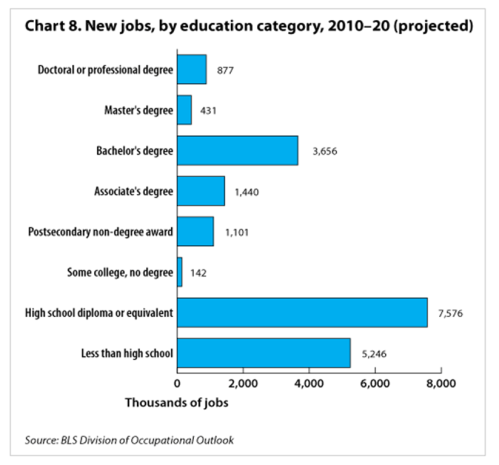
The Occupation Outlook Handbook, published by the BLS, shows the projected job growth by education category in the 2010-2020 decade:

While the number of jobs created in this decade that will require a Bachelor’s degree or higher is predicted to be nearly 5 million, the number of jobs predicted to be created requiring some college/no degree or less is nearly 13 million.

So if the key to employment (and financial) security for the average worker is a Bachelor’s degree, but the greatest numbers of jobs being created in the next decade won’t require a Bachelor’s degree, how do we reconcile this as employers?

Do we hire college educated workers for jobs that only require a high school diploma?  Are we already doing that now?

Do we work to raise the general level of worker education because we believe it’s the key to global competitiveness?

Do we encourage students to enroll in career and technical education programs in and after high school rather than college because those are the skills needed in the economy?

The data around employers having difficulty finding the talent/skills they need isn’t as simple as it looks.  It’s actually quite challenging.  Under every layer of data is another layer of data.  Solving our talent attraction and acquisition needs won’t be solved with one tactic. But it’s a safe bet that solving our talent challenges will include strengthening relationships between employers and the education infrastructure to produce the skills our economy really needs.

As I look at the data, the optimist in me says we’re covered over in opportunity.  The realist in me says we’ve got a lot of work to do and not a lot of time in which to do it.

7 Comments

Filed under Bureau of Labor Statistics, China Gorman, Demographics, Education Deficit, Employment Data, HR, Post-secondary education, SHRM, Talent Management, Talent pipeline, U.S. Department of Labor, Uncategorized, Unemployment, Unemployment Rate

Data Point #5: We Can’t Succeed Without Baby Boomers

In earlier Data Point Tuesday posts (here and here) I’ve recommended the Bureau of Labor Statistics’ website as a treasure trove of talent management related data.  Another great source of useful information is SHRM, the Society for Human Resource Management.

SHRM’s research group works tirelessly to bring relevant, actionable trend and survey information to its members.  And if you aren’t a member (why aren’t you?), the value of SHRM’s research services alone is more than the cost of membership. *

Workplace Visions is part of SHRM’s Workplace Trends and Forecasting program and is published multiple times each year – as new data become available.  The reports are useful signposts for new developments that impact organizations, talent management and HR professionals.

The first such report published this year is “Changes to Retirement Benefits:  What HR Professionals Need to Know in 2012” (member protected).  It’s full of useful observations about changes coming to 401(k) plan rules, Social Security changes to keep an eye on and great data from EBRI (The Employee Benefits Research Institute).

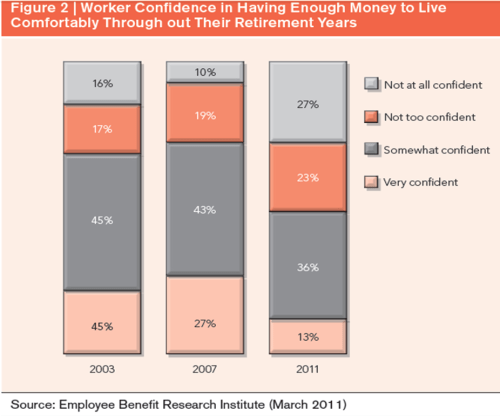
One of the discussion points piqued my interest:  data from EBRI about the reduction in confidence by Baby Boomers that they will have enough money in their retirement years to live comfortably.  See the chart below.  This has big potential impact for employers.

The aha! is that while a steady stream of Americans still plan to retire in their early to mid-60s, many more workers are unsure when they’ll be able to retire – or if they’ll be able to retire.  As you can see from the chart, in 2007 70% of EBRI survey respondents reported some level of confidence in their retirement plans.  That number fell to 49% in 2011.  SHRM also cites data from Towers Watson surveys with similar outcomes.

What does this mean for talent management professionals?  Well, SHRM thinks that providing a stronger hand in retirement planning and financial education for Baby Boomers will help reduce retirement-related anxiety.  I absolutely agree.

Additionally, though, SHRM counsels HR professionals to “weigh the positives and negatives of employing an older workforce.”   They counsel that “older workers are often costlier to keep on board, due to higher salaries and health benefits costs.” Woah.  The  thought that employers will have robust options besides Baby Boomers and other older workers to staff their organizations isn’t supported by the demographic trends.

My take is a little different.  Here’s what the data say:

  • the U.S. population is growing more slowly leading a more slowly growing civilian work force (http://bls.gov/news.release/pdf/ecopro.pdf),
  • the Baby Boom generation moves entirely into the 55-years-old+ age group by 2020 and will represent 25.2% of the work force (up from 13.1% in 2000)
  • the “prime-age” labor cohort (ages 25-54) is projected to drop to 63.7% (from 71.1% in 2000) of the work force

So the engagement, development and retention of Baby Boomers and other older workers will be a very critical part of most organizations’ talent strategies because they’ll make up 25% of the available work force.  Providing incentives to stay, financial education for pro-active retirement planning and unique engagement strategies — among others — will all be part of talent strategy in 2020.  There won’t be any weighing the positives and negatives of employing an older workforce.  But there will be significant effort spent in figuring out how to keep the Baby Boomers’ skills, talents,and  organizational knowledge in play in the work force — and in our organizations.

At 25% of the available workforce, there won’t be other options.  We won’t be able to succeed without Baby Boomers.

*Full Disclosure:  I am SHRM’s former Chief Operating Officer

8 Comments

Filed under Baby Boomers, Bureau of Labor Statistics, Business Success, China Gorman, Demographics, Employment Data, HR, Retirement Planning, Talent Management, Talent pipeline, U.S. Department of Labor