Monthly Archives: March 2012

Data Point #4: Cyclical vs. Structural Unemployment

The U.S. Department of Labor/Bureau of Labor Statistics is a gold mine of information.  It crunches massive amounts of data having to do with labor and the economy, and is prolific in providing projections for the future.  (See previous posts here and here.)

An interesting monthly publication put out by the BLS is the Monthly Labor Review.  The January edition included an Overview of projections to 2020 based on its Employment Outlook 2010-2020.  The overview contains a review of the underlying data behind all of the BLS’s projections.  Labor force participation by demographic, the connection between GDP and productivity, job growth by sector/industry, job growth by occupation, job growth by education level – all are included in this overview.

What I found most interesting was a graph and brief discussion comparing the most recent recession and the resulting time to labor market recovery to the previous four recessions.  Take a look at the graph.

We all know that the effects of the 2007-2009 recession are still being felt.  In fact, the graph shows that we are a long way from reaching “recovery to level at start of recession” — some 30 months out from the official end of the recession.  No surprise, but perhaps the combination of the length of the recovery together with the continued gap between where we are and the “recovery to level at start of recession” is noteworthy.  Also of note:  this overview reports that the BLS sets the “natural rate of unemployment” at 5.2%.  We’re still a long way from the recovery to level at start of recession rate — and a much longer way from the natural rate some 40 months from the official start of the recession.

The real question is, why is this recovery taking so long compared to the previous recoveries shown in the graph?  Labor market analysts discuss the cyclical vs. structural causes that continue to depress hiring and job creation.  Cyclical unemployment occurs when workers are laid off because of weak demand, but who expect to be re-hired when demand picks up – usually by the same organization, and usually in the same occupation or industry.

Structural changes in the economy also create job loss – our most recent recession proved that unequivocally.  Structural unemployment could also be caused by weak demand, but is fundamentally caused by other dynamics that impede workers’ abilities to return to work when demand picks up.  For example, new technology and resulting productivity gains may reduce the need to rehire workers with less current skills and may reduce the number of workers needed even after recovery.   As time goes on, the skills deficit of the structurally unemployed gets bigger and so they may well experience longer periods of unemployment.  Retraining in new occupations will be required for these workers in many cases.  Sound familiar?

As HR and talent management professionals take into account the impact of both cyclical and structural unemployment in their locations and industries, their approach to creating a robust talent pipeline will be far more realistic and attainable if they focus on causes of structural unemployment.  Just as employers are having difficulty finding the skills they need, the structurally unemployed are having difficulty finding new homes for their outdated skills.

Surely the answer is obvious to more than me.

7 Comments

Filed under Bureau of Labor Statistics, Cyclical Unemployment, Employment Data, Job Creation, Monthly Labor Review, Structural Unemployment, Talent pipeline, U.S. Department of Labor, Uncategorized, Unemployment

AT&T, JAG and the Talent Deficit

In my post yesterday, I suggested that employers will need to start making strategic partnerships with education institutions and economic development organizations, among others, to start dealing with the upcoming acute shortage of workers who have graduated from high school and have some college under their belt.

A great example of this came to my attention yesterday.  On Monday AT&T announced an investment of $250,000,000 over the next five years to improve high school graduation rates.  Here’s how their announcement began:  “ As access to skilled workers becomes increasingly vital to the U.S. economy, AT&T is launching a quarter-billion-dollar campaign to help more students graduate from high school ready for careers and college, and to ensure the country is better prepared to meet global competition.”

Investing in JAG – Jobs for America’s Graduates – is an example of strategic corporate investment in the future of the talent pipeline.  JAG, the most effective program of its kind – is a state-based national non-profit organization dedicated to preventing dropouts among young people who are most at-risk.  In more than three decades of operation, JAG has delivered consistent, compelling results – helping nearly three-quarters of a million young people stay in school through graduation, pursue post-secondary education and secure quality entry-level jobs leading to career advancement opportunities.  The kids in the AT&T Aspire video are great examples of JAG at work in the trenches.

Who wouldn’t hire those kids?

I ended my Data Point Tuesday post yesterday with this imperative:  “The sooner talent acquisition professionals and learning/development professionals in organizations begin to work together on workforce planning and tackling the education deficit, the sooner the talent pipeline will begin to be prepared for 46 million new jobs.”

Looks like AT&T is out in front.  Again!

3 Comments

Filed under Aspire, AT&T, China Gorman, Education Deficit, High School Graduation Rates, JAG, Job Creation, Talent pipeline, Uncategorized

Data Point #3: The U.S. Education Deficit and 46.8 Million New Jobs

Many business leaders and most talent management professionals know that the demographic shifts that are happening now and are projected to happen in the next several years will impact every organization’s ability to meet its business goals.  On top of demographic trends,  education trends are also going in the wrong direction.  Between 1997 and 2009 the U.S. position as a world leader in education has slipped from 4th to 11th, as an example.

According to Help Wanted: Projections of Jobs and Education Requirements through 2018, a report published by Georgetown University, the U.S. economy will create 46.8 million openings by 2018 – 13.8 million brand new jobs and 33 million “replacement” jobs,” positions vacated by workers who have retired or permanently left their occupation by 2018.

Good news for the economy and the working population of the U.S., right?  Well, maybe.

Let’s peel back just one layer of the onion and look at what these new and replacement jobs will require.  According to the Georgetown report, nearly 63% of these jobs will require workers with at least some college education.

This data projects that one-third of the new jobs will require a Bachelor’s degree or better and nearly 30% will require a two-year Associate’s degree or some college.  Only 36% will require a high school diploma or less – and that percentage of all jobs continues to decline.

Here’s the challenge for employers, according to the Georgetown report:  by 2018 the U.S. post-secondary education system will have produced 3 million fewer college graduates than required by the labor market.  And what if the economy recovers faster than expected with greater job growth and greater Baby Boomer retirements?  The delta gets even bigger.

Here’s where talent management professionals should be thinking creatively and strategically.

If the working population will not be educated enough for these 46 million new jobs, employers will have to be focused on educating them.

But how to begin?  Individual employers, groups of employers (aligned geographically or by industry) will have to have a multi-faceted approach, but the cost effective bet is starting with their existing workforce.  Organizations are going to have to educate their own workers and look to current best practice (tuition reimbursement programs, for examples) as well as innovate new approaches.

Strategic partnerships between employers and education institutions are beginning to create new education paradigms.  But that won’t be enough.  Other stakeholders will need to begin their involvement in educating the workforce:  local and regional economic development organizations, local workforce boards, state departments of labor and education, professional associations, labor unions – all will begin to partner with employers to deliver the educated talent they need.  Talent management leaders should be out in front on this issue, defining the skills outcomes required.

It’s clear that demand will outstrip supply in almost all occupational categories soon.  The sooner talent acquisition professionals and learning/development professionals in organizations begin to work together on workforce planning and tackling the education deficit, the sooner the talent pipeline will begin to be prepared for 46 million new jobs.

12 Comments

Filed under CAEL, Education Deficit, Job Creation, Post-secondary education, Talent pipeline, Tuition Reimbursement, Uncategorized

Data Point #2: Quits vs. Layoffs/Discharges

The unemployment rate is 8.3%.  Better than a year ago, but still 8.3%.  The Bureau of Labor Statistics says that there are 12.8 million unemployed workers in the United States.  Most believe that the real number is closer to 18 million – the difference being those who have been unemployed so long that they’ve given up hope in finding a job.

There’s no doubt that the economy is showing signs of improvement.  However, last Tuesday the Dow lost more than 200 points – the single biggest one-day loss in 2012.  Gasoline averages $3.80 a gallon and is predicted to top $4.00/gallon by summer.  Fears of the European economy tanking and taking the U.S. economy with it are still strong.  And the anticipation of a myriad of tax increases hitting businesses and individuals on January 1, 2012 creates enormous uncertainty.

Job satisfaction in the U.S. continues to decline and the percentage of workers who report being engaged is less than 33% by some measures.

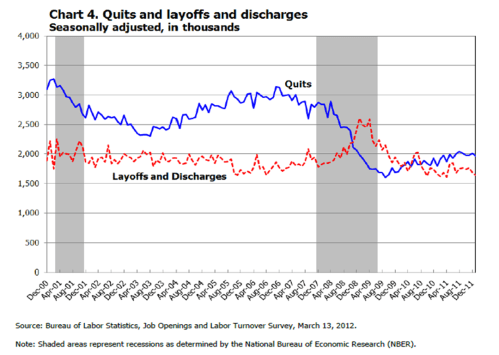
So this next data point is somewhat astonishing, and cause for concern by HR professionals everywhere.  According to data released today by the U.S. Department of Labor’s Bureau of Labor Statistics, the numbers of workers who are leaving their jobs voluntarily continues to grow and outpace the number of workers who are leaving their jobs involuntarily.

The graph shows that during good economic times the number of workers who leave their jobs voluntarily is larger – significantly larger – than those who are involuntarily terminated.  It stands to reason.  If they don’t like their boss, if they don’t trust their CEO, if their work isn’t meaningful, if another company offers more money – they resign.

It also stands to reason – and the chart shows this clearly – that in bad economic times the number of workers who quit voluntarily drops precipitously. Leaving your job in a really bad economy– without a new one to go to — defies logic.  And unless the situation is unbearable, most people are logical when it comes to their employment and cash flow.

Most would agree that the economy is still bad.  There are still millions of workers looking for jobs.  The economic and political environments are shaky.  Yet the number of people thinking “I can’t take it another day – there’s got to be something better than this:  I quit” is  growing.  In this economy.  With these uncertainties.

     What does this say about the level of dissatisfaction and disengagement within our workforces?

     What does this say about the cultures of our organizations?

     What does this say about our ability to retain the talent that we need?

Well, if you’re an optimist like I am, this is what you think:

     What a great opportunity we have to create a differentiated employee experience!

     What a great time to start strengthening our culture!

     What a great time to start recruiting!

7 Comments

Filed under Bureau of Labor Statistics, Data Point Tuesday, Employment Data, Engagement, Talent pipeline, U.S. Department of Labor, Uncategorized

Data Point #1: Unemployment Rate vs. Layoff Data

The U.S. Bureau of Labor Statistics published a mixed bag of news week before last.  While the unemployment rate fell from 8.5% in December to 8.3% in January, the number of mass layoff events in January grew by 50 over the previous month.  (A mass layoff event  involves at least 50 workers from a single employer.)  The total number of employees involved in these events, however, was reduced month-over-month by 15,728.  So while more employers were downsizing in January, fewer employees were impacted.  Good news, right?  Maybe…

Looking at the trend lines in the chart below, HR professionals may scratch their heads and wonder what is different in January 2012 from April 2008?  The number of initial claims are similar:  128,643 in April 2008 vs 129,920 in January 20102.  But the unemployment rate is significanttly dissimilar:  5% unemployment in April 2008 vs. 8.3% unemployment in January 2012.  What’s going on?

Clearly, the lagging effects of the economic downturn which began to gather steam in the 3rd and 4th quarters of 2008 are still being felt.  The resulting embedded base of unemployed workers continues to weigh heavily on the U.S. economy and the unemployment rate despite the falling numbers of layoff events and impacted workers.

So how is this data useful for HR professionals?  Simple.  Putting the long-time unemployed back to work has to be job #1 in our organizations and our communities.  As your organization plans to grow its employee base — whether with contract, temporary or full-time employees — what are your plans to target the long-term unemployed for inclusion in the talent pipeline?

3 Comments

Filed under Bureau of Labor Statistics, China Gorman, Data Point Tuesday, Employment Data, HR, Talent pipeline, U.S. Department of Labor, Uncategorized