Monthly Archives: January 2013

From the Archives: Job security is the #1 talent attraction magnet. Wait. What?

This was originally published on April 17, 2012.  It’s worth repeating…

In doing some research for a speech I’m giving, I came across The Talent Management and Rewards Imperative for 2012 from Towers Watson and WorldatWork.  It’s chock full of interesting data based on the 2011/2012 Towers Watson North American Talent Management and Rewards Survey and an unpublished Towers Watson 2011 survey of over 10,000 full-time employees in North America on topics such as total rewards, communication and other work-related issues.  Because I’ve been looking at data about the state of the talent pipeline (see Data Points #3, #5, #6), I thought this would be interesting reading.  Little did I know!

A couple of the data points that stood out to me challenge the “conventional wisdom.”  See what you think:

  • Only 11% of organizations have trouble retaining employees generally
  • Fully 68% of organizations identify high potentials, but only 28% inform those employees who have been identified.
  • Organizations underestimate the effect work-related stress and work/life balance have on employee retention, and do not recognized the significance of job security in attracting top talent.

Wait.  What?

It’s the last point that brought me up short.  Look at the chart below.
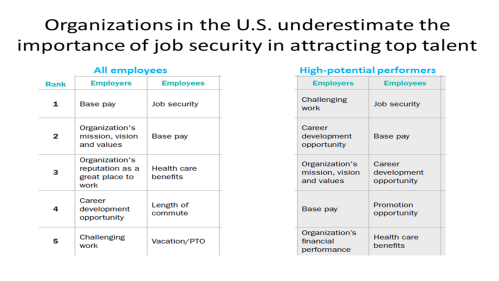
There are important disconnects between what employees report will attract them into a new job and what employers believe will be important in attracting talent into their organizations.  And if you look at the differing views between employers and high potential performers you’ll be even more surprised.

In all of the writing on this topic that I have seen in the last 18 months, no one else reports the significant importance of job security as part of an organization’s EVP (employee value proposition).  And look how it ranks as #1 for all employees as well as high-potential employees.  #1.

Not meaningful work.  Not alignment with the organization’s mission.  Job security.  Am I the only one surprised by this finding?

Look at the disconnect between the top 5 factors for all employees and employers’ top 5 factors.  Outside of base pay it’s a total mismatch!

On the high-potential performers side, outside of base pay and career development opportunity it’s a total mismatch!

It looks like we’re totally out to lunch when it comes to knowing what’s motivating in terms of EVP and the talent pipeline.  Out. To. Lunch.

In a world that observes the incredible talent acquisition strategies and investments at organizations like Zappos, PepsiCo, Rackspace and AT&T, we’re encouraged to believe that creating cultures of happiness and engagement are what it takes to delight customers and retain employees – high potential or otherwise.  And I chose those organizations because I know the ground-breaking work each is doing in terms of building their talent communities and the engagement of their workforce.  They truly are ground breaking.

It turns out talent attraction may be a bit more mundane than “creating a little weirdness.”

It turns out that some of the basics like job security and base pay still hold huge sway in our workforce.  And I think this is good news.  It gives” regular” employers doing good work and being good to their employees a fighting chance to keep their employees and attract the talent they’ll need going forward.

Basic blocking and tackling.  Basic management competence.  Basic HR.  Can’t get away from them if you want your organization to succeed.

2 Comments

Filed under AT&T, Business Success, Career Planning, China Gorman, Culture, Engagement, HR, Talent Management, Talent pipeline

Big Trouble in the Talent Pipeline

data point tuesday_500

I’m not generally big on infographics.  I find them self-serving and hard to read and digest.  Here’s an exception.  It’s called Unprepared for College and was posted on the College@Home.com blog.

I’ve written about the non-performance of the U.S. education system in preparing our future workforce here and here.  This infographic puts the issues front and center.  I don’t see how we can continually turn away from this data.

  • Half of all college students drop out before receiving a degree
  • 1 in 4 college freshman don’t complete their 1st year
  • Over half-a- million college freshman drop out every year

But wait.  It gets worse:

  • 80% of college freshman say high school is too easy but
    • 5 out of 10 college freshman can’t find New York or Ohio on a map of the U.S.
    • 9 out of 10 can’t find Afghanistan on a map of Asia
    • 3 out of 10 can’t find China on a globe
    • 4 out of 10 can’t find Israel, Iraq or Saudi Arabia
    • 7 out of 10 can’t find North Korea

And worse:

College@Home High School Readiness Benchmarks

And then there’s this:

  • 4 out of 5 students currently pursuing a math or science degree feel that their K-12 education did not prepare them for college
  • 2.2 million college freshman are learning high school material in college
  • 80% of students in remedial classes in college had a high school GPA of 3.0 or higher
  • 20% of freshman with a 4.0 high school GPA need remediation in math, English or both
  • And 8 out of 10 freshman believed they were ready for college when they graduated from high school

The bottom line?  Only 56% of students enrolled in a 4-year program receive a degree within 6 years.

So.  What are we doing about this?  Government can’t or won’t act.  We can blame teacher unions, local governments, state governments, the voting public, parents, the students themselves – but none of that helps solve the problem.

Seems to me that business in general – and HR specifically – needs to step up to the plate.  After all, we’re the ones most concerned with the unskilling of our populace.  We’re the ones who know the most about the kinds of skills we need today and the kinds of skills we’ll need tomorrow, and next month and in the years to come.  I think it’s up to us.  What do you think?

12 Comments

Filed under China Gorman, College Graduation Rates, Connecting Dots, Education Deficit, High School Graduation Rates, Jobs for America's Graduates, Post-secondary education, STEM, Talent pipeline

Connecting Dots: Employee-style

data point tuesday_500

Back in July, I referenced data from the Glassdoor Q2 2012 Employment Confidence Survey.  If you’ll recall, this quarterly survey monitors four key indicators of employee confidence:  job security, company outlook, salary expectations and re-hire probability.  The Q4 2012 Survey from Glassdoor is out and the results are interesting.

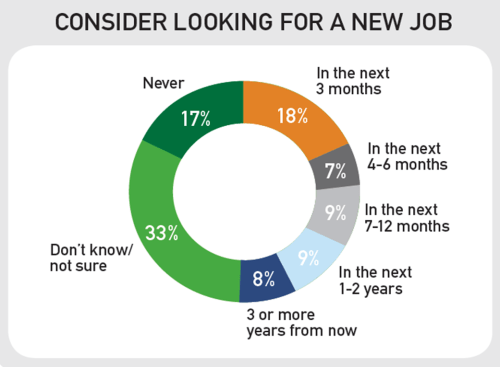
It’s probably not shocking to anyone who reads this blog that half (51%) of employees (including self-employed people) will consider looking for a new Glassdoor logojob if the state of the economy stays the same or improves, with 33% looking for a new job in less than a year and nearly one in five (18%) planning to look for a new job in the next three months.  We’re hearing that our employee base is not engaged and other sources have said that as much as 90% of the employed population will look for a new job in 2013.

Glassdoor ECS Q412 - consider looking for a new job

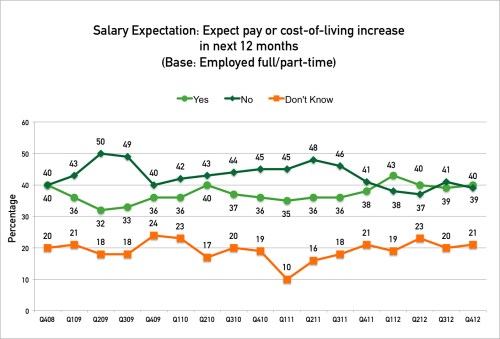
What’s interesting to me is that, if you look at other data points in this survey, it makes perfect sense that a high percentage of employees think they’ll look for work this year. Why?  Well, according to the survey, 39% of employees don’t expect a pay or cost-of-living increase in 2013 and 21% aren’t sure if they’ll get an increase this year.

Glassdoor ECS Q412 - salary-expectations (2)

So.  60% of employees don’t think – or aren’t sure – they’ll get an increase this year.  I’m thinking that has something to do with the percentage of employees who will be looking for a new job this year.  And guess what?  The most important factor these employees say that will influence their decision on whether or not to accept a job offer is…wait for it…salary and compensation!

Employees are pretty good at connecting dots:

I don’t think I’m going to get a raise this year   +

I’ll be looking for a new job this year  =

The most important factor in my decision to accept a new job will be the salary and compensation

Makes perfect sense to me.

But I also think that a majority of employees will receive raises of some sort this year.  Even small ones.  So why do so many think that there is no soup for them?

Perhaps we’re causing this supposed exodus ourselves by not communicating clearly – at the employee level – what our compensations plans for this year are.  Or, maybe we’re being extremely clear and they don’t believe us.

Either way, it’s a problem.  Either way, we should never forget that our employees are smart and know how to connect the dots.

Maybe it’s time we do the same.

2 Comments

Filed under China Gorman, Compensation, Connecting Dots, Employee Loyalty, Engagement, Glassdoor, HR Data

From the Archives: Stick a Fork in Annual Performance Review Systems

While I’m traveling, I thought I’d re-post one of the most popular Data Point Tuesday posts from 2012.  Enjoy.

Today’s data points come from two recent surveys:  one from Achievers and one from Cornerstone OnDemand.  Both surveys show clearly that annual performance review systems’ time has come.  It’s over.  Time to stick a fork in them.

Well, it’s time to stick a fork in them if you’re interested in providing the kind of feedback to your employees that is focused on growing their skills, binding them closer to the organization and engaging their full and discretionary energy.

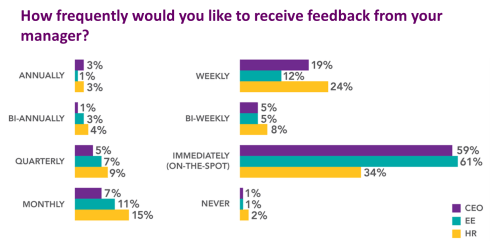
Let’s look first at the Achievers data.  As part of a survey fielded in April of this year, employees were asked how frequently they would like to receive feedback from their managers.  HR professionals and CEOs were asked how frequently they thought employees in their organizations would like to receive feedback from their managers.  Do the answers surprise you?

No surprise that employees would like to receive feedback immediately or on the spot – or at least weekly.  Maybe a bit of a surprise that both HR professionals and CEOs know this.  Here’s the question, though:  if employees, HR professionals and CEOs all know that employees don’t want feedback in an annual context, then why are the majority of performance feedback systems in use today based on an annual model?

Making matters worse, Cornerstone OnDemand published survey results from late 2011 with related findings:

  • only 37% of employees report that they’ve been given useful feedback from their manager/employer in the performance review process
  • Only 32% said that their performance goals are aligned with their company’s business objectives
  • Only 20% have established career goals with their manager/employer

So.  Annual feedback systems satisfy no one from a frequency perspective.  And feedback systems in general are not providing useful feedback for employee skill growth or engagement – or in line with business objectives.

At this point you could say, “Yikes!” and start moaning.

Or, you could say, “This looks like an opportunity for HR to make a significant contribution to the success of the business!” and start collecting similar data from your organization to identify whether this opportunity is real.  If it is real, I see the building of a compelling business case in your future – just in time for the FY2013 budget planning process.

And a new more powerful way to engage employees and manage performance in your organization could be right around the corner.

19 Comments

Filed under Achievers, Annual Performance Reviews, Business Case, Business Success, China Gorman, Cornerstone OnDemand, Engagement, HR Data, Performance Feedback

HR’s 2013 “To Do” List

data point tuesday_500

I’m not big on New Year’s resolutions.  Everyone else, though, has their top ten lists of resolutions for 2013.  And for HR, everyone wants you to go socially mobile into the Cloud.

Me?  Not so much.

I am big on “to do” lists, though.  And, while there’s lots for HR to do in 2013, here are my top 4:

to-do-list iPad1.)  Have a tactical plan to stay on top of regulatory (pay particular attention to NLRB rulings and timetables for implementation of the Affordable Healthcare Act) and legislative changes coming from your city, your state house and Washington D.C.


2.)  Review your HRIS providers and products:

  • Can you move to the Cloud in 2013 to reduce software and hardware expenses?
  • If any of your providers have been acquired or are likely acquisition targets do you know what your options are?

3.)  Schedule a review of employee programs that are 5 years or older. There are more effective, next-generation solutions that are generally cheaper to deploy and more employee friendly. Likely candidates include:

  • Performance management systems
  • Rewards and recognition programs
  • Learning management systems

4.)  Get a handle on your Big HR Data. Explore some of the new products that gather all the employee data from your disparate HR systems and help you and your organization’s managers make more intelligent, fact-based people decisions.

That’s not a long list.  But it is a powerful list.

Just think how you’d feel at the end of 2013 if you implemented a new rewards and recognition program that actually incented engagement and productivity.

Just think how you’d feel if you installed a system that made getting accurate, timely employee data into the hands of front line managers easy.

Just think how you’d feel if you saved your organization thousands of dollars by moving essential HRIS programs to the Cloud.

It’s good to feel powerful and effective.  It’s even better to BE powerful and effective.

How’s that for a New Year’s Resolution?

1 Comment

Filed under Annual Performance Reviews, China Gorman, Connecting Dots, New Year's Resolutions, Performance Management, Rewards & Recognition, To Do Lists