Category Archives: Culture

The Big Reveal

2013 Best

Everyone wants to work at a great place, and today, they’ll find out if they do. Great Place to Work® is counting down the 2013 World’s Best Multinational Workplaces list during a live, online broadcast today for the first time ever. Join me in congratulating the 2013 World’s Best Multinational Workplaces and follow us at 9AM Pacific Time in the GoLive event when we’ll stream live the reveal of the third annual list of the World’s Best Multinational Workplaces.

Several executives from the top 25 companies will join us on set to share their approaches and successfull practices that help them build, sustain and grow the world’s most coveted workplace cultures. These organizations have thousands of people in different countries working across multiple time zones, and yet, their universal commitment to every employee makes them great beyond any border.

It’s no coincidence that great workplaces are also industry leaders across the board. Client satisfaction, ROI and quarterly earnings all start with the people who make it happen. Year after year, companies that see each employee as a whole person ultimately see the most valuable business results. These companies offer internal programs for personal well-being, provide professional development opportunities, and foster transparent communities for the best talent to connect, learn and succeed together.

We are honored to celebrate these companies and their dedication to sustaining healthy work environments for their employees. They help us achieve our mission of creating a better society by having a positive impact on their people and the communities within which they work.

Join us at 9:00 a.m. Pacific Time today, Tuesday, October 22, to find out who made the 2013 list and hear from the best what it takes to become a Great Place to Work®. http://worldsbest.greatplacetowork.net/index.html

Leave a comment

Filed under China Gorman, Culture, Great Place to Work Institute, World's Best Multinational Workplaces

Who Knows More About Culture than HR?

data point tuesday_500

The importance of culture in making or breaking a merger/acquisition has long been an interest of mine. After spending 25 years at the top outplacement/career transition business, I’ve seen the best and worst of people practices in M&A – and the best and worst of culture awareness in M&A. So I read with interest the recent whitepaper by Mercer, Culture in M&A: We Know It’s Important, So Now What? And I found some interesting nuggets.

We all know this, but Mercer’s survey data show that “failure to address corporate culture is the key barrier in up to 85% of failed M&A transactions.” 85%. I’ll bet even your gut is surprised by that high percentage. Good to have hard data on that one, right?

This is a short report, as whitepapers go, so if there’s a merger or acquisition in your future, I encourage you to download the report here because the data are pretty compelling that culture should be a primary driver during due diligence and integration execution in a successful integration.

And who knows more about culture than HR?

Mercer Org Culture Tops Elements Critical to Deal Success

The relative importance of corporate culture as a driver of deal success as compared to customer relationship management, human resources, IT and regulatory compliance could be shocking to some – but not to leaders who have been on the wrong end of one of these deals. And by wrong end I mean a due diligence process and integration execution plan that ignored the importance of culture and people, focusing solely on “cost synergies” and “accretive” value; a due diligence process and integration plan that didn’t have HR’s fingerprints all over it.

And if you need any more convincing, there’s this to consider:

Mercer Paving the Way for Deal Success

So even if your focus is on achieving operational efficiencies, addressing culture in deals is a critical success factor.

And who knows more about culture than HR?

Other topics covered (briefly) in the report include:

  • Identifying company culture

  • Understanding target company culture

  • Analyzing data on culture

  • Using surveys to engage leaders

  • Planning for integration

  • Soliciting employee feedback

  • Tracking the integration process

As you prepare for the deal, remember that although your CEO, CFO, Chief Communications Officer and head of corporate strategy may talk the talk about culture in an acquisition or merger, it’s HR (you!) that usually ends up having to walk the talk for the increasingly critical dynamic of integrating cultures. And by the way, the “cost synergies” and “accretive” value never happen if culture isn’t the centerpiece of the due diligence and integration plans.

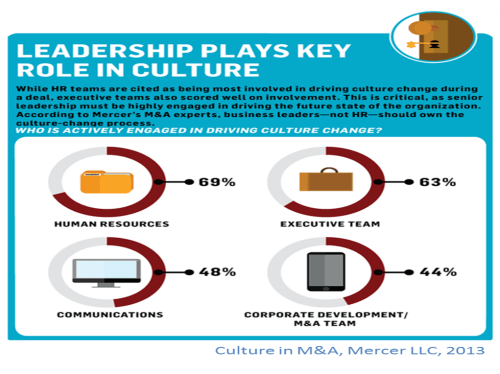
Mercer Leadership Plays Key Role in Culture

So look at it this way:  since most organizations make HR largely responsible for the cultural integration piece in M&A activity, and failure to address corporate culture is the key barrier in 85% of failed transactions, HR has an enormous opportunity to drive up the success rate of M&A activity, quantify its value and participate as a full member of the organization’s strategic leadership.

As the economy improves and M&A activity begins to ratchet up at home and globally, HR is uniquely positioned to lead real bottom- and top-line impact by taking the culture integration mantle and running with it. And by running I mean creating the business case with hard data to ensure that culture issues are pro-actively dealt with even before due diligence begins.

Because who knows more about culture than HR?

4 Comments

Filed under China Gorman, Culture, Data Point Tuesday, M&A Planning, M&A Success, Mercer

From the Archives: Job security is the #1 talent attraction magnet. Wait. What?

This was originally published on April 17, 2012.  It’s worth repeating…

In doing some research for a speech I’m giving, I came across The Talent Management and Rewards Imperative for 2012 from Towers Watson and WorldatWork.  It’s chock full of interesting data based on the 2011/2012 Towers Watson North American Talent Management and Rewards Survey and an unpublished Towers Watson 2011 survey of over 10,000 full-time employees in North America on topics such as total rewards, communication and other work-related issues.  Because I’ve been looking at data about the state of the talent pipeline (see Data Points #3, #5, #6), I thought this would be interesting reading.  Little did I know!

A couple of the data points that stood out to me challenge the “conventional wisdom.”  See what you think:

  • Only 11% of organizations have trouble retaining employees generally
  • Fully 68% of organizations identify high potentials, but only 28% inform those employees who have been identified.
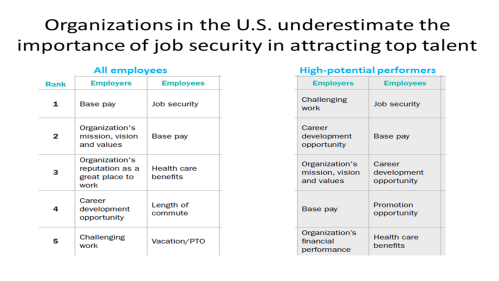
  • Organizations underestimate the effect work-related stress and work/life balance have on employee retention, and do not recognized the significance of job security in attracting top talent.

Wait.  What?

It’s the last point that brought me up short.  Look at the chart below.

There are important disconnects between what employees report will attract them into a new job and what employers believe will be important in attracting talent into their organizations.  And if you look at the differing views between employers and high potential performers you’ll be even more surprised.

In all of the writing on this topic that I have seen in the last 18 months, no one else reports the significant importance of job security as part of an organization’s EVP (employee value proposition).  And look how it ranks as #1 for all employees as well as high-potential employees.  #1.

Not meaningful work.  Not alignment with the organization’s mission.  Job security.  Am I the only one surprised by this finding?

Look at the disconnect between the top 5 factors for all employees and employers’ top 5 factors.  Outside of base pay it’s a total mismatch!

On the high-potential performers side, outside of base pay and career development opportunity it’s a total mismatch!

It looks like we’re totally out to lunch when it comes to knowing what’s motivating in terms of EVP and the talent pipeline.  Out. To. Lunch.

In a world that observes the incredible talent acquisition strategies and investments at organizations like Zappos, PepsiCo, Rackspace and AT&T, we’re encouraged to believe that creating cultures of happiness and engagement are what it takes to delight customers and retain employees – high potential or otherwise.  And I chose those organizations because I know the ground-breaking work each is doing in terms of building their talent communities and the engagement of their workforce.  They truly are ground breaking.

It turns out talent attraction may be a bit more mundane than “creating a little weirdness.”

It turns out that some of the basics like job security and base pay still hold huge sway in our workforce.  And I think this is good news.  It gives” regular” employers doing good work and being good to their employees a fighting chance to keep their employees and attract the talent they’ll need going forward.

Basic blocking and tackling.  Basic management competence.  Basic HR.  Can’t get away from them if you want your organization to succeed.

2 Comments

Filed under AT&T, Business Success, Career Planning, China Gorman, Culture, Engagement, HR, Talent Management, Talent pipeline

Data Point #9: Employer Loyalty Isn’t Dead? Wait. What?

MetLife published its 10th Annual Study of Employee Benefit Trends on March 19th, 2012.  At 80 pages, it’s a read.  But it’s a fascinating read.

The report shows clearly that the strong role of workplace benefits in driving employee attraction, retention and productivity continues as reported by these MetLife studies during the last 10 years and persists today during the slow economic recovery.  Interestingly, the study correlates satisfaction with benefits to employee job satisfaction, and also shows clearly that employees who are dissatisfied with their benefits are more likely to want to work somewhere else.

The data are fascinating.  And I recommend the investment of 30 minutes to read it through.

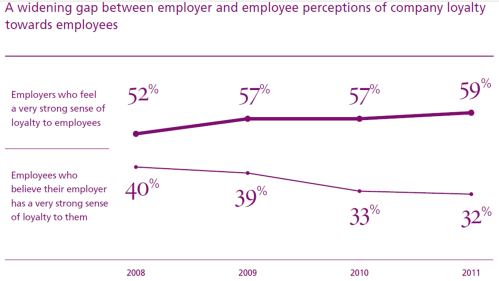
The data point that I found most interesting in the study follows:

I haven’t seen anyone discuss employer loyalty to employees in a long time.  I think I assumed, by looking at other trends, that the issue of employer loyalty was long dead.  Building employee loyalty, however, was a whole other discussion:  we call it employee engagement.  And employers are starting to pay attention to this issue because of the rapid shift in workforce demographics coming down on us like a load of bricks. (See my posts on this topic here and here.)

But where has been the focus on employer engagement? Have we all assumed that employer loyalty is dead and gone forever?  That employees “know the score” and don’t expect employers to be loyal to them?  Well, MetLife reports that between 2008 and 2011 employer loyalty scores have increased 5% from 52% to 59%!  Wait.  What?

In the same time period, however, the perception by employees that their employers are loyal to them has decreased 8% from 40% to 32%.  How pitiful is that?  Employers think they’re doing better, but employees aren’t getting the message.  And in fact, more of them aren’t getting the message as time goes on.

I think this is interesting.  Despite all the attention being paid to employee engagement – through salary, through benefits, through recognition, through providing strong ethical cultures, through providing meaningful and interesting work — in fact, the study finds evidence of a widening disconnect between employers and employees.

Job insecurity and expectations that benefits will be cut may well be contributing to employees feeling less important to their employers.  This “loyalty gap” presents an immediate opportunity for HR and C-Suite leaders to really step up communication and feedback about their increased loyalty.  Of course, the proof is in the pudding, and for employees to believe that their employer is growing more loyal to them, they are going to have to see a change in behavior – if they stick around long enough.

6 Comments

Filed under China Gorman, Culture, Demographics, Employee Benefits, Employee Loyalty, Employer Loyalty, Engagement, MetLife, Talent pipeline, Uncategorized

What’s an unconference like, anyway?


I’m really getting jazzed about RecruitFest! in Boston on October 7th and 8th.  RecruitingBlogs.com has put together a track leader line-up that looks outstanding, Monster is the big sponsor, and it’s Beantown!  How much better could it possibly get?

I have a sense of what an unconference is like and I’m eager to experience it for the first time.  I’m expecting lots of smart recruiting and talent management professionals to roll up their sleeves and dig in to some really important topics with energy and passion.  The power of focused, collective experience to generate new ideas can be awesome.  Hope we get some of that going.

 Here’s what I hope we don’t do:  have the same endless and pointless discussions about whether HR is ever going to get a seat at the table (man, I hate that phrase), or whether recruiting should be part of HR. 

 I hope we focus more positively…more hopefully…more meaningfully on what we actually can do differently to impact the performance of our organizations.  I hope we focus on what is in our power to control:  our intentions, our behavior, our risk taking.  Because if all we’re going to do is lament our lack of power and our inability to catch the eye or ear of the CEO we’ll have wasted precious time and energy. 

 I’m interested in having conversations that change behavior, that improve performance and that make us (whoever we are) more powerful.  That will be a great investment of time and energy.  That will be a great unconference. 

 Are you with me?  If so, then you should click here and register right this minute!  Because if you register before the end of the week, you’ll get a discount (use the code “chinagorman”) and you also might win the Monster VIP hotel package!  What a deal. 

I hope you’ll join us, roll up your sleeves and contribute to two days that really could change HR.  Who wouldn’t want to do that?

4 Comments

Filed under Business Success, China Gorman, Culture, Engagement, HR, HR Conferences, Uncategorized

Fear and Loathing in Orlando

I’ve just returned from the SHRM-affiliated HR Florida state conference. What an experience!  Organized and executed entirely by SHRM chapter volunteers, this conference had over 1,400 attendees in a beautiful and roomy resort in Orlando.  Carol MacDanielLori Goldsmith , Stephen M. Geraghty-Harrison and the entire team did a remarkable job in bringing a content-laden and interactive experience to the attendees.  Truly a terrific experience.

Here’s something that was validated for me in Orlando about HR professionals and social media.  Of the 1,400+ attendees at the conference in Orlando, maybe 200 were engaged actively in social media.  That’s 14%.

Knowing that this would be an issue, the folks at HR Florida did a superb job of providing sessions, support and encouragement for the attendees to start to engage with social media.  A very robust effort.

Trish MacFarlane over at HR Ringleader noticed it too.  And I agree with her identified reason for the lack of engagement:  fear.   I’m not sure what they’re afraid of, but here are some suggestions to those of us who do “get it”:

  • be encouraging
  • be role models
  • be generous with your time
  • teach and mentor
  • be patient
  • BE LEADERS

Despite the conventional wisdome that social media is only for the younger generations, a post on The Social Graf blog by Erik Sass gave some interesting data about the adoption of social media by those who aren’t young.  Here’s what it says about survey data collected from Princeton Survey Research Associates on behalf of the Pew Internet & American Life Project:

  • Among Internet users ages 50+ overall, social network use increased from 22% in April 2009 to 42% in May 2010. To boot, 10% of the 50+ cohort uses Twitter or a similar “status update” service, either to post updates or check other people’s updates.
  • Looking at specific age cohorts, social network use among Internet users ages 50-64 surged from 25% to 47%, with 20% of this group saying they check into social networks on a daily basis — up from 10% last year.
  • By contrast, social network use among Internet users ages 18-29 appears to be reaching saturation, growing from 76% in April 2009 to 86% in May 2010.

There’s a message here for HR professionals.  It says more of our employees are engaged in social media than aren’t — and not just the folks we assumed were engaged!  We have a real opportunity, perhaps even an obligation, to get out in front of our employees.

Because if they’re using social media at home they’re using social media at work.

But I get it.  It’s scary.  I held my breath when I jumped into social media when I was the Chief Operating Officer of SHRM.  And guess what?  I lived.  More to the point, SHRM lived.  My adoption of social media paved the way for greater engagement of members and non-members alike.  And it also paved the way for SHRM to begin to step up organizationally to the opportunities active social media involvement creates.  Their new public relations campaign, We Know Next, has significant social media outreach strategies embedded in it.

As a profession, we need to be able to lead the social media policy discussions, not abdicate them to the legal department or the marketing department.  As business leaders, we need to understand the implications of the use (and misuse) of social media on our corporate and employer brands.  As HR leaders, we need to be out in front of our employees and understand the impact of social media on employee engagement and our cultures.

This is the work of Human Resources.  It’s new (for most).  It involves technology.  It’s scary.  So let’s step up and support our colleagues in learning these new applications for engaging our employees and building stronger cultures.  Let’s not let fear paralyze our profession from doing its essential work:  providing strategic business leadership that positively impacts employee and customer satisfaction.

After all, isn’t that our job?

8 Comments

Filed under Business Success, China Gorman, Culture, HR, HR Conferences, Leadership, Social Media

Why isn’t your culture a tourist attraction or a profit center?

If you’re reading this blog post, you’re either a participant in the world of social media, or you’re my mom.  (Hi, Mom!)   If you’re a participant in the world of social media, you’ve heard of Zappos.  Because Zappos has been the poster child for the effective use of social media to drive sales through customer satisfaction for the last 3 or 4 years, they’re mentioned in every presentation on social media I’ve ever seen.  Heck, even I referenced them in a talk I gave to the Human Resource Policy Institute at Boston University last year.   It seems as if Zappos is everywhere in social media and more and more in traditional media – and I hear that HR professionals are starting to tire of hearing about Zappos’ success with all things social media, its engaging culture, the free tours of its headquarters (which they do 4 times a day!), and their 10 core values. 

It does seems as if Zappos and its CEO, Tony Hseih, are everywhere in the traditional print and social media scenes these days.  (Check out the current Harvard Business Review article, “How I did it…Zappos’s CEO on Going to Extremes for Customers.”)  And the topic is always the same:  Tony’s conviction that culture drives organizational success.  Period.  

Since I moved back to Vegas last month, I took the opportunity to go on the Zappos tour, meet some of their leaders, and do a little poking around.  I can understand HR folks being skeptical after all the coverage.  Usually when something seems too good to be true, it is.  But before you throw them overboard, ask questions.  Go visit.  Test them.  Don’t decide not to talk about them because you think they’re overexposed.   Because here’s the thing:  what they’re doing is working.  The hype matches the reality.

The leadership of the company is singularly focused on creating a culture based on 10 core values and it’s clear when you visit that the employees know them and live them.  Check out this video.  And you can see and hear CEO TonyHsieh talk about the culture here.   

And the results and stats are impressive.  Their turnover is low, their customer satisfaction (which they track daily through net promoter scores) is enviable, it’s harder to get a job there than it is to get in to Harvard, and they’ve successfully weathered being acquired by Amazon.  Here’s a memo the CEO sent to his colleagues last week at the one year anniversay of that acquisition.  (Note that he tweeted the public availability of this memo after posting it internally.)

You’ve seen all this before.  But here’s where the rubber meets the road.  Not only is the culture the foundation for their success, they’ve created a new company, Zappos Insights, to share their learnings, provide support, and create a community of culture focused leaders.  In other words, they’ve turned their successful culture into a profit center.

I attended a Zappos Insights Gold one-day event last month.  There were 13 of us in the group:  three leaders of a small tech firm that had just been purchased by a major telcom company; two leaders from a hip shoe business in New York City; a team of seven (including the Director) from the customer service division of a major cruise line; and me.  It was an illuminating day to say the least.  We got to talk to HR and recruiting folks, the pipeline (training) leader, managers from the Customer Loyalty Team (call center), with lots of time for interaction and Q&A.  We started, of course, with the tour of the headquarters and got to see the Zapponians at work in their natural habitat. 

I’ll be honest.  I was skeptical.  But I have to tell you the culture was palpable.  There was a positive energy in the place that I haven’t felt for some time.  With a 36 year old CEO and over 400 people in the call center, it wasn’t surprising that the average age felt like it was well under 30.  But to be fair, it felt good.  Really good. 

I had read Tony Hsieh’s new book, Delivering Happiness, before the event, so I was current on the Zappos history (which is so important that there’s a course on it in the pipeline (training) curriculum).  And I attended as a participant, but also as an observer of this phenomenon.  Gang, they’re doing great stuff.  The participants of that one day event came away with concrete information – right from the source – about how to select employees and treat customers to create a culture of success.  Adding membership to the experience keeps you in touch with others who are trying to achieve the same results and gives you a constant influx of interviews, how to’s, and other useful, practical information from the Zappos leadership team. 

So I don’t know about you, but I think there’s something to this.  Creating a culture that’s so strong it draws tourists and can be turned in to a profit center seems like a good thing to me.  What do you think?

20 Comments

Filed under Business Success, Culture, Customer service, HR, Leadership, Uncategorized