Category Archives: HR Data

7.8% Huh?

Most people saw the U.S. jobs report numbers on Friday and thought, “this doesn’t make sense.”   All the data we’ve been seeing shows that employment continues to be weak and job seekers continue to drop out of the job market.

Monster’s Employment Index for September showed a 2 point decline month-over-month:

That’s a decline in U.S. online job posting activity.  This would indicate a slowdown in hiring not a hiring urge of massive proportions.

The Glassdoor Q3 Employment Confidence Survey shows a pretty strong worsening of confidence on the part of job seekers that they’ll find a job in the next six months:

This wouldn’t indicate that job seekers see people around them getting jobs.  And 59% of employed people don’t think they could replace their job in six months.  Six months!

So what’s the deal with the massive reduction in the unemployment rate from 8.1% to 7.8%?  Well, as I wrote here, the official BLS unemployment rate combines data from two surveys conducted by the U.S. government:  The Establishment Survey which surveys employers and the Household Survey which surveys thousands of households on a range of topics including employment.  The two surveys tell two very different stories in September.

Here’s the Establishment Survey portion of the jobs report from the BLS (U.S. Bureau of Labor Statistics):

Total nonfarm payroll employment increased by 114,000 in September. In 2012, employment growth has averaged 146,000 per month, compared with an average monthly gain of 153,000 in 2011.

So we’re down from the monthly average in both 2011 and 2012.  And the monthly average in 2011 was higher than this year’s monthly average.  Nonfarm payroll employment increased by 114,000 in September.  That isn’t enough to cover the new entrants into the labor force – much less hundreds of thousands of unemployed job seekers.

The Household Survey tells a different story:

Total employment rose by 873,000 in September, following 3 months of little change. The employment-population ratio increased by 0.4 percentage point to 58.7 percent, after edging down in the prior 2 months. The overall trend in the employment-population ratio for this year has been flat. The civilian labor force rose by 418,000 to 155.1 million in September, while the labor force participation rate was little changed at 63.6 percent.

So.  Total employment – as reported by individuals not employers – rose by 873,000 in September following “three months of little change.”  Despite declining confidence in almost every other survey we see, 873,000 people reported working in September who weren’t working in August.  It boggles the mind.

Here’s where those jobs came from:

The number of persons employed part time for economic reasons (sometimes referred to as involuntary part-time workers) rose from 8.0 million in August to 8.6 million in September. These individuals were working part time because their hours had been cut back or because they were unable to find a full-time job.

Part-timers.  600,000 new part-timers.  Part-timers who could be working as little as a couple of hours a week from home. Truly, it boggles the mind.

This is all very confusing.  We’re covered over in statistics, trends and data that tell us that the employment picture is stagnant at best.  Confidence in the job market continues to decline. And the unemployment rate went down .3% in one month.

I’m with Jack Welch:  I can’t connect these dots.

5 Comments

Filed under Bureau of Labor Statistics, Connecting Dots, Employment Data, Glassdoor, HR Data, Jack Welch, Monster, U.S. Department of Labor, Unemployment, Unemployment Rate

Best-in-Class Engagement Metrics

The Aberdeen Group just published a fascinating report, The Rules of Employee Engagement:  Communicating, Collaborating and Aligning with the Business, that looks at what best-in-class organizations are doing about engagement and why they’re doing it.  Author Madeline Laurano takes a pretty deep dive into the subject and her analysis reveals some pretty intriguing conclusions.  What hooked me from the start were the three metrics for performance criteria to distinguish best-in-class companies for employee engagement:

  • 71% of employees exceeded performance expectations, compared to 14% of Laggard organizations
  • 85% of 1st choice candidates accepted an offer, compared to 8% of Laggards
  • 72% of employees rated themselves highly engaged, compared to 9% of employees of Laggard organizations

Most of the statistics we see about the value of engagement focus on tying engagement scores to financial outcomes.  No question:  we need that.  Data about the outcomes of engagement are helpful in building business cases for investing in the employee experience.

But tying other types of outcomes to higher engagement scores can also be helpful – like the number of 1st choice candidates accepting employment offers.  If a talent shortage truly is the number 1 concern of CEOs and their boards around the world, as the latest Lloyd’s Risk Survey suggests, then strategies that effectively raise the likelihood of securing the top talent you go after should be of interest. And it makes sense that A+ talent likes to affiliate with other A+ talent.

And connecting the dots between engagement outcomes and high levels of individual employee performance also makes sense.  I’ve long wondered at the value of trumpeting the engagement scores of every employee — when we all know that it’s the most effective employees’ opinions we care most about.  Linking employee performance and engagement scores makes a great deal of sense to me.

Take a look at the report.  I think you’ll find the data extremely useful.

2 Comments

Filed under Business Case, Business Success, China Gorman, Connecting Dots, Economist Intelligence Unit, Engagement, HR, HR Data, Lloyd's, Performance Feedback

HR Stakeholders

I was doing some research for a keynote speech I’ll be giving and I took another look at the SHRM Foundation’s Effective Practice Guideline on CSR.  I wrote about it here, and was reading it again, thinking “Gee this is great stuff.”  (Stuff, being a highly technical term that data geeks use a lot.)

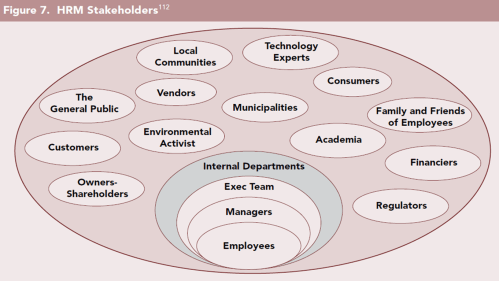
I came across this graphic of the stakeholders HR professionals need to connect with when designing and promoting CSR approaches and programs within their organizations.   As I reviewed it, I thought it was a good reminder of the breadth of the stakeholders that HR needs to factor into all of its work – whether it’s CSR, talent acquisition, talent management, benefits administration, strategic planning, learning and development – or yes, even the planning of the annual company picnic.

As I looked over the graphic, the only missing stakeholder group that I noted was the Board of Directors – but I’m pretty sure the authors include them the Owners-Shareholders group.  With the growing regulation of business and the focus on board oversight, I’d call them out as a separate group.  What do you think? Would you add any other distinct groups?

7 Comments

Filed under China Gorman, Corporate Social Responsibility, CSR, HR, HR Data, HR Stakeholders, SHRM Foundation

Low Employment vs. High Unemployment Around the World

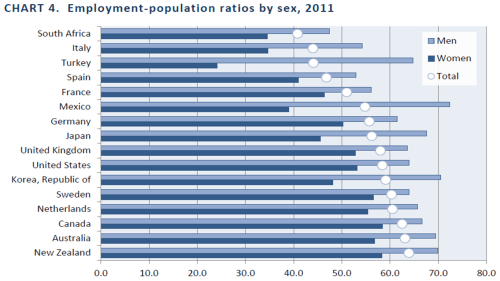
As we prepare to attract, develop and retain skilled workers around the world, who works and who doesn’t work is interesting to me.  So I thought I’d share the following charts that I ran across in a collection of statistics published by the International Labor Comparisons Division of the BLS.  The first shows a comparison of the employment population ratios (proportion of the working-age population that is employed) by sex in 16 countries, adjusted to U.S. concepts.
According to the BLS definitions, employment includes all people who:

  1. worked at least 1 hour as paid employees, working in their own business, profession, or on their own farm, or worked at least 15 hours as unpaid workers in a family-operated enterprise, and
  2. all those who did not work but had jobs or businesses from which they were temporarily absent due to vacation, illness, bad weather, childcare problems, maternity or paternity leave, labor-management disputes, job training, or other family or personal reasons, regardless of whether they were paid for the time off or were seeking other jobs.

(Actually, I don’t know which is more interesting, the definition of employment above or the chart that follows…)

It’s interesting to note the differences in employment percentages  between men and women. Turkey (40.7),  Mexico (33.4), the Republic of Korea (22.4) and Japan (22) all have differences of 20 points or more between the sexes’ employment rates, and Italy (19.5) is right there as well.  Those are big gaps.

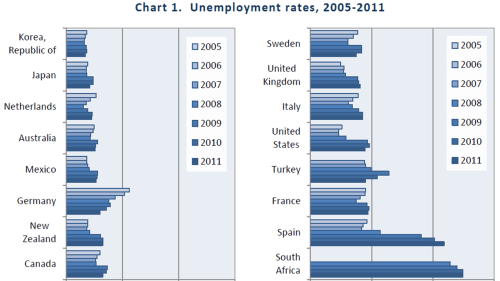
But add this to the mix:  there doesn’t appear to be a strong correlation between these low employment rates of women and the overall national unemployment rates.  See the chart below:

It intuitively makes sense that South Africa with the lowest percentage of women employed in the workforce would also have the highest overall unemployment rate.  However the relationship between these two data points isn’t as consistent as we might assume across other countries.

Look at the data for Mexico, Japan and Korea.  They all report low employment rates for women and low overall unemployment rates.  Not so intuitive.

That’s what I enjoy about people related statistics.  Just when you think you’ve figured it out, the data throw you curve ball.

What do you think the story is here?  Is it fair to try to find a pattern in data like this?  What conclusions can you draw from this?

2 Comments

Filed under Bureau of Labor Statistics, China Gorman, Connecting Dots, Demographics, Employment Data, HR Data, U.S. Department of Labor, Unemployment, Unemployment Rate

Surprise! Telecommuting Isn’t So Great for Employees…

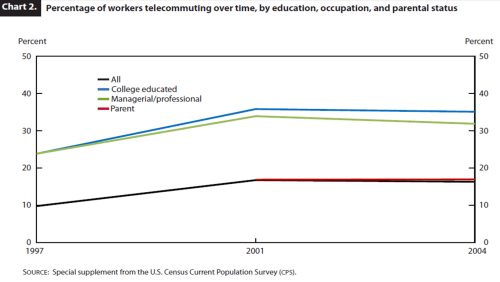
The June Monthly Labor Review published by the Bureau of Labor Statistics (U.S. Department of Labor) had an interesting article about the surprising impacts of telecommuting in the U.S. workforce.  Surprising because the data analysis show that telecommuting hasn’t taken hold to any strong degree in the U.S.  And where it has taken hold, the impact isn’t positive:   from an employee perspective, the data suggest that the impact of telecommuting is negative from a work/life integration view!

Wait.  What? Isn’t telecommuting the perk that allows employees more flexibility and balance between work and personal life?  Well, no.  The data suggest not so much.

The Hard Truth About Telecommuting, by Noonan and Glass, says:  “telecommuting appears, instead, to have become instrumental in the general expansion of work hours, facilitating workers’ needs for additional work time beyond the standard workweek and/or the ability of employers to increase or intensify work demands among their salaried employees.”

The average number of hours worked per week from home by telecommuters is small.  And hasn’t been growing to any great degree since the mid-1990’s.  What is interesting is that most of telecommuting hours are overtime hours – they aren’t replacing office hours, they appear to be growing overtime hours.  So while more and more employers tout their “work-flex” telecommuting policies, the percentage of workers who telecommute isn’t growing.

Also surprising, is that younger workers are not telecommuting any more often than more mature workers and parents aren’t telecommuting more than the population as a whole!

The big value of telecommuting, according to this report, appears to accrue to a very few higher level professional employees.  For the rest, it actually appears to encourage longer work weeks.  As the report surmises, being available to telecommute may actually allow employers to increase expectation for work availability during evenings and weekends encouraging longer workdays and workweeks – the exact opposite of the intent.

It might be interesting to take a look at your organization’s use of telecommuting and determine whether this “flexible” approach is creating more or less stress, more or the same hours, more or the same productivity – and if it’s being utilized effectively.  In other words, is it an ineffective perk that feels good to offer and merely looks great on the “best” lists or is it a productivity and engagement tool that is actually producing value for your workforce?

9 Comments

Filed under Bureau of Labor Statistics, China Gorman, Engagement, HR Data, Monthly Labor Review, Telecommuting, U.S. Department of Labor

Workforce Reporting and Analytics

A great deal is written for and about HR’s agenda in the “post recession” economy and world.  Everyone has an opinion.  To be honest, sometimes it’s a little tiring.

Because I try to stay on top of the key issues facing organizations and the management of their talent to achieve business success, I read all the reports.  So when I ran across yet another report titled Human Capital Trends 2012, I steeled myself for another rote discussion of becoming strategic, immersing the function in social media, yada, yada, yada.

Imagine my delight, when I started reading and found an actually interesting and useful report from Deloitte.  Really.  Download it here and read it.

Deloitte identifies key business trends facing organizations in 2012.  Key trends include:

  • Growth is the top priority for many CEOs this year.
  • Developing the next generation of leaders to drive future growth is a nearly universal need.
  • People risk is a risky business so HR’s role in managing enterprise risk is expanding.
  • Advanced tools are turning workforce data into powerful insights that help businesses navigate uncertainty.

There are several additional trends called out and discussed, but I found the treatment of these particularly useful.

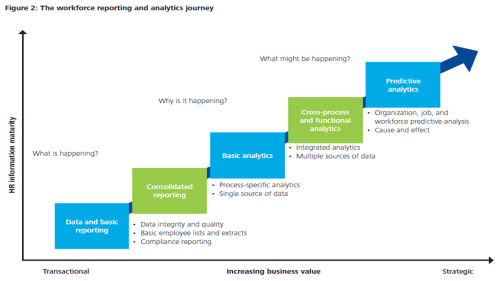
The discussion of the ability of workforce reporting and analytics to help make better, more informed decisions about people was easily understandable — for once.  For instance, I think the chart below is one of the most easily understood diagrams of how tactical reporting can lead into predictive analytics.  By breaking it down into three categories even emerging HR professionals can grasp the concept and context of predictive analytics:

  • What is happening?
  • Why is it happening?
  • What might be happening?

As far as maturity models go, this one is a winner!

I think you’ll enjoy the entire report.  It’s full of high level trends that all HR professionals will recognize as well as practical approaches to combat, overcome or exploit them.  Get a cup of coffee, your highlighter, and check out this report.

6 Comments

Filed under Analytics, Business Success, Deloitte, HR Data, Predictive Analytics, Workforce Reporting

Getting leave management wrong has consequences — and they aren’t what you think!

Leave management is one of those tactical HR functions that we’re required by law to get right.  With more than 300 state, local and federal laws/regulations with which to comply, U.S. employers have to stay on top of an ever-changing morass of guidelines that impact their employees in very personal ways.  It’s not just about vacation or PTO.

Workforce Management has published trend survey data on this topic and even though the subject of tracking employee time off is pretty tedious, the issues surrounding it are business critical.  The 2011 trend survey, published in early 2012 and sponsored by WorkForce Software, is amazingly interesting. I know, surprising, right?

For example, unless you’re the one responsible for ensuring compliance with all applicable laws/regulations, did you know that 40% of employers report an error rate of 3 or more unearned leave days per 100 employees per pay period? That’s pretty big from a payroll expense perspective.  And what do you do when you find out? Clawback the unearned time? And how do you do that? Take time out of next year’s leave pool? Ouch.

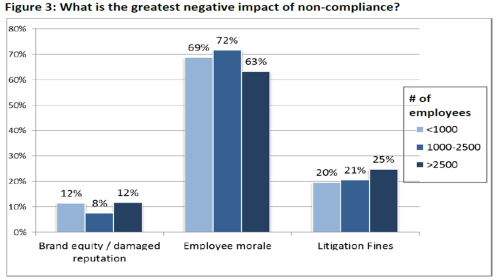
That’s why I found it really interesting that when the survey asked employers what the greatest negative impact of non-compliance was, Employee Morale was far and away the biggest impact. Regardless of the employer’s size.

Here’s why this makes sense to me:  I learned early in my leadership career that you have to get employees’ compensation right. You have to pay them the right amount; you have to pay them on time; and you have to manage their time off accurately. You can’t screw up any of these and not impact morale. And if you screw up any or all of these up more than once you’re sunk.

And so it really isn’t surprising that more than litigation fines/costs and brand equity/reputation, employee morale is HR’s biggest concern in ensuring compliance in managing time off. I don’t think this concern is driven by the old “touchy-feely” rap that HR used to get. This is cold, hard reasoning about the cost to the engagement and retention of employees if the organization can’t get the basic building blocks of paying people correctly right.

So reducing the error rate isn’t just about reducing payroll dollar mistakes, it’s about productivity and morale. There’s more interesting data in this report. You can download it here.

1 Comment

Filed under China Gorman, Connecting Dots, Engagement, HR Data, Leave Management, PTO, Talent Management, Workforce Management, WorkForce Software

“Survey Says…”

I was talking to a friend in the research/analysis business the other day and she lamented that there didn’t seem to be a firm understanding of the definitions of FTE (Full Time Equivalent) or Head Count in the HR world. Specifically, she shared that when research firms like hers send out surveys to HR professionals there frequently are demographic questions that include asking how many FTEs are in the HR function in their organization.  My friend has been frustrated by the frequency of responses that show the confusion between the definitions of FTE and Head Count and how that impacts the ability make accurate conclusions from the rest of the survey responses.

Here’s the thing:  I know that HR professionals know the difference between FTE and Head Count. But somehow, when surveys need filling out, confusion reigns.


I’ve spoken to a number of HR folks over the last couple of weeks and asked what the head count in their HR department was. They quickly came up with a number and the answer usually started with “…around…”   Then I asked what their budgeted FTEs were.  Regardless of the size of the organization, the answer started with, “well, I’m not sure. I’d have to look that up.”

HR people know head count, that’s for sure – or can come pretty darned close.  But they first ask if you want them to include temps, interns and other “off the budget” people. They literally count heads. Which, of course, is correct. Thus the term, Head Count.

If you ask for FTEs, they are frequently not sure. FTE seems to require preciseness; head count, not so much.  Maybe it has to do with the budget.  Budget-related = official:  “I’ll look it up.”  Not budget-related = unofficial:  “I can get close.”

Here’s  how SHRM defines FTEFTE is an abbreviation for full-time equivalent, which represents the total labor hours invested. To convert part-time staff into FTEs, divide the total number of hours worked by part-time employees during the work year by the total number of hours in the work year (e.g., if the average work week is 37.5 hours, the total number of hours in a work year would be 37.5 hours per week x 52 weeks = 1,950 hours). Converting the number of employees to FTEs provides a more accurate understanding of the level of effort being applied in an organization. For example, if two employees are job sharing, they constitute one FTE.

So there is a difference; and sometimes it’s a big difference.

The next time you receive a survey from SHRM, a research organization, or your C-suite, and it asks for FTE information, don’t confuse Head Count for FTE – and go ahead and look it up!

2 Comments

Filed under C-suite, China Gorman, FTE, Full Time Equivalent, Head Count, HR, HR Data, SHRM, Survey

Paycheck Pessimism

Most people in the HR space know Glassdoor™ as a social media site that gathers anonymous information about employers from current and former employees.  Users can leverage their Facebook network to uncover connections at a company, view current openings, as well as review proprietary information that includes salary reports, company reviews, interview questions, CEO approval ratings and more.  It’s an incredibly useful site for job seekers to get the real skinny on a potential employer from the people who know it best:  its employees.

Of course, for employers and HR professionals, the site offers a full array of branding and recruitment-oriented services including the ability to create enhanced company profiles, Facebook career profiles, targeted job ads and more.

But for our purposes at Data Point Tuesday, we like Glassdoor™ because of its Quarterly Employment Confidence Survey.  Couple this report with monthly BLS reports and you get a robust picture of workforce and employer confidence and other dynamics.

For example, the Glassdoor Employment Confidence Survey surveys employees on their confidence in the areas of pay raises, job market expectations, company outlook and job security.  It’s great data and it’s presented in a highly consumable format.

The most recent survey was conducted by Harris Interactive between June 12 and 14 of 2,208 adults 18 years or older and was published on July 6.  Generally the data show improving or holding steady opinions on workplace confidence dynamics by employees with the exception of optimism in pay raises.  This dropped since last quarter to 40% (from 43%), while 37 % do not expect a pay increase – a low since the survey began in Q4 2008.

At first glance this seems a little off.  Expectations for a raise are at the lowest point since the 4th quarter of 2008 – and lower than the 4th quarter of 2008 when the economy was at its worst? Aren’t we starting to feel better about the economy?  Well, some of us are and some of us clearly are not!  The report says this:

  • Employee optimism in pay raises has dropped slightly since last quarter to 40%, while 37% reported they do not expect a pay increase…
  • The gender gap is closing around expectations for a pay increase over the next 12 months; 41% of women expect an increase compared to 40% of men.  However, men’s optimism around pay has declined five percentage points since last quarter while women’s optimism crept up one percentage point.
  • Younger workers are significantly less optimistic about pay raises than last quarter; 37% of 18-34 years olds expect pay raises in the next 12 months whereas nearly half (49%) expected raises last quarter.  All of the other age ranges have increased 2-4% from last quarter – 48% of 35-55, 42% of 45-54 and 36% of 55+ year olds.

So, if I read this right, men and young people under 35 report strong declines in optimism about pay increases while women report slight increase in optimism.

Men:  down 5%

Young people:  down 12%

Women:  up 1%.

How does this track with your turnover and engagement data?  Tracking turnover data by gender and age demographic is common.  How about engagement data?  Can you make connections between this lack of reported paycheck optimism among males and young people to the engagement data in your organization?  It might be worth a look.

And it might be worth keeping an eye on during the coming quarters – particularly in relation to the election in November.  Young people played a very active and pivotal role in the last presidential election.  Is their level of paycheck pessimism such that they won’t participate as strongly?  Or will it motivate them to even higher levels of activism?  And how will that translate to your organization’s turnover and engagement rates?

This is what’s so great about data.  They let you connect import dots.  Also, they always raise more questions than answers – but if you’re interested and aware you’ll start asking more of the right questions and connecting critical dots.  And who knows?  That could lead to formulating more effective people management and business risk mitigation strategies.

Isn’t that what HR is all about?

7 Comments

Filed under Bureau of Labor Statistics, Connecting Dots, Engagement, Glassdoor, HR, HR Data, Turnover

Data Analytics: Too Sophisticated for HR?

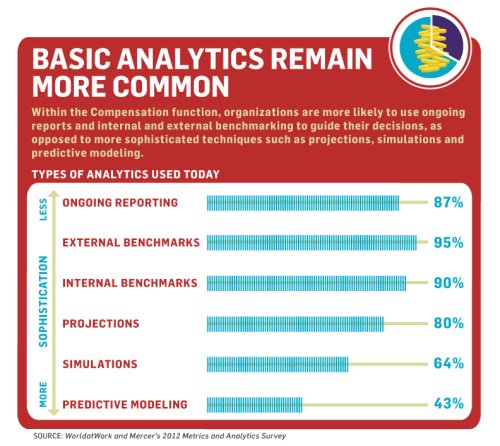
Mercer and WorldatWork have collaborated again on a survey and report about current total rewards/compensation trends in metrics and analytics.  The focus of the research was to understand what types of analytics are currently being conducted and what technologies are being used to conduct them.

It’s an interesting report – especially from the vantage point of what it says about the relationship between HR and data and HR and analytics.  The survey was fielded in February, 2012 to compensation leaders who are WorldatWork members (the dataset held 560 scrubbed responses , a final 10.9% response rate), so they all have more than a passing knowledge of the total rewards function.

The big takeaways of the survey data are that:

  • Rather than use sophisticated analytical approaches like projections, simulations and predictive modeling to support decision making, organizations are more likely to use ongoing reports and benchmarking from internal and external peer groups.
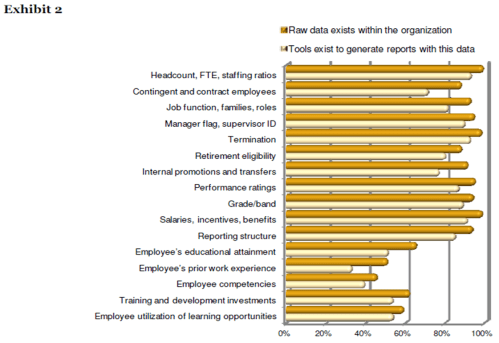
  • Survey respondents report lack of access to and confidence in data regarding education competencies/capabilities and training investments – critical to workforce analytics.
  • Compensation professionals may be falling behind their colleagues in other HR functional areas in their adoption of more sophisticated analytics methodologies.

The report discusses why adoption of more powerful analytics is low despite 67% of respondents indicating adequate skill levels to engage in higher level analytics and almost half (47%) having 1 -2 FTEs tasked with HR-related analytics.  More important, 75% of the respondents reported that C-suite executives in their organizations have asked for workforce projections, simulations or predictive modeling.

Mercer and WorldatWork point out that while respondents report that some data is not available or of poor quality, 75% of respondents say their organizations are working to improve the consistency of their data. Paradoxically, 52% are unclear where responsibility for data integrity lies.

I found it interesting that the researchers suggest that “unavailable” data may result from a lack of interest in the data rather than an ability to access it.  A compelling point.

From the responses outlined in the exhibit above, one could readily agree with the researchers that critical workforce information about education, competencies, prior work experience and investments in training aren’t top of mind for compensation professionals. It could easily be that compensation professionals believe these datasets and their analysis more naturally belong to other HR functions:  learning/development and talent management/acquisition.

The writers argue that rewards/compensation professionals have a preoccupation with the behavioral side of rewards and overlook the “asset side” – the impact of rewards on the ability of the organization to acquire appropriate talent.

The bottom line for the researchers is to encourage rewards/compensation professionals to begin to think more expansively – and use higher levels of analytics – on the role of rewards in driving human capital development and business success and focus a little less on salary competitiveness and pay-performance sensitivity as performance drivers.

A very interesting report and very useful data as you begin to plan your 2013 budget.  Stepping up your workforce analytics sophistication could be a game changer for your organization.

4 Comments

Filed under C-suite, China Gorman, Employee Benefits, Engagement, HR Analytics, HR Data, HR Technology, Mercer, Rewards & Recognition, Talent Management, Total Rewards, WorldatWork