Category Archives: SHRM

#NextChat: Change Management

Join me Wednesday, November 28 at 3:00 pm EST for SHRM’s #NextChat!  Follow @WeKnowNext, me — @ChinaGorman — and hundreds of HR professionals and SHRM members for an interactive Tweet Chat.  Our topic is Change Management.  Follow the hashtag #nextchat and join in the conversation!

Here’s the deal:

You’re introducing a new software solution for…performance management, rewards and recognition, time and attendance management…your choice.  The solution will impact every employee.  You’re heading up the change management project.  What’s next?  Check out this post before you join us on the next #NextChat.

Change management model?  What’s your favorite?

  • Kotter
  • Lewin
  • McKinsey Seven S
  • Bridges

You have the project timeline.

You have the budget.

You have the communication plan.

What are you missing?

Here are the questions we’ll be discussing.  Give them some thought and join us!

Q1:         What’s your favorite change management model and why?

Q2:         What one thing would you recommend to others as the “make or break” piece of your successful change management project?

Q3:         What member of senior management is the most critical to have out in front of a change management process?

Q4:         How much time and $ should a change management plan focus on training?

Q5:         How do you know if your change management plan was successful?

Never been part of a Tweet Chat?  Then just lurk in the background as you follow this hashtag on Twitter:  #NextChat.  You’ll have fun — and learn a lot as well.

See you on Wednesday on the interwebs!

Leave a comment

Filed under Change Management, China Gorman, NextChat, SHRM, Tweet Chat

“Survey Says…”

I was talking to a friend in the research/analysis business the other day and she lamented that there didn’t seem to be a firm understanding of the definitions of FTE (Full Time Equivalent) or Head Count in the HR world. Specifically, she shared that when research firms like hers send out surveys to HR professionals there frequently are demographic questions that include asking how many FTEs are in the HR function in their organization.  My friend has been frustrated by the frequency of responses that show the confusion between the definitions of FTE and Head Count and how that impacts the ability make accurate conclusions from the rest of the survey responses.

Here’s the thing:  I know that HR professionals know the difference between FTE and Head Count. But somehow, when surveys need filling out, confusion reigns.

I’ve spoken to a number of HR folks over the last couple of weeks and asked what the head count in their HR department was. They quickly came up with a number and the answer usually started with “…around…”   Then I asked what their budgeted FTEs were.  Regardless of the size of the organization, the answer started with, “well, I’m not sure. I’d have to look that up.”

HR people know head count, that’s for sure – or can come pretty darned close.  But they first ask if you want them to include temps, interns and other “off the budget” people. They literally count heads. Which, of course, is correct. Thus the term, Head Count.

If you ask for FTEs, they are frequently not sure. FTE seems to require preciseness; head count, not so much.  Maybe it has to do with the budget.  Budget-related = official:  “I’ll look it up.”  Not budget-related = unofficial:  “I can get close.”

Here’s  how SHRM defines FTEFTE is an abbreviation for full-time equivalent, which represents the total labor hours invested. To convert part-time staff into FTEs, divide the total number of hours worked by part-time employees during the work year by the total number of hours in the work year (e.g., if the average work week is 37.5 hours, the total number of hours in a work year would be 37.5 hours per week x 52 weeks = 1,950 hours). Converting the number of employees to FTEs provides a more accurate understanding of the level of effort being applied in an organization. For example, if two employees are job sharing, they constitute one FTE.

So there is a difference; and sometimes it’s a big difference.

The next time you receive a survey from SHRM, a research organization, or your C-suite, and it asks for FTE information, don’t confuse Head Count for FTE – and go ahead and look it up!

2 Comments

Filed under C-suite, China Gorman, FTE, Full Time Equivalent, Head Count, HR, HR Data, SHRM, Survey

A Day in the Life…

One of many things that SHRM does well is to try to evaluate the services it provides to its members. So I wasn’t surprised that SHRM sent me an invitation to evaluate my experience at this year’s Annual Conference in Atlanta. And I tried to be honest. But really, how do you give feedback to an organization that executes its biggest event so well – year in and year out?

But I’ve been thinking about the question that asked what I would recommend for future Annual Conferences.  I gave a quick answer.  And I’ve been thinking about it more and I’d like to expand on my answer.

I suggest having a series of sessions called “A Day in the Life of…”  When I answered the question I was specific: engage one of the CHROs in the Fortune 100 to describe what their job and life are really like as an example for emerging HR leaders to see. We don’t see many CHROs on any stage at SHRM. I understand all the reasons why we don’t see them, but I think SHRM needs to try harder. Presenting a role model in the flesh would be high impact.

But as I’ve been thinking about it, why not also have sessions with CHROs from a privately held company with 5,000 employees, from a public company with 25,000 employees, from a large education institution, from a think tank, from a large national non-profit, and from a pre-IPO tech start-up? Not a panel discussion. A session by each of them, individually.

Not everyone in HR wants to be the CHRO of GE, but some do. Not everyone in HR wants to be the CHRO in a privately-held company, but some do. Show them what it’s like. Show them what it takes to get there – and stay there.

And then I thought, well, how about other functions? What’s it like to be the Chief Marketing Officer in the Fortune 100 – and what do they think about and want from HR?

How about a day in the life of the CFO of a global public retailer – and what they think about and want from HR?

How about the Chief Information Officer at a large privately-held technology company?

And how about the head of Total Rewards in a Fortune 250 company – how did they get there?

The head of Talent Acquisition in a Fortune 500 company – how did they get there?

The Chief Learning Officer in a global hospitality company – how did they get there?

You get my drift. A series of “A Day in Life of…” would put real leaders on the podium to share what works for them and what doesn’t work for them.  How they got there and what they’d do over again and what they would skip. And from everyone:  what advice for emerging or aspiring HR leaders.

Not only would this be interesting for intentional HR professionals, it would be helpful for those who got here by accident and aren’t sure where to go, whether or not to stay, and what is possible.  Holding successful HR (and other) leaders up for conference attendees to hear from and get coaching from might be the next big step in speaker impact that SHRM is looking for.

As with most good ideas, this came out of several conversations I had with HR leaders in Atlanta. Thanks. You know who you are.

8 Comments

Filed under China Gorman, Conferences, HR, HR Conferences, SHRM, SHRM Annual Conference

It’s a Wrap!

Well…another SHRM Conference is in the can. In Atlanta. In the Georgia World Congress Center. More than 13,000 attendees – with more than 1,000 from outside the U.S.

Here’s my assessment:  no one does HR conferences like SHRM. Period.

  • More than 200 concurrent sessions
  • High profile keynote speakers
  • World class entertainment
  • More than 800 exhibitors in the Expo Hall
  • Social media integrated throughout
  • Involvement of more than 700 local SHRM member volunteers
  • More than 350 SHRM employees

The SHRM Annual Conference is the single largest gathering of HR professionals anywhere in the world – year in and year out. And it’s motivating and exciting to be a part of that.

And while the mechanics are impeccable, the content engaging, and the crowds impressive, the real value of a gathering like this aren’t the mechanics, content and crowds. The real value of SHRM is the personal connections we make, the conversations we have, the meeting IRL of people we only know through social media, the meeting IRL of people we read about in HR Magazine, the private coaching from our mentors, the chance meetings of people who will be new personal and professional friends.

On second thought, it’s not actually a wrap, my friends. It’s a hug. It’s a hug from our profession. It’s a hug from our colleagues, our heroes, our game changers.  And who doesn’t need a hug from time to time?

4 Comments

Filed under China Gorman, Conferences, HR Conferences, SHRM, SHRM Annual Conference

HR Talent Shortage

SHRM has just released a new report in its series on The Ongoing Impact of the Recession. The current release focuses on the Manufacturing Industry.  Previous reports have focused on the Federal Government, State and Local Government and the Finance Industry.

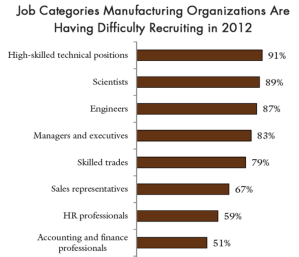
This report clearly shows the continued strong degree of difficulty in hiring professionals with STEM education backgrounds – as well as mangers and executives, the skilled trades, sales professionals, HR professionals and accounting/finance professionals. It should come as no surprise to any business leader or talent management professional that finding professionals in the U.S. with STEM backgrounds is difficult.  The U.S. education infrastructure is not producing enough graduates in these disciplines. See my posts here and here.

It is surprising to note, however, that in addition to reporting a high degree of difficulty in finding STEM professionals and skilled trade workers, manufacturing employers are also having a difficult time finding managerial and executive talent, and sales, HR and accounting/finance talent.

Hmmmm.  A shortage of HR talent. Is this good or bad news?

2 Comments

Filed under Education Deficit, Hiring Difficulty, HR, SHRM, STEM, Talent pipeline

What a Difference 3 Years Makes!

Three years ago in at its Annual Conference in New Orleans SHRM took a tiny, tentative baby step into the land of Social Media by fielding a concurrent session on HR Blogging.  It was called “HR Bloggers: who are they and why should I care?”  Four HR bloggers, 2 SHRM members and two (then) non-SHRM members) were featured in a panel discussion.  There was only one guideline:  no cussing.

The panelists, Kris Dunn (www.hrcapitalist.com), Lance Haun (www.lancehaun.com), Jessica Lee (www.fistfuloftalent.com) and Laurie Ruettimann (www.thecynicalgirl.com), spoke in language not recognized by most HR professionals about social media, tweeting and social community.  The most interesting part of the conversation to me was the discussion on whether or not bloggers should be held to commonly accepted journalistic ethical standards.

Also noteworthy about this session was the fact that it was live-streamed, a first-ever event at a SHRM conference.

And that was it. Well, if tentatively, received.  Tiny baby steps.

Flash forward 3 years and WOW!

A micro site on the SHRM website dedicated to the conference experience called The Buzz.

A social media lounge for bloggers – and there are lots of them.  The Hive – a 3,000 square foot social media hub/genius bar/meeting spot/training ground – prominently positioned and staffed by true HR social media experts to help attendees get started in social media or get more effective at social media.

Want to set up a Twitter account?  They’ll help you do it on the spot.  Want to change your FaceBook profile? They’ll help you do it on the spot.  Can’t figure out how to share a profile on LinkedIn?  They’ll help you do it on the spot.  Want to fill out your profile on SHRMConnect and get started?  They’ll help you do it on the spot.

Curtis Midkiff (@SHRMSocMedGuy), head of SHRM’s social media efforts has conceived and produced a brilliantly elegant approach to adding social media to the fabric of the conference experience.  If you’re a newbie, his team at The Hive will get you started.  If you’ve started but need help reaching the next level, his team at The Hive will get you there.  If you’re an expert, you’re welcome in the social media lounge – but beware. You will feel honor-bound to write a blog post and publish it immediately.  (Sort of like this one.)

Couple these efforts with free WiFi connectivity in the convention center and you have a benchmark, 21st century social media enabled conference.  Well done, Curtis and team.  Well done!

1 Comment

Filed under Conferences, HR Conferences, SHRM, SHRM Annual Conference, Social Media, The Hive

Maximizing Your Conference Investment

This is an updated post from August 2010.

The 2012 SHRM Annual Conference is just around the corner.  Word has it that there will be many first-timers in attendance.  This is for them — and for other attendees who want to be sure they maximize the financial and time investments they’re making.  Here are three proven strategies for making sure you get your money’s worth.

Sessions

Conferences generally have 3 types of content sessions:

  1. General Sessions:  these are sessions that are intended for the full complement of attendees.  The speakers are typically big names in the industry who speak on universal topics relevant to the conference theme or they are big celebrity names meant to draw your attendance to the conference.  SHRM does both — and usually always has a movie star or TV personality on the big stage.  Big names sell tickets, folks.  Think of them as the motivational part of the conference.
  2. Concurrent Sessions:  these are the main content tracks that are scheduled throughout the conference.  Each time slot will hold multiple options for your consideration.  Designed for smaller subsets of the conference attendees, these tend to be led by consultants, academics and a few practitioners and are focused content of a practical nature.  Think of them as the skill building part of the conference experience.
  3. Sponsor Highlights:  these are sessions that feature a sponsor or exhibitor’s product or service, are marketing-focused in nature, and come as part of their sponsorship/exhibitor fee.  SHRM doesn’t do this very often — but the exhibitors frequently hold mini-sessions in their booth space in the expo hall.  Don’t dismiss them.  You can get great information about what’s new and cutting edge as well as scope out potential new partners.  (I’ll be conducting mini sessions in the Achievers booth on Sunday and Monday.  Come over and say “hi.”)

In a typical two-and-a-half- or three-day conference, it’s important to select wisely the sessions you want to attend – and in advance.  But it’s also important not to over-schedule yourself (more on that later). I recommend attending all the General Sessions.  The big names generally have value and the celebrity speakers are usually engaging, entertaining and motivating.  Then attend concurrent sessions in about 60-75% of the time slots.

Save Time For Networking

One of the particular values of attending a conference in person (as opposed to an online conference or a series of webinars) is the opportunity to meet other like minded people.  Look at the list of presenters.  Look at the list of sponsors/exhibitors.  Find out who else will be attending.  Then target 4-8 people that you’d really like to meet and talk with – and find them at the conference.  Leaving time in your session schedule to set short appointments when you find people on your target list will allow you to be thoughtful in creating new relationships.  Don’t pass up the opportunity to learn from industry pros – who, by the way, also want to network and meet people just like you!

You know how to network, right?  You prepare for these opportunities in advance by identifying what you’d like to talk about with each target and prepare 2 or 3 questions to get the conversation rolling.  You can ask everyone the same questions, or you can customize your approach to each person.  Your confidence will be strong as you introduce yourself to these folks and you’ll be surprised how amenable perfect strangers are to meet and talk with you.

If you aren’t on Twitter or FaceBook, now would be a good time to start accounts.  Many of the people you want to meet are using social media to connect with new and old friends.  I’ll be there.  Connect with me.  On Twitter I’m @ChinaGorman and it’s easy to friend me on FaceBook.  Just mention #SHRM12 in the invitation and I’ll accept.  Social media will be prevalent in Atlanta.

Nothing is More Attractive Than a Smile

As you walk the conference halls and expo aisles, make sure your demeanor and body language is open.  And smile.  Intentionally.  You’ll appear open, friendly, not intimidating or intimidated.  Really, there’s nothing more attractive than a smiling face.  And there’s nothing that builds your confidence to approach strangers than acting open and welcoming.

Attending a conference and getting your money’s worth isn’t hard.  But it takes some forethought and planning.  Both you and your organization want to realize the investment it took to get there.  Make sure you get the full value of the experience.

5 Comments

Filed under Achievers, China Gorman, Conferences, HR, HR Conferences, SHRM, SHRM Foundation, Talent Management

Data Source Highlight: SHRM Foundation

From time-to-time we won’t discuss a particular data point, we’ll highlight a particular data source.  Due to the ubiquity of content on the web, it’s important to find trustworthy and relevant sources of data.  Today, I recommend the SHRM Foundation.

You don’t have to be a SHRM (Society for Human Resource Management) member to avail yourself of the wealth of knowledge published for free by the SHRM Foundation, SHRM’s separate 501(c) (3) nonprofit affiliate.  The Foundation’s mission is to “advance global human capital knowledge and practice by providing thought leadership and educational support, and sponsoring, funding and driving the adoption of cutting-edge, actionable, evidence-based research.”

In addition to providing scholarships to SHRM members for degree completion and certification, the Foundation performs two very important functions for the Human Resources profession:

  • It is one of the leading funders of rigorous academic HR research
  • It creates educational resources for the profession, including EPGs (Effective Practice Guidelines) which makes research findings easily accessible.

I make this introduction to the Foundation because many in HR don’t know what the Foundation does for all HR professionals – SHRM members or not – and so don’t avail themselves of the research that is practical and relevant to the job of HR.

Of the most useful of the Foundation’s products, EPGs integrate current research findings on what works in real life with expert opinion on how to conduct HR effectively and have been published on a wide array of topics critical to talent and organization management success.  Recent EPGs have included:

  • Human Resource Strategy
  • Promoting Employee Well-Being
  • Recruiting and Attracting Talent
  • Retaining Talent
  • Developing Leadership Talent

Case in point:

HRM’s Role in Corporate Social and Environmental Sustainability, the newest in the series of Effective Practice Guidelines (EPGs) from the Foundation.

Want a readable, rigorous overview of how HR can integrate CSR and environmental sustainability into the culture of an organization?  Want to know what new competencies you need to develop to be a credible leader in this regard?  Want a roadmap to embed CSR and ER into an organization’s mission so that “its impacts on employees, communities and their stakeholders align with the sustainability vision” of the organization?

In 31 pages, noted CSR experts Elaine Cohen, Sully Taylor and Michael Muller-Camen provide an extraordinary review of what the research says, what effective practice looks like, the inclusion of several case studies and the introduction of successful organizational models – all written for easy consumption by HR practitioners.  It’s a goldmine of information.

For example, early in this EPG, a discussion of the different manifestations of CSR ends with this very useful diagram:

This visual, based on work by Archie Carroll, brings useful context to any business discussion about CSR – and would be a strong starting point for any business case an HR professional would bring forward.  The Foundation’s EPGs are full of these kinds of easy to understand and extremely useful data points.

If you aren’t familiar with the SHRM Foundation’s EPG series, I recommend that you visit their site and start browsing the titles.  I guarantee that after reading one you’ll not only feel smarter – you’ll actually  be smarter.

Full disclosure:  I served on the SHRM Foundation Board of Trustees from 2007 – 2010.

2 Comments

Filed under Corporate Social Responsibility, CSR, Effective Practice Guidelines, Environmental Sustainability, SHRM, SHRM Foundation, Uncategorized

Data Point #11: Talent optimism vs. realism

We’re surrounded by all kinds of data points about the talent/skill shortage.  I wrote about it here and here.  Today we have two data points:  one comes from SHRM’s Q2 2012 Jobs Outlook Survey Report and the second comes from the BLS 2012 Occupational Outlook Handbook.

SHRM’s Jobs Outlook Survey has some interesting data from a small sample of its 250,000+ members.  (This particular survey was sent to 3,000 randomly selected SHRM members with 336 members responding, for an 11% response rate.)  These quarterly JOS surveys ask HR professionals interesting questions about optimism in job growth, planned changes in total staff levels, categories of workers companies will hire and categories of workers most difficult to hire in the previous quarter.

I was particularly interested in the responses to the question asking which categories of workers were most difficult to hire in the 1st Quarter of this year.  The sample is small (n=246), so the data are directional at best, but do line up with other data sources.
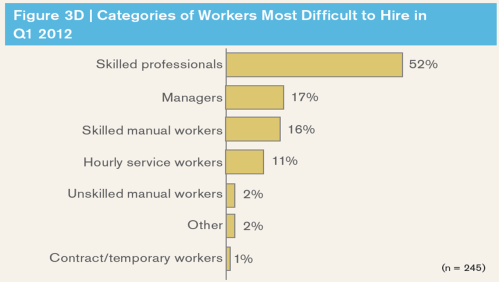
This data is congruent with BLS (U.S. Bureau of Labor Statistics) data relative to education level attainment and the corresponding unemployment rates in April.  The higher the unemployment rate, the lower the difficulty to hire:

  • Less than high school:                                   12.5%
  • High school no college:                                  7.9%
  • Some college or Associate degree:               7.6%
  • Bachelor’s degree or higher:                         4.0%

In other words, it’s more difficult to find skilled professionals and managers in this job market because there are fewer of them unemployed and there are fewer of them overall.  It’s easier to find service workers and unskilled manual workers because more of them are unemployed and there are more of them overall.

But still, as the SHRM report highlights, employers are having difficulty in hiring at all levels.  Which makes me wonder:  are we being unnecessarily restrictive in our job specifications?  Are we hiring people with college degrees when an associate degree would suffice?  Are we requiring associate degrees when a high school degree would be adequate?  I don’t know the answer, but considering the data is interesting.

The Occupation Outlook Handbook, published by the BLS, shows the projected job growth by education category in the 2010-2020 decade:
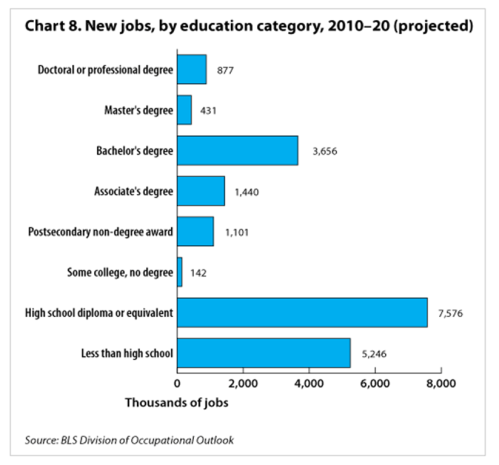
While the number of jobs created in this decade that will require a Bachelor’s degree or higher is predicted to be nearly 5 million, the number of jobs predicted to be created requiring some college/no degree or less is nearly 13 million.

So if the key to employment (and financial) security for the average worker is a Bachelor’s degree, but the greatest numbers of jobs being created in the next decade won’t require a Bachelor’s degree, how do we reconcile this as employers?

Do we hire college educated workers for jobs that only require a high school diploma?  Are we already doing that now?

Do we work to raise the general level of worker education because we believe it’s the key to global competitiveness?

Do we encourage students to enroll in career and technical education programs in and after high school rather than college because those are the skills needed in the economy?

The data around employers having difficulty finding the talent/skills they need isn’t as simple as it looks.  It’s actually quite challenging.  Under every layer of data is another layer of data.  Solving our talent attraction and acquisition needs won’t be solved with one tactic. But it’s a safe bet that solving our talent challenges will include strengthening relationships between employers and the education infrastructure to produce the skills our economy really needs.

As I look at the data, the optimist in me says we’re covered over in opportunity.  The realist in me says we’ve got a lot of work to do and not a lot of time in which to do it.

7 Comments

Filed under Bureau of Labor Statistics, China Gorman, Demographics, Education Deficit, Employment Data, HR, Post-secondary education, SHRM, Talent Management, Talent pipeline, U.S. Department of Labor, Uncategorized, Unemployment, Unemployment Rate