Fighting for a Pessimistic Workforce

data point tuesday_500

OK.  So there’s an awful lot to be pessimistic about these days.  That goes for Baby Boomers, Millennials and Xers.  That goes for your workforce.

There’s the economy, the unemployment rate, cost of benefits, the fiscal cliff, taxes, the soaring price of college educations, the high school dropout rate…  There’s a lot. And Mercer has captured some critical information about how this pessimism – that isn’t going away – is coloring the views of the future held by many of your employees.

The questions we need to ask ourselves are:  how do I engage and motivate a workforce mired in pessimism, and, how do I (we) counteract a perceived environment of scarcity?

The recently published 12th annual 2012 Mercer Workplace Survey provides results that should give any HR professional more than a momentary woah! as we think about these questions. The survey has a cross-section of active 401(k) participants who were also enrolled in their employer’s health plan.  1,656 participants were interviewed online in June of this year.

The high points include:

  • US employees are still concerned about saving enough for retirement
  • Workers over 50 are more concerned than their younger counterparts about their job security and have much lower retirement expectations
  • Workers perceive that the value of their benefits has dropped

If you haven’t surveyed your workforce lately, this report’s results might just motivate you to start asking some questions.  Questions beyond, would you recommend our organization as a good place to work?

Other nuggets from the survey:

  • 36% of the respondents over 50 are still concerned about losing their jobs, its highest level since 2007 (25%)
  • a survey record 44% of all respondents have considered delaying their retirement – with 59% of those aged 50+ considering delaying their retirement, up four points from last year
  • 62% of those over 50 believe they will have to work at least part time when they do retire vs. 48% of younger workers

Mercer Putting Off Retirement

Data like this can be helpful in knowing what questions to ask yourselves and your workforce as you deal with the talent challenges that face most organizations.

  1. If Baby Boomers are putting off retirement indefinitely, how do we keep the Millennials who want those jobs engaged and continuing to develop their skills?
  2. If all workers – and Baby Boomers in particular – are concerned about job security how do collaboration and innovation fare in a culture of perceived scarcity?
  3. If Baby Boomers believe that they’ll have to work part time once they do retire, how can we harness that experience in a win-win solution?

Pessimism is insidious.  It worms its way into your workforce and destroys your employees’ visions (and expectations) of a bright future for your organization and for them.  While it’s true that many of the concerns that are driving employee pessimism are out of your control (the fiscal cliff, taxes, politics, healthcare costs, etc.), you need to find powerful, positive evidence in the organization that will counteract the pessimism attacking from the outside:  a strong, ethical culture; authentic and transparent leadership; a focus on employee and customer engagement; commitment to learning and development – all of these can convince a workforce that, although the outside world may not be as friendly as it could be or once was, the inside world of your organization is a place worthy of the investment of time, commitment and heart.

Of course, you have to believe that first.

Leave a comment

Filed under Baby Boomers, China Gorman, Connecting Dots, Engagement, GenX, HR Data, Mercer, Millennials, Retirement Planning, Talent Management

Skills Shortage or Inflated Job Requirements

HR Examiner logoI have a guest post over at HR Examiner today.  Editor John Sumser has started a series of posts on the skills shortage.  You really should read it.  And my post, too.

Leave a comment

Filed under Uncategorized

If They Want Cake…

data point tuesday_500

I was reading the results of the recent Making Smart Benefit Choices survey of workers by Mercer and was struck by the confluence of societal issues that are impacting the choices workers are making today.  The key insights from the survey results are these:

  • Workers desire benefits with a decidedly short-term benefit over those with longer-term value
  • Employers need to ramp up their workforce education efforts regarding balancing short- and long-term benefit choices

Employers are not Marie Antoinette.  “Let them eat cake” cannot be an appropriate response when surveys show that cake would be a more popular benefit than, say, fruit or broccoli.  (Mayor  Bloomberg’s foray into the regulation of food options notwithstanding.)

So in the age of disappearing and underfunded defined pension plans and the very real specter of a bankrupt Social Security system in the US (and similar situations in most developed nations), what are the responsibilities of employers to their employees when considering changes in benefit plans?  How much should employers take into account their employees’ preferences for short-term gain over long-term value?

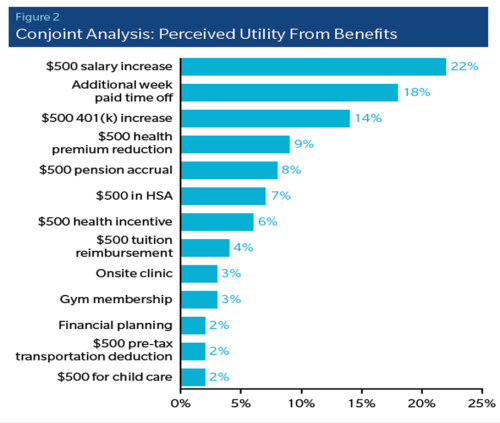
It’s interesting to note this survey’s results.  In part, respondents were asked about their preferences in a trade-off (conjoint) analysis that allowed Mercer to rank 13 core benefits.  A salary increase of $500 was used as the benchmark variable against which to measure how benefits are valued by workers.  Here is the chart with the results:

Mercer Making Smart Benefit Choices 2

I’m fascinated that after a $500 salary increase, the next choice is one week of paid time off.  This certainly synchs with the data that SHRM and the Families and Work Institute are publishing that more flexibility over time is becoming a cultural imperative – and the financial value of a week off is greater than $500 if you’re making more than $26,000 per year.

But given the state of retirement benefits, Social Security, and the general lack of preparedness of the workforce for retirement, the short term focus of the respondents is arresting.

But then again, we live in a business world that measures organization success quarter by quarter, rather than year by year or through business cycles.  We live in a political world that brings the economy to “fiscal cliffs” with some regularity.  We live in a society that appears to value now in ways that leave us unprepared for tomorrow.

So I guess it really shouldn’t surprise us that workers focus on now rather than tomorrow even though an additional $500 402(k) increase would have much greater value over time.  What’s an employer to do in all good conscience?  Give more paid time off or ensure a little more retirement stability?  Give more paid time off or reduce employees’ share of health care costs?

This is a tough one with which HR and Benefits leaders in organizations of all sizes are wrestling.  Employers surely want benefits packages that attract and retain their best and brightest talent.  Employers surely want their employees to be better prepared for an uncertain financial future.  It seems as if these may be in conflict, based on this survey’s results.  So how to decide?

“Let them eat cake” is one way to go:  continue the focus on now and leave the future to the business and policy and political leaders of the future.

I think I’d rather use some of today’s resources to educate my workforce so that they’re making truly educated choices.  I think I’d rather use some of today’s influence to begin to leave behind the now focus for a future focus that might ensure a little more sustainability all around.

While I love cake – especially the chocolate kind – I think that employers have a responsibility to the economy and to the future as well as to the workforce.  What about you?  Are you a cake or a broccoli professional?

5 Comments

Filed under China Gorman, Connecting Dots, Employee Benefits, Families and Work Institute, HR, Mercer, PTO, SHRM, Sustainability, Workflex

Wake Up and Smell the Quality of Hire!

All eyes are focused on talent acquisition these days because:

  • The talent pipeline is dwindling
  • Our education system doesn’t prepare young people for actual work
  • Baby Boomers are about to take a hike and never look back
  • Millennials’ tenure averages  18 months
  • Facebook is the new Monster (not)
  • LinkedIn is the new Career Builder (not)
  • Job seekers won’t fill out application forms any more
  • Passive candidates are where the action is
  • Unless you have an online talent community your organization won’t be able to compete successfully for talent
  • Students graduating from college only want to work for Google

These are just a few of the things we “know” about talent acquisition these days.  Some might even be true – or close to true.  But what most definitely is true is that the pressure for talent acquisition performance is building.

Analyst Madeline Laurano’s recent report Stratgic Talent Acquisition:  Are You Prepared to Hire the Best? from the Aberdeen Group is a great place to start if you’re starting to feel the pressure.  The data is current, the analysis is fascinating and the conclusions will get you started in the right direction with a clear picture of the end state.

I especially like the Aberdeen Group’s research model that identifies Best-in-Class Performance, Competitive Maturity Assessment and Required Actions.  It’s a great approach for any research as it provides the high points with guideposts for action and recognizable benchmarks to measure progress.

Because so much attention and discussion is currently focused on talent acquisition, I think the three key performance criteria that Laurano shows distinguish Best-in-Class performance will make any HR professional wake up and smell the coffee:

  • 91% of first year employees were retained
  • 86% of key positions were filled internally
  • 23% year-over-year improvement in hiring management satisfaction

Really.  86% of key positions filled internally?  On what planet?  That’s effective talent management right there.

As you read the report, it comes as no surprise, then, that the big new bottom line is this:  Quality of Hire – not time-to-fill or cost-per-hire – is the game changer.  Focus on that, and you’ll have a direct line to profitability.  And retention.  And performance.  And the ability to develop talent internally.

So, for the 97% (!) of organizations that have no long-term approach to talent acquisition, taking an hour to read this report could give you what you need to move your talent acquisition results to a new level of effectiveness and business impact.  So plug in the coffee maker.  It’s time to wake up and smell the Quality of Hire!

5 Comments

Filed under Aberdeen Group, China Gorman, Connecting Dots, Quality of Hire, Talent Acquisition, Talent Management

#NextChat: Change Management

Join me Wednesday, November 28 at 3:00 pm EST for SHRM’s #NextChat!  Follow @WeKnowNext, me — @ChinaGorman — and hundreds of HR professionals and SHRM members for an interactive Tweet Chat.  Our topic is Change Management.  Follow the hashtag #nextchat and join in the conversation!

Here’s the deal:

You’re introducing a new software solution for…performance management, rewards and recognition, time and attendance management…your choice.  The solution will impact every employee.  You’re heading up the change management project.  What’s next?  Check out this post before you join us on the next #NextChat.

Change management model?  What’s your favorite?

  • Kotter
  • Lewin
  • McKinsey Seven S
  • Bridges

You have the project timeline.

You have the budget.

You have the communication plan.

What are you missing?

Here are the questions we’ll be discussing.  Give them some thought and join us!

Q1:         What’s your favorite change management model and why?

Q2:         What one thing would you recommend to others as the “make or break” piece of your successful change management project?

Q3:         What member of senior management is the most critical to have out in front of a change management process?

Q4:         How much time and $ should a change management plan focus on training?

Q5:         How do you know if your change management plan was successful?

Never been part of a Tweet Chat?  Then just lurk in the background as you follow this hashtag on Twitter:  #NextChat.  You’ll have fun — and learn a lot as well.

See you on Wednesday on the interwebs!

Leave a comment

Filed under Change Management, China Gorman, NextChat, SHRM, Tweet Chat

Competence: Enemy of Change?

When organizations are planning to introduce some kind of change into their system – structural change, new technology, new leadership, the merging in of an acquisition – planning for the implementation is key, right?

Usually a change management model is chosen on which to build the process, and there are lots of them:

  • Bridges
  • Kotter
  • McKinsey Seven S
  • Lewin
  • Nadler Tushman

Each of these models places an extreme value on communication.  And rightfully so.  Most experts advise that when you think you have communicated enough about change…communicate some more.  Not bad advice.

But the advice that almost every model neglects is this:  spend more time training than communicating; spend more money on training than on communication; spend more leadership time and energy in training than in being visible; spend more innovation on training than on well, innovation.

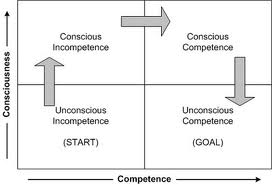
Here’s the deal:  adults like to be competent.  It’s important to them.  It’s motivating because it generates feelings of mastery and gives the sense of control.  When you introduce change that suddenly makes them incompetent, productivity plummets.  When you make them incompetent, morale decreases. When you make them incompetent, turnover increases.  When you make them incompetent and don’t give them a fast path to competence, your change management process is sunk.

Burch’s work for GTI that identifies the pathway from unconscious or conscious incompetence to unconscious or conscious competence ought to be at the heart of any change management process.  You want your employees to adopt your new technology solution?  Be sure your change management process focuses primarily on moving your employees out of conscious incompetence to conscious competence ASAP.

Because guess what?  Communication doesn’t cure incompetence.  Telling doesn’t change behavior, training changes behavior.  So change management plans that focus more on communication than training don’t achieve the desired adoption outcomes.

All but the most change hardy in your workforce – that small percentage of Early Adopters – will resist changing because being competent is everything.  And that old technology solution you decided to replace?  Well, everyone was competent on it.  And now, with the decision to move to a Cloud-based, mobile-enabled, SaaS solution, you’ve made them all incompetent.

So help them out.  Communicate like crazy.  And get the C-Suite involved.

But spend every waking minute ensuring that that training on the new solution is available 24/7.  That it’s available in classrooms and webinars.  In every language your workforce speaks.  In every location your workforce reports to duty. During every shift your workforce works.  Multiple times.  Let your employees participate in the training more than once.  Make it easy and convenient to get competent.

And when the project goes long and over budget, don’t you dare touch the training budget.  In fact, if it goes long and over budget, increase the training budget.

Because competence is the enemy of change.

11 Comments

Filed under Change, Change Management, China Gorman, Concious Competence, Concious Incompetence, Connecting Dots

From Tragedy to Triumph

As an employer, how are you feeling about the epidemic that is our high school dropout rate?  As an employer, how are you evaluating the quality of students who do manage to graduate from high schools in the communities where you have operations?  As an employer, would you like to have educated, motivated, enthusiastic high school graduates lining up outside your employment office ready to start their careers with your organization and committed to making a difference for you, your customers and your community?

If you’re like Verizon, AT&T, Archer Daniels Midland, McDonalds, Apollo Group and many more employers of all sizes, you’re already supporting the work of JAG (Jobs for America’s Graduates) in 32 states and 1,000 communities to provide support to the most at-risk high school students in the toughest high school situations imaginable.

JAG programs this year supported more than 43,000 such students and achieved a 94% graduation rate.  Let me write that again:  JAG programs this year supported more than 43,000 such students and achieved a 94% graduation rate.  In the high schools with the most disenfranchised students:  inner city schools, Indian reservation schools, forgotten rural schools, crime-ridden schools, underfunded schools, JAG is working a kind of magic.

At its Annual Leadership Awards Event last week in Washington, D.C., 300+ JAG student leaders and almost as many of their teachers came together to attend the JAG 2012 National Student Leadership Academy and to celebrate their success in overcoming all the odds stacked up against them. (Here‘s my review of last year’s event.)

Two student leaders took to the podium during the luncheon to talk about their journey “from tragedy to triumph,” as Darnell Willliams described his life experience.  Darnell, currently a college student interning in the South Caroline Department of Employment & Workforce, described how JAG opened a door for him.  “The door had a sign that said One Way:  Up!”

Sage Zephier, a senior from Wagner, SD (which sits in the Yankton Indian Reservation) has a 3.0 grade point average; scored a 26 on the ACT; is a three sport athlete in football, wrestling (state) and track (state) and will attend college in the fall to the study athletic training and psychology.  His journey from tragedy to triumph would truly make you stand up and cheer.

Both Sage and Darnell have battled the worst that a young person could face – and it would be completely expected for them to have fallen between the cracks of social and family services, education systems, tribal systems and community safety nets.  Except someone forget to tell that to Sage and Darnell.  And that someone was the JAG Specialist in their high school.  That’s the person who convinced these two young men – and thousands of other girls and boys – that they mattered.  That they had a future that included education, jobs, financial security, the ability to contribute to their community and the ability to make a difference for others.


In 2012 there are more than 43,000 young people with stories similar to Sage and Darnell who are beating the odds and succeeding in high school and planning to go to college, enter the military or secure a job.  These are kids we would not have expected to make it out of 10th grade, much less graduate from high school.

Since the first high school adopted the JAG program and curriculum 32 years ago, nearly 1,000,000 young people who most likely would have never been able to contribute positively to the economy have graduated from high school, gone to college, served our country in the military and started successful careers – all of which changed the employment and economic trajectory of their families.

So.  As an employer, would you like to have educated, motivated, enthusiastic high school graduates lining up outside your employment office ready to start their careers with your organization and committed to making a difference for you, your customers and your community?

If your answer is yes, then you know what to do.  Get involved with the JAG organization in your state.  Support it financially and sit on its board of trustees.  If JAG isn’t yet in your state, start a conversation with your Governor and get it going!  The contributions you make today to support JAG in your community will come back to your organization in the form of successful students who are ready to commit to your success – and their own success.  Young people like Sage and Darnell.  Trust me:  you’d hire them in a heartbeat!

1 Comment

Filed under Apollo Group, Archer Daniels Midland, AT&T, China Gorman, High School Graduation Rates, JAG, Jobs for America's Graduates, McDonald's, Talent pipeline, Verizon

What Gets Your Employees Out of Bed in the Morning?

SHL Talent Analytics™ has published a white paper that you need to read if you are involved with acquiring, developing or managing talent.  And that would be everyone in HR.  The SHL Talent Report: Big Data Insight and Analysis of the Global Workforce is a thorough review of the state of talent – especially leadership talent – around the world.  Using their vast global supply of data from organizational surveys, almost 4 million assessments from almost 200 countries, and the work of 300+ occupational psychologists, authors Eugene Burke and Ray Glennon provide compelling insights into the state of today’s talent as well as opportunities to prepare tomorrow’s talent for success.

The white paper covers the following talent issues with data that is deep and makes it easily understandable:

  • Leadership
  • Innovation
  • Organizational Risk
  • Diversity
  • Global Distribution of Critical Skills

Each section is compelling and could stand alone in its organizational usefulness.  At 72 pages long, though, it’s a not a tough read.

I was particularly taken with the section on Diversity.  Its discussion of gender and leadership should be required reading for all those involved in the acquisition and development of talent headed to the C-Suite.  (I wrote about that here recently.)

But even more interesting was the discussion of generational differences.  This is a topic that won’t go away for those in the talent management business –for good reason!  Burke and Glennon believe “it’s not really about gender and generations…it’s about the best person for the job and having managers who know how to leverage differences effectively.”

Right.  How many times have we heard this?  But the data they share are compelling.

I’ve seen a great deal of analysis that show that, while the values differences between generations are more a difference in  order of importance than a complete difference in values, these data show the impact of the difference in order of importance in a pretty dramatic visual:

Think about the beleaguered manager in your organization who has all three generations represented on their team.  Do you think they understand these motivational and values differences?  Do you think they interact and communicate differently with their team members in order to engage their team?  Do you think they have the skills to leverage these generational differences in ways that motivate their team to greater productivity and efficiency?  Do you think they could use these insights to become a more effective leader?

What would be the impact on turnover, engagement and performance if all the managers in your organization had these insights and knew how to leverage them?

And, oh by the way, what gets you up in the morning?

2 Comments

Filed under Baby Boomers, China Gorman, Connecting Dots, GenX, HR Analytics, HR Data, Millennials, SHL, Talent development

Voices of JAG

Now more than ever we need Jobs for America’s Graduates.

JAG is currently operating in 32 states with more than 800 local program affiliates.  If JAG is in your state you need to get involved.  If JAG is not in your state you need lead the way for its introduction.

That is all.

Leave a comment

Filed under China Gorman, Connecting Dots, Education Deficit, High School Graduation Rates, JAG, Jobs for America's Graduates

The 40 Hour Workweek is Alive and Well…

…said no one recently anywhere in the world.

I know this will come as a shock to business people everywhere – especially those in Human Resources. But here’s the data from Hogan Assessments:

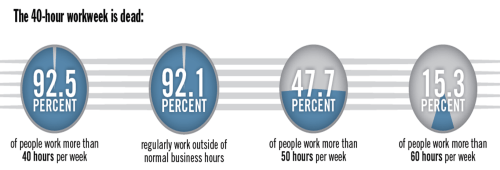
Virtually everyone (92.5%) who works a full time job around the world works more than 40 hours per week.

Virtually everyone (92.1%) who works a full time job around the world regularly works outside of normal business hours.

Nearly half (47.7%) of workers work more than 50 hours per week.

And 15.3% of people work more than 60 hours per week.

I blame technology, smart phones and social media.  How about you?  How many hours a week do you work?

1 Comment

Filed under China Gorman, Connecting Dots, Hogan Assessments, HR, HR Data