What Comes First: Employees or Customers?

As a business leader, I’ve always believed that one of the most important aspects of my job is to create and lead a culture that motivates employees to come to work every day and do their very best work.  I’ve always known that in order to acquire, delight and retain customers my organizations (at the local, regional, national and global levels) needed to acquire, engage and retain the best talent.  I’ve always known that the link between customer and employee satisfaction is strong.

Over the last few months I’ve been able to take the time to read some great books, articles and research reports; to meet with thought leaders and executives; and to attend conferences and courses focused on these aspects of organization and leadership success.  Now I’ve got more than a “gut” instinct that the focus on creating a culture that puts customers first by recruiting, developing and retaining the right employees brings dividends that are more than repeat customers and happy employees.  Now I’ve got real data.
Where did I get the data?  I’ve read research reports from BlessingWhite, Gallup, SHRM, the U.S. Department of Labor and others.  I’ve read books by Chip Conley, Mark Sanborn, Geoff Colvin, Leigh Branham and Mark Hirschfeld, Tony Hsieh, Jim Collins, Dave Logan, John King and Halee Fischer-Wright and Jonathan Haidt among others.  I’ve had conversations with Tony Hsieh, Dave UlrichDoug and Kimberly Rath, Cathy Missildine-Martin, Paul Hebert, Joe Gerstandt, Jason Lauritsen, Chris Hoyt, Lars-Henrik Friis-Molin, John Sumser, William Tincup and many others.  Basically, I’ve been a sponge.

And the outcome?  Well now I see clearly that while having happy, committed employees is critical for organizational success, having the right happy, committed employees makes the difference between good customer service and exceptional customer service;  the difference between good organization performance and exceptional organization performance — by any measure you wish to use. 

The right happy employees are determined by what will exceed the customers’ expectations.  And that’s about culture and values. 

To create a culture that retains happy employees feels good on many levels.  What leader doesn’t want to walk around and see smiling faces on their employees?  But to create a culture that retains employees happy to make your customers ecstatic is the secret sauce of organization success. 

The reason for an organization’s existence is not to create a “happy” environment for employees.  The reason for an organization’s existence is to create value for its stakeholders by serving its customers.  You win in business by serving your customers better than anyone else.  And it’s clear to me now that the key to serving your customers better than anyone else lies squarely in creating a culture that attracts and retains the right employees.  I’m not sure many leaders see the difference here, but it seems huge to me.

In the hard work of creating a motivating culture almost every organization starts with their employees:  what makes them happy, what will engage them, what will motivate them to commit over the long haul.  I’ve come to believe that the hard work of creating a motivating culture needs to start at a different place:  conversations with customers and potential customers.  What is important to them in their interactions with your employees?  What values will motivate their engagement, their commitment over the long haul?  Once you have that input you can begin to translate it into organizational values, characteristics, behaviors and skills that become the basis for your culture work – and, ultimately, your talent acquisition, engagement, development and retention strategies.
It’s clear to me that both culture and organization success has to start with the customer.  Only then will you know what kind of talent acquisition, engagement and retention strategies will lead to the type of organizational success that will value your organization among the strongest financial performers and land you on the lists of best companies to work for. 

In other words, when creating and leading your organization’s culture look first to your customers and second  to your employees. 

Most do it the other way around.

15 Comments

Filed under Uncategorized

Chynna or China?

I’ve been doing a lot of public speaking lately:  keynotes, workshops, “chapter” meetings, business group talks, etc.  This is an activity I really enjoy and have been doing for years.  I’ve been fortunate to speak to business, academic and professional groups all over the world including Warsaw, Eindhoven, Zurich, Lisbon, Prague, Beijing, ShangHai, and Mumbai as well as great domestic locations all over the U.S.

 These experiences have been notable for a number of reasons:

  • People of all walks of life all over the world want to be connected with their counterparts
  • The issues and concerns of these populations truly are more alike than different
  • There is a continued thirst for learning everywhere in the world
  • Technology usually works (don’t know why that is notable, but it is)
  • The audience is always surprised (pleasantly, I think) at my desire to really connect with them in a personal way
  • The people who introduce me usually get some important fact wrong in the introduction

I was promoted to CEO by introducers long before I was ever in the C-Suite.  More than once I’ve been introduced as Chynna Phillips – the only other “China” people have ever heard of.  A couple of months ago I was introduced as the COO of Zappos.com (In my dreams…I do use a Zappos.com case study in some of my speeches on employee engagement and retention).  Being introduced as “China” in China was interesting.  Kind of stopped translation traffic a couple of times. 

Public speakers have to quickly get over being bothered when the introducers don’t get the facts quite right.  Especially in other countries when the introduction is in a language you don’t understand and the only words you recognize are your name and your organization’s name!  That’s when I smile warmly, shake the introducer’s hand and say “Thanks you for that lovely introduction…I think!”

If you’re contemplating speaking in front of groups whose first language is not your own, you have to think about what kind of translation you prefer.  If you use simultaneous translation you have to really prepare a speech script and stick to it because the translator is reading off the script into the headphones of the audience.  If they’re really, really good they can follow when you go off script, but it makes their job horrendously difficult, your message may not get through and you’d never know.  This approach is typically used when the audience is quite large, more formal, and, in my case, their comfort with English is not strong.  It’s an expensive proposition.  The benefit for your message is that an hour-long presentation takes an hour.

If you have a translator translate as you speak, it’s difficult to build enthusiasm and momentum because you have to stop every 20-30 seconds for the translator to translate.  PowerPoints really help in this scenario because they keep everyone focused during the starts and stops.  (In many places around the world business people and students have comfort with written English, but not spoken English.)  The real rub here is that an hour’s worth of content takes two hours to present because, essentially, everything is presented twice:  once in your language and once in theirs.  So you choose whether to have the audience sit for two hours and struggle through the content or to edit your content like mad to have a much shorter presentation.

Honestly, my preference is the simultaneous translation.  When I get going on some data, a real life example, or an anecdote that proves my point, I find it almost impossible to stop and wait for the translation.  On the other hand, when I get going on some data, a real life example, or an anecdote that proves my point, I frequently wander off the script so I can tailor it to the audience and that’s hell on a translator.

All that notwithstanding, whether I’m introduced as Chynna Philips or China Gorman, whether the technology works or not, whether they got my title right or wrong, whether a translator is involved or not, public speaking is about creating moments of learning, inspiration and, for me, connectedness.  That’s why I enjoy opportunities to share with audiences of all types in big cities and small communities, with students and with professionals, in the U.S. or anywhere else in the world. 

Public speaking isn’t the only way to understand that, truly, we are more alike than we are different.  But it’s one of my favorites.  And if you’re going to get my title wrong in the introduction, I really like Queen.

13 Comments

Filed under Uncategorized

TRU London: Here I Come!

I wrote a lot about HR conferences last year because I spoke at a lot of them.  And because some of them are changing their approaches to engaging their target audiences.  And because I learn a lot at HR conferences.  And because people who attend HR conferences are among the best in the profession.  And they’re fun.

I’m pretty excited that my 2011 HR conference experience is starting next month in London at TRU London 3.  Did I mention it is in London, my favorite city in the world?  Bill Boorman, founder of the TRU unconference movement, invited me to be a track leader as well as to lead a master class prior to the start of the event. 

While I’ve been a speaker at HR conferences that bent the rules (see my post on RecruitFest! last fall), I’ve never actually participated in a true (no pun intended) unconference.  So I’m really looking forward to this. 

I’m not sure what to expect as a track leader, but I’m gearing up for great discussions, divergent points of view, a truly global perspective, and the chance to hear from people way smarter than me about the latest approaches to recruiting.

My master class is going to be focused on tying engagement to recruitment.  In Turning Back the Tidal Wave of Turnover I’ll provide some of the most recent engagement data from leading organizations like Gallup and BlessingWhite and lead a discussion about what the data means as organizations start losing employees to the improving economy and start hiring again. 

I expect to learn a lot from that discussion as well as from the interactions with a great group of track leaders that include thought leaders like Craig Fisher, John Sumser, Laurie Ruettimann, Glen Cathey, and many more big thinkers whom I have not yet met.  Here’s the website to check out the other leaders.

So here’s the deal:  join us in London February 16-18 for TRU London 3.  Sign up here and make your reservations today.  I can’t imagine a better spot to be in the middle of February – or a better group of people with which to learn. 

And did I mention that it is in London?

4 Comments

Filed under Uncategorized

Every Day Is New Year’s Day

New Year’s is the time of year when everyone is writing about predictions and resolutions.  I count myself in good company with Laurie Ruettimann at TheCynicalGirl.com:  “I think resolutions are for wimps, suckers, and Valerie Bertinelli.”  Well, that might be a bit extreme (especially the Valerie Bertinelli part), but the fact remains, I don’t do New Year’s resolutions.

I haven’t made one in years.  Instead, I try to live my life in a way that encourages me to change and grow whenever I face new challenges and have new experiences.  I don’t limit those opportunities for growth to one time each year.  Because real behavioral change is hard.  Really hard.

Let’s face it.  New Year’s resolutions are about making a change in our behavior:  making our lives better by quitting smoking, losing weight, going back to school to get a degree, repairing a relationship, and more.  And since changing behavior is really hard, just deciding to “change” on one night of the year doesn’t work. 

When I think of the times I really focused on changing something about my behavior, I needed more than just deciding to change.  I needed to accept that change was required so that I could achieve my desired outcome.  In other words, it takes more than desire to change – especially if you’re evaluating the current behavior as less than positive.

That’s where the Kubler-Ross grief model becomes relevant in understanding how to make change happen.  I think of it more as a model to create personal change.  You know that the five stages are: Denial, Anger, Bargaining, Depression and Acceptance. 

Most New Year’s resolutions get quickly off track at the Anger stage.  And for many, it only takes a few days.  But to really change behavior, you must have a plan that helps you move through all the stages to positive action…and sustained change.

For example, when I finally realize that in order to lose weight I must start to live a more balanced lifestyle including healthy eating and regular exercise I go into denial:  “I can lose weight and not change what I eat.”  That doesn’t last long because I slip right into Anger.  “Dammit! I like eating chocolate and French fries and I’m not giving them up!”  That stays for a while and then, weasel-like, I begin to bargain with myself:  “Well, if I just exercise more I can still have ice cream every day.”  Then the cold hard realization sets in that I can’t be the healthy me without really changing my behavior as it relates to what I eat.  And that’s where most New Year’s resolutions stop.  Depression or avoidance set in and we’re done.  Finished.  No change.  Just the same old same old.

But Acceptance is where the rubber meets the road.  It’s the place where resolutions become action and change starts to happen.  And it’s accepting that change must happen in order to achieve a better outcome.  Like losing weight and living a healthier lifestyle. 

Personally, I think that having a plan gets us through Denial, Anger, Bargaining and Depression and into Acceptance more quickly.  Maybe not, but that’s how it works for me.  Because a plan keeps me focused on the future and what I want to achieve.

So that’s how I think about making change happen in my personal life.  Works for my professional life as well.  And that’s why I don’t do New Year’s resolutions.  My new year starts whenever I tackle something that needs to change for the better in my life. 

So, really, every day has the opportunity to be New Year’s Day.  And I like that.

12 Comments

Filed under Change, Kubler-Ross Grief Model, New Year's Resolutions, The Cynical Girl

Am I Rich, or What?

You know what?  I like gifts.  Especially this time of year.

And Social Media has been the gift that keeps on giving – all year this year for me.  It has enabled me to connect with some pretty inspiring people in 2010.  Through Twitter, FaceBook, LinkedIn and my blog, www.chinagorman.com, I’ve “met” hundreds of smart, interesting and committed HR professionals.  I count myself one lucky gal.

The real gift, though, is taking these relationships beyond the social media channel.  Talking with people on the phone – or, better yet, meeting face-to-face.  And I got to do that with some pretty special people this year.  People that I now count as friends not just contacts.  People with whom I have a real relationship.  People who have provided support, information, wise counsel and friendship.  The real gift.

These are the folks I connected with face-to-face in 2010 for the first time and who have inspired me:

  • Steve Boese                     Genius behind HR Happy Hour
  • Susan Burns                   “They were people before they were   resumes.”
  • Matt Charney                 Social media maven
  • Joni Doolin                      Business intel + people metrics = brilliance
  • Joe Gerstandt                “Fly your freak flag proudly”
  • Paul Hebert                     Neo Thought generator
  • Maren Hogan                 Community manager to the HR stars
  • Chris Hoyt                        Pepsi’s secret recruitment weapon
  • Charlie Judy                    Brave HR pro who speaks the truth
  • Jason Lauritsen             Epitome of walking the talk
  • Trish McFarlane            Role model for HR pros. In every way.
  • Jessica Miller-Merrell  Trail blazer in the world of HR and social media
  • Shauna Moerke              Real genius behind HR Happy Hour
  • Jamie Naughton            A CHRO or a CEO in 10 years:  her choice
  • Jason Seiden                    Teaching us we should all fail spectacularly
  • John Sumser                    Ranker of influence and predictor of disruption
  • William Tincup               The real deal. In every category.
  • Sarah White                    “Social media is not real.”

Am I rich, or what?

12 Comments

Filed under Relationships, Social Media

If I could change one thing about HR…

My friend Michael Carty and his colleagues at Xpert HR in the U.K. (whom I have never met!) invited me to contribute to their blog series: If I could change one thing about HR…

Please visit my guest post there at http://www.xperthr.co.uk/blogs/employment-intelligence/2010/12/china-gorman-if-i-could-change.html


1 Comment

Filed under Business Success, China Gorman, HR, Leadership, Uncategorized, Xpert HR

Good news for the talent pipeline

I’ve long been concerned about the state of the talent pipeline in the United States.  That’s why I serve on the boards of CAEL (the Council for Adult and Experiential Learning) and JAG (Jobs for America’s Graduates).  These two non-profit organizations work on opposite ends of the education pipeline.  CAEL works to make lifelong learning available and affordable to working adults of all economic backgrounds.  JAG works to eradicate high school dropouts.  Both organizations are doing amazing work.  Visit CAEL’s website here and JAG’s website here.

 I’ve been very concerned (well, worried is a more accurate description) about the employability of young people entering the economy for the first time.  The data stream is robust in describing most high school and many college graduates as lacking in essential workplace skills.  Skills like reading and writing English, math, collaboration and teamwork, and dealing appropriately with the public appear to be lacking in these young people.  Additionally, real world abilities to take direction from a boss, arrive to work on time and carry out job assignments are in question.

 I was believing the data that said the U.S. was doomed.

 And then I was asked to speak at a career management conference last week for 60 college students at my alma mater, Principia College in the Midwest.  Initially I was to give a presentation titled Job Search and Social Networking.  I did that.  But because another conference presenter was unable to attend at the last minute, I also did sessions on Resumes and Cover Letters and Interviewing.

 While these 60 liberal arts college juniors and seniors may not be representative of the more than 1.6 million seniors who will graduate in 2011, they give me hope.  Lots and lots of hope!

 These kids were articulate and curious.  They asked great questions.  They spoke well, they wrote well (we had a resume writing lab from 7:30-11:30 one evening!), they were confident and they worked hard.  They were smart, charming, funny, engaged and had a strong, positive sense of their future. 

 More impressive to me was their understanding that the beginnings of their professional lives weren’t going to be a cake walk.  They had a real sense of the reality of the job market as well as the requirements of building a career through hard work.  These young people are going to show up for work and actually work!  I would be proud to have any of these young men and women on my staff. 

 I share this because my experience with these young people belie all the data that we’re seeing.  It’s easy for business leaders to get discouraged by focusing on the surveys that point out the shortcomings of those entering the workforce for the first time.  It’s easy for us to throw up our hands and start to send jobs to other regions of the world because we believe that their talent pipelines are more robust.

 But I encourage you to take another look.  And I really encourage you to spend some time with the career offices at colleges and universities near you.  Lend your real world expertise to these students when they need it most:  as they’re planning their first career steps.  Help them make wise choices.  Support their understanding about how the world of work really works. 

 You’ll make a huge impact and I think you’ll sleep a little easier.  And who knows, you might just find some talent that will fit your organization!

10 Comments

Filed under Principia, Talent development, Talent pipeline, Uncategorized

Estate planning or legacy creation?

I love it when convergence happens.  I’ve been wrestling with something for the last few weeks and it all came together for me yesterday. 

For the past few weeks my husband and I have been doing something we should have done about 10 years ago:  we’re doing estate planning that includes updating our wills, establishing a trust, selecting trustees, the whole nine yards. 

 We interviewed attorneys, consulted with friends, asked questions:  all the things rational people do when they start a rational process like this.  What no one told us about was the emotional side of this process.  More than figuring out to whom we should leave what things, we were planning for a future that neither of us wanted.  We were making decisions that would be implemented if I pass before my husband.  Or if he passes before me.  Or if we go together.  No matter how you look at it, we were spending time doing rational planning for an unsatisfactory future with a hugely negative, emotional component.  

 And it was hard, not at all fun and stressful.  And it culminated in a fight – something we rarely do.  What helped us got over the fight quickly was the realization that we weren’t fighting over how to divide stuff between our two families if we went out together; rather, we had allowed fear to overshadow our thinking and our emotions.  Fear of a life without the other and all that meant.  We gave in and lashed out.  Dumb.  But human.  And then we recovered and moved forward quickly and harmoniously making the right rational decisions to get this process finished. 

 But I was missing something.  And that nagged at me.

 So here’s the convergence.  Yesterday I attended a fundraising luncheon for the YWCA of Silicon Valley expertly organized by a dear friend.  It was an outstanding event.  We heard from people whose lives had been saved or restored by this agency’s outstanding work.  The stories were inspiring testimonies of the results of caring and the power of a second chance.  And they had something else in common:  these survivors were working on something bigger.  They were capitalizing on their second chances by making sure their lives have real meaning for their families and their communities.  They are purposefully creating a lasting positive legacy.

 These stories were followed by a keynote speech given by Doris Kearns Goodwin, historian of U.S. presidents.  She is an extraordinarily powerful speaker who talked about LBJ, FDR and Eleanor, and Abraham Lincoln.  She talked about them in terms of what they thought about their legacies.  She shared stories about LBJ and his profound sadness that the failures of Viet Nam wiped out, in his mind, the civil rights progress that were gained during his presidency.  She discussed Eleanor Roosevelt’s tireless work to support and even create her husband’s legacy and as well as her own place in history.  And she detailed Lincoln’s stubborn recovery from deep depression and potential suicide because he had not yet created an impact that would leave proof of his life in history. 

 And I began to connect the dots.

 Over dinner last night a good friend and I discussed this concept of legacy.  And it created an entirely different context for the estate planning process my husband and I have been going through.  In addition to getting our physical legacy in order, we really should be focused on getting our meta-physical legacy in order.  We should be thinking about how we add value to the lives of the people we love and how we want to do more of that before we’re gone.  We should be thinking about the legacies we want to leave in our professional lives and in our communities.  That’s true estate planning.  And that’s what we’re really working on.

 Money is just money.  But the outcomes of being an influence for good last longer.  Stuff is just stuff.  But the impact on people’s lives of a life lived ethically that is focused on leaving each situation better than it was found can be profound.  That’s the estate we want to continue to build.  That’s the legacy we want to leave. 

 In the grand scope of things, I hope that our physical estate will provide some joy and financial stability to our loved ones.  But that’s not the legacy that matters to me.  Our true legacy is the productive and moral lives lived by the student athletes my husband has coached throughout his career.  Our true legacy is the enriched and productive lives lived by those I have led and whose careers I have supported through my leadership career. 

 The stuff and money will be short lived and impact a few.  It’s my hope that our true legacy will live in big and small ways in all the individual lives we’ve been blessed to touch.  That’s my kind of estate planning.  And it doesn’t seem so negative and stressful any more.

7 Comments

Filed under Estate Planning, Uncategorized

Urgency vs. the status quo

I’m noticing that something powerful is going on within the HR space.   It’s organic.  It’s energetic.  It feels urgent.  It’s about getting HR people more intimately connected with each other.  It’s about gaining confidence and strength through closer relationships.  And it might be turning the conference world on its ear.

HR conferences organized by groups likes SHRM (including SHRM global and its 52 state councils), ASTD, WorldatWork, ERE, LRP and others have done a very strong job of creating traditional conference experiences that provide content, continuing education credits, vendor showcases and limited networking experiences. 

But well-executed as they are, well-attended as many of them are, and well-marketed as they are, they don’t provide something that seems to be getting more and more valuable to a certain subset of HR leaders:  the opportunity to have intimate discussions with thought leaders.  And there’s a growing sense of immediacey about what’s missing.  So what’s my evidence?

Well, first there is HRevolution.  An early entrant in the HR “un-conference” space, two HRevolutions have been held and the third is in the planning stages.  Organized by Trish McFarlane, Ben Eubanks, Steve Boese and others, this grass roots gathering gets HR folks together to wrestle with each other on topics relating to the relevance of HR.  Facilitators lead discussions rather than speakers giving presentations.  It’s been given high marks for engaging its attendees, but questions of “what’s next?” persist.

The “Tru” un-conferences in Europe appear to be similar to HRevolution in that they have sprung from concerned and committed individuals in the HR space rather than from organizations in the HR space.  I’ll know more after attending the TruLondon conference in February.

RecruitFest! organized by RecruitingBlogs.com also joined the “un-conference” space, but mixed it up in 2010 with a different approach.  Instead of discussion groups, thought-leaders held conversations for the viewing audience (75 in studio; almost 4,000 through the live stream) to listen and watch.  It got the thought leader discussion piece right with some engagement of attendees and it also got high marks.  But again, “what do I do now?” questions followed.

The HRevolution, TruEvents and RecruitFest! unconferences are broad in their reach.  They engage interested professionals from all over the world to attend either in person or virtually. 

Now here’s a new twist:  the HR Reinvention Experiment held last Thursday for senior HR leaders in the state of Nebraska.  Jason Lauritsen, a senior HR executive in Lincoln asked himself “what’s next?” after attending the last HRevolution.  He assembled a small group of like minded business leaders in the HR space in Omaha and Lincoln and they gathered nearly 70 senior leaders from across Nebraska to talk with each other and begin to address challenges in Nebraska that need HR’s leadership.  And with the support of several local sponsor organizations, the HR Reinvention Experiment began to take shape.

A combination of traditional and un-conference organizing approaches, the HR Reinvention Experiment included tailored keynote presentations (me and Jason Seiden), small group discussions led by true thought leaders (Paul Hebert, Joe Gerstandt, William Tincup and Roger Fransecky) and a couple of traditional “concurrent session” topics (Chris Bryant and Greg Harris).  Limited to 75 attendees from a specific geographic area, HRRE was a day full of challenging content, discussion and engagement, all with a local focus.   

To further underscore its difference from traditional conference approaches, HRRE was held in the open spaces of the Hot Shops Art Center, an art center (and former mattress factory) consisting of working art studios, showrooms and gallery spaces.  Attendees, surrounded by the creative process, carried their folding chairs from space to space throughout the day so that gathering spots magically opened up in places like pottery and glass blowing studios as well as galleries.

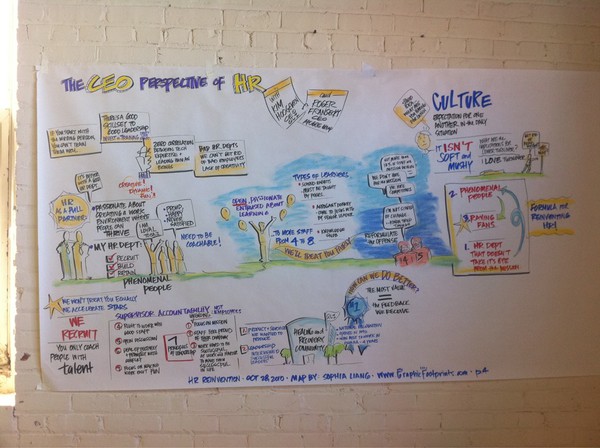
Instead of PowerPoints and handouts, the HRRE organizing team hired the graphic genius of Sophia Liang (Graphic Footprints) to make a graphic recording of the keynote sessions, as well as several of the discussion sessions.  This is the recording of the lunch keynote, “The CEO Perspective of HR,” a discussion between two CEOs: Roger Fransecky and Kim HoogeveenThe additional recordings will be shared on the HRRE website soon.

It was a full day to say the least.  I participated as the opening keynoter giving the attendees an “HR Wake-Up Call” as well as attending as a participant for the full day’s activities.  The experience was challenging, fun, engaging and thought-provoking.  It brought together many of Nebraska’s HR leaders for a day of thoughtful and personal engagement and pushed them to ask new questions and assume different outcomes.

But while the “what’s next?” question persists, I have a feeling that there will indeed be a “next” in Nebraska.  These business leaders seem ready to take action.  HRRE felt like a catalyst that will start to move the discussions into action.  Time will tell, of course, but the framework exists to launch a new kind of self-driven professional community. 

Professional organizations catering to HR leaders should be taking note of the grass roots efforts to connect in new and more impactful ways.  Whether it’s learning and conferences or advocacy and membership, there are unmet needs that are becoming urgent in the HR world.  The frequency and level of innovation happening in this space suggests that the current infrastructure is becoming less relevant to a portion of the population.  And this portion of the HR population has the commitment, skills and intellectual curiosity to do something about it.  We should all stay tuned….

6 Comments

Filed under China Gorman, Conferences, HR, HR Conferences, Leadership, Uncategorized

Unemployed…and grateful

Trish McFarlane wrote a post over at HRRingleader a couple of weeks ago about gratitude.  I loved that post.  Not because she mentioned me, but because I know what a powerful force for good gratitude is. 

And she got me thinking about my life and the gratitude I feel every day for the people in my life, the experiences I’ve had and the extraordinary life I’ve led.  I’ve been afforded opportunities that a middle class kid who grew up in a small town in Michigan couldn’t even begin to imagine.  My parents instilled in me the belief that I could do anything – but not even they could have conceived of the path my life would take.

 My grandparents made it possible for me to attend an outstanding boarding school when the school system in my town was nearly broke and broken.  I was able to excel at an equally outstanding small liberal arts college and made friends that last today.  I met and married my soul mate who has provided love, support and more fun than should be legal for almost 30 years. 

As my career unfolded it has afforded me the opportunity to lead teams of gifted professionals, to travel the world to support my organizations and to work alongside some pretty impressive intellects housed in some of the finest people I’ve ever met.  I’ve served on the boards of several non-profit organizations that are making real differences in our world and I’ve been blessed by involvement in my faith community.

 Most recently I’ve been filled with wonder and gratitude for the way my community of friends have been supporting my job search.  It’s hard to make an executive transition these days.  It’s easy to feel like a tiny sliver in a bad pie chart.  The news is never positive about job growth and the messages from the press seem to target job seekers with ever more depressing reasons why we’ll never find our next situation – or if we do, how drastically under employed and unfulfilled we’ll be.

 But you know what?  My friends and professional network are incredible.  They keep me focused on a positive outcome.  They send me leads.  They introduce me to their colleagues.  They introduce me to executive search firms.  And they give me encouragement. 

 And you know what else?  I’ve never met some of these folks face to face.  We’ve connected through social media – and I don’t just mean LinkedIn.  We comment on each others’ blogs.  We tweet.  We email each other.  And we talk to each other on the phone.  And when they’re in town they call and we get together.  Sometimes for the first time.

 I know how powerful gratitude is.  It can change your health.  It can change your job.  It can change your life.  And I’m sitting here in my beautiful home office, with my sweet dog next to me and my amazing husband down the hall and I’m grateful.  Grateful for all the good in my life.  Grateful for all the good people in my life.  Grateful for all the opportunities I’ve had and will continue to have to do good in my life and make a positive difference.  And thinking that, even without a job, I’m amply employed.  And unspeakably grateful.

5 Comments

Filed under China Gorman, Gratitude, Social Media