Tag Archives: Data Point Tuesday

HR Delegation to Cuba

data point tuesday_500Want to be among the first U.S. HR professionals to see how HR is practiced in Cuba? Then join me and co-leader Gerry Crispin on an 8 day study tour in November! Check it out here: http://citizens.peopletopeople.com/OurPrograms/CAP/Pages/2015-Citizens-GormanCrispin-Cuba.aspx

For 50 years, People to People Ambassador Programs has provided educational travel for professionals and students across the globe. With more than 20,000 Ambassadors traveling annually, People to People Ambassador Programs is one P2P Logoof the world’s most recognized and respected educational travel providers and plays a significant role in increasing global awareness. I became aware of People to People as the Chief Operating Officer of SHRM as I led delegations of senior HR professionals to India and China under their auspices. They provide a first class environment for significant learning and handle the travel logistics in an incredibly high quality way.

Gerry Crispin got the ball rolling in organizing a delegation of senior HR professionals to Cuba last month and asked me to join him as co-leader. Because of my previous experience, I leapt at the chance and am pleased to officially announce that a People to People Citizen Ambassador HR Program to Cuba is open for enrollment! Gerry and I are working together to lead what will be an incredible first-in experience in the senior HR community.

Human resource and talent management professionals are educated and trained to assist organizations with how they lead and support workers’ motivation, skills, knowledge and experience in the pursuit of individual and organizational goals.

Our delegation will interact with our Cuban counterparts during a series of meetings and site visits. We plan to meet with government officials, HR and other leaders in a variety of settings to learn and discuss:

  • How individuals entering the workforce in Cuba are prepared through training and education
  • How individuals find work and how the needs of the society, their organizations and institutions find workers
  • How Cuba’s planned economy conducts its workforce planning activities
  • How Cuba is evolving in each of the above areas given their unique situation in the global economy

In addition to the professional visits, our delegation will enjoy authentic and immersive cultural activities with the aid of an expert guide. We will meet in Miami on November 13, 2015 andl depart for Cuba early the next morning to visit Havana, Regla, and Las Terrazas. We will return to Miami on November 21.

The cost per delegate is $4,899.00 USD (based on double occupancy). This includes the overnight in Miami, round-trip international airfare from Miami, transportation within Cuba, all meetings and group cultural activities, first-class hotel accommodations, most meals, professional guides and interpreters, most tips and taxes, Cuban visa, 24 hour emergency support during travel, and essentially all other costs associated with participation.

We currently have 22 colleagues registered – which means there are only 3 spots left (a deposit of $500.00 will hold your place). If you would like to secure your spot on the delegation or if you have questions, I encourage you to contact People to People Citizen Ambassador Programs at 877-787-2000. The email address is citizens@peopletopeople.com . Enrollments will be accepted on a first-come first-served basis.

Gerry and I are pleased to be involved in this exciting opportunity and hope you will strongly consider participating along with us. Please feel free to connect with me if you’d like to discuss this experience. It will be one of the most unique and meaningful professional experiences of your life!

Leave a comment

Filed under China Gorman, Cuba, Data Point Tuesday, Gerry Crispin, Global HR

Skills?

data point tuesday_500

I’m traveling this week and am sharing one of my most popular posts from 2013. Might be worth a re-visit!

Skills shortages in 2020 will rise to an entirely new level. And I’m not talking about STEM skills, although they’re critical. Or the ability to speak multiple parched earthlanguages, which needs to be more common in the U.S. Or even the readiness of college graduates to take a place in the economy, which a majority of employers report is lacking.

I’m talking about the skills that the globally-connected, superstructured, computationally focused, smart-machine powered organizations of the future staffed by longer living and working, new media using employees will require.

We’re all thinking about that right? We’re re-writing job descriptions and re-wording job postings to incorporate the emerging skills we know we’ll need. Aren’t we? Well, maybe not. We know the names of the skills we can’t get today – those STEM, analytical thinking, communication and personal responsibility/accountability skills we’re sure our young people don’t have.

But really. What about the skills for the future?  I’m not sure what we’ll call those skills. I’m not even sure they’re skills, to be honest, but here’s what I do know:

  • People are living longer and will want/need to have longer careers
  • Smart machines are taking over the most routine workplace tasks
  • Data – big, medium and small – are changing the way decisions are being made at every organizational level
  • Text isn’t the only way we communicate any more
  • Organization structures and behaviors are changing due to social technologies
  • We say “Global” but what that really mean is that innovation and growth will be primarily driven through the integration of differing cultural norms and diversity

IFTF LogoThe Institute for the Future’s Future Work Skills 2020 highlights recent research that predicts the kinds of skills for which we’ll be recruiting in 2020 (which is only 6 and-a-half years away). Trust me when I write that the majority of HR/recruiting professionals are not ready for this. ATSs aren’t ready for this. LinkedIn, Facebook and Twitter aren’t ready for this. And clearly, our education infrastructure isn’t ready for this. And yet, here we are.

The IFTF identifies and defines ten skills that we need to begin to teach now so we can deploy them in six-and-a-half-years.  They are:

  1. Sense-making:  the ability to determine the deeper meaning or significance of what is being expressed
  2. Social Intelligence:  the ability to connect to others in a deep and direct way, to sense and stimulate reactions and desired interactions
  3. Novel & Adaptive Thinking:  proficiency at thinking and coming up with solutions and responses beyond that which is rote or rule-based
  4. Cross-cultural Competency:  ability to operate in different cultural settings
  5. Computational Thinking:  the ability to translate vast amounts of data into abstract concepts and to understand data-based reasoning
  6. New-media Literacy:  the ability to critically assess and develop content that uses new media forms, and to leverage these media for persuasive communication
  7. Transdisciplinarity:  literacy in and ability to understand concepts across multiple disciplines
  8. Design Mindset:  the ability to represent and develop tasks and work processes for desired outcomes
  9. Cognitive Load Management:  the ability to discriminate and filter information for importance, and to understand how to maximize cognitive functioning using a variety of tools and techniques
  10. 10.   Virtual Collaboration:  the ability to work productively, drive engagement, and demonstrate presence as a member of a virtual teaSocial intelligence (we call it EQ today, I think) and Cross-cultural Competency are certainly emerging in more sophisticated and global organizations currently. Perhaps we have a leg up with these two.

But have you ever seen a job description requiring Transdisciplinarity and a Design Mindset?

What kind of behavioral interview questions would you use to determine if a candidate has Cognitive Load Management and Novel/Adaptive Thinking Skills?

How would you Tweet those jobs? How would your careers page change?

And once onboard, how would you manage the performance of employees’ Virtual Collaboration and Sense-making?

And speaking of job descriptions and performance management, how will New-media Literacy and Social Intelligence change the very nature of these processes?

Whew! We think the current skills shortage is frustrating and scary. It could be that the future skills shortage will upend everything!


Leave a comment

Filed under China Gorman, Data Point Tuesday, Demographics, Institute for the Future, Skills Shortage

The Optimal Technical HR Stack

data point tuesday_500I’ve written previously about the new research coming out of KeyInterval Research here and here. The third report from the dynamic duo that is Tincup and Sumser is out now and it’s a blockbuster! Determining the optimal technical HR stack is big. It’s big and expensive. It’s big and expensive and can make or break an HR leader’s career.

But first, you have to know what a technical stack is. I don’t assume that the majority of HR professionals know what this is, so here’s what Wikipedia says:

“A technology stack comprises the layers of components or services that are used to provide a software solution or application. Traditional examples include the OSI seven-layer model, the TCP/IP model, and the W3C technology stack. Technology stacks are often articulated as a list lof technologies, such as “J2EE with Java Server Faces running against a SQL Server database” or as a diagram.”

So a Technical HR Stack would be the collection of technologies/solutions that HR uses to manage all the people processes across an organization. It’s the payroll, recruiting, performance management, total rewards/recognition, learning management systems – all of these and more. And an Optimal Technical HR Stack would be the best collection of technologies/solutions that HR would use to manage the people processes across an organization.

I read some research 3 or 4 years ago that reported that organizations deploy, on average, 18 separate HR technology solutions – many of which are unable to connect with each other. These days the average may well be higher as HR professionals (and their IT partners) turn to technology to provide more efficient outcomes and the HR vendor community continues to innovate the use of SaaS, analytics, mobile and video.

So how can an HR leader or department make sense of the opportunities to apply technology, much less identify the “optimal” vendors and solutions? Well, the first step would be to buy this report. The analyses are practical. The insights are remarkable. This is a sea change in showing how HR technology is working – or not working – and what is actually happening in terms of finding solutions in an existing suite, looking for new providers or developing home grown solutions. The realities will surprise you.

The report delves into thirteen major areas of HR Technology and reveals 8 separate metrics in each area. The metrics include some of these:

  • Market Penetration
  • Net Promoter Score®
  • How long companies keep their software
  • Whether companies outsource, develop internally or use a tool that is part of an existing suite

The areas covered are:

KIR Optimal HR Stack July 14 2015It’s interesting to note that as a result of their research, nine other areas of adoption will be added to their research agenda for 2016. Some of those are Engagement, Collaboration Tools, Video Interviewing, and Assessment.

Without giving away the groceries here, some of the interesting findings include the following;

  • The components (see above) with the highest and lowest NPS® scores are not what you think
  • The replacement cycle (the amount of time between purchases) might be exactly what you would predict
  • The frequency of developing homegrown solutions is pretty low
  • The market penetration of the components is less than you would have predicted
  • The likelihood that a component is outsourced is surprising
  • Vendor brand recall is pretty high

Let’s look at just one of the thirteen solution components:  Recruiting Systems. The analysts at KeyInterval believe that “Recruiting is where innovation happens most frequently in HR.”

“With between 12 and 20 sub-processes, recruiting operations rarely use all of the same tools in the same sequence. Unlike other HR functions recruiting techniques vary by job, industry, region, corporate culture and, business model.” Because of this, the analysis shows that practitioners don’t much like their recruiting systems. The conflict between the required fast action of identifying, recruiting and hiring the right kind of talent, and the legal requirements to collect and retain hiring data often collide. Indeed, the KeyInterval research shows that no other tool in the HR Tech Stack is so conflicted. HR professionals “routinely expect innovative results and performance from a system that is designed to mitigate legal risk.”

If you’re thinking about going to the market for a new HR technology solution, or you’ve finally decided to replace an existing solution, this report should be your first stop. It will help you see what other organizations your size are doing – buying, building or outsourcing. It will provide a road map for how to begin.

Here’s the thing:  it will make you smarter than you already are. You can order it here.

1 Comment

Filed under #HRTechTrends, China Gorman, Data Point Tuesday, HR Data, HR Technology, KeyInterval Research, Recruiting

Millennials To Business: You’re Doing It Wrong!

data point tuesday_500

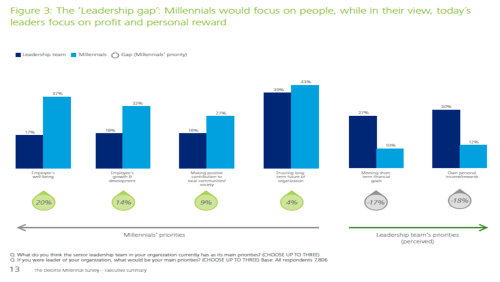
Deloitte’s 4th annual Millennial Survey sends a message from more than 7,800 degreed and employed Millennials from 29 countries around the world to employers: “Business should focus on people and purpose, not just products and profits.” It’s easy for the Gen Xer and Baby Boomer business leaders to respond to this message with the corporate equivalent of “Get off my lawn!” But that would be short sighted, since the Millennials are now officially the largest age group in the economy and we need them. And we need them pretty desperately.

In this world of Big Data one can find a survey analysis to prove any position. Pretty much. And I am generally wary of survey analyses that play up differences between the generations in the workplace because my go-to research from the Great Place to Work® Institute shows that – in the workplace, at least – every person, regardless of generation, wants 3 things:

  • Resepct – including appreciation and fairness
  • Work that gives meaning to their lives and makes them proud
  • Camaraderie with their workmates

These three dynamics in a culture power all kinds of good outcomes and they show little differentiation between age cohorts regardless of industry, geographic location or size of business.

So I take with a grain of salt the results of surveys like this and still recommend that you read them. They provide interesting insights that can add color to your own questions and planning. And the graphs show some interesting gaps in the perception of what Millennials believe “should be” in contrast to “what is.” These are useful insights.

“Today’s Millennials place less value on visible (19%), well-networked (17%), and technically-skilled (17%) leaders. Instead, they define true leaders as strategic thinkers (39%), inspirational (37%), personable (34%) and visionary (31%).”

Deloitte Millennial survey 1

That’s troublesome for celebrity CEOs but good news for the rest of us.

The last 15 pages of the report show graphs that depict Millennials’ takes on the purpose of business, business performance and employee satisfaction, leadership attributes, their skills, and the gender gap regarding leadership readiness and leadership aspirations. Interesting stuff.

But these data points also underscore the growing global focus on creating more human workplaces. The resounding success of the recent WorkHuman Conference produced by Globoforce, is another piece of this trend. My belief is that while all of us want a more human workplace: Millennials are just demanding it more than those of us who were socialized in a less human era. And they are voting with their careers.

The results of surveys like this one from Deloitte give us directional information to use when considering the challenges of growing our businesses, attracting the right talent, and developing and retaining the talent we need to succeed in our competitive marketplaces. And to make our workplace cultures more human.

2 Comments

Filed under China Gorman, Data Point Tuesday, Deloitte, Globoforce, HR Data, Leadership, Millennials, WorkHuman

CEOs Get It. Do HR Leaders?

data point tuesday_500Here’s another survey analysis and report that should be required reading for all HR professionals: pwc’s 18th Annual Global CEO Survey. The survey looks at how business leaders are finding new ways to compete in “an era of unprecedented digital change.” I know, it sounds like another consulting firm’s move to make the complicated even more complicated and gin up their sales. But I didn’t find this analysis to be that. Instead, I found it useful to put context around some of our biggest challenges and opportunities. 1,322 CEOs in 77 countries were interviewed: 125 in Central and Eastern Europe; 459 in Asia Pacific, 94 in the Middle East and Africa; 330 in Western Europe; 167 in Latin America and 147 in North America. This was truly a global survey.

The survey findings are grouped into 5 themes:

  • Growth
  • Competition
  • Technology
  • Partnering
  • Diversity

The first four themes are fairly predictable – and they all have some impact on talent strategies and HR functions – but the fifth, Diversity, might be a surprise to you. Think about it. More than 1,300 CEOs around the world were interviewed for this survey. Would you have predicted that Diversity was among the 5 most critical themes to emerge? You might have hoped for it, but would you have predicted it?

This survey analysis report is a roadmap for HR to anticipate what’s coming in terms of focus and strategy from the CEO. The report is not long. You could read it in an hour. And come away with some critical new business perspectives that will make your HR strategies and plans align with the real world – as your CEO sees it – and support your business’s growth plans.

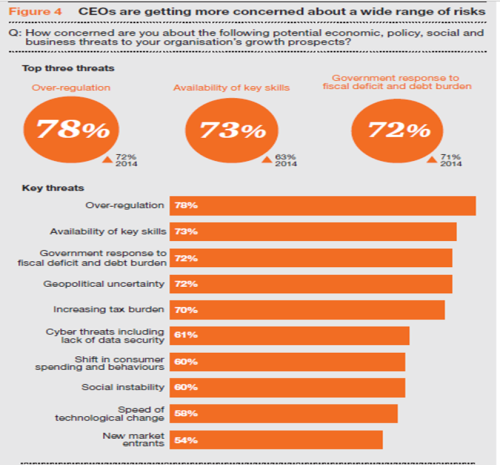
I’ll share just two graphics that I found interesting. The first shows the range of risks that CEOs are beginning to be concerned about:

pwc CEO Survey June 30 2015CEOs were asked how concerned they were about a list of potential economic, policy, social and business threats to their organization’s growth prospects. You can see the list above. Do you see that the threat of not having access to necessary skills is a greater threat then cyber security? Than the speed of technological change? Than Geopolitical uncertainty? Do you see that of the list they could choose from, CEOs chose the threat of not having access to necessary skills as the second most concerning threat to their organization’s growth processes?

That seems big to me. So, are your talent acquisition, development and retention strategies and programs developing fast enough to address this concern?

The second chart I will share shows just how all-pervasive and consistent the lack of talent concern is for CEOs:

pwc CEO Survey 2 June 30 2015The question posed to these CEOs was “what one capability do you think will be most critical for tomorrow’s CEO’s to cultivate?” The choices were:

  • Innovation
  • Leadership
  • Strategic Thinking
  • Customer Focus
  • Collaboration
  • Digital Astuteness
  • Personal Qualities (e.g. honesty, integrity)
  • Adaptability
  • Knowledge and Skills
  • Talent Acquisition and Management

It wasn’t surprising to me that out of that list of 10 critical future CEO capabilities that Strategic Thinking would be first on the list of necessary capabilities. And it’s first by a mile. But look at what is in second place: Talent Acquisition and Management! I’ll bet you wouldn’t have predicted that.

This suggests to me that CEOs see lack of skills as such a big concern that they are going to involved personally with reducing that threat. Are you ready for your CEO to be actively involved in setting and executing your talent acquisition and development strategy? I’m not thinking that their involvement would be a bad thing. Quite the contrary. But I’m not sure the average HR department is ready to add their CEO to the team.

In my mind, these two graphs, and the subtext of the survey report, show that talent is becoming one of the most critical competitive advantages for business growth worldwide. And CEOs know it. The lack of talent/skills is clearly being evaluated by CEOs all over the world – in every sector and in every size of business – as their Achilles Heel. So CEOs get it. The big question is, does HR get it?

4 Comments

Filed under CEOs pwc, China Gorman, Data Point Tuesday, Diversity, HR, Strategy, Talent Acquisition, Talent development

The Employee Recognition Landscape is Changing

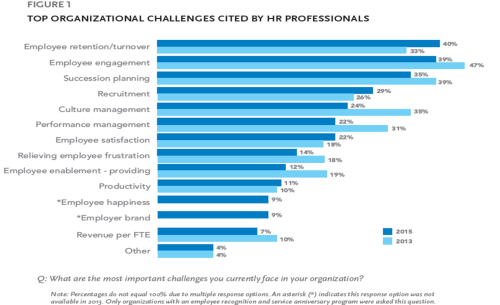
data point tuesday_500The fifth research report in an annual partnership between SHRM and Globoforce was published this week. And, interestingly, there is a surprise. Namely, that retention/turnover is the top challenge reported by nearly 1,000 SHRM members. This is a surprise top challenge compared to the last 2 years – and it makes sense. With the economy and hiring improving, businesses are wise to become concerned that the “grass is greener” syndrome may take hold of their very best employees. The employees who are super marketable as job opening grow.

(In full disclosure mode, I should mention that I am the former Chief Operating Officer of SHRM and am currently Chair of Globoforce’s WorkHuman advisory board.)

In 2013 and 2012, the SHRM/Globoforce surveys identified employee engagement and succession planning as the topmost HR concerns. Perhaps the fact that retention/turnover are the top concerns is fueling the fear of escalating talent wars due to economic growth, demographic shifts, globalization and a workforce that believes they can have it all: meaningful work, career growth, leaders they trust, equitable pay and appreciation for their efforts.

The concern for employee engagement is down with 47% of respondents citing it as a top challenge compared to 39% in 2014. That’s a big delta. And potentially a big deal.

GloboforceSHRM June 23 2015The other surprise for me in the survey results is the data-backed understanding that values-based employee recognition is seen as contributing significantly to bottom-line organizational metrics. This is surprising for two reasons:

  1. The culture conversation is becoming rooted in values, and
  2. HR organizations are using data to create business cases for culture/values as a quantifiable business imperative.

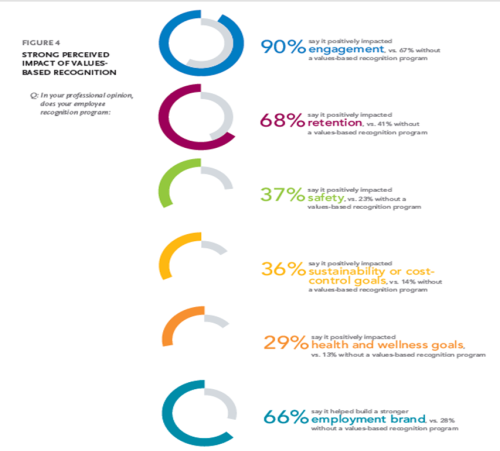
The strength of values-based recognition behaviors and programs is growing:

GloboforceSHRM 2 June 23 2015Tying employee recognition to organization values seems a no-brainer and the data are proliferating that building employee programs and leadership behaviors on foundations of values-based culture are not only winning the war for talent, they are winning the competitive wars for revenue and growth, innovation, collaboration, and profitability.

The report is a fairly quick read and if you’re interested in learning about how recognition, values and culture are impacting the workforce today, the nearly 1,0000 SHRM members who took the survey have interesting insights to share.

3 Comments

Filed under China Gorman, Data Point Tuesday, Employee Engagement, Employee Recognition, Globoforce, Organization Values

Business Resilience and Freedom

data point tuesday_500

Creating a great workplace culture that is employee focused is hard. Worthwhile and hard. Creating a freedom-centric culture is also worthwhile. And even harder, because it is focused not just on creating a culture that is based on trust, it is focused on creating a culture without fear.

WorldBlu, is an organization dedicated to developing world-class freedom-centered (rather than fear-based) organizations and leaders. Their vision is to see one billion people leading and working in freedom. Founder and CEO Traci Fenton has spent 20 years studying the effects of freedom in organizations and has come to agree with leading thinkers and scholars like Warren Bennis, Philip Slater, and others, that democracy in the workplace is inevitable because “it is the most efficient social system in times of unrelenting change.”

Traci and her team have just published the results of some interesting analysis in a report titled, Freedom at Work: Growth & Resilience An empirical analysis of how freedom and democracy in the workplace impact business performance. If you’re convinced, as I am, that corporate culture impacts business performance, then this analysis will be of great interest.

Each year since 2007 WorldBlu™ has published its list of Most Freedom-Centered Workplaces™. In that time, more than 130 companies in every industry that range in size from 5 to more than 60,000 employees from all over the world have met the standard to become WorldBlu™ certified. Companies like DaVita, Menlo Innovations, Glassdoor, WD-40, Great Harvest Bread Company and, yes, Zappos, all proudly claim to be cultures free from fear.

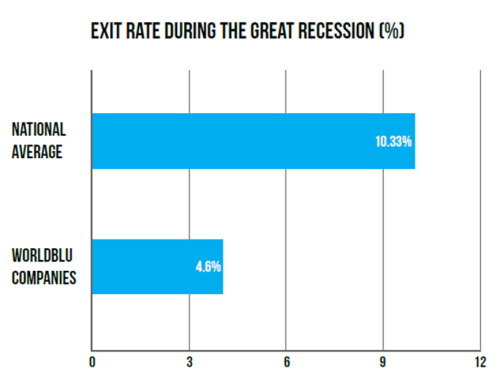
This report, Freedom at Work: Growth & Resilience, looks at WorldBlu™ certified companies and how they fared in terms of s growth and survival during and after the Great Recession of 2007. The data are impressive. S&P listed companies’ revenue growth rate during the 3-year period of 2010 – 2013 – the end of the downtown and beginning of the recovery paled in comparison to WorldBlu™ certified companies during the same period.

June 16 2015 WorldBlu 1Additionally, the exit rate of WorldBlu companies during that same time period was less than half the national average.

June 16 2015 WorldBlu 2As the report states, 2007 – 2011 were bleak years for businesses and their employees. And many businesses around the world failed, closed their operations or sold out. Case studies from Menlo Innovations and DaVita are fascinating examples of organization leaders who take their commitment to culture several steps further than creating trust between leadership and employees. They truly approach their entire ecosystem in a democratic fashion and the results were significant. Take a look.

Leave a comment

Filed under China Gorman, Culture, Data Point Tuesday, Freedom at Work, Traci Fenton, WorldBlu

Working in the “Gig Economy”

data point tuesday_500

Last week I introduced you to Mary Meeker’s Internet Trends 2015 report which I suggested should be required reading for HR. This report, which really should have been titled, The Internet in 2015 Is All About HR, shared important data points and analysis relating to basic HR functions and the impact the internet is having on basic organization functions.

This week, I’d like to point out the McKinsey Global Institute’s new report, A Labor Market That Works: Connecting Talent With Opportunity in the Digital Age. Even if you only the read the Executive Summary, this is worth your time. It’s full of employment-related data from the major global economies as it links those statistics to the growing impact of online talent platforms – and their potential, in the gig economy, to transform both the employer/employee relationship and how workers find work and build economic opportunity. It’s important information and their analysis of (mostly) Linkedin data are arresting.

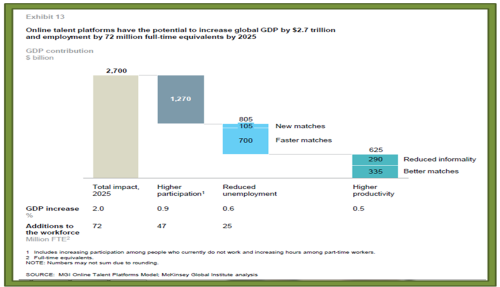
The report is organized into three broad topics: Better, fast matching; Economic impact; and Talent management for companies. All three topics could sustain a full report on their own, but I’ll focus on the second: Economic impact. The gig economy powered by online talent platforms, by their analysis, will be contributing $2.7 trillion to global GDP by 2025. They do the math by analyzing three channels of impact:

  • Increasing labor force participation and hours worked among part-time employees
  • Reducing unemployment
  • Raising labor productivity

McKinsey Exhibit 13 June 9 2015

This adds 72 million workers to the global workforce and adds a full 2% to the projected world GDP for 2025. The largest impact, $1.3 trillion, come from great labor participation and more hours worked. Shortening job searches and creating matches that would not have been otherwise will lower unemployment rates, creating the second biggest impact at $805 billion. The third biggest impact is the increase of productivity through higher quality job matches and a shift to formal employment from informal grows global GDP by $625 billion.

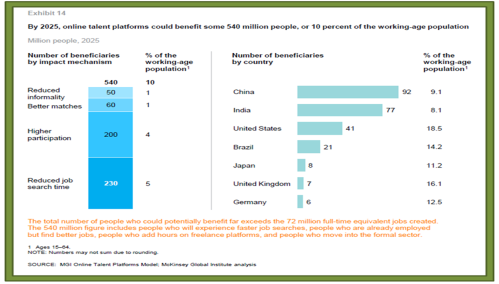
But their analysis also shows that the positive impact of the gig economy is greater than dollars as 540 million people (nearly 70% more than the current population of the United States) will benefit from these new ways of connecting workers to work. That’s big, right? And that’s only 10 years from now.

McKinsey Exhibit 14 June 9 2015

As an HR leader, are you concerned about the talent pipeline? Having trouble filling your current open positions? Wondering if the use of internet based solutions will produce better results? The real question may be, “how fast can I start implementing online talent platform solutions in order to connect workers to the work we have available?”

The report continues to make the economic case for the positive impact of internet enabled platforms by predicting their use could reduce public spending on labor market programs, allocating as much as $89 billion/year from unemployment benefits savings to education and vocational training programs to ensure a skilled talent pipeline. McKinsey also predicts that online talent platforms may increase innovation, strengthen productivity and generally “improve the development of human capital across economies.”

This is Big Data at its best: boiled down to useful constructs. The full report is 100 pages. I recommend that you download it and take it section by section. I think you’ll be glad you did.

1 Comment

Filed under Analytics, Big Data and HR, China Gorman, Data Point Tuesday, Gig Economy, HR Analytics, HR Data, McKinsey, Online Talent Platforms

Required Reading for HR: Internet Trends 2015

data point tuesday_500Really. I’m not kidding. You may think from the title that Internet Trends 2015 is a report that has nothing to do with Human Resources. You couldn’t be more wrong. It’s ALL about HR. And how nearly everything about business, work and the employer/employee relationship is changing because of what the internet enables.

The report, prepared by Kleiner Perkins Caufield & Byers’ Mary Meeker for this year’s Code Conference, presents the 2015 Internet Trends report, 20 years after the first The Internet Report was published in 1995. You’ve probably heard about this year’s report because every journalist in the world was agog at one piece of data: how Millennials relate to their smartphones. Everyone now knows that 87% of Millennials in the U.S. report that “my smartphone never leaves my side, night or day.” That’s one of several data points on one page of a 196 page report. And while interesting, it is among the least interesting data points in the report. I promise.

But first. You need to know some definitions to get the full value of the report. Here are a few terms and acronyms you should – and probably already – know:

  • MAU = Monthly Active Users (how many users are on an application at least once a month)
  • DAU = Daily Active Users (how many users are on an application at least once a day)
  • Y/Y = Year over Year (compares results from two consecutive years)
  • API = Application Programming Interface (how programs/apps connect to each other)
  • GDP = Gross Domestic Product (total value of goods and services produced by a nation)
  • GMV = Gross Merchandise Value (total sales value of merchandise sold through an internet channel)
  • VoIP = Voice over Internet Protocol (Skype would be a good example)

This report hits on all of HR’s buttons with high impact data: the nature of work, the job market, benefits, age demographics in the workplace, freelancers, government benefits, union participation, employer retirement plans, healthcare, the impact of drones on work, what’s happening in China and India and more. All in a report about internet trends. And almost every page is a data-rich picture of how things are changing. This might be my favorite page because it is the continuous thread of everything else discussed in the report:

KPCB 2015 Trends 2

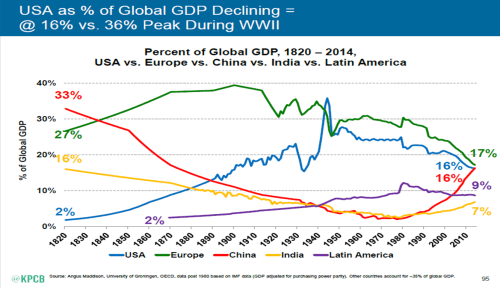
And this might be my favorite chart because the impact of the data here fuels most everything else mentioned in the report. The connections between economic growth/decline, demographic changes, the internet and business impact every HR person everywhere, every day. Everywhere. Every day. This report shows these connections clearly.

KPCB 2015 Trends 1I’d like to make this report mandatory reading for all HR professionals. If you’re having a hard time grasping what the opportunity really is for HR to keep ahead of the profound changes happening all around us, this report will help you understand. Read it. Discuss some of the findings (pay particular attention to the section at the end, Ran Outta Time Thoughts) in staff meetings and with other leaders in your organization. Develop a point of view about how internet trends are impacting your organization and your people, and begin to strategize responses that will work for your business and your people. You must.

And oh yes, read this report.

6 Comments

Filed under #HRTechTrends, China Gorman, Data Point Tuesday, Employee Demographics, GDP, Human Resources, Internet Trends, KPCB, Mary Meeker

I’m Not Your Mother!

data point tuesday_500Some things are simple. Some things are complicated. And some things that seem simple are actually pretty complicated. For example, it seems like a simple observation that happy employees are better employees. And, in fact, data abound to prove that point. But how to get happy employees is a little more complicated.

Early in my career as a business leader I always believed that people were my critical competitive edge and that creating a strong, caring culture was my job. But happiness? Come on. I wasn’t my employees’ mother. The nature of the employer/employee relationship, I believed, was a commercial relationship. Employees come to work, do a good job and I pay them. The more I could remove obstacles from their ability to do good work, the more I could offer development and thanks for a job well done, the better they performed. It wasn’t rocket science. Treat people well and they’ll treat your employees well. I got that. But trying to make them happy? I didn’t think that was part of the deal. (And I was a pretty effective business leader.)

But as I matured as a leader, I did begin to wonder about this notion of working to create happiness at work. I spent some time at Zappos – a culture whose leader is all about making his workforce happy. And while the Zappos culture wouldn’t be a fit for me, it worked for them. And they were happy. Really happy. And their business results were such that they could sell the business to Amazon for over $1 billion.

And then I became CEO of the Great Place to Work Institute and was covered over in data that prove a direct line from employee well-being to financial performance. And so while early in my career the notion of employee happiness didn’t register as a leadership imperative, I now believe that creating a culture that, in Tony Hseih’s words, delivers happiness to employees is quite clearly a practical and effective way to achieve top line growth, profitability, customer loyalty and, most importantly, employee loyalty.

In preparation for the Globoforce WorkHuman Conference in a couple of weeks, I was reading up on employee happiness and ran across one of their white papers, The Science of Happiness. It’s a quick read and makes some rather simple but profound points backed up by reliable data.

Here are 6 reasons why you want happy employees based on research from the Wall Street Journal and the iOpener Institute. Happy employees:

  • Stay twice as long in their jobs as their least happy colleagues

  • Believe they are achieving their potential 2x as much

  • Spend 65% more time feeling energized

  • Are 58% more likely to go out of the way to help their colleagues

  • Identify 98% more strongly with the values of their organization

  • Are 186% more likely to recommend their organization to a friend

Download the paper. It’ll take you less than 10 minutes to read and will give you some simple ideas to begin to see the benefits of focusing on employee well-being and happiness. And then join me at the WorkHuman Conference June 8-10 in Orlando and let’s talk about happiness, gratitude, culture, and employee and organization success.

2 Comments

Filed under China Gorman, Culture, Data Point Tuesday, Globoforce, WorkHuman, Zappos