Tag Archives: SHRM

Recruiting and Social Networking

data point tuesday_500

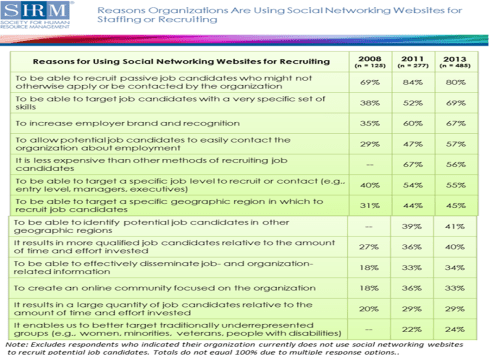
SHRM (Society for Human Resource Management) debuted some new survey data at their recent Talent Management Conference in Las Vegas. Published on April 11th, Social Networking Websites and Recruiting/Selection is interesting. And some of the data may not be what you think.

Employers use social networking sites during the recruitment process as tools to recruit candidates who might not normally apply. Expanding their reach to passive candidates, candidates with specific skill sets and candidates in specific geographies, recruiters seem to be very strategic in their use of social networking tactics and sites. I’m not surprised by these data.

Here are some of the findings I found a little surprising:

  • More than half (57%) of employers do not have a formal or informal policy on screening candidates via social networking sites.  

Really? In this age of increasing regulation and compliance, the majority of employers don’t have a policy about using social media to screen candidates? No guidance for recruiters? No guidance for hiring managers? I wonder if this is an “ignorance is bliss” approach or a calculated “we already have policies covering the use of social media at work” approach.

  • Employers that have policies on screening candidates are evenly split (21% each) in allowing or prohibiting the use of social networking sites for screening purposes.

This fascinates me. And it bears watching. There are legal dangers in the offing. Court cases are starting to decide the legal issues involved in using social media sites for applicant screening. And recruiters and HR pros don’t want to end up on the wrong side of this one.

  • About two-thirds of employers never have used or no longer plan to use social networking sites (69%) or online search engines (65%) to screen applicants.

This makes sense given the regulatory environment HR deals with today. And the fact that the courts are just starting to address these issues. However, it’s entirely unrealistic to believe that hiring managers aren’t using social networking sites to screen applicants. I believe that HR isn’t. I don’t believe that hiring managers aren’t.

  • 41% of employers target executive/upper management (e.g. CEO, CFO) when searching for candidates on social media.

This is really surprising and could spell doom for the executive recruiting industry. I would have expected a much smaller percentage of employers would use social networking sites for the recruitment of executives since it’s assumed that most employers turn to executive recruiters to find executive talent like CEOs and CFOs. If the use of social networking/media sites for executive hiring gives employers confidence to recruit executives on their own, a major shift in the executive hiring dynamic could be underway.

I was also interested in the differences in the survey question answers between 2008, 2011 and 2013.  Not only are the percentages changing, the number of respondents is growing, which I believe means that social media is being integrated into more nooks and crannies of HR. Take a look:

Social Networking Websites and Recruiting Selection SHRM 2013

This is interesting on lots of levels. And I look forward to continued growth at the intersection of HR and social technologies.

Hopefully SHRM will field this survey again in 2 or 3 years.

8 Comments

Filed under Candidate Screening, China Gorman, Data Point Tuesday, HR Data, Recruiting, SHRM, SHRM Survey Results, Social Media, Social Networking, Social Technology

Is Talentism the New Capitalism?

data point tuesday_500

“Is talentism the new capitalism?”

Klaus Schwab, Founder and Executive Chairman of the World Economic Forum, thinks so and said as much as he opened this year’s event in Davos.

Mercer chose this quote to open the executive summary of its new report, Talent Rising:  High-impact Accelerators to Global Growth. It includes some great survey data from more than 1,250 HR and talent management executives in 65 countries around the world. It includes important and useful data about how organizations are or are not expanding their definition of capital to include talent.

Forever, it seems, organizations’ primary sources of value and competitive advantage have been financial in nature:  money, lands, buildings and machines – all the values carried on the balance sheet. Mercer’s observation that with human capital being the main determinant of success today, it is troubling that so many organizations leave the development of their talent “largely to external systems and forces, with resulting gaps in their talent portfolios.”

(One could also position that if, indeed, human capital is the main determinant of organization success today, then there should be an entry on the balance sheet to capture its importance. But that’s for another day.)

This report is a huge call to action – not just for HR, but for the entire C-suite. And it is a great roadmap for HR to initiate the discussion of talent as capital.

Central to this discussion is the definition of strategic workforce planning. We hear about this all the time in HR. And BCG, funded by the World Federation of Personnel Management Associations together with SHRM, has observed that there is low current capability worldwide in strategic workforce planning. Perhaps that’s because we know it when we see it, but we can’t really define it.

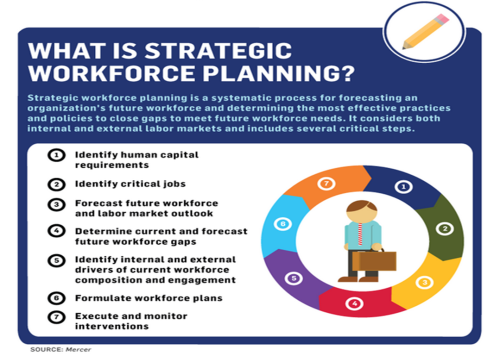
Mercer’s done a great job of defining strategic workforce planning and published a great infographic along with the Talent Rising executive summary.

Mercer Strategic Workforce Planning Infographic

This 7 step virtuous circle seems simple enough, but I think we all know that sometimes the most simple things are the hardest to achieve. And that certainly would be true for strategic workforce planning. Identifying accelerators on which to focus might help organizations begin to break the process down into manageable chunks.  Just knowing where to begin will undoubtedly help some make progress.

“Talentism is the new capitalism.” Well, maybe in 5-10 years. When HR is seen as a business function and not an overhead function.  And human capital is valued on the balance sheet.

We can dream, can’t we?

6 Comments

Filed under Boston Consulting Group, C-suite, CEOs, China Gorman, Connecting Dots, HR Credibility, Human Capital, Mercer, SHRM, Strategic Workforce Planning, Talentism, World Economic Forum

Sources of Hire: Is Perception Reality?

data point tuesday_500

Along with Quality of Hire, Source of Hire is starting to take center stage in the talent acquisition world. The annual report tracking and analyzing Source of Hire from CareerXroads is out today.  Sources of Hire 2013:  Perception is Reality contains truly interesting data – understandable and actionable.  And the authors ask some really important questions about B2D (Big Bad Data) and how to measure the pre-application talent supply chain.

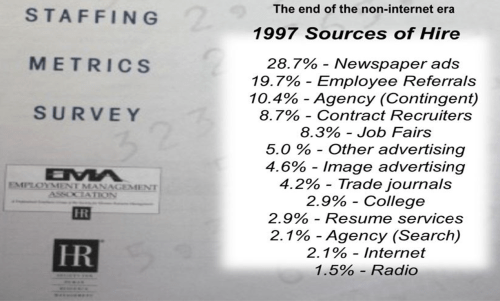
Early in the whitepaper, Gerry Crispin and Mark Mehler, the principals at CareerXroads, show the following chart of source of hire data from 1997 – collected by SHRM and EMA (now part of SHRM).

Sources of Hire 1997

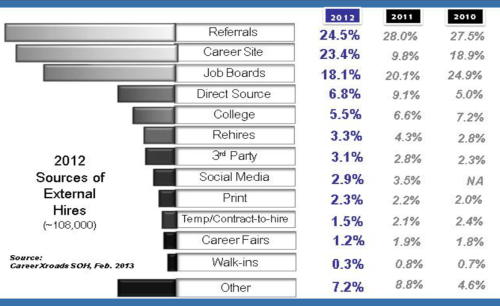
Talk about a blast from the past! Newspaper ads generated the most hires at 28.7% of hires and Agencies – both contingent and executive search – generated 12.5% of hires. My how the world has changed.  Here’s the 2012 data:

2012 Sources of Hire

Print has fallen from a combined (newspaper and trade journals) 32.9% to 2.3%!  “Internet” has grown from 2.1% (had Al Gore even invented the internet in 1997?) to a combined (career site, job boards and social media) 44.4%!

There is a lot in which to be interested in comparing these two charts, so have fun.

There nuggets of pure gold in this whitepaper.  Two in particular stood out to me. The first is the expectation for increased hiring in 2013.

Total Hires 2013 Source of Hire

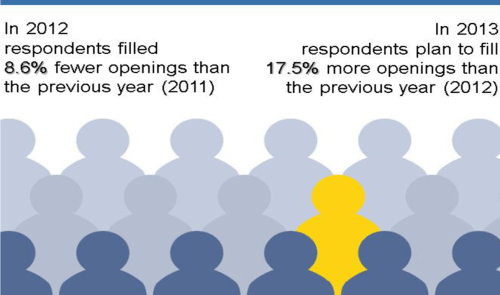
If true, we’re about to see a whole lot of domestic hiring!  The national hiring figures are trending slowly upward, but at the same time we read in the press that the implementation of the new health care rules is retarding hiring in the small business sector, the sector credited with being the job creation “engine.” This will be interesting to watch. Will the need for growth overcome the risk and costs associated with that growth?

The second nugget is the reminder that the source of the majority of hires is the pool of existing employees.

Internal Movement Source of Hire

The whitepaper accurately points out that internal movement and promotion are higher during difficult economic periods – and this is evident in the graph above.  However, a steady increase in this category may also be due to the perception of a growing skills scarcity in the outside talent market.

Enjoy the whitepaper. And begin to ask yourself some of the questions posed by Gerry and Mark.  Questions like…

  • How comfortable are you defending the 2013 plan for your budget, recruiters, technology tools, partners, vendors, training and your sources to your peers and colleagues?

  • How much should your 2013 recruiting strategy include improving your collection and analysis methods?

  • Are referrals the best source of hire?

  • What “Sources” interact with each other the most?

  • How can I collect Source of Hire data?

4 Comments

Filed under CareerXroads, China Gorman, Connecting Dots, Data Point Tuesday, Gerry Crispin, Hiring, Hiring Difficulty, HR Data, Mark Mehler, Quality of Hire, SHRM, Source of Hire, Talent Acquisition

Cigars and Policy Changes: in support of Marissa Mayer and Jackie Reses

Freud with cigarSometimes a cigar is just a cigar and sometimes a policy change is just a policy change.  And to attribute larger societal meaning is misguided and, well, you know, not smart.

Ending telecommuting at Yahoo! isn’t a new skirmish in the “mommy war” as USA Today proclaims.

Ending telecommuting at Yahoo! isn’t a frontal attack on GenX and GenY as countless bloggers are screaming.

Ending telecommuting at Yahoo! isn’t a stake in the heart of workplace flexibility as SHRM believes.

Ending telecommuting at Yahoo! is a bold decision by a bold CEO trying to turn her business around.

I’m a business leader.  I get it.

I get it that when you’re turning around a business you frequently have to make decisions that are unpopular.

I get it that when you make decisions to support your strategic plan others will assign meaning that was never meant.

I get it that you may have to make decisions that will change the culture in big ways.Yahoo!

I get the panic stress you feel when you decide to that cultural change is required and that decision will potentially put good people at risk.

I’m a business leader. I get it.

Turning around a business isn’t for sissies of either sex.  Ask Carly Fiorina and Mark Hurd and Meg Whitman.

The current brouhaha over Yahoo!’s decision to bring the field back home and end telecommuting is out of control.  The HR community, in particular, is totally wound around the crankshaft over this decision.  The cries of “foul!” are everywhere in the Twitterverse, the Blogosphere, old media and new media, radio and television.

And I understand the concern, although some of the hysteria is a little hard to take.  Workflex, as SHRM and the Families and Work Institute call it, is a boon for working mothers and fathers, a requirement – we’re told – for hiring and retaining GenX and GenY, and a central plank in improving engagement.  Their data is solid.  I get it.

Except when it isn’t working.  Except when management has lost line of sight into employee productivity.  Except when the culture of work and communication has gotten inefficient and lost its discipline and rigor. Except when out of sight truly is out of mind.

Marissa MayerI give Mayer and Reses big time credit for stepping up to the plate and swinging for the fences.  I saw the memo.  It said that the time for focusing on speed, communication, collaboration and quality is at hand. And in the CEO’s judgment, that means being physically together in hallways, work spaces and cafeterias.

They’re turning a business around, people!  And that’s intense work.  It requires all hands on deck.  I think Mayer and Reses Jackie Reseswant – and need – to harness the talent in Yahoo! in ways that keep the focus and intensity high.  In an environment where leaders can be hands-on and where communication isn’t delayed one second by distance and physical separation.

Say what you will about the value of engaging your workforce by allowing flexible work arrangements, but doing things the way you’ve always done them and expecting a different outcome is, well, you know, not smart.  And no one ever called Mayer that.

Saving a business isn’t about comfort and preferences. It’s about rolling up sleeves and doing whatever it takes to emerge triumphant.  And if that means some long-term, previously engaged colleagues decide that the new requirements don’t fit their lifestyle, then they’ll make other plans.  That’s tough, for sure.  But it’s how things work sometimes.  Everyone has choices to make and consequences to manage. I think Mayer is making tough choices and I think she’s prepared for the consequences.

Is this a referendum on workflex? No

Is this an assault on working parents? No

Is Mayer betraying her gender and her generation? No

Will this change the talent management landscape overnight and around the world? No

Is this one CEO and CHRO working together to change a culture’s priorities and save a business?  Yes

I get it.  So should you.

51 Comments

Filed under China Gorman, Connecting Dots, Families and Work Institute, Jackie Reses, Marissa Mayer, SHRM, Telecommuting, Yahoo!

If They Want Cake…

data point tuesday_500

I was reading the results of the recent Making Smart Benefit Choices survey of workers by Mercer and was struck by the confluence of societal issues that are impacting the choices workers are making today.  The key insights from the survey results are these:

  • Workers desire benefits with a decidedly short-term benefit over those with longer-term value
  • Employers need to ramp up their workforce education efforts regarding balancing short- and long-term benefit choices

Employers are not Marie Antoinette.  “Let them eat cake” cannot be an appropriate response when surveys show that cake would be a more popular benefit than, say, fruit or broccoli.  (Mayor  Bloomberg’s foray into the regulation of food options notwithstanding.)

So in the age of disappearing and underfunded defined pension plans and the very real specter of a bankrupt Social Security system in the US (and similar situations in most developed nations), what are the responsibilities of employers to their employees when considering changes in benefit plans?  How much should employers take into account their employees’ preferences for short-term gain over long-term value?

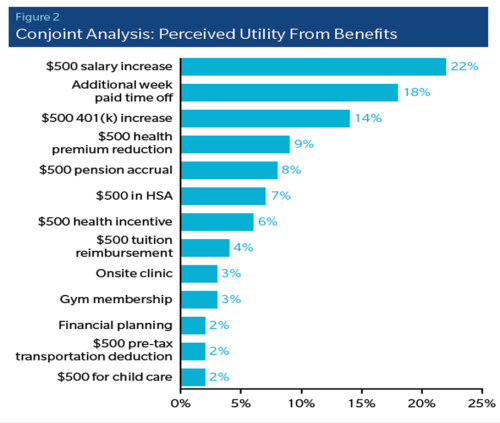
It’s interesting to note this survey’s results.  In part, respondents were asked about their preferences in a trade-off (conjoint) analysis that allowed Mercer to rank 13 core benefits.  A salary increase of $500 was used as the benchmark variable against which to measure how benefits are valued by workers.  Here is the chart with the results:

Mercer Making Smart Benefit Choices 2

I’m fascinated that after a $500 salary increase, the next choice is one week of paid time off.  This certainly synchs with the data that SHRM and the Families and Work Institute are publishing that more flexibility over time is becoming a cultural imperative – and the financial value of a week off is greater than $500 if you’re making more than $26,000 per year.

But given the state of retirement benefits, Social Security, and the general lack of preparedness of the workforce for retirement, the short term focus of the respondents is arresting.

But then again, we live in a business world that measures organization success quarter by quarter, rather than year by year or through business cycles.  We live in a political world that brings the economy to “fiscal cliffs” with some regularity.  We live in a society that appears to value now in ways that leave us unprepared for tomorrow.

So I guess it really shouldn’t surprise us that workers focus on now rather than tomorrow even though an additional $500 402(k) increase would have much greater value over time.  What’s an employer to do in all good conscience?  Give more paid time off or ensure a little more retirement stability?  Give more paid time off or reduce employees’ share of health care costs?

This is a tough one with which HR and Benefits leaders in organizations of all sizes are wrestling.  Employers surely want benefits packages that attract and retain their best and brightest talent.  Employers surely want their employees to be better prepared for an uncertain financial future.  It seems as if these may be in conflict, based on this survey’s results.  So how to decide?

“Let them eat cake” is one way to go:  continue the focus on now and leave the future to the business and policy and political leaders of the future.

I think I’d rather use some of today’s resources to educate my workforce so that they’re making truly educated choices.  I think I’d rather use some of today’s influence to begin to leave behind the now focus for a future focus that might ensure a little more sustainability all around.

While I love cake – especially the chocolate kind – I think that employers have a responsibility to the economy and to the future as well as to the workforce.  What about you?  Are you a cake or a broccoli professional?

4 Comments

Filed under HR, China Gorman, Employee Benefits, SHRM, Mercer, Connecting Dots, PTO, Workflex, Sustainability, Families and Work Institute

#NextChat: Change Management

Join me Wednesday, November 28 at 3:00 pm EST for SHRM’s #NextChat!  Follow @WeKnowNext, me — @ChinaGorman — and hundreds of HR professionals and SHRM members for an interactive Tweet Chat.  Our topic is Change Management.  Follow the hashtag #nextchat and join in the conversation!

Here’s the deal:

You’re introducing a new software solution for…performance management, rewards and recognition, time and attendance management…your choice.  The solution will impact every employee.  You’re heading up the change management project.  What’s next?  Check out this post before you join us on the next #NextChat.

Change management model?  What’s your favorite?

  • Kotter
  • Lewin
  • McKinsey Seven S
  • Bridges

You have the project timeline.

You have the budget.

You have the communication plan.

What are you missing?

Here are the questions we’ll be discussing.  Give them some thought and join us!

Q1:         What’s your favorite change management model and why?

Q2:         What one thing would you recommend to others as the “make or break” piece of your successful change management project?

Q3:         What member of senior management is the most critical to have out in front of a change management process?

Q4:         How much time and $ should a change management plan focus on training?

Q5:         How do you know if your change management plan was successful?

Never been part of a Tweet Chat?  Then just lurk in the background as you follow this hashtag on Twitter:  #NextChat.  You’ll have fun — and learn a lot as well.

See you on Wednesday on the interwebs!

Leave a Comment

Filed under Change Management, China Gorman, NextChat, SHRM, Tweet Chat

A Day in the Life…

One of many things that SHRM does well is to try to evaluate the services it provides to its members. So I wasn’t surprised that SHRM sent me an invitation to evaluate my experience at this year’s Annual Conference in Atlanta. And I tried to be honest. But really, how do you give feedback to an organization that executes its biggest event so well – year in and year out?

But I’ve been thinking about the question that asked what I would recommend for future Annual Conferences.  I gave a quick answer.  And I’ve been thinking about it more and I’d like to expand on my answer.

I suggest having a series of sessions called “A Day in the Life of…”  When I answered the question I was specific: engage one of the CHROs in the Fortune 100 to describe what their job and life are really like as an example for emerging HR leaders to see. We don’t see many CHROs on any stage at SHRM. I understand all the reasons why we don’t see them, but I think SHRM needs to try harder. Presenting a role model in the flesh would be high impact.

But as I’ve been thinking about it, why not also have sessions with CHROs from a privately held company with 5,000 employees, from a public company with 25,000 employees, from a large education institution, from a think tank, from a large national non-profit, and from a pre-IPO tech start-up? Not a panel discussion. A session by each of them, individually.

Not everyone in HR wants to be the CHRO of GE, but some do. Not everyone in HR wants to be the CHRO in a privately-held company, but some do. Show them what it’s like. Show them what it takes to get there – and stay there.

And then I thought, well, how about other functions? What’s it like to be the Chief Marketing Officer in the Fortune 100 – and what do they think about and want from HR?

How about a day in the life of the CFO of a global public retailer – and what they think about and want from HR?

How about the Chief Information Officer at a large privately-held technology company?

And how about the head of Total Rewards in a Fortune 250 company – how did they get there?

The head of Talent Acquisition in a Fortune 500 company – how did they get there?

The Chief Learning Officer in a global hospitality company – how did they get there?

You get my drift. A series of “A Day in Life of…” would put real leaders on the podium to share what works for them and what doesn’t work for them.  How they got there and what they’d do over again and what they would skip. And from everyone:  what advice for emerging or aspiring HR leaders.

Not only would this be interesting for intentional HR professionals, it would be helpful for those who got here by accident and aren’t sure where to go, whether or not to stay, and what is possible.  Holding successful HR (and other) leaders up for conference attendees to hear from and get coaching from might be the next big step in speaker impact that SHRM is looking for.

As with most good ideas, this came out of several conversations I had with HR leaders in Atlanta. Thanks. You know who you are.

8 Comments

Filed under China Gorman, Conferences, HR, HR Conferences, SHRM, SHRM Annual Conference

It’s a Wrap!

Well…another SHRM Conference is in the can. In Atlanta. In the Georgia World Congress Center. More than 13,000 attendees – with more than 1,000 from outside the U.S.

Here’s my assessment:  no one does HR conferences like SHRM. Period.

  • More than 200 concurrent sessions
  • High profile keynote speakers
  • World class entertainment
  • More than 800 exhibitors in the Expo Hall
  • Social media integrated throughout
  • Involvement of more than 700 local SHRM member volunteers
  • More than 350 SHRM employees

The SHRM Annual Conference is the single largest gathering of HR professionals anywhere in the world – year in and year out. And it’s motivating and exciting to be a part of that.

And while the mechanics are impeccable, the content engaging, and the crowds impressive, the real value of a gathering like this aren’t the mechanics, content and crowds. The real value of SHRM is the personal connections we make, the conversations we have, the meeting IRL of people we only know through social media, the meeting IRL of people we read about in HR Magazine, the private coaching from our mentors, the chance meetings of people who will be new personal and professional friends.

On second thought, it’s not actually a wrap, my friends. It’s a hug. It’s a hug from our profession. It’s a hug from our colleagues, our heroes, our game changers.  And who doesn’t need a hug from time to time?

3 Comments

Filed under China Gorman, Conferences, HR Conferences, SHRM, SHRM Annual Conference

HR Talent Shortage

SHRM has just released a new report in its series on The Ongoing Impact of the Recession. The current release focuses on the Manufacturing Industry.  Previous reports have focused on the Federal Government, State and Local Government and the Finance Industry.

This report clearly shows the continued strong degree of difficulty in hiring professionals with STEM education backgrounds – as well as mangers and executives, the skilled trades, sales professionals, HR professionals and accounting/finance professionals. It should come as no surprise to any business leader or talent management professional that finding professionals in the U.S. with STEM backgrounds is difficult.  The U.S. education infrastructure is not producing enough graduates in these disciplines. See my posts here and here.

It is surprising to note, however, that in addition to reporting a high degree of difficulty in finding STEM professionals and skilled trade workers, manufacturing employers are also having a difficult time finding managerial and executive talent, and sales, HR and accounting/finance talent.

Hmmmm.  A shortage of HR talent. Is this good or bad news?

1 Comment

Filed under Education Deficit, Hiring Difficulty, HR, SHRM, STEM, Talent pipeline

What a Difference 3 Years Makes!

Three years ago in at its Annual Conference in New Orleans SHRM took a tiny, tentative baby step into the land of Social Media by fielding a concurrent session on HR Blogging.  It was called “HR Bloggers: who are they and why should I care?”  Four HR bloggers, 2 SHRM members and two (then) non-SHRM members) were featured in a panel discussion.  There was only one guideline:  no cussing.

The panelists, Kris Dunn (www.hrcapitalist.com), Lance Haun (www.lancehaun.com), Jessica Lee (www.fistfuloftalent.com) and Laurie Ruettimann (www.thecynicalgirl.com), spoke in language not recognized by most HR professionals about social media, tweeting and social community.  The most interesting part of the conversation to me was the discussion on whether or not bloggers should be held to commonly accepted journalistic ethical standards.

Also noteworthy about this session was the fact that it was live-streamed, a first-ever event at a SHRM conference.

And that was it. Well, if tentatively, received.  Tiny baby steps.

Flash forward 3 years and WOW!

A micro site on the SHRM website dedicated to the conference experience called The Buzz.

A social media lounge for bloggers – and there are lots of them.  The Hive – a 3,000 square foot social media hub/genius bar/meeting spot/training ground – prominently positioned and staffed by true HR social media experts to help attendees get started in social media or get more effective at social media.

Want to set up a Twitter account?  They’ll help you do it on the spot.  Want to change your FaceBook profile? They’ll help you do it on the spot.  Can’t figure out how to share a profile on LinkedIn?  They’ll help you do it on the spot.  Want to fill out your profile on SHRMConnect and get started?  They’ll help you do it on the spot.

Curtis Midkiff (@SHRMSocMedGuy), head of SHRM’s social media efforts has conceived and produced a brilliantly elegant approach to adding social media to the fabric of the conference experience.  If you’re a newbie, his team at The Hive will get you started.  If you’ve started but need help reaching the next level, his team at The Hive will get you there.  If you’re an expert, you’re welcome in the social media lounge – but beware. You will feel honor-bound to write a blog post and publish it immediately.  (Sort of like this one.)

Couple these efforts with free WiFi connectivity in the convention center and you have a benchmark, 21st century social media enabled conference.  Well done, Curtis and team.  Well done!

1 Comment

Filed under Conferences, HR Conferences, SHRM, SHRM Annual Conference, Social Media, The Hive