Recruiting and Social Networking

data point tuesday_500

SHRM (Society for Human Resource Management) debuted some new survey data at their recent Talent Management Conference in Las Vegas. Published on April 11th, Social Networking Websites and Recruiting/Selection is interesting. And some of the data may not be what you think.

Employers use social networking sites during the recruitment process as tools to recruit candidates who might not normally apply. Expanding their reach to passive candidates, candidates with specific skill sets and candidates in specific geographies, recruiters seem to be very strategic in their use of social networking tactics and sites. I’m not surprised by these data.

Here are some of the findings I found a little surprising:

  • More than half (57%) of employers do not have a formal or informal policy on screening candidates via social networking sites.  

Really? In this age of increasing regulation and compliance, the majority of employers don’t have a policy about using social media to screen candidates? No guidance for recruiters? No guidance for hiring managers? I wonder if this is an “ignorance is bliss” approach or a calculated “we already have policies covering the use of social media at work” approach.

  • Employers that have policies on screening candidates are evenly split (21% each) in allowing or prohibiting the use of social networking sites for screening purposes.

This fascinates me. And it bears watching. There are legal dangers in the offing. Court cases are starting to decide the legal issues involved in using social media sites for applicant screening. And recruiters and HR pros don’t want to end up on the wrong side of this one.

  • About two-thirds of employers never have used or no longer plan to use social networking sites (69%) or online search engines (65%) to screen applicants.

This makes sense given the regulatory environment HR deals with today. And the fact that the courts are just starting to address these issues. However, it’s entirely unrealistic to believe that hiring managers aren’t using social networking sites to screen applicants. I believe that HR isn’t. I don’t believe that hiring managers aren’t.

  • 41% of employers target executive/upper management (e.g. CEO, CFO) when searching for candidates on social media.

This is really surprising and could spell doom for the executive recruiting industry. I would have expected a much smaller percentage of employers would use social networking sites for the recruitment of executives since it’s assumed that most employers turn to executive recruiters to find executive talent like CEOs and CFOs. If the use of social networking/media sites for executive hiring gives employers confidence to recruit executives on their own, a major shift in the executive hiring dynamic could be underway.

I was also interested in the differences in the survey question answers between 2008, 2011 and 2013.  Not only are the percentages changing, the number of respondents is growing, which I believe means that social media is being integrated into more nooks and crannies of HR. Take a look:
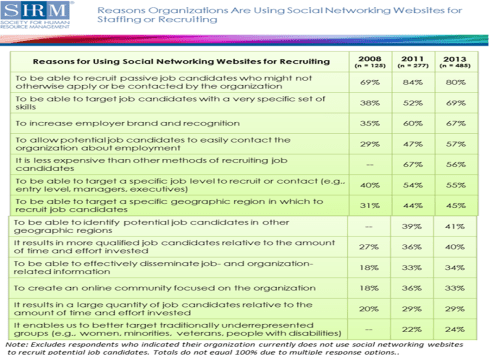
Social Networking Websites and Recruiting Selection SHRM 2013

This is interesting on lots of levels. And I look forward to continued growth at the intersection of HR and social technologies.

Hopefully SHRM will field this survey again in 2 or 3 years.

9 Comments

Filed under Candidate Screening, China Gorman, Data Point Tuesday, HR Data, Recruiting, SHRM, SHRM Survey Results, Social Media, Social Networking, Social Technology

Youth Unemployment: A Growing Problem

data point tuesday_500

You probably know a good kid like this. Graduating from high school in June. From an OK high school. Not the best student. Probably not able to get in to college – even if they could afford it and were motivated to try. They had a part-time job a couple of years ago, but got laid off. Haven’t really looked for a job since then. No real skills that employers can use. No idea how to look for a job. Starting to think about the future. No idea where to start.

Guess what? Their prospects are not good. And they need help.

You know we have an unemployment problem. Did you know we have a youth unemployment problem?

Employers of every size in every sector lament the lack of skills available to them in the talent pool.  Whether you’re reading reports from McKinsey, the Georgetown University Center on Education and the Workforce, or countless other research organizations, the message is all too similar:  our post-secondary education system isn’t delivering enough degreed individuals to meet the demands of employers world-wide. And it’s only going to get worse. Something I’ve written about here, here and here.

But it isn’t just the post-secondary education system. The secondary system is doing even worse. The youth labor market has collapsed since 2000.  The rate of overall youth employment in the teen population has fallen from 45% in 2000 to 26% in 2012 – a 42% drop, to the lowest point in post-World War II history. In 1989 the youth employment rate was 48.5%.

Here are some sobering statistics from research completed in 20120 by The Center for Labor Market Studies at Northeastern University for Jobs for America’s Graduates:

  • In 2000, the share of employed, non-college-bound youth from the high school class of 2000 was just under 70%

  • In 2011, the share of employed, non-college-bound youth from the class of 2011 was 45%, the lowest since the survey started in 1965

  • In October 2011, the employment/population rates for these non-college-bound high school graduates ranged from a low of 32% among African Americans to a high of 48% among Caucasian youth.

  • Fewer than half of these employed, non-college-bound graduates were able to obtain a full-time job – yielding a full-time employment/population ratio of 21%

  • Among the non-college-bound population of high school graduates, only 25% of Caucasian, 24% of Hispanic, and 7% of African American youth were working full time.

And these are high school graduates.  In the U.S., the percentage of high school graduates by state ranges from 62% (Nevada) to 88% (Iowa), with an overall average of 78%. What about the 22% of young people who drop out of high school?  What are their prospects?

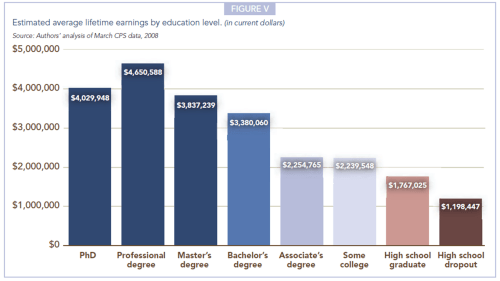
From an historical perspective, this chart shows the economic impact of dropping out of high school. But that lifetime earning amount of $1,198,447 will surely decline as fewer young people with – or without – high school degrees gain full-time employment.

Georgetown Projections of Jobs Education Requirements Figure V

And this is a problem. If unemployment in the teen population continues to rise, then a key argument to persist in high school to graduation begins to fade, further impacting college graduation rates. If unemployment in the teen population continues to rise, then key employment skills building experience will decline making employment less likely as they age in to their 20’s. If unemployment in the teen population continues to rise, then a whole host of societal challenges will grow – and none of them positive for people or the economy.

Involvement in organizations like JAG* (Jobs for America’s Graduates) can help. I’ve written about JAG here and here. It’s the longest-lived, most successful program in the U.S. that keeps the most at-risk kids in school through graduation and then stays with them through their first year of employment, college or military service. And it is making a difference in the graduation and employment rates of kids in 33 states.  Here are some current outcomes;

  • The employment/population ratio in spring 2012 was 72% for all young people in JAG versus only 42% for their national comparison group.

  • Nearly 60% of those JAG graduates not enrolled in college were employed full time in May 2012, compared to only 30% of their comparison group counterparts. Over three times the rate of teenagers in general who were working.

    • Nearly 48% of non-college enrolled African American JAG graduates were working full time versus only 17% of their comparison group peers.

    • 61% of Hispanic JAG non-college enrolled graduates were employed full time versus only 42% of their comparison group.

    • 68% of Caucasian JAG non-college enrolled graduates were employed full time versus only 31% of their comparison group.

It’s hard to argue with success. It’s even harder to argue with 32 years of consistent success. This video really captures the effectiveness of this approach:

Employers that hire skills that require high school graduation need to be concerned about the entire talent pipeline, not just the college degreed pipeline.

And by concerned, I mean involved in keeping young people in school until they graduate so that they are employable.

And by involved, I mean supporting programs like JAG that are focused on providing real, sustainable results.

And by support I mean financial support, political influence support and the promise to provide job interviews to every JAG student where they have a presence. (Archer Daniels Midland has done just that!)

You know we have an unemployment problem. Did you know we have a youth unemployment problem?

*I serve on JAG’s national board of directors.

4 Comments

Filed under Archer Daniels Midland, China Gorman, Data Point Tuesday, High School Graduation Rates, JAG, Jobs for America's Graduates, Skills Shortage

You Think We Have Skills Shortages Now? Let’s Talk in 2020!

data point tuesday_500

Skills shortages in 2020 will rise to an entirely new level. And I’m not talking about STEM skills, although they’re critical. Or the ability to speak multiple parched earthlanguages, which needs to be more common in the U.S. Or even the readiness of college graduates to take a place in the economy, which a majority of employers report is lacking.


I’m talking about the skills that the globally-connected, superstructured, computationally focused, smart-machine powered organizations of the future staffed by longer living and working, new media using employees will require.

We’re all thinking about that right? We’re re-writing job descriptions and re-wording job postings to incorporate the emerging skills we know we’ll need. Aren’t we? Well, maybe not. We know the names of the skills we can’t get today – those STEM, analytical thinking, communication and personal responsibility/accountability skills we’re sure our young people don’t have.

But really. What about the skills for the future?  I’m not sure what we’ll call those skills. I’m not even sure they’re skills, to be honest, but here’s what I do know:

  • People are living longer and will want/need to have longer careers
  • Smart machines are taking over the most routine workplace tasks
  • Data – big, medium and small – are changing the way decisions are being made at every organizational level
  • Text isn’t the only way we communicate any more
  • Organization structures and behaviors are changing due to social technologies
  • We say “Global” but what that really mean is that innovation and growth will be primarily driven through the integration of differing cultural norms and diversity

IFTF LogoThe Institute for the Future’s Future Work Skills 2020 highlights recent research that predicts the kinds of skills for which we’ll be recruiting in 2020 (which is only 6 and-a-half years away). Trust me when I write that the majority of HR/recruiting professionals are not ready for this. ATSs aren’t ready for this. LinkedIn, Facebook and Twitter aren’t ready for this. And clearly, our education infrastructure isn’t ready for this. And yet, here we are.

The IFTF identifies and defines ten skills that we need to begin to teach now so we can deploy them in six-and-a-half-years.  They are:

  1. Sense-making:  the ability to determine the deeper meaning or significance of what is being expressed
  2. Social Intelligence:  the ability to connect to others in a deep and direct way, to sense and stimulate reactions and desired interactions
  3. Novel & Adaptive Thinking:  proficiency at thinking and coming up with solutions and responses beyond that which is rote or rule-based
  4. Cross-cultural Competency:  ability to operate in different cultural settings
  5. Computational Thinking:  the ability to translate vast amounts of data into abstract concepts and to understand data-based reasoning
  6. New-media Literacy:  the ability to critically assess and develop content that uses new media forms, and to leverage these media for persuasive communication
  7. Transdisciplinarity:  literacy in and ability to understand concepts across multiple disciplines
  8. Design Mindset:  the ability to represent and develop tasks and work processes for desired outcomes
  9. Cognitive Load Management:  the ability to discriminate and filter information for importance, and to understand how to maximize cognitive functioning using a variety of tools and techniques
  10. 10.   Virtual Collaboration:  the ability to work productively, drive engagement, and demonstrate presence as a member of a virtual teaSocial intelligence (we call it EQ today, I think) and Cross-cultural Competency are certainly emerging in more sophisticated and global organizations currently. Perhaps we have a leg up with these two.

But have you ever seen a job description requiring Transdisciplinarity and a Design Mindset?

What kind of behavioral interview questions would you use to determine if a candidate has Cognitive Load Management and Novel/Adaptive Thinking Skills?

How would you Tweet those jobs? How would your careers page change?

And once onboard, how would you manage the performance of employees’ Virtual Collaboration and Sense-making?

And speaking of job descriptions and performance management, how will New-media Literacy and Social Intelligence change the very nature of these processes?

Whew! We think the current skills shortage is frustrating and scary. It could be that the future skills shortage will upend everything!

6 Comments

Filed under Annual Performance Reviews, China Gorman, Data Point Tuesday, Hiring Difficulty, HR Data, Institute for the Future, Performance Management, Skills Shortage, STEM, Workforce Skills

HR Priorities and Business Value

data point tuesday_500

SHL has published their fascinating yearly report on global assessment trends.  SHL, acquired last year by CEB, is an assessment company, so reporting SHL Logoon assessment trends is right up their alley.  The survey data are interesting and the conclusions are worth noting by anyone in HR.

But their questions and conclusions go way beyond the use of assessment instruments for employment selection and employee development strategies and practices.

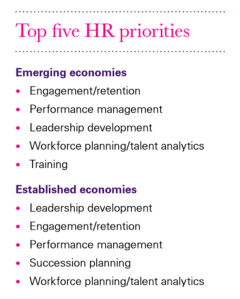
SHL Top 5 HR Priorities 2013The first part of the report reviews  organizations’ talent management focus and landscape.  For example , the authors compare the top five HR priorities in emerging economies to the top 5 HR priorities in established economies.

The lists are similar but not identical. You can see that four of the priorities show up on both lists, although prioritized differently; and that succession planning shows up in the top 5 on the established economies list, while training shows up in the top 5 on the emerging economies list.

Other findings relate to HR’s use of big data and the perception that there is room for improvement around the world in using objective data to make workforce decisions. In fact, less than 25% of the survey respondents reported that their organizations have a clear understanding of workforce potential.

The second part of the report focuses on the assessment of talent – both for hiring and for employee development.  Interesting findings in this section include the desire by nearly 75% of respondents to improve talent measurement and the practice of linking pre-hire and post-hire testing to specific business outcomes.

The third part of the report focuses on technology in testing, with a specific focus on mobile devices and social media. The key findings here include data showing that emerging economies want to use mobile technology assess candidates – both recruiters and candidates want this capability; and social media data is becoming less critical to hiring decisions. (See last week’s Data Point Tuesday.)

The report concludes with four recommendations for HR in 2013:

  • Big data presents HR with a unique opportunity to demonstrate business value

  • Only the right data will lead to the success of talent initiatives

  • HR should embrace innovation that improves how talent is recruited, but with caution

  • Mobile technology should be considered for competitive advantage, not to follow the crowd

The data in this report are presented in a way that is easily understood and useful.  At 30 pages, it’s worth the 45 minutes it will take to scan it and then hone in on the impactful sections.  I especially appreciated the selected references at the end, as well as the key findings lists from the same survey reports for 2009 – 2011. I’m always interested in the evolution of these kinds of lists.

But the bottom line for me is that here’s yet another source of global HR data shining a light on HR’s need to figure out how to demonstrate its business value. Whether you prefer this report to others you’ve discovered here at Data Point Tuesday — or you prefer other sources of HR data and analysis, the drum beat is the same:  aligning HR strategy (and tactics) to business outcomes is the only way to demonstrate business value. And the only way for HR professionals to be seen as business leaders.

1 Comment

Filed under Big Data and HR, China Gorman, Data Point Tuesday, Employment Screening, HR Data, SHL, Talent Assessment, Talent Management

Background Screening: Not So Fast

data point tuesday_500

Well, not so fast, my friend, as Lee Corso likes to say. A new survey results report from EmployeeScreenIQ, Employment Screening Practices & Trends: Not so fast, my friend (Lee Corso)The Era of Heightened Care and Diligence, brings up some important issues and is interesting on several fronts.
First, from a regulatory perspective, it would seem that employers aren’t paying a lot of attention to the relatively new EEOC guidance on criminal background checks that was released in April 2012.  According to the survey, of the almost 70% of respondents who said that their organizations have reviewed the EEOC guidance, only a little more than half of them have not made changes to their screening policies as a result. More interesting, though, is the 32% of respondents who either weren’t familiar with or haven’t reviewed the guidance. Huh.

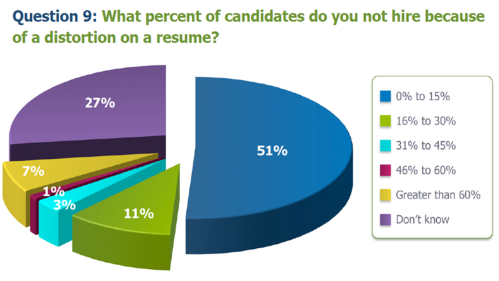
Second, more than half the respondents report that only 15% or less of job candidates distort their resumes to the extent that they aren’t hired. This is surprising given the perception that distorting resume claims is the best way to be disqualified from employment opportunities. Surprisingly, these survey results may reflect that employers see resume distortion as a minor factor in the screening process. Huh.

EmployeeScreenIQ Resume Distortion Impact

Third, and most interesting to me, is the impact of the legal uncertainty for using social media as a source of background screening information. This uncertainty appears to have scared the you-know-what out of employers. Huh.

Actually, I’m not sure I believe the data here. Or rather, the survey questions may not have been posed to the right people.

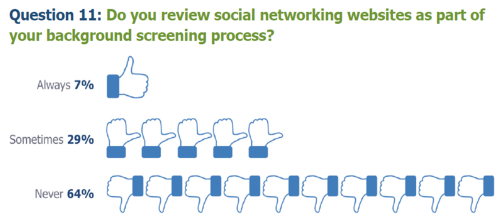
EmployeeScreenIQ Social Networking Sites

Really? Only 36% of employers always or sometimes check social networking sites for background information? Huh. Here’s what I think is happening. Those corporate folks responsible for filling out surveys like this – in the recruiting function – know the legal quicksand that is forming around the use of social media for employment screening and are clear that their formal guidelines restrict the use of Facebook, LinkedIn, Google+, blogs, etc. in this way. This doesn’t mean that hiring managers aren’t doing it anyway. In fact, I think it’s a fair bet that although many employers are specific in excluding social networking sites for candidate background screening, as reported in this report, hiring managers do it anyway. All. The. Time.

That’s why the next survey question’s answers seem highly suspect to me.

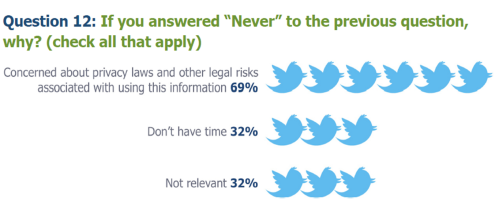
EmployeeScreenIQ Why Not Social

Don’t have time? Right.  Not relevant? Please.

I guarantee that hiring managers make the time because they think checking out “social” behavior is extremely relevant.

This report brings up some great questions for recruiters and hiring managers and shows the need, I think, for greater communication between these two groups. Staying on top of EEOC guidance is, of course, a critical part of HR’s regulatory and risk mitigation obligations. Evaluating the impact of resume distortion is part of the recruiters’ responsibility. And staying current on the evolving legal decisions in the employment/social media space is a critical new high impact area of contribution for the HR and recruiting functions.

One might not think that the arcane world of background screening would present such an interesting opportunity for HR pros. Think again.

5 Comments

Filed under Background checks, Candidate Experience, China Gorman, Connecting Dots, Data Point Tuesday, EEOC, EmployeeScreenIQ, Employment Screening, HR Credibility, Talent Acquisition

Is Talentism the New Capitalism?

data point tuesday_500

“Is talentism the new capitalism?”

Klaus Schwab, Founder and Executive Chairman of the World Economic Forum, thinks so and said as much as he opened this year’s event in Davos.

Mercer chose this quote to open the executive summary of its new report, Talent Rising:  High-impact Accelerators to Global Growth. It includes some great survey data from more than 1,250 HR and talent management executives in 65 countries around the world. It includes important and useful data about how organizations are or are not expanding their definition of capital to include talent.

Forever, it seems, organizations’ primary sources of value and competitive advantage have been financial in nature:  money, lands, buildings and machines – all the values carried on the balance sheet. Mercer’s observation that with human capital being the main determinant of success today, it is troubling that so many organizations leave the development of their talent “largely to external systems and forces, with resulting gaps in their talent portfolios.”

(One could also position that if, indeed, human capital is the main determinant of organization success today, then there should be an entry on the balance sheet to capture its importance. But that’s for another day.)

This report is a huge call to action – not just for HR, but for the entire C-suite. And it is a great roadmap for HR to initiate the discussion of talent as capital.

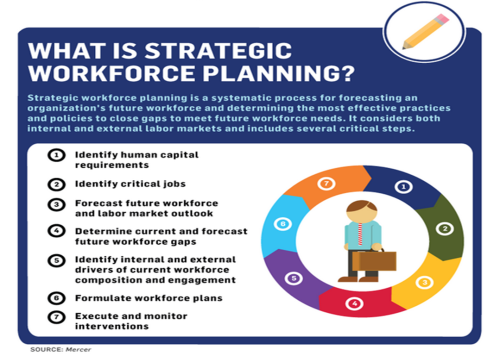
Central to this discussion is the definition of strategic workforce planning. We hear about this all the time in HR. And BCG, funded by the World Federation of Personnel Management Associations together with SHRM, has observed that there is low current capability worldwide in strategic workforce planning. Perhaps that’s because we know it when we see it, but we can’t really define it.

Mercer’s done a great job of defining strategic workforce planning and published a great infographic along with the Talent Rising executive summary.

Mercer Strategic Workforce Planning Infographic

This 7 step virtuous circle seems simple enough, but I think we all know that sometimes the most simple things are the hardest to achieve. And that certainly would be true for strategic workforce planning. Identifying accelerators on which to focus might help organizations begin to break the process down into manageable chunks.  Just knowing where to begin will undoubtedly help some make progress.

“Talentism is the new capitalism.” Well, maybe in 5-10 years. When HR is seen as a business function and not an overhead function.  And human capital is valued on the balance sheet.

We can dream, can’t we?

6 Comments

Filed under Boston Consulting Group, C-suite, CEOs, China Gorman, Connecting Dots, HR Credibility, Human Capital, Mercer, SHRM, Strategic Workforce Planning, Talentism, World Economic Forum

Sources of Hire: Is Perception Reality?

data point tuesday_500

Along with Quality of Hire, Source of Hire is starting to take center stage in the talent acquisition world. The annual report tracking and analyzing Source of Hire from CareerXroads is out today.  Sources of Hire 2013:  Perception is Reality contains truly interesting data – understandable and actionable.  And the authors ask some really important questions about B2D (Big Bad Data) and how to measure the pre-application talent supply chain.

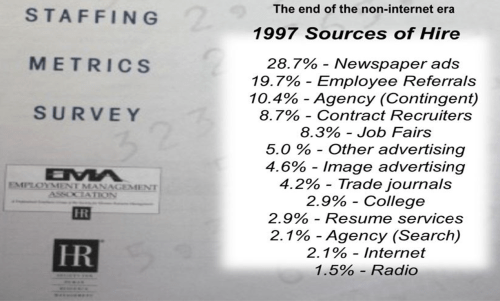
Early in the whitepaper, Gerry Crispin and Mark Mehler, the principals at CareerXroads, show the following chart of source of hire data from 1997 – collected by SHRM and EMA (now part of SHRM).

Sources of Hire 1997

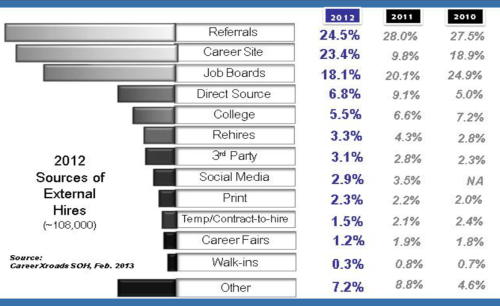
Talk about a blast from the past! Newspaper ads generated the most hires at 28.7% of hires and Agencies – both contingent and executive search – generated 12.5% of hires. My how the world has changed.  Here’s the 2012 data:

2012 Sources of Hire

Print has fallen from a combined (newspaper and trade journals) 32.9% to 2.3%!  “Internet” has grown from 2.1% (had Al Gore even invented the internet in 1997?) to a combined (career site, job boards and social media) 44.4%!

There is a lot in which to be interested in comparing these two charts, so have fun.

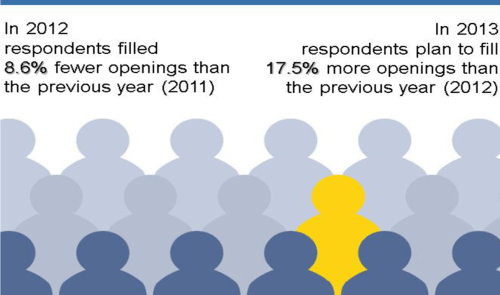
There nuggets of pure gold in this whitepaper.  Two in particular stood out to me. The first is the expectation for increased hiring in 2013.

Total Hires 2013 Source of Hire

If true, we’re about to see a whole lot of domestic hiring!  The national hiring figures are trending slowly upward, but at the same time we read in the press that the implementation of the new health care rules is retarding hiring in the small business sector, the sector credited with being the job creation “engine.” This will be interesting to watch. Will the need for growth overcome the risk and costs associated with that growth?

The second nugget is the reminder that the source of the majority of hires is the pool of existing employees.

Internal Movement Source of Hire

The whitepaper accurately points out that internal movement and promotion are higher during difficult economic periods – and this is evident in the graph above.  However, a steady increase in this category may also be due to the perception of a growing skills scarcity in the outside talent market.

Enjoy the whitepaper. And begin to ask yourself some of the questions posed by Gerry and Mark.  Questions like…

  • How comfortable are you defending the 2013 plan for your budget, recruiters, technology tools, partners, vendors, training and your sources to your peers and colleagues?

  • How much should your 2013 recruiting strategy include improving your collection and analysis methods?

  • Are referrals the best source of hire?

  • What “Sources” interact with each other the most?

  • How can I collect Source of Hire data?

4 Comments

Filed under CareerXroads, China Gorman, Connecting Dots, Data Point Tuesday, Gerry Crispin, Hiring, Hiring Difficulty, HR Data, Mark Mehler, Quality of Hire, SHRM, Source of Hire, Talent Acquisition

The Tip of the Engagement Spear

data point tuesday_500

BlessingWhite’s Employee Engagement Research Update has recently been released.  It’s an update to their massive research published in 2011. Measuring engagement is tricky – from gaining consensus on terms and definitions, to crafting survey questions that generate useful answers, to identifying key findings, to agreeing on recommendations – it’s all very tricky.

BlessingWhite does a good job managing the trickiness.  But truthfully, there’s not a lot of difference in engagement scores globally since their 2011 findings.

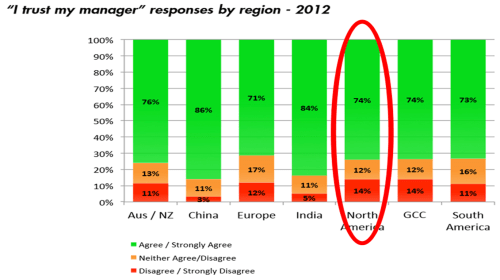
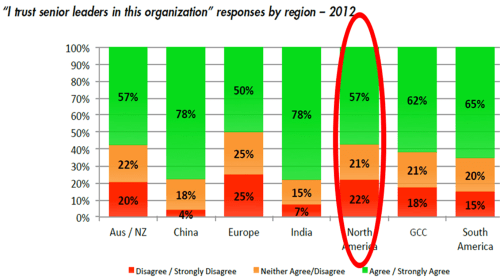
Here’s what caught my attention, though, as it did 2 years ago, as I read through the report:  a greater percentage of the workforce trust their managers more than they trust the executives in their organizations.

This makes sense, right? Managers have day-to-day interaction with their colleagues and can get to know them in personal ways. Executives, on the other hand, rarely have one-to-one interaction with the majority of the employees their organization. And the survey results show the difference in trust levels.

I trust my manager BW 2013

I trust senior leaders BW 2013

It’s a good thing that employees in North America trust their managers more than they trust their senior leaders because there’s a high correlation between engagement and trust in managers. Or maybe it’s the other way around.  Either way, BlessingWhite points out that while engaged employees have other factors that motivate them – like interesting work, a sense of contribution and career aspirations – less-engaged employees are far more dependent on knowing their manager personally to reach higher levels of engagement.

This makes managers the tip of the engagement spear. And why we spend so much time focused on managerial effectiveness in almost every category of performance.

Not so with senior leaders, which is understandable because they don’t have the ability to interact personally with every employee, as BlessingWhite points out.  But they do have the responsibility to set the direction of the culture, communicate that direction with a “clear line-of-sight” throughout the organization, and create a culture that fuels engagement and business results. In other words, set the managers up for success in engaging their teams in more personal ways.

The CASE model, reviewed briefly at the end of the report, focuses senior leaders to fulfill four key workforce needs in building and leading their cultures:

  • Community for a sense of belonging and purpose
  • Authenticity  as a basis for trust and inspiration
  • Significance to recognize individuals’ contributions
  • Excitement to constantly encourage – and raise the bar on – high performance

It’s a good message for executives. It’s a great message for managers. It’s a call-to-action message for HR to know how to help executives drive performance and grow their culture while supporting managers to make more personal connections.

Engagement isn’t the answer to every organizational challenge. But it does seem clear that highly engaged workplaces are more productive than less engaged workforces. And almost every organizational challenge I can think of gets solved more effectively and faster with an engaged workforce working the solution and being led by managers who are personally leading the way.

8 Comments

Filed under BlessingWhite, China Gorman, Connecting Dots, Data Point Tuesday, Engagement, HR Data, Managerial Effectiveness, Workforce Management

From the Archives: Memo to HR

data point tuesday_500

Until last week’s post about Yahoo! CEO Marissa Mayer’s decision to end telecommuting, the post below from March 18, 2011 was the most read of all my posts.  Interesting.

TO:                         HR

FROM:                  China Gorman

RE:                         News flash!

Date:                     March 18, 2011

Guess what?  Your CEO probably gets it.

I know HR pros like to kvetch about the C-Suite in their organizations:

  • “My CEO doesn’t get it.”
  • “The CEO and CFO run the business like people are widgets.”
  • “I can’t get the C-Suite interested in cutting edge HR solutions.”

Those days are over, friends.  I’ve met and talked with a number of CEOs lately.  CEOs from Fortune 200 companies, medium-sized companies and start-ups.  I’ve been struck by the conversations we’ve had.  Because in each case, these CEOs exhibit many of the behaviors HR pros are looking for from their CEOs.  Here are some of the signs:

1.       Talent acquisition/development comes up early in a conversation about their top challenges.

2.       They have done reading – or in some cases, writing – about corporate culture and are actively involved in leading a change in their organization’s culture.

3.       They have embraced the research of an OD or culture expert/guru whose work they are integrating into their culture and language.

4.       Succession planning is among the top issues on which their leadership team is working.

5.       Employee engagement is critical to them.  They know the scores of their organization’s most recent employee attitude survey and are peering over the shoulders of their operations leaders to ensure the opportunities for improvement are moving forward — in line with the culture change work they’re leading.

6.       Supervisors/managers are measured by how well they manage the performance and development of their people.

7.        Diversity/inclusion enters the conversation early when talking about culture.

But here’s the thing, HR.  This is a trend.  We’re going to see more and more of these behaviors from CEOs as we experience the pending generational shift in the ultimate C-Suite in organizations large and small.

So here’s the big question:  Are you ready? Are you ready to be evidence-based in your leadership?  Are you ready to base organization and business solutions on current research and analytics?  I hope so.  Because the next generation of CEOs – as well as some in the current generation as my experience indicates – while  they’re beginning to focus on what HR would say are the right issues, they’re still the CEO.  They’re still all about the numbers.  Outcomes.  Growth.  Quality.  They still need fact and data to support their decision making.  That’s not going to change.   And if they don’t get that fact and data from HR where are they going to get it?

CEOs don’t really make critical decisions much by “gut feel” and that probably won’t change.  Ever.   Sure, some may be more spontaneous than others.  Some may be more extroverted than others.  And some may actually sound like HR professionals.  But they’re still CEOs.  They still have to deliver top and bottom line performance this quarter and next.  And they have to have a plan for the longer horizon – a plan that is based on real data and supported by the current set of facts.

Where would the average HR professional begin to source useful research data and analytics?  SHRM, CIPD, ASTD, WorldatWork – all the large HR-related professional associations are investing more and more into their research capabilities.  They all conduct and publish top notch research in every aspect of the people domain in organizations. They want their members to embrace more rigorous and sound methodologies.  Heck.  They’re pleading with their members to be consumers of relevant research because they know the day of reckoning is approaching.

Other organizations like The Conference Board, the Corporate Executive Board and Bersin & Associates all publish extraordinary research that enable HR to make fact-based decisions and to get HR metrics aligned with financial metrics.  Free sources of actionable research-based data include the SHRM Foundation, the U.S. Department of Labor,  the U.S. Bureau of Labor Statistics and innumerable non-profit organizations that cover the waterfront of issues and functions.

Since more and more CEOs are “getting” the fact that people and culture are critical to business success, is HR “getting” that in order to respond to this CEO movement in their direction, they need to be making movement into the fact and data-based world of the CEO?  I surely hope so.

It’s past time to get comfortable with research and analytics — and making them actionable.

16 Comments

Filed under Data Point Tuesday, Uncategorized

Candidate Experience vs. the Black Hole

data point tuesday_500

A couple of months ago I shared some data from an Aberdeen Group report about benchmarking quality of hire best practices here. It’s a great benchmark list of outcomes.  But how about the inputs?

More specifically, in terms of quality of hire, how about benchmarking the quality of the candidate experience? Call me crazy, but it seems to me that a higher quality candidate experience translates into a higher quality of hire.

As background, The Talent Board was formed in January 2011 to assist recruiting organizations in understanding and evaluating the experiences of their candidates.

“While there is an inherent dissatisfaction that comes with rejecting employment candidates, the Talent Board believes that it is possible to:

  • Treat all employment candidates with professionalism and respect
  • Shrink the recruiting “blackhole” effect on candidates.”

The Talent Board founders, Gerry Crispin, Elaine Orler and Ed Newman and their colleagues have just produced the 2012 Candidate Experience report from their survey and awards program.   In its second year, the research was based on survey responses from 90 companies (up from 57 in 2011) and more than 17,500 completed candidate surveys (up from 11,500).

To be clear, that’s 17,500 candidates for employment answering questions about their experience as an applicant in four defined phases of the talent acquisition process:

  1. Candidate attraction
  2. Expression of interest
  3.  Candidate dispositioning before the finalist stage
  4. Candidate evaluation & selection

The report gives data from the employer questionnaire as well as from the candidate questionnaire.  As examples, here are two such questions.  Interesting to note the differences between employers and their candidates.

CandE Emp #34 Cand #20

But for most, the topic of most interest is the infamous “black hole” – that old familiar experience of applying for a job by filling out an application on line, attaching a resume to an online application or email, or using snail mail to send in a resume … and never getting a response.   Worse, the black hole could happen after a phone interview.  Or after a face-to-face interview.  At the entry level.  At the professional level.  At the executive level.  Yes the black hole is everywhere. In every industry, geography and size of company.  We’ve all experienced it. And we’ve all derived meaning from it.

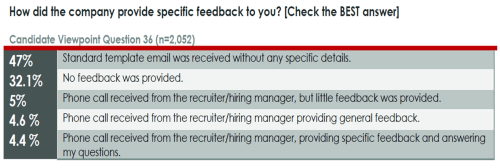
The 90 employers that participated in the Candidate Experience Survey last year are paying attention to the black hole.  And while a boilerplate email message from a “do not reply” address notifying an applicant that they won’t be a candidate is only a smidge better than the black hole, bad communication is better than no communication and it’s a baby step in the right direction.  The report goes on to show guarded optimism that while some employers are beginning to provide feedback to disposed candidates when asked, not many are making it a standard practice.

But here’s the kicker:   fully one third of candidates from employers who care about the black hole were provided no specific feedback about their application. And nearly half received a standard email template with no specific information.

CandE Candidate Question #36

One third got no feedback. Zero. Zip. Nada. That’s a massive black hole, right there. And think what meaning is derived from it about the employer’s brand, culture, management, products and services. Connecting those dots isn’t hard.

So.  While a few employers are connecting the dots between quality of hire and quality of candidate experience, it’s clearly not enough.  If your organization is beginning to look at quality of hire metrics, don’t forget the candidate experience.  I’m not sure you can improve one without improving the other.

And check out the process for participating in the 2013 CandE Awards program.  You can’t improve future performance without a clear understanding of current performance.  That includes quality of hire – which surely includes the candidate experience.  Time to get rid of the black hole!

5 Comments

Filed under Black Hole, CandE Awards, Candidate Experience, China Gorman, Connecting Dots, Data Point Tuesday, HR Data, Quality of Hire, Talent Acquisition, Talent pipeline, The Talent Board