Your EVP May Not Be Enough

According to some new data from the folks at Kelly OCG, employees all over the world are planning their work lives in dramatically new ways.  In their white paper, The Autonomous and Empowered Workforce, data from the Kelly Global Workforce Index™ is presented using compelling visuals.

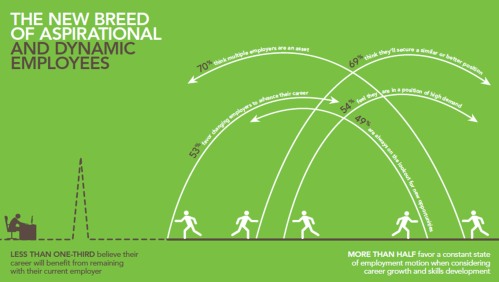
The graphic below is pretty interesting and sums up much of the data in the white paper.  The highlights are:

  • Less than a third of employees believe their career will benefit from remaining with their current employer
  • More than half favor a constant state of employment motion when considering career growth and skills development
The fine points of what today’s employees think about the future of their careers according to KellyOCG include:

  • 49% are always on the lookout for new opportunities
  • 70% think multiple employers are an asset
  • 53% favor changing employers to advance their career
  • 54% feel they are in a position of high demand
  • 69% think they’ll secure a similar or better position

From an employee engagement and retention perspective, it is interesting that employees in the Americas seem to be trailing behind employees in EMEA and APAC as it relates to the relevance of a career-for-life, with 49% of employees in the Americas agreeing that a career-for-life with one employer is relevant.  Only 29% of APAC and 21% of EMEA employees see that relevance. So hanging on to employees in APAC and EMEA is already harder than hanging on to employees in the Americas.

But for how long?

Compare that to the finding that 65% of employees in the Americas consider work experience with multiple employers to be an asset and we can imagine that the career-for-life relevance may be exiting stage left before the end of the second act.

Certainly as you read the Kelly Global Workforce Index™ you’ll find lots of interesting dots to connect that may impact the work you do in 2013 to strengthen your EVP (Employee Value Proposition).  But this data are clear that there is a shift coming more rapidly than many may think.  A shift to job changing as a proactive career management strategy as opposed to job changing as a reactive crisis coping response.

If true, this is big.  And impacts everything from talent acquisition strategies, to onboarding processes, to rewards/recognition programs, to learning and development offerings, to performance management systems and more.

If true, this is big. Really big.

2 Comments

Filed under Career Management, China Gorman, Connecting Dots, Employee Value Proposition, EVP, HR Data, Kelly Global workforce Index, Kelly OCG, Talent Management

Is HR Mad for Social?

What a week!

Monday and Tuesday in the U.K. at TruLondon; Wednesday in Dublin at the Kelly OCG Talent Strategy Summit; and Thursday and Friday in Amsterdam at the HR Tech Europe Conference. Hanging with HR Professionals from Europe, the Middle East, Asia and North America. Focused on the challenge of increasing the productivity and efficiency of organizations by managing talent better. A global challenge, surely.

The talk at TruLondon was focused on making talent acquisition smarter, more social (because that’s how talent operates today), and more effective. (You can read my take on the conference here.)

The conversation in Dublin was more general, but the use of social technologies was a central thread.

And social was front and center throughout HR Tech Europe – whether it was in keynotes by thought leaders like Thomas Otter, Naomi Bloom, Peter Hinssen  or Josh Bersin, the iHR competition where 6 emerging tech based HR solutions companies vied for the coveted “best new HR tech company,” or as many as 10 (out of 52) breakout sessions that had “social” in their titles.

It made me wonder: is HR mad for social? Every conversation I had in London, Dublin and Amsterdam touched on social – either in discussing conference content or in casual, more personal conversations.  A sample of things overheard:

  • “What a stitch: I just got endorsed for my BBQ skills on LinkedIn.” (not me)
  • “The Twitter stream was rocking during Josh Bersin‘s presentation.”
  • Naomi Bloom said “building/sustaining/deploying social networks to achieve business outcomes, and the business networks of workforce members, are foundational.”
  • Thomas Otter said “mobile devices and social networks are changing the way we work.”
  • “The nexus of Big Data and HR and social will take us to a whole new level of strategic impact.”
  • “Talent Acquisition and Learning and Development are outliers in the world of HR when it comes to early adoption – especially in the social and mobile arenas.”

Frankly, I knew for sure that HR is mad for social at HR Tech Europe when a session leader, a senior HR leader from a French firm, used an image of a kitten with the following caption: “please adopt me.” (HR + kittens = done deal.)

I don’t think that focusing on social technologies to help support HR in making bigger impacts in talent management challenges is a bad thing. We just have to ensure that we are being data-based and  strategic and not just focusing on the next new shiny object. We must ensure that any new solution we introduce into our organizations does 3 things:

  • Strengthens the relationships between employees and their managers, employees and customers, and employees and senior leadership
  • Is based on, collects and produces actionable data
  • Links with the talent strategy – which is rooted in the business strategy

Unless the myriad of solutions coming to the HR/Talent marketplace with social features can do those three things, they may well be just shiny objects mewling like kittens to be adopted.

Unless the myriad of solutions coming to the HR/Talent marketplace with social features can do those three things, they’ll do nothing to increase HR’s ability to lead the necessary strategic  workforce and talent planning actions.

Unless the myriad of solutions coming to the HR/Talent marketplace with social features can do those three things, HR won’t be able to fund them, much less implement them.

The discussions in London, Dublin and Amsterdam were engaging – whether in casual conversation or from behind the podium – and will lead the way for increasing HR’s impact on business performance and growth. And that’s just where HR needs to play:  improving business performance through the greater productivity of talent.  If that isn’t the focus, then social becomes a distraction and a waste of time, energy and money.

Then we won’t be mad for social – we’ll be mad at social. And rightfully so.

1 Comment

Filed under China Gorman, Conferences, Connecting Dots, HR, HR Conferences, HR Technology Conference, Kelly OCG, Social Technology, Talent Management, Technology, Tru Events

#Tru Innovation

Bill Boorman photo by Heather Bussing

Two years ago I wrote about my first TruLondon unconference experience.  Read it here.  I called it The King of All Social Recruiting. It was less about the event and more about Bill Boorman, the conference  “disorganizer.”  I’ve just attended and led a track at TruLondon6 and I have to say it was another Bill Boorman Tour de Force.  This guy just doesn’t stop innovating.

Bill innovates like you and I breathe.  I don’t know how else to describe him.  For instance, at this unconference he enticed a major new sponsor to underwrite the first ever conference-based live streaming Google+ hangouts.  The first.  Ever.  The good folks from Kelly OCG’s EMEA team underwrote the filming and live streaming of “hangouts” – discussions, really – live streamed on Google+.  Kelly OCG had thousands of viewers to this unscripted, captivating content – challenging and fun conversations with thought leaders from around the world on topics that ranged from “should leaders manage the different generations differently?” to a

Kelly OCG Google+ Live Streaming Hangout photo by Heather Bussing

presentation and discussion led by the CEO of Stack Overflow, Joel Spolsky.  Some of the hangouts were social media focused, some were recruiting focused, some were just cool conversations by really smart people with expertise and opinions about the state of talent acquisition and development.  These were happening simultaneously with the three tracks of group discussions (not filmed or streamed live) in each time block.

China Gorman and Mervyn Dinnen at TruLondon6 photo by Heather Bussing

At the same time, Mervyn Dinnen from JobSite recorded and live streamed interviews with many of the notables in attendance.  John Sumser and I had a fun conversation about whether or not there really is a talent or skills shortage.  Check out the JobSite channel to see the recorded interviews.

True to the Tru brand, stars in the talent firmament  like Johnny Campbell, Paul Maxin, Henry Stewart, Andy Headworth,

Photo by Heather Bussing

John Sumser, Gerry Crispin, Crystal Miller and Heather Bussing led fascinating group discussions and challenged the attendees to share, learn and think differently.  As a track leader, I learned as much from the colleagues in my discussion as I hope they learned from me.

I have to say it was entertaining, fun – and I really learned a lot.  Just what I want from a conference – or unconference – experience.

If you get the chance to attend one of Bill’s Tru events – and they’re all over the world now with stops coming up in Amsterdam, Zurich, Cape Town, Hong Kong, Singapore, New Orleans, Seattle and lots more – you really need to do it.  Leave your “normal” conference experience expectations outside, though.  This will be a conference like no other you’ve ever attended.  And you’ll be smarter for it – and your network will have grown exponentially with innovators like Bill Boorman.

Well, not really like Bill Boorman — there’s only one of him.

1 Comment

Filed under Bill Boorman, China Gorman, Conferences, Connecting Dots, HR Conferences, Talent Acquisition, Tru Events, Unconference

A Funny Thing Happened on the Way to the C-Suite…

The Career Engagement Group from New Zealand recently conducted  an online survey of over 1,000 employed people ages 18-65.  The focus of the survey was to understand the career aspirations, agility and drivers of the current workforce across key demographics such as gender, age and career stage.

Maybe because the survey originated in New Zealand, some different questions were asked than the usual employee engagement surveys we see so routinely today.  It’s always good to get a different take on what’s important.

One of the subjects covered that seemed out of the ordinary was Leadership Aspiration.  Now that I think about it, I’m not sure I’ve ever been asked – in the many engagement and career development surveys I’ve taken – if I wanted to lead at the most senior level in an organization.  It’s a great question.  And the answers surprised me.  How about you?

Leadership Aspirations & Gender & Generations

  • Only 11% of all respondents want to lead at the most senior level in an organization.
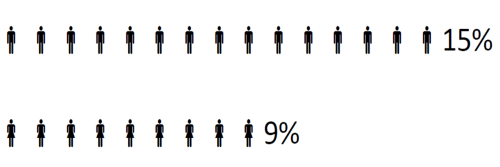
  • Women report lower leadership aspirations than men – 15% of all males aspire to senior leadership positions, while only 9% of all females had similar aspirations.
  • Younger people have higher leadership aspirations overall.

Hmmm.  Only 11% of all respondents want to lead at the most senior level in an organization!  That surprises me.  A lot.  I would have loved to have seen the breakdown in responses by age group as well as gender.  Because I might have thought that the younger generations might be less interested in the stress and costs of leadership at the top than their older colleagues, but the results say otherwise according to the Career Engagement Group.

And women being less interested in leadership at the top than men?  That’s kind of a show stopper, don’t you think?  With more and more women entering the workforce around the world, this finding should be concerning.  Many industry-leading organizations are working hard to keep women in their organizations – maybe they should also be more encouraging about the value and rewards of life at the top.  According to this survey, there aren’t a lot of people — male or female –dreaming about being the CEO and making plans to get to the top.

When the demographics are already working against us (see my posts here and here) and the C-Suite is justifiably concerned about where the next generation of leaders is coming from, perhaps what’s needed is a marketing campaign to encourage workers to reach for the top.

What do you think?

2 Comments

Filed under C-suite, Career Development, Career Planning, CEOs, China Gorman, Connecting Dots, Demographics, Engagement, HR Data, Leadership Aspiration, Talent development, Talent pipeline

Building the HRM Technology Business Case

The highly anticipated CedarCrestone 2012-2013 HR Systems Survey White Paper, 15th Annual Edition was released at the HR Technology Conference in Chicago last week.

If you have any thought of adding HRM technology to your budget next year, the data in this report can be the foundation of your business case for the investment request.  Even if you aren’t going to ask for technology investment money for FY2013 this report will give you important data for managing your technology in new ways.

In analyzing the more than 1200 survey responses to identify key common practices, the CedarCrestone team (led by Lexi Martin) used these four independently validated key financial metrics to identify the highly successful organizations:

  • Revenue per employee:  Top performers is $681,903 vs. $352,576 for all others
  • Profit per employee:  Top performers is $317,508 vs. $131,157 for all others
  • Operating income growth (EBIT):  Top performers is 61% vs. 11% for all others
  • Return on Equity:  Top performers is 23% vs. 10%

Once the pool of top performing organizations was created, the analysis for common practices began and resulted in identifying the following Seven Practices of Top Performing Organizations:

  1. Top Performers have standardized processes and sophisticated change management processes.
  2. Top Performers are more likely to already have, or be planning a move to, a SaaS HRMS.
  3. Top Performers avoid extensive customizations of their HRMS.
  4. Top Performers have higher user adoption of employees, and manager self service, and shared services.
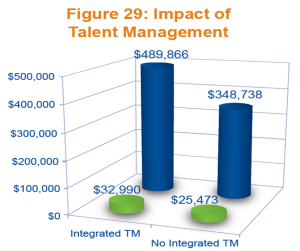
  5. Top Performers are more likely to have an integrated Talent Management system on the same platform as their HRMS solution.
  6. Top Performers have more sophisticated business intelligence solutions in place and more often put these tools in the hands of managers.
  7. Top Performers have more HR technologies in use and spent less on HR technology per employee.

The CedarCrestone 2012-2013 Survey White Paper goes into great detail about each of the seven best practices with quick characteristic overviews as well as deep data dives.  Well written and easily understood, this report is full of really useful information – whether you’re an HR department of one or one hundred.

The best practice that caught my eye was #7:  Top Performers have more HR technologies in use and spend less on HR technology per employee.

Regardless of the application category, Top Performers have more technology in place than the others.  We place each respondent in a technology application adoption quartile:  62% of Top Performers are in the top quarter of application adoption vs. 35% of the other publicly traded organizations; the categories of BI (Business Intelligence) and social applications both had 20%+ differences in adoption  between Top Performers and non-top performers.  And all of that technology still comes at a 12% lower cost per employee! 

It may seem  counter-intuitive that more technology means less cost, or that more technology means less humane-ness.  But what’s more humane than the organizational stability that comes with success?  What’s more humane than a highly profitable business that’s able to invest in talent?  What’s more humane than the organizational growth and longevity that higher levels of productivity produce?

Download the CedarCrestone report here, get a cup of coffee and spend an hour on the data and conclusions.  You won’t be sorry because these dots connect.

It’s budget season. You need the business case to invest in HRM technology and this report will give you most of the firepower you’ll need.  You could be a hero at this time next year!

1 Comment

Filed under Business Case, CedarCrestone, China Gorman, Connecting Dots, EBIT, HR Analytics, HR Data, HR Technology, HR Technology Conference, HRM Technology

A Whole Lotta Business Going On!

Last year I wrote about the HR Technology Conference and titled my post “HR people doing business. Wait.  What?”  I attended this event for the first time last year and was struck by the business activity going on at the conference.  It wasn’t about swag; it wasn’t about recertification credits; it wasn’t about getting autographed books.  Some of it was attendees really having buying conversations with vendors; some of it was vendors doing business with other vendors; and some of it was organizations having hiring discussions with candidates who happened to be attendees, vendor employees, speakers, etc.  And all that was happening this year as well.  You just can’t escape the feeling that business is going on when you walk the halls and floor of this conference.

There was an added dimension to the floor this year.  And maybe it was there previously and I just wasn’t aware.  But there was lots of money at this conference looking for investment opportunities.  I talked with a number of VC and other investors who came to see what was new and to make relationships for investment purposes!

There’s a lot of money flowing into the HCM space these days – untold numbers of VC outfits; strategic buyers like IBM, Oracle, Salesforce; the public markets with IPO offerings like Workday.  With talent issues being top of mind for every business leader with a Chief in their title, it’s no wonder that money is seeking opportunity in this field.

And you could absolutely feel it at HR Tech which concluded in Chicago yesterday.  Investments were being poised to happen in start-ups as angel investments, start-up investments, series A, B and C investments as well as outright purchases.  The talent management issues of organizations all over the world are creating opportunities for innovative solutions that will help us get better talent more efficiently with a great likelihood of longevity.  That’s what we want as business leaders.  And money was there looking for opportunities to make that happen.

As Mark Hurd, President of Oracle, told the conference attendees, “I want the best people at the lowest cost that I can get them.”  Exactly.  As an organization leader who “gets” HCM’s value, Hurd is no longer in the minority of C-suite leaders.  And that means greater emphasis on productivity and efficiency and cost.  And that opens the door wide to innovation and investment.

The HR Technology Conference is the one conference to attend to find out how to make your HCM infrastructure more productive, more efficient, more cost effective and more future oriented.  It’s the one conference to attend to meet senior business leaders who are focused on winning through talent and systems to manage that talent.  It’s the one conference to attend to get a glimpse of what will be possible in the future to ensure organization success.  If it isn’t on your agenda for next year, it should be.

3 Comments

Filed under C-suite, Conferences, HR Conferences, HR Executive Magazine, HR Technology Conference, IBM, Oracle, Salesforce, Talent Management, Workday

7.8% Huh?

Most people saw the U.S. jobs report numbers on Friday and thought, “this doesn’t make sense.”   All the data we’ve been seeing shows that employment continues to be weak and job seekers continue to drop out of the job market.

Monster’s Employment Index for September showed a 2 point decline month-over-month:

That’s a decline in U.S. online job posting activity.  This would indicate a slowdown in hiring not a hiring urge of massive proportions.

The Glassdoor Q3 Employment Confidence Survey shows a pretty strong worsening of confidence on the part of job seekers that they’ll find a job in the next six months:

This wouldn’t indicate that job seekers see people around them getting jobs.  And 59% of employed people don’t think they could replace their job in six months.  Six months!

So what’s the deal with the massive reduction in the unemployment rate from 8.1% to 7.8%?  Well, as I wrote here, the official BLS unemployment rate combines data from two surveys conducted by the U.S. government:  The Establishment Survey which surveys employers and the Household Survey which surveys thousands of households on a range of topics including employment.  The two surveys tell two very different stories in September.

Here’s the Establishment Survey portion of the jobs report from the BLS (U.S. Bureau of Labor Statistics):

Total nonfarm payroll employment increased by 114,000 in September. In 2012, employment growth has averaged 146,000 per month, compared with an average monthly gain of 153,000 in 2011.

So we’re down from the monthly average in both 2011 and 2012.  And the monthly average in 2011 was higher than this year’s monthly average.  Nonfarm payroll employment increased by 114,000 in September.  That isn’t enough to cover the new entrants into the labor force – much less hundreds of thousands of unemployed job seekers.

The Household Survey tells a different story:

Total employment rose by 873,000 in September, following 3 months of little change. The employment-population ratio increased by 0.4 percentage point to 58.7 percent, after edging down in the prior 2 months. The overall trend in the employment-population ratio for this year has been flat. The civilian labor force rose by 418,000 to 155.1 million in September, while the labor force participation rate was little changed at 63.6 percent.

So.  Total employment – as reported by individuals not employers – rose by 873,000 in September following “three months of little change.”  Despite declining confidence in almost every other survey we see, 873,000 people reported working in September who weren’t working in August.  It boggles the mind.

Here’s where those jobs came from:

The number of persons employed part time for economic reasons (sometimes referred to as involuntary part-time workers) rose from 8.0 million in August to 8.6 million in September. These individuals were working part time because their hours had been cut back or because they were unable to find a full-time job.

Part-timers.  600,000 new part-timers.  Part-timers who could be working as little as a couple of hours a week from home. Truly, it boggles the mind.

This is all very confusing.  We’re covered over in statistics, trends and data that tell us that the employment picture is stagnant at best.  Confidence in the job market continues to decline. And the unemployment rate went down .3% in one month.

I’m with Jack Welch:  I can’t connect these dots.

5 Comments

Filed under Bureau of Labor Statistics, Connecting Dots, Employment Data, Glassdoor, HR Data, Jack Welch, Monster, U.S. Department of Labor, Unemployment, Unemployment Rate

The Language of Business

Visier, named one of the “2012 Awesome New Technologies for HR” by Bill Kutik, the founding conference co-chair of the upcoming HR Technology Conference in Chicago, is changing the face of HR analytics.  And by changing the face, I mean, putting a beautiful, incredibly interactive and astonishingly useful face on the workforce data collected by the many and disparate systems inside organizations.

All vendors in the HCM space commission research and surveys by credible third party organizations and write what they hope are useful white papers to ensure an educated prospect and customer base.  These white papers, while clearly biased, have some powerful data and insights that any HR practitioner – generalist, specialist or leader – can use to educate themselves.  Trolling through the Resources tabs of HCM solutions providers when you have some downtime can be worthwhile.

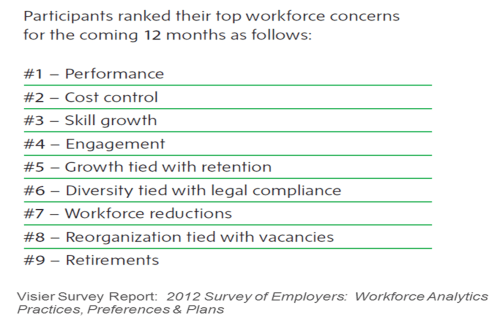
As I was browsing through the white papers at the Visier site, I came upon some great stuff.  Since Visier is in the workforce analytics business the subject matter is all tied to workforce analytics.  And they’ve got some great survey and research data for you.  But in this survey report, 2012 Survey of Employers:  Workforce Analytics Practices, Preferences & Plans, tucked in at the very end, was a chart showing what more than 150 U.S.-based employers (presumably through the voice of HR professionals taking the survey) thought their top workforce concerns were for 2012:

This is the first survey that I’ve read in which performance was ranked as the top workforce concern of HR professionals.  These top concerns lists are everywhere and none of them rank performance at the top.

  • Llloyd’s annual Risk Index (most recent 2011) lists Talent and Skills Shortages as Risk #2 (Loss of Customers is Risk #1)
  • Deloitte’s 2012 Human Capital Trends lists Growth as #1
  • The HR Policy Association (most recent list is 2011) lists Executive Development and Succession at the top of CHRO concerns
  • The WFPMA &  Boston Consulting Group survey (most recent is 2010) of global HR leaders lists Managing Talent as the most critical global HR issue
  • Human Resource Executive’s annual “What’s Keeping You Up Now” survey (most recent is September 2011) lists “Ensuring employees remain engaged and productive” as #1 (note that the 4th concern in the Visier survey was engagement.  Performance and engagement are not the same thing.)

I’m happy to see a survey of HR professionals identifying workforce performance as their top concern because performance is about business.  Performance is quantifiable.  Performance isn’t touchy feely.  Performance is not the language of professionals who chose HR because they “like to work with people.”  Performance is the language of professionals who are comfortable with measurements, analytics, data, accountability, business success.  In short, performance is the language of business people.  And I cheer when HR people speak the language of business rather than the language of HR.

Leave a comment

Filed under Analytics, Business Language, Business Success, China Gorman, HR Analytics, HR Conferences, HR Technology, Performance, Visier

Hiring is Broken

SmartRecruiters, a two-year old recruitment platform for social enterprises, published the findings of a survey of 1,100 online adults on today’s hiring process.

The findings are:

a)      Fascinating

b)      Not terribly surprising if you’re paying attention

c)       The stuff of nightmares

d)      All of the above

If you chose “d” you are correct.  Here’s the data:

  • Finding the right candidate takes too long:  55% of respondents involved in hiring at their company reported that filling a vacant position typically takes longer than 60 days, and 43% reported that open positions aren’t filled within their required timeframe
  • Employers settle for good enough:  almost half of respondents involved in hiring report settling for a candidate that was just “good enough” because finding the right candidate took too long
  • Most people are unhappy with hiring:  more than 60% of respondents, job-seekers and employers said that their experience with the hiring process has been less than positive
  • Inefficient hiring impacts more than HR:  70% of people surveyed indicated that their company includes at least three employees in each hiring decision
  • Candidates give up before applying:  almost half – 46% — of respondents have chosen not to apply for a job they are interested in due to an application process that was “too lengthy or complicated”
  • Candidates expect a more mobile, more social experience:  nearly half – 47% — of people surveyed said they would be more likely to apply for a job if they could apply with their online social profile (such as LinkedIn or Facebook) rather than with a resume and cover letter, and 57% would be interested in applying from their mobile device if that option existed

This is one of those areas of talent management — like performance management — where everyone, all the stakeholders, knows that the current systems don’t work.  And they don’t work with a vengeance.  But getting it to the top of the “to do” list for action never seems to happen.

With more than 15 million Americans looking for work (and another several million who have given up), taking more than 60 days to fill positions seems ludicrous.

With more than 15 million Americans looking for work (and another several million who have given up), employers settling for good enough because their systems are cumbersome and selection is hard and there are lots of candidates shortchanges the business and ensures a workforce that won’t deliver on the organization’s goals and strategies.

With more than 15 million Americans looking for work (and another several million who have given up), having more than 60% of the processes’ participants report a less than positive experience means we’re demotivating all the stakeholders to do this well.

With more than 15 million Americans looking for work (and another several million who have given up), involving 3 or more people in the hiring process might not be such a bad idea.  But when it takes months to arrange interviews instead of hours we’re missing the most valuable talent.  Guaranteed.

With more than 15 million Americans looking for work (and another several million who have given up), using processes that dis-incent participation – even when there’s a job at the other end – shows that we don’t value the candidate pool or the candidate experience.  No matter how much we bemoan the lack of talent that meets our needs (see my posts here and here), using systems that intimidate, confuse and scare applicants is simply crazy.

With more than 15 million Americans looking for work (and another several million who have given up), using pre-existing data like profiles on LinkedIn and Facebook can only improve the efficiency of the process.

And it’s not that recruiters aren’t working hard.  And it’s not that job seekers aren’t doing their best to connect and market their abilities. It’s that we haven’t prioritized this as a “must fix.”  Leveraging technology to match supply and demand is a no-brainer.  And emerging businesses like SmartRecuiters, HireVue, RiseSmart, Pinstripe, Acertiv, Achievers – and all the other innovative tech-based solutions out there – have elegant, easy-to-use, cost effective applications that can start to solve these issues.  And start to solve them NOW!

So yeah: hiring is broken.  And yeah, fixing it could be really easy.

The real question is:  why haven’t we moved hiring to the top of the to-do list?  Hiring will continue to be the stuff of nightmares until we decide to fix it.  It might be that simple.

8 Comments

Filed under Annual Performance Reviews, Candidate Experience, China Gorman, Hiring, Hiring Difficulty, Performance Management, SmartRecruiters, Talent Acquisition

Best-in-Class Engagement Metrics

The Aberdeen Group just published a fascinating report, The Rules of Employee Engagement:  Communicating, Collaborating and Aligning with the Business, that looks at what best-in-class organizations are doing about engagement and why they’re doing it.  Author Madeline Laurano takes a pretty deep dive into the subject and her analysis reveals some pretty intriguing conclusions.  What hooked me from the start were the three metrics for performance criteria to distinguish best-in-class companies for employee engagement:

  • 71% of employees exceeded performance expectations, compared to 14% of Laggard organizations
  • 85% of 1st choice candidates accepted an offer, compared to 8% of Laggards
  • 72% of employees rated themselves highly engaged, compared to 9% of employees of Laggard organizations

Most of the statistics we see about the value of engagement focus on tying engagement scores to financial outcomes.  No question:  we need that.  Data about the outcomes of engagement are helpful in building business cases for investing in the employee experience.

But tying other types of outcomes to higher engagement scores can also be helpful – like the number of 1st choice candidates accepting employment offers.  If a talent shortage truly is the number 1 concern of CEOs and their boards around the world, as the latest Lloyd’s Risk Survey suggests, then strategies that effectively raise the likelihood of securing the top talent you go after should be of interest. And it makes sense that A+ talent likes to affiliate with other A+ talent.

And connecting the dots between engagement outcomes and high levels of individual employee performance also makes sense.  I’ve long wondered at the value of trumpeting the engagement scores of every employee — when we all know that it’s the most effective employees’ opinions we care most about.  Linking employee performance and engagement scores makes a great deal of sense to me.

Take a look at the report.  I think you’ll find the data extremely useful.

2 Comments

Filed under Business Case, Business Success, China Gorman, Connecting Dots, Economist Intelligence Unit, Engagement, HR, HR Data, Lloyd's, Performance Feedback