
Data Point #3: The U.S. Education Deficit and 46.8 Million New Jobs

Many business leaders and most talent management professionals know that the demographic shifts that are happening now and are projected to happen in the next several years will impact every organization’s ability to meet its business goals.  On top of demographic trends,  education trends are also going in the wrong direction.  Between 1997 and 2009 the U.S. position as a world leader in education has slipped from 4th to 11th, as an example.

According to Help Wanted: Projections of Jobs and Education Requirements through 2018, a report published by Georgetown University, the U.S. economy will create 46.8 million openings by 2018 – 13.8 million brand new jobs and 33 million “replacement” jobs,” positions vacated by workers who have retired or permanently left their occupation by 2018.

Good news for the economy and the working population of the U.S., right?  Well, maybe.

Let’s peel back just one layer of the onion and look at what these new and replacement jobs will require.  According to the Georgetown report, nearly 63% of these jobs will require workers with at least some college education.

This data projects that one-third of the new jobs will require a Bachelor’s degree or better and nearly 30% will require a two-year Associate’s degree or some college.  Only 36% will require a high school diploma or less – and that percentage of all jobs continues to decline.

Here’s the challenge for employers, according to the Georgetown report:  by 2018 the U.S. post-secondary education system will have produced 3 million fewer college graduates than required by the labor market.  And what if the economy recovers faster than expected with greater job growth and greater Baby Boomer retirements?  The delta gets even bigger.

Here’s where talent management professionals should be thinking creatively and strategically.

If the working population will not be educated enough for these 46 million new jobs, employers will have to be focused on educating them.

But how to begin?  Individual employers, groups of employers (aligned geographically or by industry) will have to have a multi-faceted approach, but the cost effective bet is starting with their existing workforce.  Organizations are going to have to educate their own workers and look to current best practice (tuition reimbursement programs, for examples) as well as innovate new approaches.

Strategic partnerships between employers and education institutions are beginning to create new education paradigms.  But that won’t be enough.  Other stakeholders will need to begin their involvement in educating the workforce:  local and regional economic development organizations, local workforce boards, state departments of labor and education, professional associations, labor unions – all will begin to partner with employers to deliver the educated talent they need.  Talent management leaders should be out in front on this issue, defining the skills outcomes required.

It’s clear that demand will outstrip supply in almost all occupational categories soon.  The sooner talent acquisition professionals and learning/development professionals in organizations begin to work together on workforce planning and tackling the education deficit, the sooner the talent pipeline will begin to be prepared for 46 million new jobs.

12 Comments

Filed under CAEL, Education Deficit, Job Creation, Post-secondary education, Talent pipeline, Tuition Reimbursement, Uncategorized

Data Point #2: Quits vs. Layoffs/Discharges

The unemployment rate is 8.3%.  Better than a year ago, but still 8.3%.  The Bureau of Labor Statistics says that there are 12.8 million unemployed workers in the United States.  Most believe that the real number is closer to 18 million – the difference being those who have been unemployed so long that they’ve given up hope in finding a job.

There’s no doubt that the economy is showing signs of improvement.  However, last Tuesday the Dow lost more than 200 points – the single biggest one-day loss in 2012.  Gasoline averages $3.80 a gallon and is predicted to top $4.00/gallon by summer.  Fears of the European economy tanking and taking the U.S. economy with it are still strong.  And the anticipation of a myriad of tax increases hitting businesses and individuals on January 1, 2012 creates enormous uncertainty.

Job satisfaction in the U.S. continues to decline and the percentage of workers who report being engaged is less than 33% by some measures.

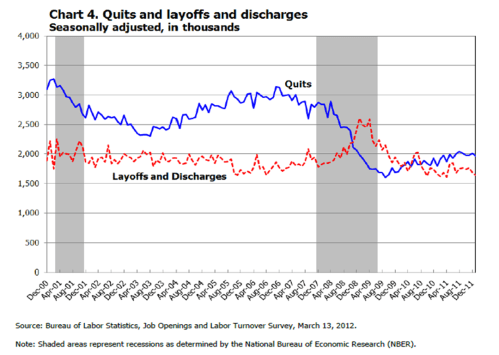
So this next data point is somewhat astonishing, and cause for concern by HR professionals everywhere.  According to data released today by the U.S. Department of Labor’s Bureau of Labor Statistics, the numbers of workers who are leaving their jobs voluntarily continues to grow and outpace the number of workers who are leaving their jobs involuntarily.

The graph shows that during good economic times the number of workers who leave their jobs voluntarily is larger – significantly larger – than those who are involuntarily terminated.  It stands to reason.  If they don’t like their boss, if they don’t trust their CEO, if their work isn’t meaningful, if another company offers more money – they resign.

It also stands to reason – and the chart shows this clearly – that in bad economic times the number of workers who quit voluntarily drops precipitously. Leaving your job in a really bad economy– without a new one to go to — defies logic.  And unless the situation is unbearable, most people are logical when it comes to their employment and cash flow.

Most would agree that the economy is still bad.  There are still millions of workers looking for jobs.  The economic and political environments are shaky.  Yet the number of people thinking “I can’t take it another day – there’s got to be something better than this:  I quit” is  growing.  In this economy.  With these uncertainties.

     What does this say about the level of dissatisfaction and disengagement within our workforces?

     What does this say about the cultures of our organizations?

     What does this say about our ability to retain the talent that we need?

Well, if you’re an optimist like I am, this is what you think:

     What a great opportunity we have to create a differentiated employee experience!

     What a great time to start strengthening our culture!

     What a great time to start recruiting!

7 Comments

Filed under Bureau of Labor Statistics, Data Point Tuesday, Employment Data, Engagement, Talent pipeline, U.S. Department of Labor, Uncategorized

Data Point #1: Unemployment Rate vs. Layoff Data

The U.S. Bureau of Labor Statistics published a mixed bag of news week before last.  While the unemployment rate fell from 8.5% in December to 8.3% in January, the number of mass layoff events in January grew by 50 over the previous month.  (A mass layoff event  involves at least 50 workers from a single employer.)  The total number of employees involved in these events, however, was reduced month-over-month by 15,728.  So while more employers were downsizing in January, fewer employees were impacted.  Good news, right?  Maybe…

Looking at the trend lines in the chart below, HR professionals may scratch their heads and wonder what is different in January 2012 from April 2008?  The number of initial claims are similar:  128,643 in April 2008 vs 129,920 in January 20102.  But the unemployment rate is significanttly dissimilar:  5% unemployment in April 2008 vs. 8.3% unemployment in January 2012.  What’s going on?

Clearly, the lagging effects of the economic downturn which began to gather steam in the 3rd and 4th quarters of 2008 are still being felt.  The resulting embedded base of unemployed workers continues to weigh heavily on the U.S. economy and the unemployment rate despite the falling numbers of layoff events and impacted workers.

So how is this data useful for HR professionals?  Simple.  Putting the long-time unemployed back to work has to be job #1 in our organizations and our communities.  As your organization plans to grow its employee base — whether with contract, temporary or full-time employees — what are your plans to target the long-term unemployed for inclusion in the talent pipeline?

3 Comments

Filed under Bureau of Labor Statistics, China Gorman, Data Point Tuesday, Employment Data, HR, Talent pipeline, U.S. Department of Labor, Uncategorized

New feature at ChinaGorman.com!

Data are ubiquitous!  Particularly when it comes to the management of people in organizations.  But although data are everywhere, it’s hard to find useful information.  And it’s hard to find free useful information.

And so today I’m introducing a new feature at my blog:  Data Point Tuesday.  Each week I’ll post a data point and briefly discuss it.  My intention is to provide HR professionals with sources of free data that can help them be stronger participants in the strategic leadership of their organizations.  And if you’ve got a great free source of data or information that is helping you be smart in your HR job, share it here.  We’ll all get smarter together.

1 Comment

Filed under Data Point Tuesday, Uncategorized

HR + Early Adoption = Oxymoron?

This is easy.  The answer is not just no, but hell no!

Despite the fact that Human Resources – Personnel, back in the day – has its roots in risk avoidance through an overarching focus on compliance,  today HR is at the forefront of early adoption – especially with respect to human capital management software.

I’ve written a white paper for Achievers (www.achievers.com) that will be available shortly.  And the great HR Technologist Himself, Steve Boese, and I will be discussing this very topic in webinar on March 7 at 1:00 pm EST.  Register here to join us.  I’m thinking that this could be an epic point/counterpoint discussion that you won’t want to miss!

Plus, you’ll get a complimentary copy of the white paper, Early Adoption:  Against HR’s Nature?

Steve Boese and me, an interesting webinar that will straighten your spine and put a swagger in your step, a free white paper and Achievers.

Be there or be…I don’t know, ummm…Personnel.

Leave a comment

Filed under Achievers, China Gorman, Early Adoption, Talent development, Technology

The one thing…

If you had one piece of job search advice to share with college seniors who are entering the job market in a few months, what would it be?  I’m working with a large group of college seniors next week to help them focus in on their career planning and job searches.  These are liberal arts students with likely majors in business, communications, the sciences and English lit.  What’s the one thing you’d tell them as they gear up for their job searches?  Please leave a comment below.  Thanks!

67 Comments

Filed under Career Planning, Principia, Student Job Search

“Thank you for saving my life” … what every non-profit board member wants to hear

Most business leaders give back.  They make financial donations, they volunteer, they serve on boards.  I’m no different.

I’ve been on a number of non-profit boards through the years.  All the organizations I supported had missions focused on the development of people, on making our talent pipeline more robust.  I was on the board of an organization that promoted the hiring of people with disabilities.  I was on the board of an organization that provided leadership development programs for young people.  I was on the board of the SHRM Foundation.

Currently, I serve as Chair of the Board of CAEL, the Council for Adult and Experiential Learning.  CAEL works at all levels within the higher education, public, and private sectors to make it easier for people to get the education and training they need.  It does critical policy and research work to ensure that working adults get access to lifelong learning.  An uphill road for sure.

And I’m on the executive committee of the board of JAG, Jobs for America’s Graduates.  JAG is a state-based national non-profit organization dedicated to preventing dropouts among young people who are most at-risk.  In more than three decades of operation, JAG has delivered consistent, compelling results – helping more than three-quarters of a million young people stay in school through graduation, pursue post-secondary education and secure quality entry-level jobs leading to career advancement opportunities.

JAG has provided infrastructure and support that has enabled more than 800,000 at-risk high school kids to graduate and move on to a job, college or the military.  JAG is changing lives pure and simple.

Here are just some of the results from the Class of 2010 – kids who graduated from high school last June:

  • The JAG graduation rate was 93%
  • Overall job placement rate was 54%
  • Full-time jobs rate of those working was 67%
  • Full-time placement rate was 88% (percentage of graduates engaged in full-time employment or a combination of employment and post-secondary education)
  • Further education rate was 47%

93% graduation rate.  That doesn’t exist anywhere.  But it does in JAG programs in 32 states and the U.S. Virgin Islands.  Routinely.

This program has worked for more than 30 years.  And you know what?  2011 was the toughest funding year in JAG’s history.  2012 will be even more difficult.  Deep budget cuts at the state level for education programs were the norm in 2011 and will be more draconian in 2012.  Sharp budget cuts of federal funding to Governors adversely impacted 9 of 32 states in 2011 with more to come in 2012.

I find this astonishing.  The education of our nation’s youth is one of the biggest issues we face.  If we’re to be competitive in the global economy we must focus on the development of the talent we have.  And it all starts in our elementary, junior and high schools.

Last week I attended the yearly JAG Leadership Awards luncheon in Washington, D.C.  More than 450 JAG high school students raised money to travel to D.C. to attend this event and the follow-on conference.  Some of these kids flew on a plane for the first time last week.  Many of them wore a suit for the first time.  Most of them had never been to our nation’s capital.

These kids are the future of the United States.  And most of these kids would have been dropped by our education system had it not been for JAG.  This was made very clear to me at the end of the lunch.

I was caught in the crush of students headed to the escalators.  A young man looked at my badge and said, “You look important.”  I responded, “No more important than you!”  He then asked if I knew Ken Smith, the President and founder of JAG.  I told him I did indeed know Ken.  The young man then held out his hand to me and introduced himself:  “I’m Ken Watkins from South Carolina.  Would you introduce me to Ken Smith?”

We reversed our direction and headed to the front of the banquet room.  When we got there, I introduced the two Kens.  The student from South Carolina looked at the President of JAG and said, “I asked to meet you because I wanted to thank you for saving my life.”

It was a quick conversation and the elder Ken quite naturally told the young man that it was really his own commitment and perseverance that saved his life – and to keep up the hard work.  I think the younger Ken understood, but it was clearly important to him to thank the man who founded the organization that provided his safety net.  It was a very moving moment – for all of us.

So I think of the other 799,999 students like young Ken from South Carolina who, over 30+ years, have responded to the opportunities created by JAG and who have entered our economy as educated, hard working citizens and contributed to the economic success of the United States and their families.

It’s important to know that in these times of political dysfunction and lack of political leadership ,that there are people and organizations who keep the prize in mind.  Who keep moving us forward.  Organizations like JAG and CAEL.

So the next time a non-profit asks you to get involved, to make a donation or to serve on their board, please seriously consider their request.  We’re adding to the talent pipeline.  We’re educating our nation.  We’re saving lives.  And if you have jobs that young people could perform, find the JAG organization in your state and interview some JAG kids.  You’ll probably hire them all!

5 Comments

Filed under CAEL, JAG, Leadership, Non-profit Board service, Talent development, Talent pipeline, Uncategorized

Memo to HR: Raise Your Hands!

Several times this year I’ve given the wrap-up keynote speech at HR conferences.  This particular speech is titled, “HR Wake Up Call.”  The message is simple:  HR professionals have far more business savvy and leadership opportunities than they are given credit for.

One of the ways I prove this is to quiz the audience on a range of business related topics, testing their savvy and knowledge.  Nearly every question I ask gets an almost unanimous positive answer.  The questions cover topics like the current unemployment rate, the current U.S. GDP and the topics of current business books.

When I ask how many in the audience have ever been responsible for a sales quota, 70-80% of the audience raises their hands.  And when I ask how many have managed a P&L, between 80 and 95% of every audience raises their hands.

After the quiz is over and we discuss the answers in detail I ask how many of their executive teams know that they’ve been responsible for a sales quota or managed a P&L.  Astonishingly most do not.

I find that remarkable.  No.  Actually, I find it disturbing.  HR professionals routinely lament their lack of standing in the strategic workings of business, and yet when they’ve got the golden ticket they ignore it.

So here’s the deal:  if you want to be an HR professional who focuses solely on the tactical and compliance parts of HR, then don’t let on that you’re a business person.  Not letting your C-suite know that you’ve managed a business will ensure that you stay off their radar and can focus on the day-to-day stuff.

If, however, your organization can benefit from your business insight and experience, and you want to operate at a strategic level – not just the tactical level – MAKE SURE YOUR FULL BACKGROUND AND EXPERIENCE ARE KNOWN!

That is all.

4 Comments

Filed under Business Language, Business Success, HR, Leadership, Uncategorized

HR people doing business. Wait. What?

I’ve been to 14 HR-related conferences in the last 12 months, with one more to go.  I’ve spoken at 10 of them, with one more to go.  When I speak, my topic may vary but the foundational message is the same:  HR people need to be business people first and HR people second.  You can get the gist of my message on a previous post here.

This year I’ve been to and spoken at SHRM conferences and un-conferences in the U.S. that were non-profit endeavors and I’ve been to and spoken at conferences and un-conferences in the U.S. and the U.K. that were for-profit endeavors.  And all of them but one share a singular mission:  to provide professional development for HR professionals.  And they offer HRCI recertification credits by the bushel.  That’s a good thing.  Every professional, regardless of functional focus, needs professional development.  We’re never done learning.  Certification and re-certification are important in managing your career and creating credibility.

But there’s one conference that treats HR people like business people.

Wait.  What?

One conference treats HR people like they impact the bottom line.  Like they are business leaders capable of making business decisions.  And spending money.  And that’s the HR Technology Conference organized by longtime HR analyst Bill Kutik and media partner Human Resource Executive Magazine, an LRP Publication.

The 2011 HRTech conference was held last week in Las Vegas, and was unique in my experience,  in many respects.

The most obvious is that vendors, sponsors and analysts are not only welcome, the organizers shine great big white-hot spotlights on them.  Other conferences see them as a necessary evil.  In fact, one might feel that the primary focus of this conference is giving vendors, sponsors, attendees and analysts a unique opportunity to get to know each other – and if the attendees learn something along the way (and get recertification credit) then everyone wins.

Unlike the nonprofit conferences of all sizes and the smaller unconferences, HRTech is a place where business gets done.  All over the place.  In the expo, in the hallways, at receptions, at afterparties, in sessions, in the press room, in the venue bars, lounges and restaurants.  Vendors, sponsors, analysts and attendees all pitching and being pitched to.  Making deals.  Buying.  The air was electric.

I also appreciate that the organizers hold the opinion that many vendors and sponsors are, in fact, experts in their fields.  Putting them on the stage, pitting them against each other, loading them up on panels creates an energy that is palpable.  And the attendees learn from state-of-the-art thinkers and business leaders.  There were practitioners on the stage, of course.  But I sensed the attendees – HR practitioners for the most part – really valuing this real time information about what’s new NOW, what’s coming SOON, and what’s to be expected NEXT YEAR.  With a focus on the business.  On ROI.  On productivity.  On impacting the bottom line.

Not exactly where most HR conferences focus.

And clearly the attendees count on this.  HR leaders from organizations of all sizes came with shopping lists.  The expo felt a little like shopping on Black Friday:  lists in hand, attendees came looking for solutions to their organizations’ people problems.

A social rewards and recognition system?

A new ATS?

An upgraded payroll system?

Want to investigate a video interviewing platform?

Need a new approach to assessments?

An outplacement 2.0 solution?

How about moving portions of your HRIS to the cloud?

If I were an HR leader and had the appropriate budget, I’d try to go to three conferences a year:  a SHRM conference (either national or state), the Bersin Impact Conference, and HRTech.  And if I had to pick only one, I think I’d pick HRTech.  I’d send my team to as many SHRM and unconferences (like HRevolution) as we could afford.

But I’d be at HRTech.

Because I’m a business person.

26 Comments

Filed under Uncategorized

HR and Furniture

Normally, I agree with everything Laurie Ruettimann says.  Not because I’m a robot, but because she’s right 99% of the time.  .9% of the time we just see things through different lenses.

And .1% of the time we just disagree.

And this falls in that .1%.

I think that when you’re in HR you have to speak the language of business.  I think speaking HR in business is the kiss of death – or irrelevance, which is really the same thing.

It’s not about furniture, it’s about influence.  And when you’re influential you speak the language of those you influence.

Business people are everywhere in organizations.  They’re in Finance (where they speak finance and business).  They’re in Marketing (where they speak marketing and business).  They’re in Operations (where they speak operations and business).  They’re in R&D (where they speak r&d and business).  They’re in Sales (where they speak sales and business).  They’re in IT (where they speak technology and business).

Business people are most definitely at the top of the organization where the only language spoken is business.  So if you want to influence the people at the top of the organization – all those people whose job titles start with a great big “C” — you have to speak to them in their language, not yours.

This quote from Frank Romer says it all:

People will sit up and take notice of you if you will sit up and take notice of what makes them sit up and take notice.

The bottom line is that language is important.  Using language your target audience doesn’t understand ensures that you won’t be understood.  It also ensures that you will have no influence.  None.  Zero.

So if HR is to be influential and interact with a certain type of furniture it has to be fluent in the language of business.

Actually, I’m pretty sure Laurie Ruettimann will agree with me.

18 Comments

Filed under Business Language, Business Success, HR, Leadership