Tag Archives: Data Point Tuesday

Careers and Learning: a New Reality

data point tuesday_500

This, from Kelly, really hits the nail on the head:  “The last two decades have radically altered the way skills are acquired and developed. Skills are no longer “front-end loaded” onto a career. Rather, they are characterized by lifelong development and renewal. Most skill sets have a finite life.”

Skills are no longer “front-end loaded” onto a career.

But who recognizes this really? Employers who lament that they can’t find the skills they need in the workforce? Students who report being less than adequately prepared to enter the economy? Unemployed workers who can’t connect to a new employer?

Most skill sets have a finite life.

This has never been truer than today – and the “lives” will be getting shorter and shorter.

In their recent Global Workforce Index™ report, Career Development and Upskilling, Kelly looks at survey data from 120,000 people (workers, presumably) in 31 countries and has some very interesting data to share.

For example, most workers believe they are proficient in critical “soft skills” but Bilingual skills, Leadership/initiative and Creativity/innovation were all seen as needing development. Employees believe this of their skill sets. And most business leaders would not argue with these areas of deficit. Of note, however, is the belief on the part of employees that they have good mastery over the most critical “soft skills.” If true, perhaps learning budgets (such as they are) could be better deployed. If untrue, some challenging performance conversations need to be held!
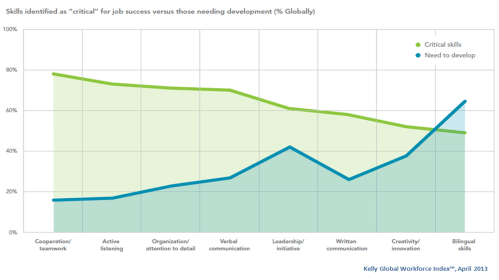
Kelly Global Workforce Index April 2013 Critical SkillsOf course, in terms of the skills gap, most attention is being paid to STEM workers.  Interestingly, these workers believe that their proficiencies in the most important skills sets of Analytical/critical thinking, Evaluation, analysis and troubleshooting, and Complex problem solving are solid (no lack of self-esteem in this group). Where they might need development are in the more complex technical side of things: systems, computer, software and mathematics, calculations, measurement and monitoring.
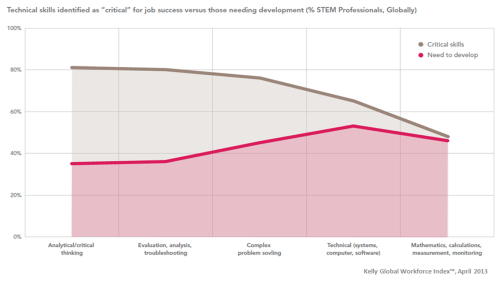
Kelly Global Workforce Index April 2013 Critical STEM SkillsIf lifelong learning really is the reality, then self-driven learning will be key.

And if self-driven learning is key, then a realistic assessment of current skill levels and actual skill gaps will be critical. For everyone:  employers, employees, learning providers – everyone!

These observations based on their survey responses seem common sense and almost obvious. Almost. I think most business leaders – and HR professionals in particular – would agree with Kelly that skills are no longer front-end loaded onto careers. They’d also agree that most skills have a shelf life.

But it doesn’t appear that we’re approaching the answers to the skills gap as a systemic shift in the nature of careers. We’re approaching it as a simple supply vs. demand dynamic – if we approach it at all. Perhaps this data can shift the conversation and approach to a more useful and motivating discussion:  the nature of careers has shifted and so the nature of education and employment needs to shift as well.

Then we might make actual progress in addressing the perceived mismatch between the jobs available and the skills in the existing talent pool.


2 Comments

Filed under Career Management, China Gorman, Data Point Tuesday, HR Data, Kelly Global workforce Index, Kelly OCG, Skills Gap, STEM

Deeply Disengaged

data point tuesday_500

DeeplyDisengaged-thumb-300x295-177582Last week a guest poster wrote an anonymous letter that was posted on the U.K. ExpertHR blog. This U.K HR professional is “at the end of their tether” and writes a very transparent and poignant piece about the reasons for their massive professional disengagement and personal sadness at their lot. The publishers suggested that others might respond with guidance for the writer and the responses were numerous and detailed. The post and its responses created a robust and fascinating discussion.

And everyone – except one responder – totally missed the point. Totally. The discussion focused on whether or not Deeply Disengaged should “stay and fight” or quit and find a more conducive employer. Ugh!

Deeply Disengaged says that their “work every day is focused around making the workplace a better place to be for employees… To me, ensuring people are at the centre of everything you do is fundamental to being successful in all other areas. It is the foundations on which everything must be based.”

But the bottom line of the post is this:  “The powers that be don’t value the work that I am doing.” The old (ugh) furniture lament. (See my post here if you aren’t familiar with the furniture lament.)

I’ll bet it’s true. I’ll bet the powers that be don’t value the work that Disengaged is doing because Disengaged don’t know the value of the work they’re doing.

So here’s the real, hard truth – for Deeply Disengaged and all the responders:  HR needs to be focused on making the organization more efficient and productive leveraging the organization’s most costly resource, people. HR’s work needs to start with the organization’s strategic and business plans and deliver solutions that enable the successful growth of the enterprise. In other words, HR needs to be focused on the business!

Deeply Disengaged lists a number of supposed outcomes from his/her work:

  • Feedback is now two-way and things are improving fast
  • Retention of employees has increased significantly
  • Retention of candidates in the recruitment process has increased
  • Speed of work output and completion has risen
  • I could talk and talk about the things I am doing and results that we have seen but you get the picture…

I have to take a step back and say, Really? You wrote some nice stuff there, but nothing quantifiable.

I have to take a step back and ask, how do you know your outcomes if you don’t (or can’t) quantify them. And if you can quantify them and you don’t talk about them, why would a business leader listen to you?

I’m skeptical because in the entire post there was not one number. Not one. How can you talk about the value of the work you’re doing without numbers? Seat at the Table NotWithout percentages of increase or decrease, without dollars (or in this case, pounds)  saved, without numbers of days saved…

And that’s the challenge for HR – all over the world:

  • To leave behind “banging on about how these areas can hit the bottom line” and focus instead on providing clear, evidence-based business cases that are linked to the strategic plan.
  • To leave behind doing things “because I believe it can and will make a difference” and start doing things that the business requires and be able to prove it with data – including numbers.
  • To leave behind being “focused around making the workplace a better place to be for employees” and leading the effort to ensure the culture and values actually enable the achievement of the strategic plan.

I’ll bet that Deeply Disengaged is more of a business thinker than they know. If they really are working on improving business processes and outcomes the way they describe, they must know something about how business works, how business leaders speak, how business decisions are made and how resources are distributed. The question becomes, why aren’t they stepping up to the plate to act like a business leader with deep HR expertise rather than the disrespected HR functionary that the organization has to put up with?

It’s a troubling question. And frankly, it’s one of the reasons I started the Data Point Tuesday feature here at http://www.chinagorman.com. To provide data- and research-based sources that will help HR professionals move up from HR functionary to business leader with HR expertise.

I feel for Deeply Disengaged. Being disrespected is the pits. But quitting is not the answer – because the same thing will happen in the next job, and the next, and the next. Until the perception of HR professionals as functionaries changes to business leaders with HR expertise, this won’t go away. And the only way to change that perception is for HR professionals to start to behave like business people, to speak the language of business people, and to become comfortable with numbers, data and research. The only way for Deeply Disengaged’s experience to change is for them to start to behave like a business person.

It’s not easy – but it’s also not hard. Because I truly do believe that most HR people really can be business people — because they do know business. They just aren’t comfortable with that. Yet.

5 Comments

Filed under Business Language, China Gorman, Data Point Tuesday, HR, HR Credibility, XpertHR

Is HR Still in a Bad Mood?

data point tuesday_500

This was a popular post from last year at this time and I’m wondering if HR is still in a bad mood…

Results from The Fifth Annual Talent Management Study by Knowledge Infusion and Human Resource Executive® were published recently in HR Executive by Mike Brennan and some of the findings were surprising.

I didn’t find it surprising that 63% of the respondents report that they have trouble filling jobs and that they can’t find the right candidates. That’s been reported frequently.

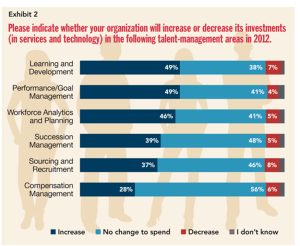
It also doesn’t surprise me that more organizations than not will be increasing their investments in Learning/Development, Performance/Goal Management and Workforce Analytics/Planning services and technology. That’s obvious.

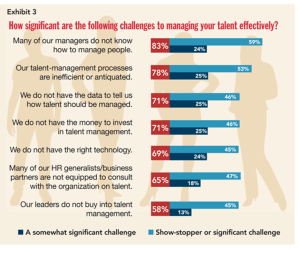
What really does surprise me is that 58% of HR executives believe that peer leaders in their organizations “do not buy into talent management.”

Lordy, I hope this isn’t the furniture conversation. And I’m willing to believe it isn’t because 83% of the respondents also believe that “many of our managers do not know how to manage people.” Additionally, 65% of the respondents believe that “many of our HR generalists/business partners are not equipped to consult with the organization on talent.”

Ouch. Either the HR respondents to this survey were all in a colossally bad mood, or they’re starting to look clear-eyed at their organizations and re-calibrate their challenges.

It’s clear that many organizations need to look at legacy systems and programs in the talent management arena (can you say annual performance review system?) and, according to this survey, they are. But focusing on leadership understanding and managerial effectiveness in talent management might be a strong first step.

It’s a great day for HR if the results of this survey mean a new focus on talent management effectiveness – at the top, in the middle, and most importantly, in HR.

But if it was just a systemic bad mood, we’re sunk. Because, in the words of one of my favorite movie characters in one of my favorite movies, “we have serious problems to solve, and we need serious people to solve them.”

1 Comment

Filed under American President, China Gorman, Data Point Tuesday, HR Credibility, HR Executive Magazine, HR Technology, Knowledge Infusion, Managerial Effectiveness, Talent Management

Tech Professionals’ Pay by the Numbers

data point tuesday_500

Dice, the career site for technology and engineering professionals, published their annual Tech Salary Survey in January. And as Chairman, President & CEO of Dice Holdings, Inc., Scot Melland observed, “The fact is you either pay to recruit or pay to retain and these days, at least for technology teams, companies are doing both.” The constant being pay.

According to the responses of 15,049 employed technology professionals between September 24 and November 16, 2012, tech professionals have garnered the biggest pay raise in a decade. The survey report is highly consumable and I recommend it to anyone involved with hiring or managing technology professionals.

The contents include:

  • 10-year trend in tech salaries
  • Salary by employment type
  • Bonus trends
  • Salary by metro and region
  • Tech employee motivators
  • Tech salary satisfaction
  • Salary by industry
  • Salary for high paying skills
  • Average salary by experience and education level

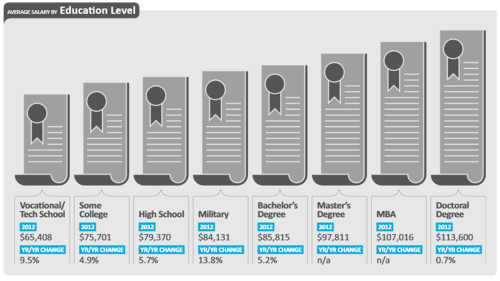
The last section, average salary by experience level, is eye popping. Check it out.

Dice Tech Salary Survey Education Level Salaries 2013-2012

First of all, we can tell by these salaries that STEM education pays off from a career opportunity perspective.

Second, we can tell by these salaries that the market perceives low supply.

Third, look at the high school graduates’ salary vs. vocational/tech school and some college salaries. What’s up with that?

Fourth, the year-over-year change in the salaries of military veterans vs. every other category is head snapping.

Let’s look at these observations.  First, I think we can all agree that there’s no downside to focusing on STEM education. No downside for employers who perceive low supply and no downside for employees whose lifetime earnings are among the highest.

Second, supply vs. demand economic principles seem firmly in charge of these salary trends. We can debate whether or not there truly are skills shortages in the marketplace today. But it seems clear that the market believes there is a shortage and is paying accordingly.

Third, as we consider the counter-intuitive data showing high school graduates earning significantly more on average than votech grads and some college/associates’ degree holders, we might be seeing generational effects coming in to play. More recent high school graduates may have more current hardware and programming learning than those who attended the votech programs of the 1970’s, 1980’s and 1990’s.  Certainly with the ability to connect to communities of interest via the social web, today’s high school students have a leg up on learning that their parents never had. Additionally, while employers aren’t spending the money they used to on internal training, technical training programs continue to be present.

Fourth, it appears that military veterans with current technology skills can enter the market at higher levels and command higher salaries. And I think we’d all agree that this is a very good thing.

This is a very useful snapshot of the salary landscape for a portion of our employees. Wouldn’t it be interesting to see the same data for other functional skillset areas? Like marketing, finance, or even HR?

Leave a comment

Filed under Average Wage, China Gorman, Compensation, Data Point Tuesday, Dice, Skills Shortage, STEM, Technology Salaries

Onboarding: Not Rocket Science

data point tuesday_500

As HR and other leaders grapple with high turnover rates among the Gen Y cohort (see last week’s post here), all kinds of issues get raised. Is the turnover due to “special” characteristics inherent in Gen Y? Is the turnover due to lack of education and training opportunities? Naivete on the part of Gen Y – the world of work doesn’t match their expectations? Could a lack of thoughtful onboarding play a part?

The Aberdeen Group published Onboarding 2013: A new Look at New Hires last month and author Madeline Laurano provides data that might help organizations become more effective in retaining the youngest of their workforce.

First of all, Aberdeen reports that only 37% of employers have invested in a formal onboarding program for longer than two years. Surveys report that it’s difficult to quantify the ROI on formal onboarding programs so “basic orientation” activities are used in substitution. Socializing new hires into the organization’s culture is popular, but hard to measure. And so, “onboarding programs have fallen short and become little more than a transition from recruitment to employee development.” Interesting.

But attention is starting to be paid and, surprise!, it’s all about productivity. One of the quickest routes to ROI is the improvement of productivity and that’s something organizations can measure. Other drivers for looking at new ways to onboard new hires include improving employee engagement, reducing turnover and improving new hire assimilation.

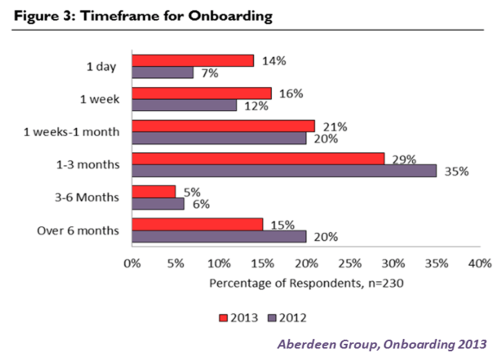
But, as the graph below shows, there’s lots of opportunity to make onboarding programs more robust, strategic and productive by spending more time.

Aberdeen Group Onboarding 2013 Fig 3

And it doesn’t have to be rocket science! The kinds of strategies being used to drive stronger onboarding programs include the following:

  • Creating new hire checklists
  • Introducing new hires to the go-to people
  • Providing forms to new hires before day one
  • Ensuring compliance on all new hire forms
  • Creating peer networking opportunities/events

But the real key appears to be creating a bridge from the candidate experience to learning/development and performance management. After offer acceptance, Best-in-Class employers are more than twice as likely than all other organizations “to integrate data from onboarding into performance management, providing key stakeholders with development plans of new hires and to tie the source of a candidate to their performance as an employee.”

Aberdeen Group Onboarding 2013 Fig 11

But still, only 26% of Best-in-Class employers enroll new hires in learning and development programs compared to 11% of all others. Hmmm….

Laurano concludes the report with recommended actions for employers in Best-in-Class, Average and Laggard categories. For the Average and Laggard categories they are not rocket science. For the Best-in-Class category, a little rocket science might be involved.

Laggard Steps to Onboarding Success

  • Establish a clear owner
  • Provide strong visibility
  • Extend the onboarding process

Industry Average Steps on Onboarding Success

  • Align onboarding with learning initiatives
  • Define metrics in advance
  • Invest in onboarding technology

Best-in-Class Steps to Onboarding Success

  • Consider gamification
  • Include cross-boarding
  • Balance tactical and strategic elements

Think about these as you and other leaders in your organization wrestle with the high turnover rate in your Gen Y employees. And take a look at this report.

Aberdeen Group reports are very easily consumed. They’re written in normal English and have an easy to understand structure. Even if you can’t spend real money to make your onboarding program more productive, you can certainly get smarter about what works and make some adjustments based on data to improve your outcomes. That’s the whole point of research, right?

6 Comments

Filed under Aberdeen Group, Candidate Experience, China Gorman, Data Point Tuesday, Gen Y, HR Data, Onboarding, Turnover

Gen Y’s Self-fulfilling Prophecy

data point tuesday_500

Accenture recently published its 2013 College Graduate Employment Survey Findings. Lots of great data. Especially if you plan to hire recent college grads. In fact, some of the data are surprising.

One of the important takeaways is that employers have unrealistic expectations for the skills of the hires they make out of college. They think these young people should be able to hit the ground running and are surprised and disappointed when they don’t. And to compound the problem, these employers are not investing in training initiatives to get the newly hired up to speed in the short term or effective in the long term. This is all pretty logical. It’s good data and if you plan on hiring entry level employees from the ranks of the newly graduated, you should read this.

But here’s what caught my attention. It’s about the willingness to commit. And it isn’t the first time I’ve seen data like these.

Young people, entering the economy for the first time, want to commit to their employers. It’s not what we expect, I know. We expect these youngsters to be gone in the career equivalent of sixty seconds. And sometimes they are. But it’s important to know that that isn’t what they want! This isn’t what they expect!

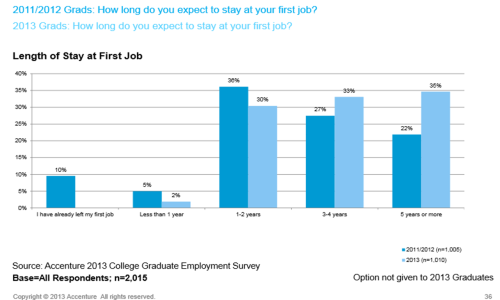
From Accenture:  The class of 2013 is expecting more career longevity from their first jobs:  68% of pending 2013 college grads expect to be at their first job more than 3 years compared to 49% of 2011/2012 college grads.

Accenture career longevity in first jobs 2013

And from the Achievers Class of 2012 white paper:

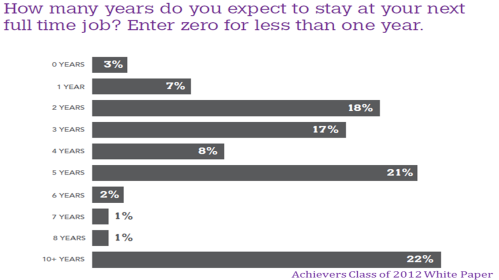
Achievers Class of 2012 White Paper

In this survey, more than 70% of 2012 college graduates expected to be with their first/next employer 3 years or longer — and 48% expected to be with their first/next employer 5 years or more. Surprising, right? Not what we expect, right? Not what we “know” about Gen Y, right?

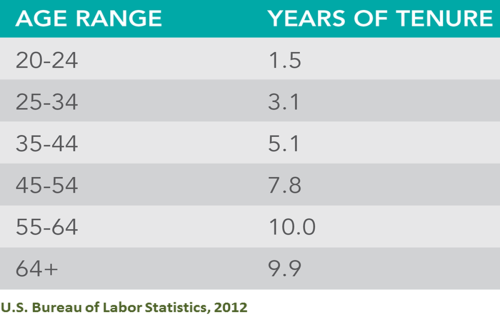
But the BLS shows us what happens once they join our organizations:

BLS years of tenure by age

So, young people entering the economy for the first time with a newly minted degree are filled with optimism and have every intention of committing to their first employer for 5 years or more. Is it naivte or is it a real desire to commit, belong and make a difference?

And what happens once they start that first job that impels them out the door in 18 months or less?  Are employers so inept at selection that they really can’t hire employees that will persist? Are young people so naïve that they don’t really know what they’re signing up for and leave when reality doesn’t match expectations? Or, as the Accenture survey suggests, are young people disappointed when expected training and development doesn’t materialize and they leave in search of greater learning opportunities?

Clearly this is a complex issue with lots of dynamics, as the Accenture survey results show. However, if we started with the belief and understanding that young people really do want to engage and commit to their employer, would we be more likely to invest in developing their skills?

If we started with the belief and understanding that young people really do want to engage and commit to their employer, would we create onboarding processes that ensure expectations – on both sides – are being understood and met?

If we started with the belief and understanding that young people really do want to engage and commit to their employer, how would we approach them differently?

I suspect that most employers believe that there’s no return in investing in a talent pool that will be gone in 60 seconds.

I further suspect that the EVP that is sold in the recruiting process doesn’t exactly come to life once the recruit joins the organization.

But I suspect that the real issue is that Gen X and Baby Boomer managers, supervisors and recruiters believe all the negative stereotypes about Gen Y and their lack of commitment to any agendas other than their own — despite multiple data sources that show just the opposite. And we’ve ended up in this tough reality that has become a full-fledged self-fulfilling prophecy.

11 Comments

Filed under Accenture, Achievers, Baby Boomers, Bureau of Labor Statistics, China Gorman, Data Point Tuesday, Employee Value Proposition, Gen Y, GenX, HR Data, Turnover, U.S. Department of Labor

Recruiting and Social Networking

data point tuesday_500

SHRM (Society for Human Resource Management) debuted some new survey data at their recent Talent Management Conference in Las Vegas. Published on April 11th, Social Networking Websites and Recruiting/Selection is interesting. And some of the data may not be what you think.

Employers use social networking sites during the recruitment process as tools to recruit candidates who might not normally apply. Expanding their reach to passive candidates, candidates with specific skill sets and candidates in specific geographies, recruiters seem to be very strategic in their use of social networking tactics and sites. I’m not surprised by these data.

Here are some of the findings I found a little surprising:

  • More than half (57%) of employers do not have a formal or informal policy on screening candidates via social networking sites.  

Really? In this age of increasing regulation and compliance, the majority of employers don’t have a policy about using social media to screen candidates? No guidance for recruiters? No guidance for hiring managers? I wonder if this is an “ignorance is bliss” approach or a calculated “we already have policies covering the use of social media at work” approach.

  • Employers that have policies on screening candidates are evenly split (21% each) in allowing or prohibiting the use of social networking sites for screening purposes.

This fascinates me. And it bears watching. There are legal dangers in the offing. Court cases are starting to decide the legal issues involved in using social media sites for applicant screening. And recruiters and HR pros don’t want to end up on the wrong side of this one.

  • About two-thirds of employers never have used or no longer plan to use social networking sites (69%) or online search engines (65%) to screen applicants.

This makes sense given the regulatory environment HR deals with today. And the fact that the courts are just starting to address these issues. However, it’s entirely unrealistic to believe that hiring managers aren’t using social networking sites to screen applicants. I believe that HR isn’t. I don’t believe that hiring managers aren’t.

  • 41% of employers target executive/upper management (e.g. CEO, CFO) when searching for candidates on social media.

This is really surprising and could spell doom for the executive recruiting industry. I would have expected a much smaller percentage of employers would use social networking sites for the recruitment of executives since it’s assumed that most employers turn to executive recruiters to find executive talent like CEOs and CFOs. If the use of social networking/media sites for executive hiring gives employers confidence to recruit executives on their own, a major shift in the executive hiring dynamic could be underway.

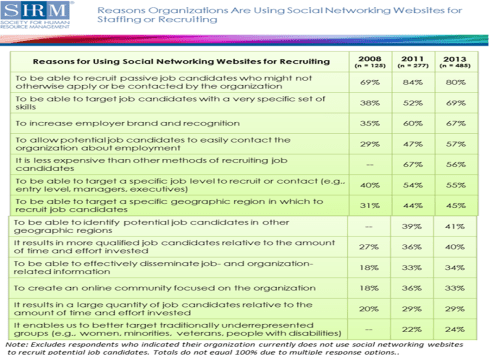
I was also interested in the differences in the survey question answers between 2008, 2011 and 2013.  Not only are the percentages changing, the number of respondents is growing, which I believe means that social media is being integrated into more nooks and crannies of HR. Take a look:

Social Networking Websites and Recruiting Selection SHRM 2013

This is interesting on lots of levels. And I look forward to continued growth at the intersection of HR and social technologies.

Hopefully SHRM will field this survey again in 2 or 3 years.

9 Comments

Filed under Candidate Screening, China Gorman, Data Point Tuesday, HR Data, Recruiting, SHRM, SHRM Survey Results, Social Media, Social Networking, Social Technology

Youth Unemployment: A Growing Problem

data point tuesday_500

You probably know a good kid like this. Graduating from high school in June. From an OK high school. Not the best student. Probably not able to get in to college – even if they could afford it and were motivated to try. They had a part-time job a couple of years ago, but got laid off. Haven’t really looked for a job since then. No real skills that employers can use. No idea how to look for a job. Starting to think about the future. No idea where to start.

Guess what? Their prospects are not good. And they need help.

You know we have an unemployment problem. Did you know we have a youth unemployment problem?

Employers of every size in every sector lament the lack of skills available to them in the talent pool.  Whether you’re reading reports from McKinsey, the Georgetown University Center on Education and the Workforce, or countless other research organizations, the message is all too similar:  our post-secondary education system isn’t delivering enough degreed individuals to meet the demands of employers world-wide. And it’s only going to get worse. Something I’ve written about here, here and here.

But it isn’t just the post-secondary education system. The secondary system is doing even worse. The youth labor market has collapsed since 2000.  The rate of overall youth employment in the teen population has fallen from 45% in 2000 to 26% in 2012 – a 42% drop, to the lowest point in post-World War II history. In 1989 the youth employment rate was 48.5%.

Here are some sobering statistics from research completed in 20120 by The Center for Labor Market Studies at Northeastern University for Jobs for America’s Graduates:

  • In 2000, the share of employed, non-college-bound youth from the high school class of 2000 was just under 70%

  • In 2011, the share of employed, non-college-bound youth from the class of 2011 was 45%, the lowest since the survey started in 1965

  • In October 2011, the employment/population rates for these non-college-bound high school graduates ranged from a low of 32% among African Americans to a high of 48% among Caucasian youth.

  • Fewer than half of these employed, non-college-bound graduates were able to obtain a full-time job – yielding a full-time employment/population ratio of 21%

  • Among the non-college-bound population of high school graduates, only 25% of Caucasian, 24% of Hispanic, and 7% of African American youth were working full time.

And these are high school graduates.  In the U.S., the percentage of high school graduates by state ranges from 62% (Nevada) to 88% (Iowa), with an overall average of 78%. What about the 22% of young people who drop out of high school?  What are their prospects?

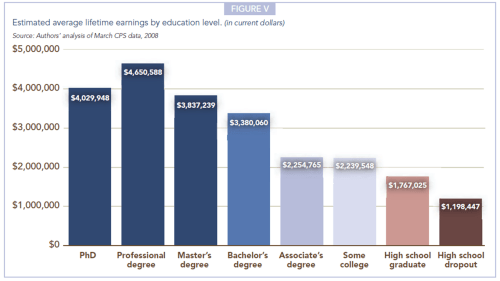
From an historical perspective, this chart shows the economic impact of dropping out of high school. But that lifetime earning amount of $1,198,447 will surely decline as fewer young people with – or without – high school degrees gain full-time employment.

Georgetown Projections of Jobs Education Requirements Figure V

And this is a problem. If unemployment in the teen population continues to rise, then a key argument to persist in high school to graduation begins to fade, further impacting college graduation rates. If unemployment in the teen population continues to rise, then key employment skills building experience will decline making employment less likely as they age in to their 20’s. If unemployment in the teen population continues to rise, then a whole host of societal challenges will grow – and none of them positive for people or the economy.

Involvement in organizations like JAG* (Jobs for America’s Graduates) can help. I’ve written about JAG here and here. It’s the longest-lived, most successful program in the U.S. that keeps the most at-risk kids in school through graduation and then stays with them through their first year of employment, college or military service. And it is making a difference in the graduation and employment rates of kids in 33 states.  Here are some current outcomes;

  • The employment/population ratio in spring 2012 was 72% for all young people in JAG versus only 42% for their national comparison group.

  • Nearly 60% of those JAG graduates not enrolled in college were employed full time in May 2012, compared to only 30% of their comparison group counterparts. Over three times the rate of teenagers in general who were working.

    • Nearly 48% of non-college enrolled African American JAG graduates were working full time versus only 17% of their comparison group peers.

    • 61% of Hispanic JAG non-college enrolled graduates were employed full time versus only 42% of their comparison group.

    • 68% of Caucasian JAG non-college enrolled graduates were employed full time versus only 31% of their comparison group.

It’s hard to argue with success. It’s even harder to argue with 32 years of consistent success. This video really captures the effectiveness of this approach:

Employers that hire skills that require high school graduation need to be concerned about the entire talent pipeline, not just the college degreed pipeline.

And by concerned, I mean involved in keeping young people in school until they graduate so that they are employable.

And by involved, I mean supporting programs like JAG that are focused on providing real, sustainable results.

And by support I mean financial support, political influence support and the promise to provide job interviews to every JAG student where they have a presence. (Archer Daniels Midland has done just that!)

You know we have an unemployment problem. Did you know we have a youth unemployment problem?

*I serve on JAG’s national board of directors.

4 Comments

Filed under Archer Daniels Midland, China Gorman, Data Point Tuesday, High School Graduation Rates, JAG, Jobs for America's Graduates, Skills Shortage

You Think We Have Skills Shortages Now? Let’s Talk in 2020!

data point tuesday_500

Skills shortages in 2020 will rise to an entirely new level. And I’m not talking about STEM skills, although they’re critical. Or the ability to speak multiple parched earthlanguages, which needs to be more common in the U.S. Or even the readiness of college graduates to take a place in the economy, which a majority of employers report is lacking.


I’m talking about the skills that the globally-connected, superstructured, computationally focused, smart-machine powered organizations of the future staffed by longer living and working, new media using employees will require.

We’re all thinking about that right? We’re re-writing job descriptions and re-wording job postings to incorporate the emerging skills we know we’ll need. Aren’t we? Well, maybe not. We know the names of the skills we can’t get today – those STEM, analytical thinking, communication and personal responsibility/accountability skills we’re sure our young people don’t have.

But really. What about the skills for the future?  I’m not sure what we’ll call those skills. I’m not even sure they’re skills, to be honest, but here’s what I do know:

  • People are living longer and will want/need to have longer careers
  • Smart machines are taking over the most routine workplace tasks
  • Data – big, medium and small – are changing the way decisions are being made at every organizational level
  • Text isn’t the only way we communicate any more
  • Organization structures and behaviors are changing due to social technologies
  • We say “Global” but what that really mean is that innovation and growth will be primarily driven through the integration of differing cultural norms and diversity

IFTF LogoThe Institute for the Future’s Future Work Skills 2020 highlights recent research that predicts the kinds of skills for which we’ll be recruiting in 2020 (which is only 6 and-a-half years away). Trust me when I write that the majority of HR/recruiting professionals are not ready for this. ATSs aren’t ready for this. LinkedIn, Facebook and Twitter aren’t ready for this. And clearly, our education infrastructure isn’t ready for this. And yet, here we are.

The IFTF identifies and defines ten skills that we need to begin to teach now so we can deploy them in six-and-a-half-years.  They are:

  1. Sense-making:  the ability to determine the deeper meaning or significance of what is being expressed
  2. Social Intelligence:  the ability to connect to others in a deep and direct way, to sense and stimulate reactions and desired interactions
  3. Novel & Adaptive Thinking:  proficiency at thinking and coming up with solutions and responses beyond that which is rote or rule-based
  4. Cross-cultural Competency:  ability to operate in different cultural settings
  5. Computational Thinking:  the ability to translate vast amounts of data into abstract concepts and to understand data-based reasoning
  6. New-media Literacy:  the ability to critically assess and develop content that uses new media forms, and to leverage these media for persuasive communication
  7. Transdisciplinarity:  literacy in and ability to understand concepts across multiple disciplines
  8. Design Mindset:  the ability to represent and develop tasks and work processes for desired outcomes
  9. Cognitive Load Management:  the ability to discriminate and filter information for importance, and to understand how to maximize cognitive functioning using a variety of tools and techniques
  10. 10.   Virtual Collaboration:  the ability to work productively, drive engagement, and demonstrate presence as a member of a virtual teaSocial intelligence (we call it EQ today, I think) and Cross-cultural Competency are certainly emerging in more sophisticated and global organizations currently. Perhaps we have a leg up with these two.

But have you ever seen a job description requiring Transdisciplinarity and a Design Mindset?

What kind of behavioral interview questions would you use to determine if a candidate has Cognitive Load Management and Novel/Adaptive Thinking Skills?

How would you Tweet those jobs? How would your careers page change?

And once onboard, how would you manage the performance of employees’ Virtual Collaboration and Sense-making?

And speaking of job descriptions and performance management, how will New-media Literacy and Social Intelligence change the very nature of these processes?

Whew! We think the current skills shortage is frustrating and scary. It could be that the future skills shortage will upend everything!

6 Comments

Filed under Annual Performance Reviews, China Gorman, Data Point Tuesday, Hiring Difficulty, HR Data, Institute for the Future, Performance Management, Skills Shortage, STEM, Workforce Skills

HR Priorities and Business Value

data point tuesday_500

SHL has published their fascinating yearly report on global assessment trends.  SHL, acquired last year by CEB, is an assessment company, so reporting SHL Logoon assessment trends is right up their alley.  The survey data are interesting and the conclusions are worth noting by anyone in HR.

But their questions and conclusions go way beyond the use of assessment instruments for employment selection and employee development strategies and practices.

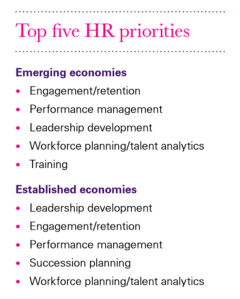
SHL Top 5 HR Priorities 2013The first part of the report reviews  organizations’ talent management focus and landscape.  For example , the authors compare the top five HR priorities in emerging economies to the top 5 HR priorities in established economies.

The lists are similar but not identical. You can see that four of the priorities show up on both lists, although prioritized differently; and that succession planning shows up in the top 5 on the established economies list, while training shows up in the top 5 on the emerging economies list.

Other findings relate to HR’s use of big data and the perception that there is room for improvement around the world in using objective data to make workforce decisions. In fact, less than 25% of the survey respondents reported that their organizations have a clear understanding of workforce potential.

The second part of the report focuses on the assessment of talent – both for hiring and for employee development.  Interesting findings in this section include the desire by nearly 75% of respondents to improve talent measurement and the practice of linking pre-hire and post-hire testing to specific business outcomes.

The third part of the report focuses on technology in testing, with a specific focus on mobile devices and social media. The key findings here include data showing that emerging economies want to use mobile technology assess candidates – both recruiters and candidates want this capability; and social media data is becoming less critical to hiring decisions. (See last week’s Data Point Tuesday.)

The report concludes with four recommendations for HR in 2013:

  • Big data presents HR with a unique opportunity to demonstrate business value

  • Only the right data will lead to the success of talent initiatives

  • HR should embrace innovation that improves how talent is recruited, but with caution

  • Mobile technology should be considered for competitive advantage, not to follow the crowd

The data in this report are presented in a way that is easily understood and useful.  At 30 pages, it’s worth the 45 minutes it will take to scan it and then hone in on the impactful sections.  I especially appreciated the selected references at the end, as well as the key findings lists from the same survey reports for 2009 – 2011. I’m always interested in the evolution of these kinds of lists.

But the bottom line for me is that here’s yet another source of global HR data shining a light on HR’s need to figure out how to demonstrate its business value. Whether you prefer this report to others you’ve discovered here at Data Point Tuesday — or you prefer other sources of HR data and analysis, the drum beat is the same:  aligning HR strategy (and tactics) to business outcomes is the only way to demonstrate business value. And the only way for HR professionals to be seen as business leaders.

1 Comment

Filed under Big Data and HR, China Gorman, Data Point Tuesday, Employment Screening, HR Data, SHL, Talent Assessment, Talent Management