Tag Archives: HR

HR + Early Adoption = Oxymoron?

This is easy.  The answer is not just no, but hell no!

Despite the fact that Human Resources – Personnel, back in the day – has its roots in risk avoidance through an overarching focus on compliance,  today HR is at the forefront of early adoption – especially with respect to human capital management software.

I’ve written a white paper for Achievers (www.achievers.com) that will be available shortly.  And the great HR Technologist Himself, Steve Boese, and I will be discussing this very topic in webinar on March 7 at 1:00 pm EST.  Register here to join us.  I’m thinking that this could be an epic point/counterpoint discussion that you won’t want to miss!

Plus, you’ll get a complimentary copy of the white paper, Early Adoption:  Against HR’s Nature?

Steve Boese and me, an interesting webinar that will straighten your spine and put a swagger in your step, a free white paper and Achievers.

Be there or be…I don’t know, ummm…Personnel.

Leave a comment

Filed under Achievers, China Gorman, Early Adoption, Talent development, Technology

Memo to HR: Raise Your Hands!

Several times this year I’ve given the wrap-up keynote speech at HR conferences.  This particular speech is titled, “HR Wake Up Call.”  The message is simple:  HR professionals have far more business savvy and leadership opportunities than they are given credit for.

One of the ways I prove this is to quiz the audience on a range of business related topics, testing their savvy and knowledge.  Nearly every question I ask gets an almost unanimous positive answer.  The questions cover topics like the current unemployment rate, the current U.S. GDP and the topics of current business books.

When I ask how many in the audience have ever been responsible for a sales quota, 70-80% of the audience raises their hands.  And when I ask how many have managed a P&L, between 80 and 95% of every audience raises their hands.

After the quiz is over and we discuss the answers in detail I ask how many of their executive teams know that they’ve been responsible for a sales quota or managed a P&L.  Astonishingly most do not.

I find that remarkable.  No.  Actually, I find it disturbing.  HR professionals routinely lament their lack of standing in the strategic workings of business, and yet when they’ve got the golden ticket they ignore it.

So here’s the deal:  if you want to be an HR professional who focuses solely on the tactical and compliance parts of HR, then don’t let on that you’re a business person.  Not letting your C-suite know that you’ve managed a business will ensure that you stay off their radar and can focus on the day-to-day stuff.

If, however, your organization can benefit from your business insight and experience, and you want to operate at a strategic level – not just the tactical level – MAKE SURE YOUR FULL BACKGROUND AND EXPERIENCE ARE KNOWN!

That is all.

4 Comments

Filed under Business Language, Business Success, HR, Leadership, Uncategorized

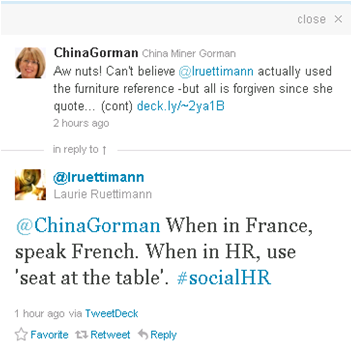
HR and Furniture

Normally, I agree with everything Laurie Ruettimann says.  Not because I’m a robot, but because she’s right 99% of the time.  .9% of the time we just see things through different lenses.

And .1% of the time we just disagree.

And this falls in that .1%.

I think that when you’re in HR you have to speak the language of business.  I think speaking HR in business is the kiss of death – or irrelevance, which is really the same thing.

It’s not about furniture, it’s about influence.  And when you’re influential you speak the language of those you influence.

Business people are everywhere in organizations.  They’re in Finance (where they speak finance and business).  They’re in Marketing (where they speak marketing and business).  They’re in Operations (where they speak operations and business).  They’re in R&D (where they speak r&d and business).  They’re in Sales (where they speak sales and business).  They’re in IT (where they speak technology and business).

Business people are most definitely at the top of the organization where the only language spoken is business.  So if you want to influence the people at the top of the organization – all those people whose job titles start with a great big “C” — you have to speak to them in their language, not yours.

This quote from Frank Romer says it all:

People will sit up and take notice of you if you will sit up and take notice of what makes them sit up and take notice.

The bottom line is that language is important.  Using language your target audience doesn’t understand ensures that you won’t be understood.  It also ensures that you will have no influence.  None.  Zero.

So if HR is to be influential and interact with a certain type of furniture it has to be fluent in the language of business.

Actually, I’m pretty sure Laurie Ruettimann will agree with me.

18 Comments

Filed under Business Language, Business Success, HR, Leadership

Layoffs Planned? What’s An Employer Brand To Do?

Like most companies, you’ve focused a lot lately on your employer brand.  Why?  Because you are paying attention to data that does more than suggest that the tie you have to your employees is growing more tenuous by the day.

You see the data:

  • Job satisfaction has been moving downward and is now at an all time low:  according to the Conference Board, only 45% of America’s workforce report being satisfied with their employment experience.
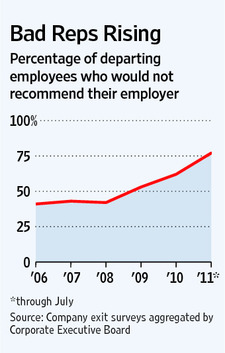
  • Over the last 6 years, the percentage of departing employees who would not recommend their employer has grown from 42% to 75%, according to company exit surveys aggregated by Corporate Executive Board
  • The percentage of all employees leaving their employers who are leaving voluntarily is growing – and now greater than the percentage of employees who are laid-off according to current BLS data.

And now, like HSBC, Cisco, Bank of America and a growing group of other employers, you’re about to announce a layoff.  A major layoff.  And like most employers, you still have critical job openings in several sectors of the business and in various locations around the world.  And you’re predicting talent shortages in many of your critical operations.  A layoff.  Really?

What’s an employer brand to do?

With the fluid nature of today’s global workforce, you know it’s critical that you maintain a positive employer brand so that you can retain the critical talent you have and continue to attract (and in the future rehire) top talent.

What’s an employer brand to do?

You know that over the course of the next decade recruiting top talent is going to continue to become more and more challenging and you realize that the way you treat employees on their way out of the organization has now become as important as how you treated them on the way in – now more than ever.  The way you treat someone during the upcoming layoff will decide – for them and their network – whether they would ever consider working for your company again.

Remaining employees have always watched how impacted employees were treated during a downsizing or restructuring event.  But now, as the Boomers are beginning to make other plans, as Gen X is itching to see the fruits of their labor, and as Gen Y is yearning to work for organizations that are changing the world – the perception of how their former colleagues are treated will have a significant impact on your company’s employer brand, how loyal they will remain to the company and ultimately how easy it will be to retain them.

In these days of lightning speed feedback on hundreds of social networks, one negative comment can spread like wildfire.  Treating employees with dignity and respect as they exit the company can do a lot to mitigate the risk of that happening.

What’s an employer brand to do?

Revisit your severance policies and make sure that outplacement services are front and center.  Companies like yours that have invested in your employment brand could easily see that investment go up in smoke quickly without providing immediate, 21st century job finding services like cloud-enabled virtual services that harness the power of social networking sites and semantic search engines to automatically and continuously deliver personalized job leads.

Truth is, there are outplacement organizations that are taking advantage of cloud computing, semantic search, virtual technology, and up-to-the-minute content being created by experts every day.  The harnessing of these technology and content-components have done two things that are important to employers:  they’ve driven cost out of the service and they’re helping former employees find jobs faster – saving UI costs and severance costs, in some cases.  Finding new jobs fast is the point.  For all the stakeholders.

While the traditional bricks and mortar outplacement firms are certainly “bolting on” some technology solutions to their learning based processes, and their consultants are learning how to harness LinkedIn and FaceBook for networking purposes, there are new entrants to the space – technology based entrants – that are redefining this industry’s processes, outcomes for laid-off employees, and deliverables to the employer.

Job boards, social networks, and the ubiquity of information about employers on the web have certainly changed the way people at all organizational levels and all levels of experience look for jobs today.  In many ways, job boards and social networks have made finding the right job a much more complex activity. Your outplacement solution needs to help untangle those complexities while motivating your former employees to move forward quickly.  Nothing will take the sting (and negative social media activity) out of job loss like finding a great new job fast!  And that’s good for your employer brand.

What’s an employer brand to do?

Be sure to review your outplacement policies before you take another step in the downsizing process.  Providing more service to more people could actually save you money.

More importantly, providing the right service can save your previous employer branding investment – because employees who feel supported as they leave their organization and who find great jobs quickly – continue to be employment brand ambassadors for you.

They won’t be part of the 75% of departing employees who don’t recommend their former employer.

4 Comments

Filed under Uncategorized

TRU London: Here I Come!

I wrote a lot about HR conferences last year because I spoke at a lot of them.  And because some of them are changing their approaches to engaging their target audiences.  And because I learn a lot at HR conferences.  And because people who attend HR conferences are among the best in the profession.  And they’re fun.

I’m pretty excited that my 2011 HR conference experience is starting next month in London at TRU London 3.  Did I mention it is in London, my favorite city in the world?  Bill Boorman, founder of the TRU unconference movement, invited me to be a track leader as well as to lead a master class prior to the start of the event. 

While I’ve been a speaker at HR conferences that bent the rules (see my post on RecruitFest! last fall), I’ve never actually participated in a true (no pun intended) unconference.  So I’m really looking forward to this. 

I’m not sure what to expect as a track leader, but I’m gearing up for great discussions, divergent points of view, a truly global perspective, and the chance to hear from people way smarter than me about the latest approaches to recruiting.

My master class is going to be focused on tying engagement to recruitment.  In Turning Back the Tidal Wave of Turnover I’ll provide some of the most recent engagement data from leading organizations like Gallup and BlessingWhite and lead a discussion about what the data means as organizations start losing employees to the improving economy and start hiring again. 

I expect to learn a lot from that discussion as well as from the interactions with a great group of track leaders that include thought leaders like Craig Fisher, John Sumser, Laurie Ruettimann, Glen Cathey, and many more big thinkers whom I have not yet met.  Here’s the website to check out the other leaders.

So here’s the deal:  join us in London February 16-18 for TRU London 3.  Sign up here and make your reservations today.  I can’t imagine a better spot to be in the middle of February – or a better group of people with which to learn. 

And did I mention that it is in London?

4 Comments

Filed under Uncategorized

If I could change one thing about HR…

My friend Michael Carty and his colleagues at Xpert HR in the U.K. (whom I have never met!) invited me to contribute to their blog series: If I could change one thing about HR…

Please visit my guest post there at http://www.xperthr.co.uk/blogs/employment-intelligence/2010/12/china-gorman-if-i-could-change.html


1 Comment

Filed under Business Success, China Gorman, HR, Leadership, Uncategorized, Xpert HR

Urgency vs. the status quo

I’m noticing that something powerful is going on within the HR space.   It’s organic.  It’s energetic.  It feels urgent.  It’s about getting HR people more intimately connected with each other.  It’s about gaining confidence and strength through closer relationships.  And it might be turning the conference world on its ear.

HR conferences organized by groups likes SHRM (including SHRM global and its 52 state councils), ASTD, WorldatWork, ERE, LRP and others have done a very strong job of creating traditional conference experiences that provide content, continuing education credits, vendor showcases and limited networking experiences. 

But well-executed as they are, well-attended as many of them are, and well-marketed as they are, they don’t provide something that seems to be getting more and more valuable to a certain subset of HR leaders:  the opportunity to have intimate discussions with thought leaders.  And there’s a growing sense of immediacey about what’s missing.  So what’s my evidence?

Well, first there is HRevolution.  An early entrant in the HR “un-conference” space, two HRevolutions have been held and the third is in the planning stages.  Organized by Trish McFarlane, Ben Eubanks, Steve Boese and others, this grass roots gathering gets HR folks together to wrestle with each other on topics relating to the relevance of HR.  Facilitators lead discussions rather than speakers giving presentations.  It’s been given high marks for engaging its attendees, but questions of “what’s next?” persist.


The “Tru” un-conferences in Europe appear to be similar to HRevolution in that they have sprung from concerned and committed individuals in the HR space rather than from organizations in the HR space.  I’ll know more after attending the TruLondon conference in February.

RecruitFest! organized by RecruitingBlogs.com also joined the “un-conference” space, but mixed it up in 2010 with a different approach.  Instead of discussion groups, thought-leaders held conversations for the viewing audience (75 in studio; almost 4,000 through the live stream) to listen and watch.  It got the thought leader discussion piece right with some engagement of attendees and it also got high marks.  But again, “what do I do now?” questions followed.

The HRevolution, TruEvents and RecruitFest! unconferences are broad in their reach.  They engage interested professionals from all over the world to attend either in person or virtually. 

Now here’s a new twist:  the HR Reinvention Experiment held last Thursday for senior HR leaders in the state of Nebraska.  Jason Lauritsen, a senior HR executive in Lincoln asked himself “what’s next?” after attending the last HRevolution.  He assembled a small group of like minded business leaders in the HR space in Omaha and Lincoln and they gathered nearly 70 senior leaders from across Nebraska to talk with each other and begin to address challenges in Nebraska that need HR’s leadership.  And with the support of several local sponsor organizations, the HR Reinvention Experiment began to take shape.

A combination of traditional and un-conference organizing approaches, the HR Reinvention Experiment included tailored keynote presentations (me and Jason Seiden), small group discussions led by true thought leaders (Paul Hebert, Joe Gerstandt, William Tincup and Roger Fransecky) and a couple of traditional “concurrent session” topics (Chris Bryant and Greg Harris).  Limited to 75 attendees from a specific geographic area, HRRE was a day full of challenging content, discussion and engagement, all with a local focus.   

To further underscore its difference from traditional conference approaches, HRRE was held in the open spaces of the Hot Shops Art Center, an art center (and former mattress factory) consisting of working art studios, showrooms and gallery spaces.  Attendees, surrounded by the creative process, carried their folding chairs from space to space throughout the day so that gathering spots magically opened up in places like pottery and glass blowing studios as well as galleries.

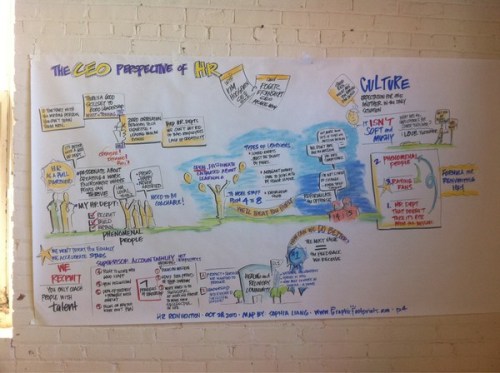
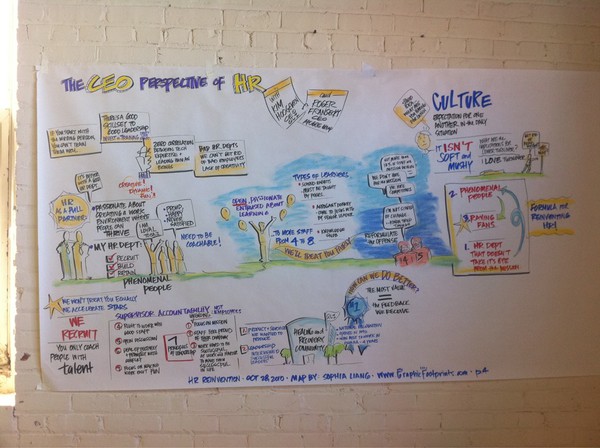
Instead of PowerPoints and handouts, the HRRE organizing team hired the graphic genius of Sophia Liang (Graphic Footprints) to make a graphic recording of the keynote sessions, as well as several of the discussion sessions.  This is the recording of the lunch keynote, “The CEO Perspective of HR,” a discussion between two CEOs: Roger Fransecky and Kim HoogeveenThe additional recordings will be shared on the HRRE website soon.

It was a full day to say the least.  I participated as the opening keynoter giving the attendees an “HR Wake-Up Call” as well as attending as a participant for the full day’s activities.  The experience was challenging, fun, engaging and thought-provoking.  It brought together many of Nebraska’s HR leaders for a day of thoughtful and personal engagement and pushed them to ask new questions and assume different outcomes.

But while the “what’s next?” question persists, I have a feeling that there will indeed be a “next” in Nebraska.  These business leaders seem ready to take action.  HRRE felt like a catalyst that will start to move the discussions into action.  Time will tell, of course, but the framework exists to launch a new kind of self-driven professional community. 

Professional organizations catering to HR leaders should be taking note of the grass roots efforts to connect in new and more impactful ways.  Whether it’s learning and conferences or advocacy and membership, there are unmet needs that are becoming urgent in the HR world.  The frequency and level of innovation happening in this space suggests that the current infrastructure is becoming less relevant to a portion of the population.  And this portion of the HR population has the commitment, skills and intellectual curiosity to do something about it.  We should all stay tuned….

6 Comments

Filed under China Gorman, Conferences, HR, HR Conferences, Leadership, Uncategorized

How to open an HR conference!

 I’m that voice that’s been saying “Really? Movie stars as keynoters at HR conferences?  Really?  How’s this going to help me be a more strategic business leader?” 

 While I was at SHRM I was successful in influencing the team to select more keynoters who had real connections to business and HR success.  Business thought leaders like Jack Welch, Anne Mulcahy, Ted Childs, John Kotter and Steve Forbes.  I’ve never understood the fascination with movie and tv stars as keynoters at HR conferences – other than everyone loves movie and tv stars.  I’ve held the position that HR conferences should bring relevant business content from real thought leaders to the attendees.  So when I saw that HR Southwest’s opening keynote was a two person comedy/juggling act, I thought, “Oh brother.  Here we go…”

 But here’s the thing:  they were fabulous!  Let me paint the picture.  We’re in Fort Worth.  It was 8:15 on Monday morning.  It was Columbus Day — a holiday in many workplaces.  Both the Rangers and the Cowboys had played at home the day before – and lost.  And it’s a commuter conference (a large majority of the 2,000+ attendees drive to the conference each day from home).  So to describe the energy in the room as the session opened as lethargic would be understating the case. 

And then The Passing Zone arrived.  Amazing jugglers, smart comedians, these two guys kept the witty patter going through 75 minutes of their act while continuously linking their actions to the HR world.  Trust, cooperation, communication, juggling priorities:  these were cleverly woven into their act in a refreshing, funny and entertaining way.  We were laughing, we were clapping, we were gasping, we were cheering.  The energy was thumping, the good humor was flowing and the conference was off to the races.  Brilliant!

 So I stand corrected.  When planning conference keynoters understand the likely mindset of the audience you are supporting.  And if it’s first thing Monday morning, wake ’em up!  The planners at HR Southwest did just that and came up with a real winner.  Well done!

3 Comments

Filed under HR, HR Conferences, Uncategorized

HR Southwest: the Real Deal


Here’s what I love about HR conferences:  the attendees.  I’m a big fan of HR professionals.  I think they’re smart.  I think they know their business.  I think they contribute daily to the success of their organizations.  I think they grab on to learning wherever they can find it.  And I think that today, like no other time before, they are caught between the proverbial rock of a fragile and unpredictable economy and the combined hard places of the current legislative/regulatory agenda, continued globalization and the need, as always, to do more with less.

 So as I attend the SHRM-affiliated HR Southwest Conference in Fort Worth, Texas today through Wednesday, I am again impressed with the way these 2,000+ dedicated HR pros are approaching this ultimate learning experience.  And make no mistake:  HR Southwest is an ultimate learning experience.  The concurrent session line-up is among the best I’ve ever seen.  The keynoters are very strong.  The exhibition hall is incredible.  And the attendees themselves are focused on making the most of the three days before them. 

 I respect the hell out of these folks.  I see a determination in their eyes as they check the conference program to chart their course through the conference.  They’re engaging with the vendors in the exhibition hall and not just collecting swag.  They’re improving their ability to serve their organizations and their communities.  They’re working on expanding both their functional expertise and their strategic leadership abilities.  What they learn here will absolutely make their organizations more competitive. 

 So, kudos to the conference team that produces HR Southwest.  It’s smart; it’s professional; it’s the real deal.  Now.  Don’t you wish you were here?

Leave a comment

Filed under Conferences, HR, HR Conferences, Uncategorized

A Tale of Two Conferences

How lucky can a gal get?  I’m speaking at RecruitFest! on Thursday (October 7) in Boston and attending HR Southwest in Fort Worth the following week (October 10-13).  Two great conferences, two great organizations, two great cities  – all focused on providing up to the minute content for the development of HR professionals.  That’s  5 conference days in 7.  Whew!

First up, RecruitFest! put on my the good folks at Recruiter.com (formerly RecruitingBlogs.com) and Monster.  And they’re cooking up something really new and special.  Here’s the deal:  they’ve collected a group of thought leaders in the Recruiting space to engage in important discussions for the benefit of the attendees.  Stars like

 And here’s the really interesting part:  there will be audience participation – questions from the live audience, questions from those watching the live stream, and questions from those listening in and participating in the Twitter back channel.  Pretty exciting stuff!  If you haven’t signed up, click here to attend in person or virtually.

Next up is HR Southwest, the largest SHRM state conference.  The organizing team is expecting nearly 2,000 live participants at the Fort Worth Convention Center!  That’s big!  That also makes HR Southwest second only to the SHRM Annual Conference in the world of SHRM conferences. 

 I remember in the early ‘90s, when I lived in Dallas and managed the southwest region of a global HR consulting firm, the cornerstone of our marketing plan every year was supporting HR Southwest.  I still have pictures (somewhere) of our booth and the team that staffed it.  We connected with our customers and showed our support for our friends in the HR profession by supporting this important event.  I wouldn’t have dropped this important event from our budget – ever!

 The keynote speakers this year look outstanding:  Ambassador Nancy G. Brinker, founder of Susan G. Komen for the Cure®; Chad Hymas, world-class wheelchair athlete; and Jon Wee and Owen Morse, otherwise known as The Passing Zone.  With more than 110 concurrent sessions and the ability to earn as many as 20.75 recertification credits from the HR Certification Institute, this conference is going to set a new standard for HR conferences.

 I’ll be tweeting at HR Southwest, so be sure to follow the #HRSWC10 hashtag and to follow me on Twitter at http://twitter.com/ChinaGorman.  See you at the conferences!

1 Comment

Filed under China Gorman, HR, HR Conferences, Social Media, Uncategorized