Category Archives: China Gorman

What’s your budget?

Great sources of free and relevant talent management data are vendor research, white papers and blogs. Of course, vendors have a bias towards research and conclusions that support their cause, but that doesn’t make the research less interesting or actionable. It just means that the reader has to understand the context.

I read an interesting article in the May issue of Talent Management that referenced a survey done by Cornerstone OnDemand and Harris Interactive on performance management.  I traced the survey results back to a post on the CSOD blog by Charles Coy.  The survey data about the effectiveness of legacy performance management systems is interesting and not at all surprising.  They don’t work and everyone knows it – employees and HR.

What was more interesting to me were the math and sources behind the potential price tag of $2 Ttrillion to U.S. employers in 2012 simply due to voluntary turnover.  That’s right: $2 Trillion!

$2 Trillion is a big number.  A very big number.  Could it be true?  If we take the stats one by one, it absolutely could be true.  Take a look:
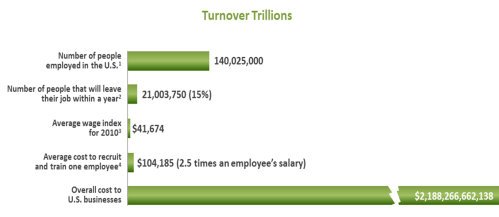
Here’s the equation where E = total employees and AW = their average wage (divide total salary cost by the number of FTEs):

(E x .15) x (AW x 2.5) = Total Turnover Cost

Try the math in your organization.  If you have 350 employees and the average wage is $50,000 then

  • 350 x .15 =                                             52
  • Average wage =                                $  50,000.00
  • Average full replacement cost =   $ 125,000.00

52 x $125,000 = $6,500,000.00

And what’s your budget? 

But, you say, your voluntary turnover is only 8%, not 15%.  Well, even if that’s true – and congratulations if it is – that’s still a lot of money.

28 x $125,000.00 = $3,500,000.00

And what’s your budget?

But, you say, that 2.5 times the average wage calculation for replacement costs is way too high.  You don’t buy that the loss of an average employee means a potential loss of intellectual capital or client relationships.  OK.  How about the impact on internal relationships and getting things done?  How about the productivity and morale of colleagues left behind?  How about the experience and job skills that you’ve lost?  Add in the hard costs of recruiting a new hire, the onboarding time, the training time to full productivity and you’ve still got a big number – even if you found and hired replacements really quickly.  Try the math at 1.5 the average wage as the full replacement cost.  With 8% turnover and 1.5 times the average wage, that’s still a big number

28 x $75,000.00 = $2,100.000.00

And what’s your budget?

And what if your voluntary turnover is higher than 15%?  Or what if the training time to productivity is longer than average?  Or what if you – like 52% of employers – can’t find the replacement talent quickly or at all?  Then the impact will be greater.  Much greater.

This is a useful discussion because it can help create a context for the broader conversation about the real cost of voluntary turnover and the cost savings in having an engaged workforce.  It can be part of the rationale in a business case for investing in any of the levers that will increase retention and reduce turnover.

It’s almost budget time in most organizations.  Financial resources are still scarce.  As you plan your 2013 budget requests for more spending on talent management solutions, be prepared with fact and data.  This might help.
1 Comment

Filed under Average Wage, Budget, China Gorman, Cornerstone OnDemand, Engagement, Harris Interactive, Talent Management, Turnover, Uncategorized

Data Point #11: Talent optimism vs. realism

We’re surrounded by all kinds of data points about the talent/skill shortage.  I wrote about it here and here.  Today we have two data points:  one comes from SHRM’s Q2 2012 Jobs Outlook Survey Report and the second comes from the BLS 2012 Occupational Outlook Handbook.

SHRM’s Jobs Outlook Survey has some interesting data from a small sample of its 250,000+ members.  (This particular survey was sent to 3,000 randomly selected SHRM members with 336 members responding, for an 11% response rate.)  These quarterly JOS surveys ask HR professionals interesting questions about optimism in job growth, planned changes in total staff levels, categories of workers companies will hire and categories of workers most difficult to hire in the previous quarter.

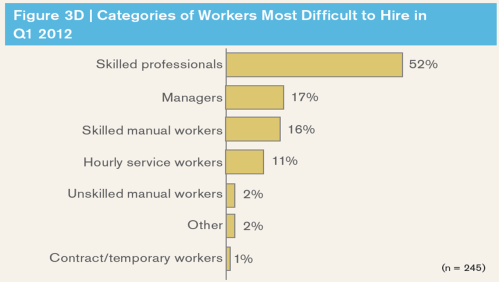
I was particularly interested in the responses to the question asking which categories of workers were most difficult to hire in the 1st Quarter of this year.  The sample is small (n=246), so the data are directional at best, but do line up with other data sources.

This data is congruent with BLS (U.S. Bureau of Labor Statistics) data relative to education level attainment and the corresponding unemployment rates in April.  The higher the unemployment rate, the lower the difficulty to hire:

  • Less than high school:                                   12.5%
  • High school no college:                                  7.9%
  • Some college or Associate degree:               7.6%
  • Bachelor’s degree or higher:                         4.0%

In other words, it’s more difficult to find skilled professionals and managers in this job market because there are fewer of them unemployed and there are fewer of them overall.  It’s easier to find service workers and unskilled manual workers because more of them are unemployed and there are more of them overall.

But still, as the SHRM report highlights, employers are having difficulty in hiring at all levels.  Which makes me wonder:  are we being unnecessarily restrictive in our job specifications?  Are we hiring people with college degrees when an associate degree would suffice?  Are we requiring associate degrees when a high school degree would be adequate?  I don’t know the answer, but considering the data is interesting.

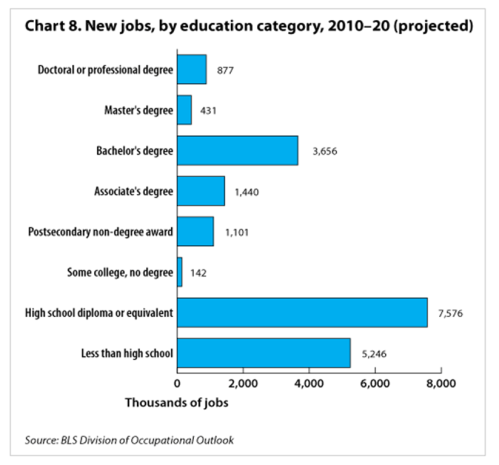
The Occupation Outlook Handbook, published by the BLS, shows the projected job growth by education category in the 2010-2020 decade:

While the number of jobs created in this decade that will require a Bachelor’s degree or higher is predicted to be nearly 5 million, the number of jobs predicted to be created requiring some college/no degree or less is nearly 13 million.

So if the key to employment (and financial) security for the average worker is a Bachelor’s degree, but the greatest numbers of jobs being created in the next decade won’t require a Bachelor’s degree, how do we reconcile this as employers?

Do we hire college educated workers for jobs that only require a high school diploma?  Are we already doing that now?

Do we work to raise the general level of worker education because we believe it’s the key to global competitiveness?

Do we encourage students to enroll in career and technical education programs in and after high school rather than college because those are the skills needed in the economy?

The data around employers having difficulty finding the talent/skills they need isn’t as simple as it looks.  It’s actually quite challenging.  Under every layer of data is another layer of data.  Solving our talent attraction and acquisition needs won’t be solved with one tactic. But it’s a safe bet that solving our talent challenges will include strengthening relationships between employers and the education infrastructure to produce the skills our economy really needs.

As I look at the data, the optimist in me says we’re covered over in opportunity.  The realist in me says we’ve got a lot of work to do and not a lot of time in which to do it.

7 Comments

Filed under Bureau of Labor Statistics, China Gorman, Demographics, Education Deficit, Employment Data, HR, Post-secondary education, SHRM, Talent Management, Talent pipeline, U.S. Department of Labor, Uncategorized, Unemployment, Unemployment Rate

Data Point #9: Employer Loyalty Isn’t Dead? Wait. What?

MetLife published its 10th Annual Study of Employee Benefit Trends on March 19th, 2012.  At 80 pages, it’s a read.  But it’s a fascinating read.

The report shows clearly that the strong role of workplace benefits in driving employee attraction, retention and productivity continues as reported by these MetLife studies during the last 10 years and persists today during the slow economic recovery.  Interestingly, the study correlates satisfaction with benefits to employee job satisfaction, and also shows clearly that employees who are dissatisfied with their benefits are more likely to want to work somewhere else.

The data are fascinating.  And I recommend the investment of 30 minutes to read it through.

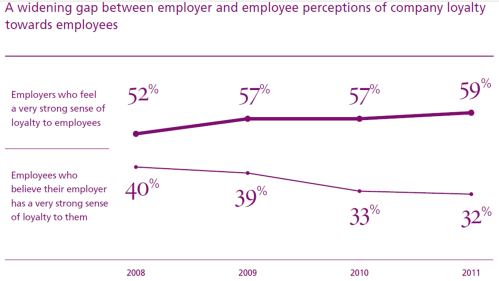
The data point that I found most interesting in the study follows:

I haven’t seen anyone discuss employer loyalty to employees in a long time.  I think I assumed, by looking at other trends, that the issue of employer loyalty was long dead.  Building employee loyalty, however, was a whole other discussion:  we call it employee engagement.  And employers are starting to pay attention to this issue because of the rapid shift in workforce demographics coming down on us like a load of bricks. (See my posts on this topic here and here.)

But where has been the focus on employer engagement? Have we all assumed that employer loyalty is dead and gone forever?  That employees “know the score” and don’t expect employers to be loyal to them?  Well, MetLife reports that between 2008 and 2011 employer loyalty scores have increased 5% from 52% to 59%!  Wait.  What?

In the same time period, however, the perception by employees that their employers are loyal to them has decreased 8% from 40% to 32%.  How pitiful is that?  Employers think they’re doing better, but employees aren’t getting the message.  And in fact, more of them aren’t getting the message as time goes on.

I think this is interesting.  Despite all the attention being paid to employee engagement – through salary, through benefits, through recognition, through providing strong ethical cultures, through providing meaningful and interesting work — in fact, the study finds evidence of a widening disconnect between employers and employees.

Job insecurity and expectations that benefits will be cut may well be contributing to employees feeling less important to their employers.  This “loyalty gap” presents an immediate opportunity for HR and C-Suite leaders to really step up communication and feedback about their increased loyalty.  Of course, the proof is in the pudding, and for employees to believe that their employer is growing more loyal to them, they are going to have to see a change in behavior – if they stick around long enough.

6 Comments

Filed under China Gorman, Culture, Demographics, Employee Benefits, Employee Loyalty, Employer Loyalty, Engagement, MetLife, Talent pipeline, Uncategorized

HR Rockstar Tour

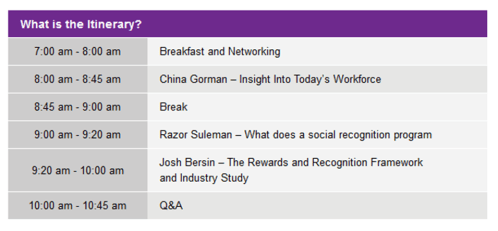
If you live in Dallas, Chicago, New York, Miami, Los Angeles or San Francisco I’d like to invite you to attend a complimentary seminar that introduces and discusses groundbreaking new research and analysis about Recognition and Rewards.  Sponsored by the good folks at Achievers, this will be great morning with a little breakfast, a little networking, a couple of HRCI credits — and a whole lot of new data about what’s working to engage employees more effectively.  Join me, Josh Bersin and Razor Suleman.  I guarantee that you’ll leave smarter than when you arrived.  It happens to me every time I’m with Josh and Razor.  It can happen for you too.  Just  send an email to Loren Maisels at Achievers asking for an invitation (Loren@achievers.com) or call her at 415-967-7809.  Tell her I invited you.

2 Comments

Filed under Achievers, China Gorman, Demographics, Engagement, Josh Bersin, Razor Suleman, Rewards & Recognition, Uncategorized

Data Point #5: We Can’t Succeed Without Baby Boomers

In earlier Data Point Tuesday posts (here and here) I’ve recommended the Bureau of Labor Statistics’ website as a treasure trove of talent management related data.  Another great source of useful information is SHRM, the Society for Human Resource Management.

SHRM’s research group works tirelessly to bring relevant, actionable trend and survey information to its members.  And if you aren’t a member (why aren’t you?), the value of SHRM’s research services alone is more than the cost of membership. *

Workplace Visions is part of SHRM’s Workplace Trends and Forecasting program and is published multiple times each year – as new data become available.  The reports are useful signposts for new developments that impact organizations, talent management and HR professionals.

The first such report published this year is “Changes to Retirement Benefits:  What HR Professionals Need to Know in 2012” (member protected).  It’s full of useful observations about changes coming to 401(k) plan rules, Social Security changes to keep an eye on and great data from EBRI (The Employee Benefits Research Institute).

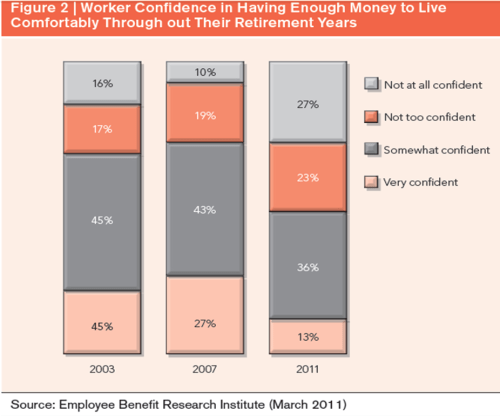
One of the discussion points piqued my interest:  data from EBRI about the reduction in confidence by Baby Boomers that they will have enough money in their retirement years to live comfortably.  See the chart below.  This has big potential impact for employers.

The aha! is that while a steady stream of Americans still plan to retire in their early to mid-60s, many more workers are unsure when they’ll be able to retire – or if they’ll be able to retire.  As you can see from the chart, in 2007 70% of EBRI survey respondents reported some level of confidence in their retirement plans.  That number fell to 49% in 2011.  SHRM also cites data from Towers Watson surveys with similar outcomes.

What does this mean for talent management professionals?  Well, SHRM thinks that providing a stronger hand in retirement planning and financial education for Baby Boomers will help reduce retirement-related anxiety.  I absolutely agree.

Additionally, though, SHRM counsels HR professionals to “weigh the positives and negatives of employing an older workforce.”   They counsel that “older workers are often costlier to keep on board, due to higher salaries and health benefits costs.” Woah.  The  thought that employers will have robust options besides Baby Boomers and other older workers to staff their organizations isn’t supported by the demographic trends.

My take is a little different.  Here’s what the data say:

  • the U.S. population is growing more slowly leading a more slowly growing civilian work force (http://bls.gov/news.release/pdf/ecopro.pdf),
  • the Baby Boom generation moves entirely into the 55-years-old+ age group by 2020 and will represent 25.2% of the work force (up from 13.1% in 2000)
  • the “prime-age” labor cohort (ages 25-54) is projected to drop to 63.7% (from 71.1% in 2000) of the work force

So the engagement, development and retention of Baby Boomers and other older workers will be a very critical part of most organizations’ talent strategies because they’ll make up 25% of the available work force.  Providing incentives to stay, financial education for pro-active retirement planning and unique engagement strategies — among others — will all be part of talent strategy in 2020.  There won’t be any weighing the positives and negatives of employing an older workforce.  But there will be significant effort spent in figuring out how to keep the Baby Boomers’ skills, talents,and  organizational knowledge in play in the work force — and in our organizations.

At 25% of the available workforce, there won’t be other options.  We won’t be able to succeed without Baby Boomers.

*Full Disclosure:  I am SHRM’s former Chief Operating Officer

8 Comments

Filed under Baby Boomers, Bureau of Labor Statistics, Business Success, China Gorman, Demographics, Employment Data, HR, Retirement Planning, Talent Management, Talent pipeline, U.S. Department of Labor

AT&T, JAG and the Talent Deficit

In my post yesterday, I suggested that employers will need to start making strategic partnerships with education institutions and economic development organizations, among others, to start dealing with the upcoming acute shortage of workers who have graduated from high school and have some college under their belt.

A great example of this came to my attention yesterday.  On Monday AT&T announced an investment of $250,000,000 over the next five years to improve high school graduation rates.  Here’s how their announcement began:  “ As access to skilled workers becomes increasingly vital to the U.S. economy, AT&T is launching a quarter-billion-dollar campaign to help more students graduate from high school ready for careers and college, and to ensure the country is better prepared to meet global competition.”

Investing in JAG – Jobs for America’s Graduates – is an example of strategic corporate investment in the future of the talent pipeline.  JAG, the most effective program of its kind – is a state-based national non-profit organization dedicated to preventing dropouts among young people who are most at-risk.  In more than three decades of operation, JAG has delivered consistent, compelling results – helping nearly three-quarters of a million young people stay in school through graduation, pursue post-secondary education and secure quality entry-level jobs leading to career advancement opportunities.  The kids in the AT&T Aspire video are great examples of JAG at work in the trenches.

Who wouldn’t hire those kids?

I ended my Data Point Tuesday post yesterday with this imperative:  “The sooner talent acquisition professionals and learning/development professionals in organizations begin to work together on workforce planning and tackling the education deficit, the sooner the talent pipeline will begin to be prepared for 46 million new jobs.”

Looks like AT&T is out in front.  Again!

3 Comments

Filed under Aspire, AT&T, China Gorman, Education Deficit, High School Graduation Rates, JAG, Job Creation, Talent pipeline, Uncategorized

Data Point #1: Unemployment Rate vs. Layoff Data

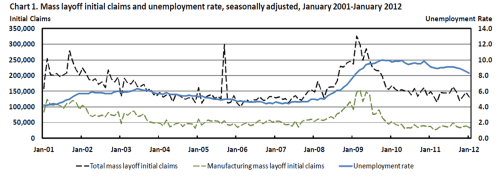
The U.S. Bureau of Labor Statistics published a mixed bag of news week before last.  While the unemployment rate fell from 8.5% in December to 8.3% in January, the number of mass layoff events in January grew by 50 over the previous month.  (A mass layoff event  involves at least 50 workers from a single employer.)  The total number of employees involved in these events, however, was reduced month-over-month by 15,728.  So while more employers were downsizing in January, fewer employees were impacted.  Good news, right?  Maybe…

Looking at the trend lines in the chart below, HR professionals may scratch their heads and wonder what is different in January 2012 from April 2008?  The number of initial claims are similar:  128,643 in April 2008 vs 129,920 in January 20102.  But the unemployment rate is significanttly dissimilar:  5% unemployment in April 2008 vs. 8.3% unemployment in January 2012.  What’s going on?

Clearly, the lagging effects of the economic downturn which began to gather steam in the 3rd and 4th quarters of 2008 are still being felt.  The resulting embedded base of unemployed workers continues to weigh heavily on the U.S. economy and the unemployment rate despite the falling numbers of layoff events and impacted workers.

So how is this data useful for HR professionals?  Simple.  Putting the long-time unemployed back to work has to be job #1 in our organizations and our communities.  As your organization plans to grow its employee base — whether with contract, temporary or full-time employees — what are your plans to target the long-term unemployed for inclusion in the talent pipeline?

3 Comments

Filed under Bureau of Labor Statistics, China Gorman, Data Point Tuesday, Employment Data, HR, Talent pipeline, U.S. Department of Labor, Uncategorized

HR + Early Adoption = Oxymoron?

This is easy.  The answer is not just no, but hell no!

Despite the fact that Human Resources – Personnel, back in the day – has its roots in risk avoidance through an overarching focus on compliance,  today HR is at the forefront of early adoption – especially with respect to human capital management software.

I’ve written a white paper for Achievers (www.achievers.com) that will be available shortly.  And the great HR Technologist Himself, Steve Boese, and I will be discussing this very topic in webinar on March 7 at 1:00 pm EST.  Register here to join us.  I’m thinking that this could be an epic point/counterpoint discussion that you won’t want to miss!

Plus, you’ll get a complimentary copy of the white paper, Early Adoption:  Against HR’s Nature?

Steve Boese and me, an interesting webinar that will straighten your spine and put a swagger in your step, a free white paper and Achievers.

Be there or be…I don’t know, ummm…Personnel.

Leave a comment

Filed under Achievers, China Gorman, Early Adoption, Talent development, Technology

If I could change one thing about HR…

My friend Michael Carty and his colleagues at Xpert HR in the U.K. (whom I have never met!) invited me to contribute to their blog series: If I could change one thing about HR…

Please visit my guest post there at http://www.xperthr.co.uk/blogs/employment-intelligence/2010/12/china-gorman-if-i-could-change.html


1 Comment

Filed under Business Success, China Gorman, HR, Leadership, Uncategorized, Xpert HR

Urgency vs. the status quo

I’m noticing that something powerful is going on within the HR space.   It’s organic.  It’s energetic.  It feels urgent.  It’s about getting HR people more intimately connected with each other.  It’s about gaining confidence and strength through closer relationships.  And it might be turning the conference world on its ear.

HR conferences organized by groups likes SHRM (including SHRM global and its 52 state councils), ASTD, WorldatWork, ERE, LRP and others have done a very strong job of creating traditional conference experiences that provide content, continuing education credits, vendor showcases and limited networking experiences. 

But well-executed as they are, well-attended as many of them are, and well-marketed as they are, they don’t provide something that seems to be getting more and more valuable to a certain subset of HR leaders:  the opportunity to have intimate discussions with thought leaders.  And there’s a growing sense of immediacey about what’s missing.  So what’s my evidence?

Well, first there is HRevolution.  An early entrant in the HR “un-conference” space, two HRevolutions have been held and the third is in the planning stages.  Organized by Trish McFarlane, Ben Eubanks, Steve Boese and others, this grass roots gathering gets HR folks together to wrestle with each other on topics relating to the relevance of HR.  Facilitators lead discussions rather than speakers giving presentations.  It’s been given high marks for engaging its attendees, but questions of “what’s next?” persist.

The “Tru” un-conferences in Europe appear to be similar to HRevolution in that they have sprung from concerned and committed individuals in the HR space rather than from organizations in the HR space.  I’ll know more after attending the TruLondon conference in February.

RecruitFest! organized by RecruitingBlogs.com also joined the “un-conference” space, but mixed it up in 2010 with a different approach.  Instead of discussion groups, thought-leaders held conversations for the viewing audience (75 in studio; almost 4,000 through the live stream) to listen and watch.  It got the thought leader discussion piece right with some engagement of attendees and it also got high marks.  But again, “what do I do now?” questions followed.

The HRevolution, TruEvents and RecruitFest! unconferences are broad in their reach.  They engage interested professionals from all over the world to attend either in person or virtually. 

Now here’s a new twist:  the HR Reinvention Experiment held last Thursday for senior HR leaders in the state of Nebraska.  Jason Lauritsen, a senior HR executive in Lincoln asked himself “what’s next?” after attending the last HRevolution.  He assembled a small group of like minded business leaders in the HR space in Omaha and Lincoln and they gathered nearly 70 senior leaders from across Nebraska to talk with each other and begin to address challenges in Nebraska that need HR’s leadership.  And with the support of several local sponsor organizations, the HR Reinvention Experiment began to take shape.

A combination of traditional and un-conference organizing approaches, the HR Reinvention Experiment included tailored keynote presentations (me and Jason Seiden), small group discussions led by true thought leaders (Paul Hebert, Joe Gerstandt, William Tincup and Roger Fransecky) and a couple of traditional “concurrent session” topics (Chris Bryant and Greg Harris).  Limited to 75 attendees from a specific geographic area, HRRE was a day full of challenging content, discussion and engagement, all with a local focus.   

To further underscore its difference from traditional conference approaches, HRRE was held in the open spaces of the Hot Shops Art Center, an art center (and former mattress factory) consisting of working art studios, showrooms and gallery spaces.  Attendees, surrounded by the creative process, carried their folding chairs from space to space throughout the day so that gathering spots magically opened up in places like pottery and glass blowing studios as well as galleries.

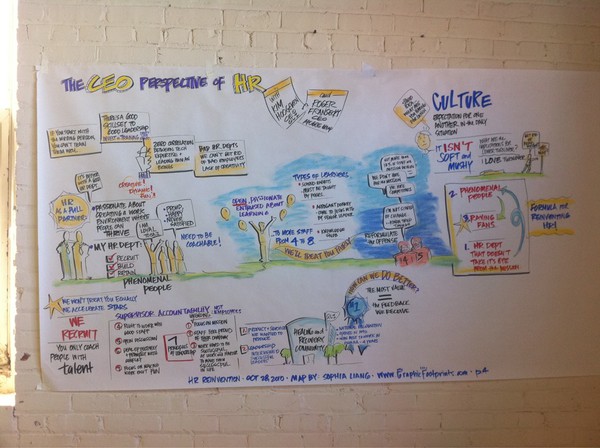
Instead of PowerPoints and handouts, the HRRE organizing team hired the graphic genius of Sophia Liang (Graphic Footprints) to make a graphic recording of the keynote sessions, as well as several of the discussion sessions.  This is the recording of the lunch keynote, “The CEO Perspective of HR,” a discussion between two CEOs: Roger Fransecky and Kim HoogeveenThe additional recordings will be shared on the HRRE website soon.

It was a full day to say the least.  I participated as the opening keynoter giving the attendees an “HR Wake-Up Call” as well as attending as a participant for the full day’s activities.  The experience was challenging, fun, engaging and thought-provoking.  It brought together many of Nebraska’s HR leaders for a day of thoughtful and personal engagement and pushed them to ask new questions and assume different outcomes.

But while the “what’s next?” question persists, I have a feeling that there will indeed be a “next” in Nebraska.  These business leaders seem ready to take action.  HRRE felt like a catalyst that will start to move the discussions into action.  Time will tell, of course, but the framework exists to launch a new kind of self-driven professional community. 

Professional organizations catering to HR leaders should be taking note of the grass roots efforts to connect in new and more impactful ways.  Whether it’s learning and conferences or advocacy and membership, there are unmet needs that are becoming urgent in the HR world.  The frequency and level of innovation happening in this space suggests that the current infrastructure is becoming less relevant to a portion of the population.  And this portion of the HR population has the commitment, skills and intellectual curiosity to do something about it.  We should all stay tuned….

6 Comments

Filed under China Gorman, Conferences, HR, HR Conferences, Leadership, Uncategorized