Category Archives: HR Data

The Hidden Job Market is Alive and Well — and That’s Not Good News!

data point tuesday_500

Last week I wrote about matching the number of job openings to the number of unemployed people by industry. The numbers were arresting. I used data from the Economic Policy Institute’s Heidi Shierholz.

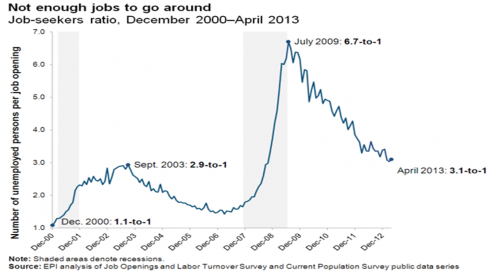
In that post, Unemployed Workers Still Far Outnumber Job Openings in Every Major Sector, Shierholz provided this graph showing the Job-Seekers ratio from December 2000 through April 2013 based on data from the BLS JOLTS Survey and Current Population Survey:
Not enough jobs to go around June 2013

This is an incredible view of the last 13 years. The Jobs-to-Seekers ratio in December 2000 was 1 to 1.1:  pretty much full employment. The unemployment rate that month was 3.9%, which means that even people who didn’t want to work were working.

As I read the data, though, it looks a little odd:  the CPS (Current Population Survey) and the JOLTS Survey together show that in April while there were 3,737,000 reported job openings, 4,425,000 workers were hired and 4,279,000 workers were separated for a net employment increase of 146,000. Which means that  688,000 more workers were hired than there were job openings. Even if these April hires were from the March job openings (3,875,000), there were still 550,000 more hires than openings.

So the hidden job market must be alive and well if we’re hiring more than half-a-million more workers than there are reported openings. Think about that. And think about the reported skills shortages. And think about the difference between structural and cyclical unemployment (which I wrote about here).

The reason our unemployment rate continues to stay at an unacceptable and economy-stopping 7%+ may not be so related to the lack of new job creation – we appear to be filling more than the reported number of job openings every month! – but to the scarcity of specific skills and talent. So maybe the skills gap is real and the 9,000,000+ workers who are unemployed will stay that way until they acquire new skills or further lower their job targets.

Either way, that’s not good news for employers with openings they can’t fill, workers who can’t find jobs for the skills they have, or our economy which can’t get out of 2nd gear.

The hidden job market is very much alive. Too bad that’s not good news.

2 Comments

Filed under Bureau of Labor Statistics, China Gorman, Data Point Tuesday, Hidden Job Market, HR Data, Job Creation, Structural Unemployment, Unemployment Rate

Forget the Skills Deficit: How About Filling Open Jobs?

data point tuesday_500

So the unemployment rate went up a little in May, from 7.5% to 7.6%. The Bureau of Labor Statistics deems this increase as “essentially unchanged.” Despite 175,000 more people working. How does this math work?

I’ve written about the how the unemployment rate in the U.S. is determined here and here. But here’s another slice of data to consider. It’s the number of job openings. The Job Openings and Labor Turnover Survey (JOLTS) published each month alongside the unemployment numbers, shares really interesting data each month. Along with the data about quits and hires, are data about job openings. Fascinating. Really.

JOLTS June 2013

So, although there were 3,757,000 job openings in April (down 118,000 from March, or “little changed” as the BLS describes it) the difference between hires and total separations was just 146,000 month over month. So on the surface, a net of 175,000 new jobs is curious.

More curious is matching the number of job openings to the number of unemployed people by industry. Economist Heidi Shierholz published a piece for the Economic Policy Institute last week that shows in stark relief that unemployed workers still significantly outnumber job openings in every major sector.  Based on analysis of the JOLTS and other data, the following chart is a snapshot of current job openings numbers by industry and the numbers of unemployed workers in those industries. It’s rather eye popping and raises lots of questions.

Unemployed far outstrips available jobs June 2013

Ouch! So think about this data when you read about employers not being able to find the right skills for their openings. Is it really skills they can’t find? Or something else? How hard are they looking? What BFOQs are they using that overlook millions of job seekers?

Curious, yes?

There are so many data points around employment, job openings, quits, hires, workers, unemployed workers, discouraged job seekers, skills, education levels, education spending… The data points come from bonafide sources (like the U.S. Bureau of Labor Statistics and  the Georgetown University Center on Education and the Workforce), quasi bonafide sources with bias (like the Economic Policy Institute, SHRM, U.S. Chamber of Commerce and AARP), vendor sponsored research and white papers, and millions of blogs and other media sources.

Lots of sources. Lots of data points. Lots of analysis. Lots of conflicting findings and conclusions.

The best we can do is be pro-active in finding sources that are transparent about their data and analysts who seem unbiased. And then be persistent in looking at all sides of an issue and smart in believing what you read.

On the issues of skills, jobs and unemployment, though, it seems that we don’t know what we’re doing. We may not even really know what the truth is. Except this:  we’ve got to do better at matching job openings with available talent. It’s clear that we haven’t figured this out. Not government, not business/employers, not education providers, not workers, not vendors, not recruiters.

Forget the skills deficit. What about filling the open the jobs?

5 Comments

Filed under Bureau of Labor Statistics, China Gorman, Data Point Tuesday, Economic Policy Institute, Employment Data, HR Data, Job Creation, SHRM, Skills Shortage, Structural Unemployment, U.S. Department of Labor, Unemployment

Careers and Learning: a New Reality

data point tuesday_500

This, from Kelly, really hits the nail on the head:  “The last two decades have radically altered the way skills are acquired and developed. Skills are no longer “front-end loaded” onto a career. Rather, they are characterized by lifelong development and renewal. Most skill sets have a finite life.”

Skills are no longer “front-end loaded” onto a career.

But who recognizes this really? Employers who lament that they can’t find the skills they need in the workforce? Students who report being less than adequately prepared to enter the economy? Unemployed workers who can’t connect to a new employer?

Most skill sets have a finite life.

This has never been truer than today – and the “lives” will be getting shorter and shorter.

In their recent Global Workforce Index™ report, Career Development and Upskilling, Kelly looks at survey data from 120,000 people (workers, presumably) in 31 countries and has some very interesting data to share.

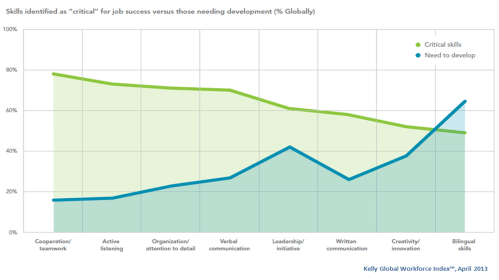
For example, most workers believe they are proficient in critical “soft skills” but Bilingual skills, Leadership/initiative and Creativity/innovation were all seen as needing development. Employees believe this of their skill sets. And most business leaders would not argue with these areas of deficit. Of note, however, is the belief on the part of employees that they have good mastery over the most critical “soft skills.” If true, perhaps learning budgets (such as they are) could be better deployed. If untrue, some challenging performance conversations need to be held!

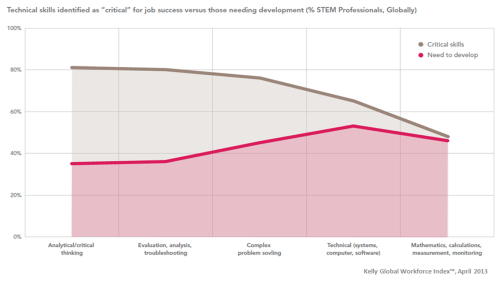
Kelly Global Workforce Index April 2013 Critical SkillsOf course, in terms of the skills gap, most attention is being paid to STEM workers.  Interestingly, these workers believe that their proficiencies in the most important skills sets of Analytical/critical thinking, Evaluation, analysis and troubleshooting, and Complex problem solving are solid (no lack of self-esteem in this group). Where they might need development are in the more complex technical side of things: systems, computer, software and mathematics, calculations, measurement and monitoring.

Kelly Global Workforce Index April 2013 Critical STEM SkillsIf lifelong learning really is the reality, then self-driven learning will be key.

And if self-driven learning is key, then a realistic assessment of current skill levels and actual skill gaps will be critical. For everyone:  employers, employees, learning providers – everyone!

These observations based on their survey responses seem common sense and almost obvious. Almost. I think most business leaders – and HR professionals in particular – would agree with Kelly that skills are no longer front-end loaded onto careers. They’d also agree that most skills have a shelf life.

But it doesn’t appear that we’re approaching the answers to the skills gap as a systemic shift in the nature of careers. We’re approaching it as a simple supply vs. demand dynamic – if we approach it at all. Perhaps this data can shift the conversation and approach to a more useful and motivating discussion:  the nature of careers has shifted and so the nature of education and employment needs to shift as well.

Then we might make actual progress in addressing the perceived mismatch between the jobs available and the skills in the existing talent pool.

2 Comments

Filed under Career Management, China Gorman, Data Point Tuesday, HR Data, Kelly Global workforce Index, Kelly OCG, Skills Gap, STEM

Onboarding: Not Rocket Science

data point tuesday_500

As HR and other leaders grapple with high turnover rates among the Gen Y cohort (see last week’s post here), all kinds of issues get raised. Is the turnover due to “special” characteristics inherent in Gen Y? Is the turnover due to lack of education and training opportunities? Naivete on the part of Gen Y – the world of work doesn’t match their expectations? Could a lack of thoughtful onboarding play a part?

The Aberdeen Group published Onboarding 2013: A new Look at New Hires last month and author Madeline Laurano provides data that might help organizations become more effective in retaining the youngest of their workforce.

First of all, Aberdeen reports that only 37% of employers have invested in a formal onboarding program for longer than two years. Surveys report that it’s difficult to quantify the ROI on formal onboarding programs so “basic orientation” activities are used in substitution. Socializing new hires into the organization’s culture is popular, but hard to measure. And so, “onboarding programs have fallen short and become little more than a transition from recruitment to employee development.” Interesting.

But attention is starting to be paid and, surprise!, it’s all about productivity. One of the quickest routes to ROI is the improvement of productivity and that’s something organizations can measure. Other drivers for looking at new ways to onboard new hires include improving employee engagement, reducing turnover and improving new hire assimilation.

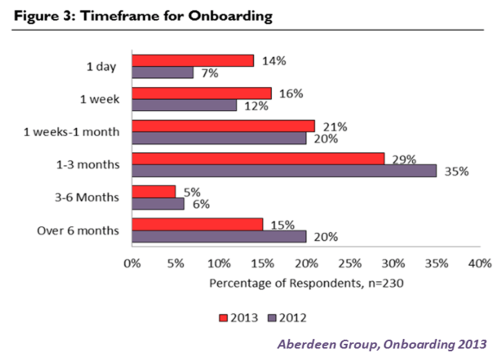
But, as the graph below shows, there’s lots of opportunity to make onboarding programs more robust, strategic and productive by spending more time.

Aberdeen Group Onboarding 2013 Fig 3

And it doesn’t have to be rocket science! The kinds of strategies being used to drive stronger onboarding programs include the following:

  • Creating new hire checklists
  • Introducing new hires to the go-to people
  • Providing forms to new hires before day one
  • Ensuring compliance on all new hire forms
  • Creating peer networking opportunities/events

But the real key appears to be creating a bridge from the candidate experience to learning/development and performance management. After offer acceptance, Best-in-Class employers are more than twice as likely than all other organizations “to integrate data from onboarding into performance management, providing key stakeholders with development plans of new hires and to tie the source of a candidate to their performance as an employee.”

Aberdeen Group Onboarding 2013 Fig 11

But still, only 26% of Best-in-Class employers enroll new hires in learning and development programs compared to 11% of all others. Hmmm….

Laurano concludes the report with recommended actions for employers in Best-in-Class, Average and Laggard categories. For the Average and Laggard categories they are not rocket science. For the Best-in-Class category, a little rocket science might be involved.

Laggard Steps to Onboarding Success

  • Establish a clear owner
  • Provide strong visibility
  • Extend the onboarding process

Industry Average Steps on Onboarding Success

  • Align onboarding with learning initiatives
  • Define metrics in advance
  • Invest in onboarding technology

Best-in-Class Steps to Onboarding Success

  • Consider gamification
  • Include cross-boarding
  • Balance tactical and strategic elements

Think about these as you and other leaders in your organization wrestle with the high turnover rate in your Gen Y employees. And take a look at this report.

Aberdeen Group reports are very easily consumed. They’re written in normal English and have an easy to understand structure. Even if you can’t spend real money to make your onboarding program more productive, you can certainly get smarter about what works and make some adjustments based on data to improve your outcomes. That’s the whole point of research, right?

6 Comments

Filed under Aberdeen Group, Candidate Experience, China Gorman, Data Point Tuesday, Gen Y, HR Data, Onboarding, Turnover

Gen Y’s Self-fulfilling Prophecy

data point tuesday_500

Accenture recently published its 2013 College Graduate Employment Survey Findings. Lots of great data. Especially if you plan to hire recent college grads. In fact, some of the data are surprising.

One of the important takeaways is that employers have unrealistic expectations for the skills of the hires they make out of college. They think these young people should be able to hit the ground running and are surprised and disappointed when they don’t. And to compound the problem, these employers are not investing in training initiatives to get the newly hired up to speed in the short term or effective in the long term. This is all pretty logical. It’s good data and if you plan on hiring entry level employees from the ranks of the newly graduated, you should read this.

But here’s what caught my attention. It’s about the willingness to commit. And it isn’t the first time I’ve seen data like these.

Young people, entering the economy for the first time, want to commit to their employers. It’s not what we expect, I know. We expect these youngsters to be gone in the career equivalent of sixty seconds. And sometimes they are. But it’s important to know that that isn’t what they want! This isn’t what they expect!

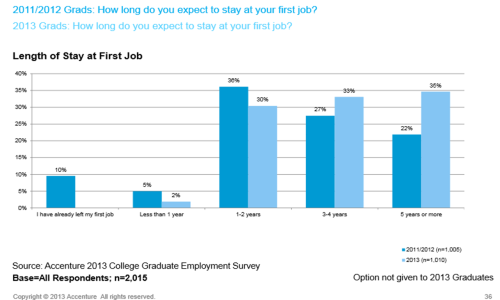
From Accenture:  The class of 2013 is expecting more career longevity from their first jobs:  68% of pending 2013 college grads expect to be at their first job more than 3 years compared to 49% of 2011/2012 college grads.

Accenture career longevity in first jobs 2013

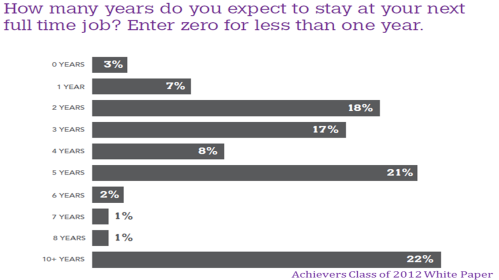
And from the Achievers Class of 2012 white paper:

Achievers Class of 2012 White Paper

In this survey, more than 70% of 2012 college graduates expected to be with their first/next employer 3 years or longer — and 48% expected to be with their first/next employer 5 years or more. Surprising, right? Not what we expect, right? Not what we “know” about Gen Y, right?

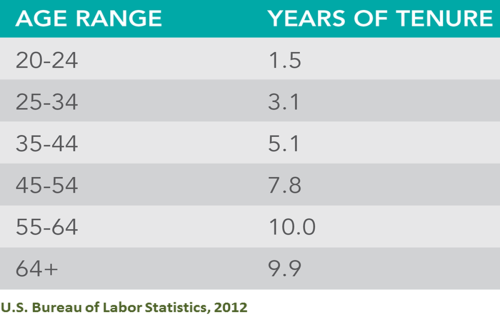
But the BLS shows us what happens once they join our organizations:

BLS years of tenure by age

So, young people entering the economy for the first time with a newly minted degree are filled with optimism and have every intention of committing to their first employer for 5 years or more. Is it naivte or is it a real desire to commit, belong and make a difference?

And what happens once they start that first job that impels them out the door in 18 months or less?  Are employers so inept at selection that they really can’t hire employees that will persist? Are young people so naïve that they don’t really know what they’re signing up for and leave when reality doesn’t match expectations? Or, as the Accenture survey suggests, are young people disappointed when expected training and development doesn’t materialize and they leave in search of greater learning opportunities?

Clearly this is a complex issue with lots of dynamics, as the Accenture survey results show. However, if we started with the belief and understanding that young people really do want to engage and commit to their employer, would we be more likely to invest in developing their skills?

If we started with the belief and understanding that young people really do want to engage and commit to their employer, would we create onboarding processes that ensure expectations – on both sides – are being understood and met?

If we started with the belief and understanding that young people really do want to engage and commit to their employer, how would we approach them differently?

I suspect that most employers believe that there’s no return in investing in a talent pool that will be gone in 60 seconds.

I further suspect that the EVP that is sold in the recruiting process doesn’t exactly come to life once the recruit joins the organization.

But I suspect that the real issue is that Gen X and Baby Boomer managers, supervisors and recruiters believe all the negative stereotypes about Gen Y and their lack of commitment to any agendas other than their own — despite multiple data sources that show just the opposite. And we’ve ended up in this tough reality that has become a full-fledged self-fulfilling prophecy.

11 Comments

Filed under Accenture, Achievers, Baby Boomers, Bureau of Labor Statistics, China Gorman, Data Point Tuesday, Employee Value Proposition, Gen Y, GenX, HR Data, Turnover, U.S. Department of Labor

Recruiting and Social Networking

data point tuesday_500

SHRM (Society for Human Resource Management) debuted some new survey data at their recent Talent Management Conference in Las Vegas. Published on April 11th, Social Networking Websites and Recruiting/Selection is interesting. And some of the data may not be what you think.

Employers use social networking sites during the recruitment process as tools to recruit candidates who might not normally apply. Expanding their reach to passive candidates, candidates with specific skill sets and candidates in specific geographies, recruiters seem to be very strategic in their use of social networking tactics and sites. I’m not surprised by these data.

Here are some of the findings I found a little surprising:

  • More than half (57%) of employers do not have a formal or informal policy on screening candidates via social networking sites.  

Really? In this age of increasing regulation and compliance, the majority of employers don’t have a policy about using social media to screen candidates? No guidance for recruiters? No guidance for hiring managers? I wonder if this is an “ignorance is bliss” approach or a calculated “we already have policies covering the use of social media at work” approach.

  • Employers that have policies on screening candidates are evenly split (21% each) in allowing or prohibiting the use of social networking sites for screening purposes.

This fascinates me. And it bears watching. There are legal dangers in the offing. Court cases are starting to decide the legal issues involved in using social media sites for applicant screening. And recruiters and HR pros don’t want to end up on the wrong side of this one.

  • About two-thirds of employers never have used or no longer plan to use social networking sites (69%) or online search engines (65%) to screen applicants.

This makes sense given the regulatory environment HR deals with today. And the fact that the courts are just starting to address these issues. However, it’s entirely unrealistic to believe that hiring managers aren’t using social networking sites to screen applicants. I believe that HR isn’t. I don’t believe that hiring managers aren’t.

  • 41% of employers target executive/upper management (e.g. CEO, CFO) when searching for candidates on social media.

This is really surprising and could spell doom for the executive recruiting industry. I would have expected a much smaller percentage of employers would use social networking sites for the recruitment of executives since it’s assumed that most employers turn to executive recruiters to find executive talent like CEOs and CFOs. If the use of social networking/media sites for executive hiring gives employers confidence to recruit executives on their own, a major shift in the executive hiring dynamic could be underway.

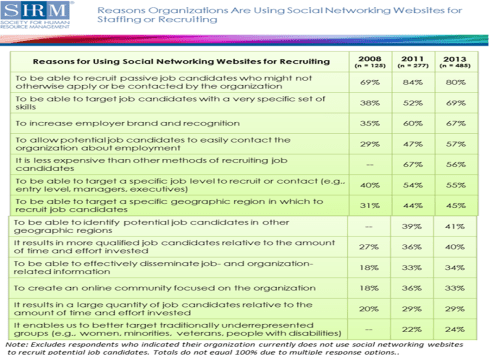
I was also interested in the differences in the survey question answers between 2008, 2011 and 2013.  Not only are the percentages changing, the number of respondents is growing, which I believe means that social media is being integrated into more nooks and crannies of HR. Take a look:

Social Networking Websites and Recruiting Selection SHRM 2013

This is interesting on lots of levels. And I look forward to continued growth at the intersection of HR and social technologies.

Hopefully SHRM will field this survey again in 2 or 3 years.

9 Comments

Filed under Candidate Screening, China Gorman, Data Point Tuesday, HR Data, Recruiting, SHRM, SHRM Survey Results, Social Media, Social Networking, Social Technology

You Think We Have Skills Shortages Now? Let’s Talk in 2020!

data point tuesday_500

Skills shortages in 2020 will rise to an entirely new level. And I’m not talking about STEM skills, although they’re critical. Or the ability to speak multiple parched earthlanguages, which needs to be more common in the U.S. Or even the readiness of college graduates to take a place in the economy, which a majority of employers report is lacking.


I’m talking about the skills that the globally-connected, superstructured, computationally focused, smart-machine powered organizations of the future staffed by longer living and working, new media using employees will require.

We’re all thinking about that right? We’re re-writing job descriptions and re-wording job postings to incorporate the emerging skills we know we’ll need. Aren’t we? Well, maybe not. We know the names of the skills we can’t get today – those STEM, analytical thinking, communication and personal responsibility/accountability skills we’re sure our young people don’t have.

But really. What about the skills for the future?  I’m not sure what we’ll call those skills. I’m not even sure they’re skills, to be honest, but here’s what I do know:

  • People are living longer and will want/need to have longer careers
  • Smart machines are taking over the most routine workplace tasks
  • Data – big, medium and small – are changing the way decisions are being made at every organizational level
  • Text isn’t the only way we communicate any more
  • Organization structures and behaviors are changing due to social technologies
  • We say “Global” but what that really mean is that innovation and growth will be primarily driven through the integration of differing cultural norms and diversity

IFTF LogoThe Institute for the Future’s Future Work Skills 2020 highlights recent research that predicts the kinds of skills for which we’ll be recruiting in 2020 (which is only 6 and-a-half years away). Trust me when I write that the majority of HR/recruiting professionals are not ready for this. ATSs aren’t ready for this. LinkedIn, Facebook and Twitter aren’t ready for this. And clearly, our education infrastructure isn’t ready for this. And yet, here we are.

The IFTF identifies and defines ten skills that we need to begin to teach now so we can deploy them in six-and-a-half-years.  They are:

  1. Sense-making:  the ability to determine the deeper meaning or significance of what is being expressed
  2. Social Intelligence:  the ability to connect to others in a deep and direct way, to sense and stimulate reactions and desired interactions
  3. Novel & Adaptive Thinking:  proficiency at thinking and coming up with solutions and responses beyond that which is rote or rule-based
  4. Cross-cultural Competency:  ability to operate in different cultural settings
  5. Computational Thinking:  the ability to translate vast amounts of data into abstract concepts and to understand data-based reasoning
  6. New-media Literacy:  the ability to critically assess and develop content that uses new media forms, and to leverage these media for persuasive communication
  7. Transdisciplinarity:  literacy in and ability to understand concepts across multiple disciplines
  8. Design Mindset:  the ability to represent and develop tasks and work processes for desired outcomes
  9. Cognitive Load Management:  the ability to discriminate and filter information for importance, and to understand how to maximize cognitive functioning using a variety of tools and techniques
  10. 10.   Virtual Collaboration:  the ability to work productively, drive engagement, and demonstrate presence as a member of a virtual teaSocial intelligence (we call it EQ today, I think) and Cross-cultural Competency are certainly emerging in more sophisticated and global organizations currently. Perhaps we have a leg up with these two.

But have you ever seen a job description requiring Transdisciplinarity and a Design Mindset?

What kind of behavioral interview questions would you use to determine if a candidate has Cognitive Load Management and Novel/Adaptive Thinking Skills?

How would you Tweet those jobs? How would your careers page change?

And once onboard, how would you manage the performance of employees’ Virtual Collaboration and Sense-making?

And speaking of job descriptions and performance management, how will New-media Literacy and Social Intelligence change the very nature of these processes?

Whew! We think the current skills shortage is frustrating and scary. It could be that the future skills shortage will upend everything!

6 Comments

Filed under Annual Performance Reviews, China Gorman, Data Point Tuesday, Hiring Difficulty, HR Data, Institute for the Future, Performance Management, Skills Shortage, STEM, Workforce Skills

HR Priorities and Business Value

data point tuesday_500

SHL has published their fascinating yearly report on global assessment trends.  SHL, acquired last year by CEB, is an assessment company, so reporting SHL Logoon assessment trends is right up their alley.  The survey data are interesting and the conclusions are worth noting by anyone in HR.

But their questions and conclusions go way beyond the use of assessment instruments for employment selection and employee development strategies and practices.

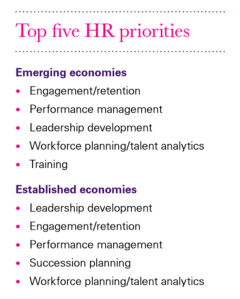
SHL Top 5 HR Priorities 2013The first part of the report reviews  organizations’ talent management focus and landscape.  For example , the authors compare the top five HR priorities in emerging economies to the top 5 HR priorities in established economies.

The lists are similar but not identical. You can see that four of the priorities show up on both lists, although prioritized differently; and that succession planning shows up in the top 5 on the established economies list, while training shows up in the top 5 on the emerging economies list.

Other findings relate to HR’s use of big data and the perception that there is room for improvement around the world in using objective data to make workforce decisions. In fact, less than 25% of the survey respondents reported that their organizations have a clear understanding of workforce potential.

The second part of the report focuses on the assessment of talent – both for hiring and for employee development.  Interesting findings in this section include the desire by nearly 75% of respondents to improve talent measurement and the practice of linking pre-hire and post-hire testing to specific business outcomes.

The third part of the report focuses on technology in testing, with a specific focus on mobile devices and social media. The key findings here include data showing that emerging economies want to use mobile technology assess candidates – both recruiters and candidates want this capability; and social media data is becoming less critical to hiring decisions. (See last week’s Data Point Tuesday.)

The report concludes with four recommendations for HR in 2013:

  • Big data presents HR with a unique opportunity to demonstrate business value

  • Only the right data will lead to the success of talent initiatives

  • HR should embrace innovation that improves how talent is recruited, but with caution

  • Mobile technology should be considered for competitive advantage, not to follow the crowd

The data in this report are presented in a way that is easily understood and useful.  At 30 pages, it’s worth the 45 minutes it will take to scan it and then hone in on the impactful sections.  I especially appreciated the selected references at the end, as well as the key findings lists from the same survey reports for 2009 – 2011. I’m always interested in the evolution of these kinds of lists.

But the bottom line for me is that here’s yet another source of global HR data shining a light on HR’s need to figure out how to demonstrate its business value. Whether you prefer this report to others you’ve discovered here at Data Point Tuesday — or you prefer other sources of HR data and analysis, the drum beat is the same:  aligning HR strategy (and tactics) to business outcomes is the only way to demonstrate business value. And the only way for HR professionals to be seen as business leaders.

1 Comment

Filed under Big Data and HR, China Gorman, Data Point Tuesday, Employment Screening, HR Data, SHL, Talent Assessment, Talent Management

Sources of Hire: Is Perception Reality?

data point tuesday_500

Along with Quality of Hire, Source of Hire is starting to take center stage in the talent acquisition world. The annual report tracking and analyzing Source of Hire from CareerXroads is out today.  Sources of Hire 2013:  Perception is Reality contains truly interesting data – understandable and actionable.  And the authors ask some really important questions about B2D (Big Bad Data) and how to measure the pre-application talent supply chain.

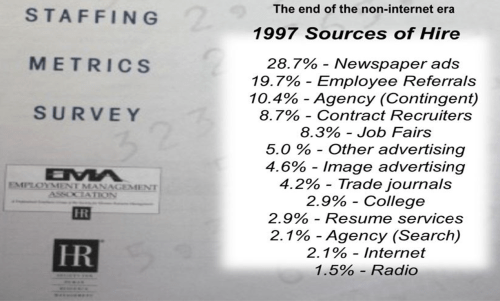
Early in the whitepaper, Gerry Crispin and Mark Mehler, the principals at CareerXroads, show the following chart of source of hire data from 1997 – collected by SHRM and EMA (now part of SHRM).

Sources of Hire 1997

Talk about a blast from the past! Newspaper ads generated the most hires at 28.7% of hires and Agencies – both contingent and executive search – generated 12.5% of hires. My how the world has changed.  Here’s the 2012 data:

2012 Sources of Hire

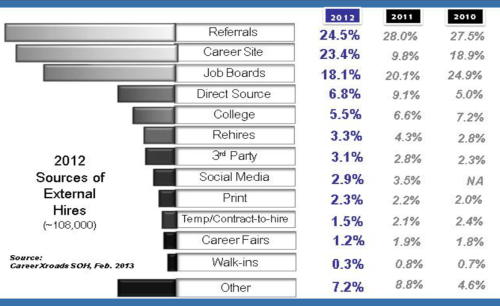
Print has fallen from a combined (newspaper and trade journals) 32.9% to 2.3%!  “Internet” has grown from 2.1% (had Al Gore even invented the internet in 1997?) to a combined (career site, job boards and social media) 44.4%!

There is a lot in which to be interested in comparing these two charts, so have fun.

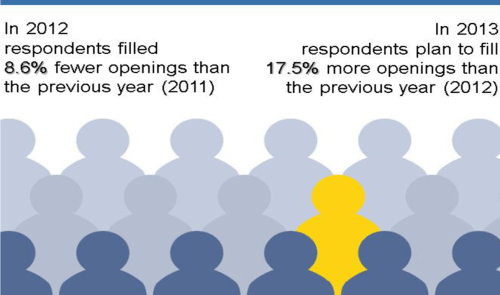
There nuggets of pure gold in this whitepaper.  Two in particular stood out to me. The first is the expectation for increased hiring in 2013.

Total Hires 2013 Source of Hire

If true, we’re about to see a whole lot of domestic hiring!  The national hiring figures are trending slowly upward, but at the same time we read in the press that the implementation of the new health care rules is retarding hiring in the small business sector, the sector credited with being the job creation “engine.” This will be interesting to watch. Will the need for growth overcome the risk and costs associated with that growth?

The second nugget is the reminder that the source of the majority of hires is the pool of existing employees.

Internal Movement Source of Hire

The whitepaper accurately points out that internal movement and promotion are higher during difficult economic periods – and this is evident in the graph above.  However, a steady increase in this category may also be due to the perception of a growing skills scarcity in the outside talent market.

Enjoy the whitepaper. And begin to ask yourself some of the questions posed by Gerry and Mark.  Questions like…

  • How comfortable are you defending the 2013 plan for your budget, recruiters, technology tools, partners, vendors, training and your sources to your peers and colleagues?

  • How much should your 2013 recruiting strategy include improving your collection and analysis methods?

  • Are referrals the best source of hire?

  • What “Sources” interact with each other the most?

  • How can I collect Source of Hire data?

4 Comments

Filed under CareerXroads, China Gorman, Connecting Dots, Data Point Tuesday, Gerry Crispin, Hiring, Hiring Difficulty, HR Data, Mark Mehler, Quality of Hire, SHRM, Source of Hire, Talent Acquisition

The Tip of the Engagement Spear

data point tuesday_500

BlessingWhite’s Employee Engagement Research Update has recently been released.  It’s an update to their massive research published in 2011. Measuring engagement is tricky – from gaining consensus on terms and definitions, to crafting survey questions that generate useful answers, to identifying key findings, to agreeing on recommendations – it’s all very tricky.

BlessingWhite does a good job managing the trickiness.  But truthfully, there’s not a lot of difference in engagement scores globally since their 2011 findings.

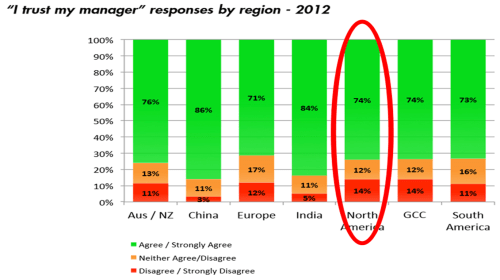
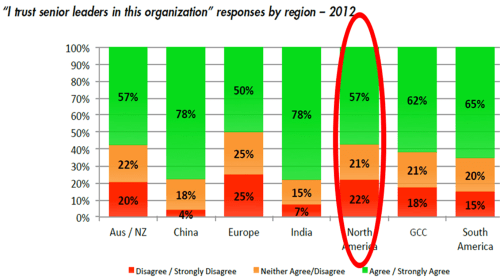
Here’s what caught my attention, though, as it did 2 years ago, as I read through the report:  a greater percentage of the workforce trust their managers more than they trust the executives in their organizations.

This makes sense, right? Managers have day-to-day interaction with their colleagues and can get to know them in personal ways. Executives, on the other hand, rarely have one-to-one interaction with the majority of the employees their organization. And the survey results show the difference in trust levels.

I trust my manager BW 2013

I trust senior leaders BW 2013

It’s a good thing that employees in North America trust their managers more than they trust their senior leaders because there’s a high correlation between engagement and trust in managers. Or maybe it’s the other way around.  Either way, BlessingWhite points out that while engaged employees have other factors that motivate them – like interesting work, a sense of contribution and career aspirations – less-engaged employees are far more dependent on knowing their manager personally to reach higher levels of engagement.

This makes managers the tip of the engagement spear. And why we spend so much time focused on managerial effectiveness in almost every category of performance.

Not so with senior leaders, which is understandable because they don’t have the ability to interact personally with every employee, as BlessingWhite points out.  But they do have the responsibility to set the direction of the culture, communicate that direction with a “clear line-of-sight” throughout the organization, and create a culture that fuels engagement and business results. In other words, set the managers up for success in engaging their teams in more personal ways.

The CASE model, reviewed briefly at the end of the report, focuses senior leaders to fulfill four key workforce needs in building and leading their cultures:

  • Community for a sense of belonging and purpose
  • Authenticity  as a basis for trust and inspiration
  • Significance to recognize individuals’ contributions
  • Excitement to constantly encourage – and raise the bar on – high performance

It’s a good message for executives. It’s a great message for managers. It’s a call-to-action message for HR to know how to help executives drive performance and grow their culture while supporting managers to make more personal connections.

Engagement isn’t the answer to every organizational challenge. But it does seem clear that highly engaged workplaces are more productive than less engaged workforces. And almost every organizational challenge I can think of gets solved more effectively and faster with an engaged workforce working the solution and being led by managers who are personally leading the way.

8 Comments

Filed under BlessingWhite, China Gorman, Connecting Dots, Data Point Tuesday, Engagement, HR Data, Managerial Effectiveness, Workforce Management