The Employee Recognition Landscape is Changing

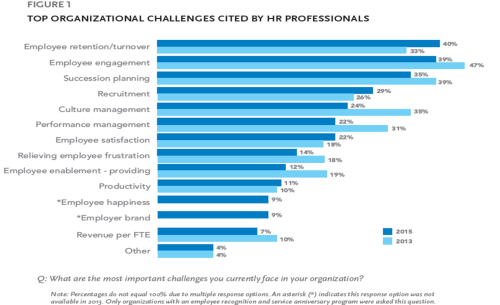
data point tuesday_500The fifth research report in an annual partnership between SHRM and Globoforce was published this week. And, interestingly, there is a surprise. Namely, that retention/turnover is the top challenge reported by nearly 1,000 SHRM members. This is a surprise top challenge compared to the last 2 years – and it makes sense. With the economy and hiring improving, businesses are wise to become concerned that the “grass is greener” syndrome may take hold of their very best employees. The employees who are super marketable as job opening grow.

(In full disclosure mode, I should mention that I am the former Chief Operating Officer of SHRM and am currently Chair of Globoforce’s WorkHuman advisory board.)

In 2013 and 2012, the SHRM/Globoforce surveys identified employee engagement and succession planning as the topmost HR concerns. Perhaps the fact that retention/turnover are the top concerns is fueling the fear of escalating talent wars due to economic growth, demographic shifts, globalization and a workforce that believes they can have it all: meaningful work, career growth, leaders they trust, equitable pay and appreciation for their efforts.

The concern for employee engagement is down with 47% of respondents citing it as a top challenge compared to 39% in 2014. That’s a big delta. And potentially a big deal.
GloboforceSHRM June 23 2015The other surprise for me in the survey results is the data-backed understanding that values-based employee recognition is seen as contributing significantly to bottom-line organizational metrics. This is surprising for two reasons:

  1. The culture conversation is becoming rooted in values, and
  2. HR organizations are using data to create business cases for culture/values as a quantifiable business imperative.

The strength of values-based recognition behaviors and programs is growing:
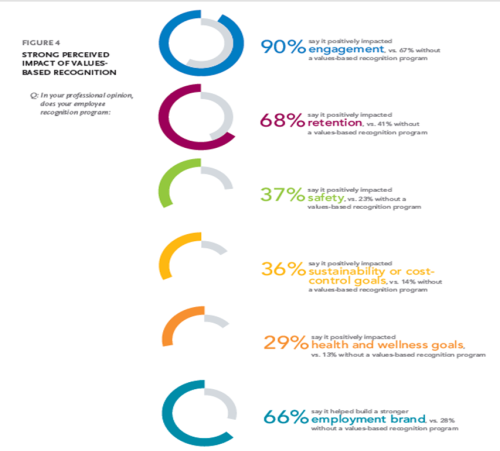
GloboforceSHRM 2 June 23 2015Tying employee recognition to organization values seems a no-brainer and the data are proliferating that building employee programs and leadership behaviors on foundations of values-based culture are not only winning the war for talent, they are winning the competitive wars for revenue and growth, innovation, collaboration, and profitability.

The report is a fairly quick read and if you’re interested in learning about how recognition, values and culture are impacting the workforce today, the nearly 1,0000 SHRM members who took the survey have interesting insights to share.

3 Comments

Filed under China Gorman, Data Point Tuesday, Employee Engagement, Employee Recognition, Globoforce, Organization Values

Business Resilience and Freedom

data point tuesday_500

Creating a great workplace culture that is employee focused is hard. Worthwhile and hard. Creating a freedom-centric culture is also worthwhile. And even harder, because it is focused not just on creating a culture that is based on trust, it is focused on creating a culture without fear.

WorldBlu, is an organization dedicated to developing world-class freedom-centered (rather than fear-based) organizations and leaders. Their vision is to see one billion people leading and working in freedom. Founder and CEO Traci Fenton has spent 20 years studying the effects of freedom in organizations and has come to agree with leading thinkers and scholars like Warren Bennis, Philip Slater, and others, that democracy in the workplace is inevitable because “it is the most efficient social system in times of unrelenting change.”

Traci and her team have just published the results of some interesting analysis in a report titled, Freedom at Work: Growth & Resilience An empirical analysis of how freedom and democracy in the workplace impact business performance. If you’re convinced, as I am, that corporate culture impacts business performance, then this analysis will be of great interest.

Each year since 2007 WorldBlu™ has published its list of Most Freedom-Centered Workplaces™. In that time, more than 130 companies in every industry that range in size from 5 to more than 60,000 employees from all over the world have met the standard to become WorldBlu™ certified. Companies like DaVita, Menlo Innovations, Glassdoor, WD-40, Great Harvest Bread Company and, yes, Zappos, all proudly claim to be cultures free from fear.

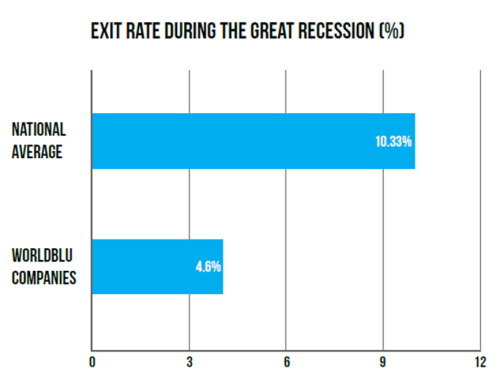
This report, Freedom at Work: Growth & Resilience, looks at WorldBlu™ certified companies and how they fared in terms of s growth and survival during and after the Great Recession of 2007. The data are impressive. S&P listed companies’ revenue growth rate during the 3-year period of 2010 – 2013 – the end of the downtown and beginning of the recovery paled in comparison to WorldBlu™ certified companies during the same period.

June 16 2015 WorldBlu 1Additionally, the exit rate of WorldBlu companies during that same time period was less than half the national average.

June 16 2015 WorldBlu 2As the report states, 2007 – 2011 were bleak years for businesses and their employees. And many businesses around the world failed, closed their operations or sold out. Case studies from Menlo Innovations and DaVita are fascinating examples of organization leaders who take their commitment to culture several steps further than creating trust between leadership and employees. They truly approach their entire ecosystem in a democratic fashion and the results were significant. Take a look.

Leave a comment

Filed under China Gorman, Culture, Data Point Tuesday, Freedom at Work, Traci Fenton, WorldBlu

Working in the “Gig Economy”

data point tuesday_500

Last week I introduced you to Mary Meeker’s Internet Trends 2015 report which I suggested should be required reading for HR. This report, which really should have been titled, The Internet in 2015 Is All About HR, shared important data points and analysis relating to basic HR functions and the impact the internet is having on basic organization functions.

This week, I’d like to point out the McKinsey Global Institute’s new report, A Labor Market That Works: Connecting Talent With Opportunity in the Digital Age. Even if you only the read the Executive Summary, this is worth your time. It’s full of employment-related data from the major global economies as it links those statistics to the growing impact of online talent platforms – and their potential, in the gig economy, to transform both the employer/employee relationship and how workers find work and build economic opportunity. It’s important information and their analysis of (mostly) Linkedin data are arresting.

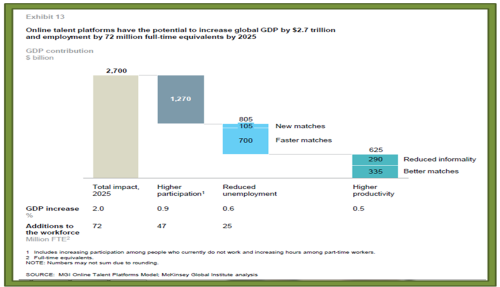
The report is organized into three broad topics: Better, fast matching; Economic impact; and Talent management for companies. All three topics could sustain a full report on their own, but I’ll focus on the second: Economic impact. The gig economy powered by online talent platforms, by their analysis, will be contributing $2.7 trillion to global GDP by 2025. They do the math by analyzing three channels of impact:

  • Increasing labor force participation and hours worked among part-time employees
  • Reducing unemployment
  • Raising labor productivity

McKinsey Exhibit 13 June 9 2015

This adds 72 million workers to the global workforce and adds a full 2% to the projected world GDP for 2025. The largest impact, $1.3 trillion, come from great labor participation and more hours worked. Shortening job searches and creating matches that would not have been otherwise will lower unemployment rates, creating the second biggest impact at $805 billion. The third biggest impact is the increase of productivity through higher quality job matches and a shift to formal employment from informal grows global GDP by $625 billion.

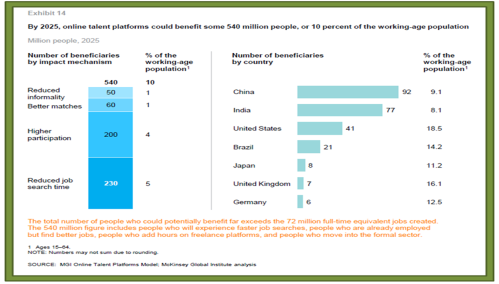
But their analysis also shows that the positive impact of the gig economy is greater than dollars as 540 million people (nearly 70% more than the current population of the United States) will benefit from these new ways of connecting workers to work. That’s big, right? And that’s only 10 years from now.

McKinsey Exhibit 14 June 9 2015

As an HR leader, are you concerned about the talent pipeline? Having trouble filling your current open positions? Wondering if the use of internet based solutions will produce better results? The real question may be, “how fast can I start implementing online talent platform solutions in order to connect workers to the work we have available?”

The report continues to make the economic case for the positive impact of internet enabled platforms by predicting their use could reduce public spending on labor market programs, allocating as much as $89 billion/year from unemployment benefits savings to education and vocational training programs to ensure a skilled talent pipeline. McKinsey also predicts that online talent platforms may increase innovation, strengthen productivity and generally “improve the development of human capital across economies.”

This is Big Data at its best: boiled down to useful constructs. The full report is 100 pages. I recommend that you download it and take it section by section. I think you’ll be glad you did.

1 Comment

Filed under Analytics, Big Data and HR, China Gorman, Data Point Tuesday, Gig Economy, HR Analytics, HR Data, McKinsey, Online Talent Platforms

Required Reading for HR: Internet Trends 2015

data point tuesday_500Really. I’m not kidding. You may think from the title that Internet Trends 2015 is a report that has nothing to do with Human Resources. You couldn’t be more wrong. It’s ALL about HR. And how nearly everything about business, work and the employer/employee relationship is changing because of what the internet enables.

The report, prepared by Kleiner Perkins Caufield & Byers’ Mary Meeker for this year’s Code Conference, presents the 2015 Internet Trends report, 20 years after the first The Internet Report was published in 1995. You’ve probably heard about this year’s report because every journalist in the world was agog at one piece of data: how Millennials relate to their smartphones. Everyone now knows that 87% of Millennials in the U.S. report that “my smartphone never leaves my side, night or day.” That’s one of several data points on one page of a 196 page report. And while interesting, it is among the least interesting data points in the report. I promise.

But first. You need to know some definitions to get the full value of the report. Here are a few terms and acronyms you should – and probably already – know:

  • MAU = Monthly Active Users (how many users are on an application at least once a month)
  • DAU = Daily Active Users (how many users are on an application at least once a day)
  • Y/Y = Year over Year (compares results from two consecutive years)
  • API = Application Programming Interface (how programs/apps connect to each other)
  • GDP = Gross Domestic Product (total value of goods and services produced by a nation)
  • GMV = Gross Merchandise Value (total sales value of merchandise sold through an internet channel)
  • VoIP = Voice over Internet Protocol (Skype would be a good example)

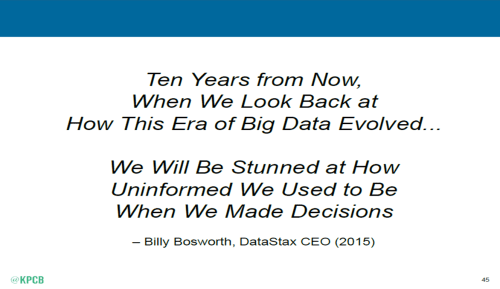
This report hits on all of HR’s buttons with high impact data: the nature of work, the job market, benefits, age demographics in the workplace, freelancers, government benefits, union participation, employer retirement plans, healthcare, the impact of drones on work, what’s happening in China and India and more. All in a report about internet trends. And almost every page is a data-rich picture of how things are changing. This might be my favorite page because it is the continuous thread of everything else discussed in the report:

KPCB 2015 Trends 2

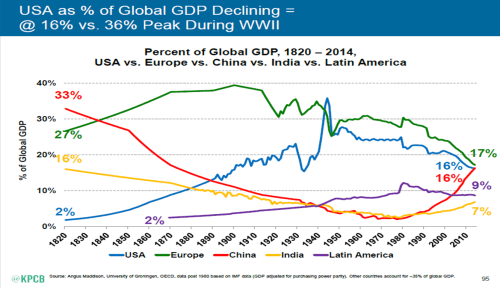
And this might be my favorite chart because the impact of the data here fuels most everything else mentioned in the report. The connections between economic growth/decline, demographic changes, the internet and business impact every HR person everywhere, every day. Everywhere. Every day. This report shows these connections clearly.

KPCB 2015 Trends 1I’d like to make this report mandatory reading for all HR professionals. If you’re having a hard time grasping what the opportunity really is for HR to keep ahead of the profound changes happening all around us, this report will help you understand. Read it. Discuss some of the findings (pay particular attention to the section at the end, Ran Outta Time Thoughts) in staff meetings and with other leaders in your organization. Develop a point of view about how internet trends are impacting your organization and your people, and begin to strategize responses that will work for your business and your people. You must.

And oh yes, read this report.

6 Comments

Filed under #HRTechTrends, China Gorman, Data Point Tuesday, Employee Demographics, GDP, Human Resources, Internet Trends, KPCB, Mary Meeker

I’m Not Your Mother!

data point tuesday_500Some things are simple. Some things are complicated. And some things that seem simple are actually pretty complicated. For example, it seems like a simple observation that happy employees are better employees. And, in fact, data abound to prove that point. But how to get happy employees is a little more complicated.

Early in my career as a business leader I always believed that people were my critical competitive edge and that creating a strong, caring culture was my job. But happiness? Come on. I wasn’t my employees’ mother. The nature of the employer/employee relationship, I believed, was a commercial relationship. Employees come to work, do a good job and I pay them. The more I could remove obstacles from their ability to do good work, the more I could offer development and thanks for a job well done, the better they performed. It wasn’t rocket science. Treat people well and they’ll treat your employees well. I got that. But trying to make them happy? I didn’t think that was part of the deal. (And I was a pretty effective business leader.)

But as I matured as a leader, I did begin to wonder about this notion of working to create happiness at work. I spent some time at Zappos – a culture whose leader is all about making his workforce happy. And while the Zappos culture wouldn’t be a fit for me, it worked for them. And they were happy. Really happy. And their business results were such that they could sell the business to Amazon for over $1 billion.

And then I became CEO of the Great Place to Work Institute and was covered over in data that prove a direct line from employee well-being to financial performance. And so while early in my career the notion of employee happiness didn’t register as a leadership imperative, I now believe that creating a culture that, in Tony Hseih’s words, delivers happiness to employees is quite clearly a practical and effective way to achieve top line growth, profitability, customer loyalty and, most importantly, employee loyalty.

In preparation for the Globoforce WorkHuman Conference in a couple of weeks, I was reading up on employee happiness and ran across one of their white papers, The Science of Happiness. It’s a quick read and makes some rather simple but profound points backed up by reliable data.

Here are 6 reasons why you want happy employees based on research from the Wall Street Journal and the iOpener Institute. Happy employees:

  • Stay twice as long in their jobs as their least happy colleagues

  • Believe they are achieving their potential 2x as much

  • Spend 65% more time feeling energized

  • Are 58% more likely to go out of the way to help their colleagues

  • Identify 98% more strongly with the values of their organization

  • Are 186% more likely to recommend their organization to a friend

Download the paper. It’ll take you less than 10 minutes to read and will give you some simple ideas to begin to see the benefits of focusing on employee well-being and happiness. And then join me at the WorkHuman Conference June 8-10 in Orlando and let’s talk about happiness, gratitude, culture, and employee and organization success.

2 Comments

Filed under China Gorman, Culture, Data Point Tuesday, Globoforce, WorkHuman, Zappos

Where Do Candidates Come From?

data point tuesday_500 There is a robust conversation in the talent arena about “candidate experience” led largely by Gerry Crispin and Elaine Orler, founders of the Talent Board and the Candidate Experience Awards (#CandE). There are lots of opinions about whether ensuring that candidates for hire have a high quality experience is meaningful. Some think the juice isn’t worth the squeeze. But I think most believe treating candidates like consumers is smart business. Two new vendor publications discuss aspects of candidate experience:

  1. Creating a 21st Century Application Process from RolePoint, and
  2. Beyond Employees: Employee Referral Programs Redefined from Smashfly

Both reports were published within the last month and contain analysis of current data. The Rolepoint whitepaper was written by global recruiting legend Bill Boorman. It highlights Intuit’s approach to embracing a social approach to the apply process, with a particular focus on making the application process streamlined and device agnostic “with equal attention paid to user experience and interface on both desktop and mobile.” Bill is a legend for a reason and his approach to this topic in the whitepaper is compelling. The Smashfly presentation provides insight into the employee/candidate referral landscape with some interesting data:

  • 77% of organizations currently have a formal referral program

  • 32% of new hires come from referrals on average, and rate highest in quality among sources of hire

  • 57% of organizations limit their referral program to employees only

  • 43% extend their program beyond employees to include alumni, contractors, customers, vendors and/or partners

  • Analysis shows those that reach beyond employees get 28% more hires from referrals and 8% better quality candidates

This survey data is interesting, and I key in on the 4th bullet. Extending referrals into other stakeholder groups makes a great deal of sense – and correlates to higher quality candidates. Take a look below: Smashfly May 19 2015 If you’re in the 23% of employers without a candidate referral program, this might be a wake up and smell the coffee moment. If you’re in the 57% of organizations limiting referrals to employees only, this might be a pedal to the metal moment. Either way, whether you’re recruiting programmers, developers, customer service agents, nurses, marketers, HR professionals or executives, approaching your trusted partners – including employees – for referrals makes good, logical sense. And treating potential candidates like consumers, that is, making it as easy for them to press the “apply” button as it is to press the “buy” button seems like a tenant from Econ 101. Check out these reports from Rolepoint and Smashfly.

1 Comment

Filed under Bill Boorman, Candidate Experience, China Gorman, Data Point Tuesday, Elaine Orler, Employee Referrals, Gerry Crispin, Rolepoint, Smashfly, Talent Acquisition

HR Tech Implementations or Business Tech Implementations?

data point tuesday_500Last month I wrote about the inaugural report issued by the analysts at KeyInterval Research. (You know them as John Sumser and William Tincup.) They have an ambitious research publication agenda – one report a month. And here’s why I like what John and William are doing:

KeyInterval is an experiment. It is our goal to stay experimental for the life of the company. With each new report, we’re experimenting with survey methodology, data sourcing, data screening, the mix of qualitative and quantitative information, and the edges of HR Technology practice. It is a search for standard practices. We are more interested in what practitioners do than what some self-appointed guru thinks they should do. Our goal is to understand the actual experience of the people who use HR Technology.”

There is little independent information about what actually works in the HR tech space outside of vendor sponsored information, that I find their approach refreshing and really useful. Their second report has just been released and it’s another really interesting look, this time at how organizations successfully implement HR technology. The report, Successful Implementations, reveals exactly how successful HR technology implementations happen. If you’ve got an implementation in your future, these findings would be a wise investment.

As with their previous report, Successful Implementations is organized in a way that makes the findings practical and easy to consume. It defines what an implementation is, gives an overview of the important insights and major findings, analyzes qualitative conversations with HR leaders, picks the right data points to share, exposes commonly held myths, identifies notable vendors and shares the study’s methodology. The piece de resistance is the quick Pocket Guide: Successful Implementation Checklist.

Here’s a quick overview of one of the data sets that might be interesting to you:

KeyInterval May 12 2015

I’m interested in all these points, but the first really speaks volumes to me. HR leaders who have sponsored successful HR technology implementations prioritize the fundamental aspects of the projects as:

  1. Quality (user satisfaction)
  2. Cost
  3. Speed

I like the order of these priorities. Putting the user (employee) experience first is just where I’d want HR to be. Putting cost second, means that fiscal responsibility is critical. Ranking time to completion third shows an operational understanding that I like. Together these show enormous business acumen. Perhaps one of the reasons their HR tech implementations have been successful is that the HR leaders on point are really business leaders first and HR leaders second. Perhaps these were more Business Tech than HR Tech. I wonder if John and William could shed light on that hypothesis…

Again, Successful Implementations contains great data, analysis and insight that would be valuable to any organization contemplating an HR technology implementation. Here’s where you can buy a copy.

2 Comments

Filed under China Gorman, Data Point Tuesday, HR Technology, John Sumser, KeyInterval, Technology Implementation

Let’s Go to Cuba and Learn!

Want to be among the first U.S. HR professionals to see how HR is practiced in Cuba? Then join me and co-leader Gerry Crispin on an 8 day study tour in November!

P2P LogoFor 50 years, People to People Ambassador Programs has provided educational travel for professionals and students across the globe. With more than 20,000 Ambassadors traveling annually, People to People Ambassador Programs is one of the world’s most recognized and respected educational travel providers and plays a significant role in increasing global awareness. I became aware of People to People as the Chief Operating Officer of SHRM as I led delegations of senior HR professionals to India and China under their auspices. They provide a first class environment for significant learning and handle the travel logistics in an incredibly high quality way.

Gerry Crispin got the ball rolling in organizing a delegation of senior HR professionals to Cuba last month and asked me to join him as co-leader. Because of my previous experience, I leapt at the chance and am pleased to officially announce that a People to People Citizen Ambassador HR Program to Cuba is open for enrollment! Gerry and I are working together to lead what will be an incredible first-in experience in the senior HR community.

Human resource and talent management professionals are educated and trained to assist organizations with how they lead and support workers’ motivation, skills, knowledge and experience in the pursuit of individual and organizational goals.

Our delegation will interact with our Cuban counterparts during a series of meetings and site visits. We plan to meet with government officials, HR and other leaders in a variety of settings to learn and discuss:

  • How individuals entering the workforce in Cuba are prepared through training and education
  • How individuals find work and how the needs of the society, their organizations and institutions find workers
  • How Cuba’s planned economy conducts its workforce planning activities
  • How Cuba is evolving in each of the above areas given their unique situation in the global economy

In addition to the professional visits, our delegation will enjoy authentic and immersive cultural activities with the aid of an expert guide. We will meet in Miami on November 13, 2015 andl depart for Cuba early the next morning to visit Havana, Regla, and Las Terrazas. We will return to Miami on November 21.

The cost per delegate is $4,899.00 USD (based on double occupancy). This includes the overnight in Miami, round-trip international airfare from Miami, transportation within Cuba, all meetings and group cultural activities, first-class hotel accommodations, most meals, professional guides and interpreters, most tips and taxes, Cuban visa, 24 hour emergency support during travel, and essentially all other costs associated with participation.

Without any serious communication we already have 8 colleagues registered (a deposit of $500.00 will hold your place) – with several more planning to enroll. With a maximum delegation of 25, the spots will fill up quickly. If you would like to secure your spot on the delegation or if you have questions, I encourage you to contact People to People Citizen Ambassador Programs at 877-787-2000. The email address is citizens@peopletopeople.com . Enrollments will be accepted on a first-come first-served basis.

Gerry and I are pleased to be involved in this exciting opportunity and hope you will strongly consider participating along with us. Please feel free to connect with me if you’d like to discuss this experience. It will be one of the most unique and meaningful professional experiences of your life!

2 Comments

Filed under China Gorman, Cuba, Gerry Crispin, Human Resources in Cuba, People to People

Improve Corporate Performance: Invest in Leadership/Talent Development

data point tuesday_500The relationship between talent and financial performance has been an “intuitive” given to enlightened leaders for a long time.

“Top executives intuitively understand that they cannot win without the right people and the right skills.”

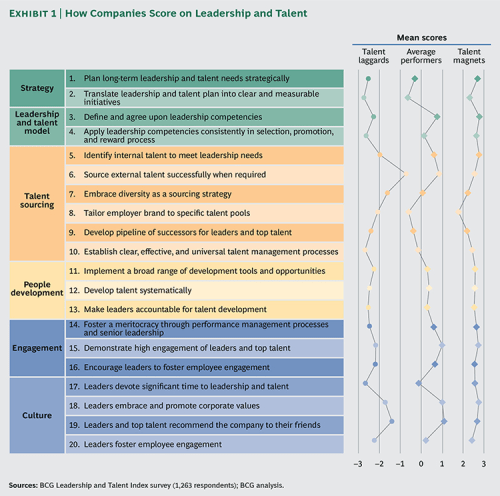
Thanks to recent work by Boston Consulting Group (BCG) it’s no longer intuitive. The data are in and they are convincing. BCG fielded its Global Leadership and Talent Index survey of 1,263 CEOs and HR directors of global companies in 85 countries. The results are compelling to say the least.

The high level findings include:

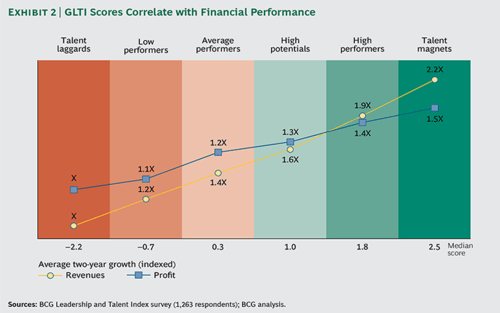
  • Leadership and talent management capabilities have a surprisingly strong correlation with financial performance. “Talent Magnets” – those companies that rated themselves strongest on 20 leadership and talent management capabilities – increased their revenues 2.2 times as fast and their profits 1.5 times afast than “talent laggards,” or those companies that rated themselves the weakest.
  • The performance spread on leadership and talent management capabilities was wide. The talent magnets had an average capability score of 2.5 (on a scale of -3 to 3), while the talent laggards had an average score of -2.2.
  • Companies – even talent laggards – that move up just one level will experience a distinct, measurable, and meaningful business performance return.

With organizations spending an estimated $40 Billion (yes, Billion!) worldwide on leadership and talent development, these findings may enable leaders all over the world to re-orient their priorities, investmemts and behavior on talent/leadership development and gain the critical involvement and support with all the members of the C-suite.

Through their research BCG divided leadership/talent management capabilities into six categories:

  • Strategy
  • Leadership and talent model
  • Talent sourcing
  • People development
  • Engagement
  • Culture

And it’s interesting to note their definitions require a great deal of accountability from leaders. This is a differentiated approach and one that should spur some thoughtful analysis by HR leaders. The chart below lays out the performance differences between the lowest organization performers – Talent Laggards and the highest organization performers – Talent Magnets and the average performers in between.

BCG May 5 2015 3Interesting, yes? What’s even more interesting, then, are the data connecting these leadership/talent management performance levels with business outcomes. Take a look:

BCG May 5 2015 2In addition to proving the real correlation between leadership/talent management performance and financial performance, a valuable take away from this data is BCG’s conclusion that

“The companies that excel at leadership and talent management have figured out how to involve their leaders, not just the HR team, meaningfully and regularly in people development. “

The one-two punch of investment in leadership/talent development and significant accountability of senior leaders should help HR leaders around the world create successful business cases for moving leadership/talent development investments forward. Let’s get ready to rumble…

2 Comments

Filed under Boston Consulting Group, China Gorman, Data Point Tuesday, HR Analytics, HR Data, Leadership Development, Talent development

The Win-Win of Leveraging Baby Boomers

data point tuesdayI’m a Baby Boomer, born smack-dab in the middle of my generation. And I’m beginning to concretely think about the answers to questions like:

  • What is the legacy that my career will leave behind?
  • What kinds of work do I really want to do going forward?
  • What will retirement look like for me?
  • When will I want to retire (because it certainly is the last thing on my mind now…)?

Just as I wrestle with these questions, organizations are facing stiff headwinds on the talent pipeline front making workers like me critical components in workforce planning activities. We all know that workforce demographics are changing rapidly and many organizations are flummoxed when they try to get a picture of how to respond to this critical talent dynamic. Say what we will about the criticality of Millennial employees, many organizations are starting to pay equal attention to retaining the backbones of their organizations: Baby Boomers.

A terrific source of practical and actionable research based information is the SHRM Foundation’s recently published Effective Practice Guideline: The Aging Workforce: Leveraging the Talents of Mature Employees. As with all the reports in this series, it takes a rigorous approach to discovering what the research says and what organizations are actually doing in the topic area. If you haven’t discovered the SHRM Foundation’s EPGs, you’ll thank me after you download and read this free report. Not just because the data are useful and the examples practical, but because it is written for practitioners not academics and is super easy to consume.

“Mature workers will be a firm’s largest source of talent in the next two decades. There will not be enough younger workers for all the positions an organization needs to fill, particularly those requiring advanced manufacturing skills or advanced education in science, technology engineering and math.”

We all know this. The real question is what do we do about it? And this report lays out a roadmap for data gathering within your organization, a planning outline, successful examples from other organizations, and strategies for moving your plan forward.

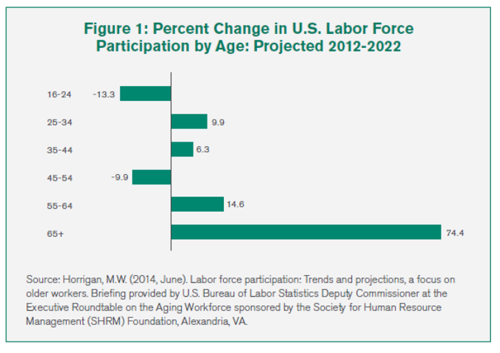
EPG April 28 2015This chart lays out the challenge well. What follows is a trove of information about mature workers. What they want, what they can do, and the inordinate benefits of keeping them engaged in the workforce. Here are several benefits outlined in the report:

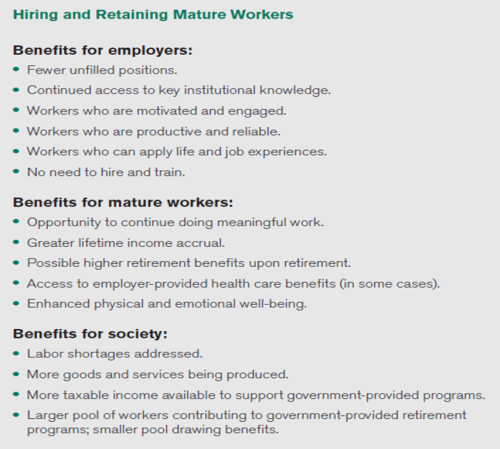
EPG 2 April 28 2015The real meat of the report are the 15 strategies for engaging and retaining mature workers that are based on both research and real organization practice. There are mini-case studies from 30 employers sprinkled throughout the strategies that share effective practices. Perhaps the most impactful sentence in the entire report is in the introduction to the 15 strategies: “The best way to engage and retain workers of any age is to provide a strong vision at the executive level, fair compensation and competent, respectful supervisors.” While the focus is clearly on the acquisition and retention of mature workers, every age demographic benefits from these strategies.

15 Strategies for engaging and retaining mature workers:

  1. Acknowledge Work Contributions
  2. Offer Flexible Work Arrangements
  3. Offer Bridge Employment
  4. Support Health and Wellness
  5. Provide Caregiver Support
  6. Offer Skills Training
  7. Provide Career and Personal Growth Opportunities
  8. Use Mixed-Age Workgroups
  9. (Re)Design Work to Match Worker Capabilities
  10. Train Managers and Supervisors
  11. Provide Support for Retirement Planning
  12. Address Age Discrimination (Real and Perceived)
  13. Foster an Age-Positive Organizational Culture
  14. Foster Job and Career Embeddedness
  15. Facilitate Critical Knowledge Transfer

It’s obvious that none of these strategies are rocket science. In fact, as you look at the list you might think, “well, these are just common sense practices that will support the engagement and retention of ALL of our workers.” And that’s the point. We can’t focus our workforce planning activities on one generation alone. And ensuring that we Baby Boomers remain engaged and valued will make the demographic transition that is looming just over the horizon more effectively managed for organizations, for workers and their families, and for society. I call that a win-win!

1 Comment

Filed under Baby Boomers, China Gorman, Data Point Tuesday, Effective Practice Guidelines, SHRM Foundation, Workforce Demographics, Workforce Planning